Category
Subcategory
Manufacturer
Model
Evaporators
Concentrators, Evaporators, etc.
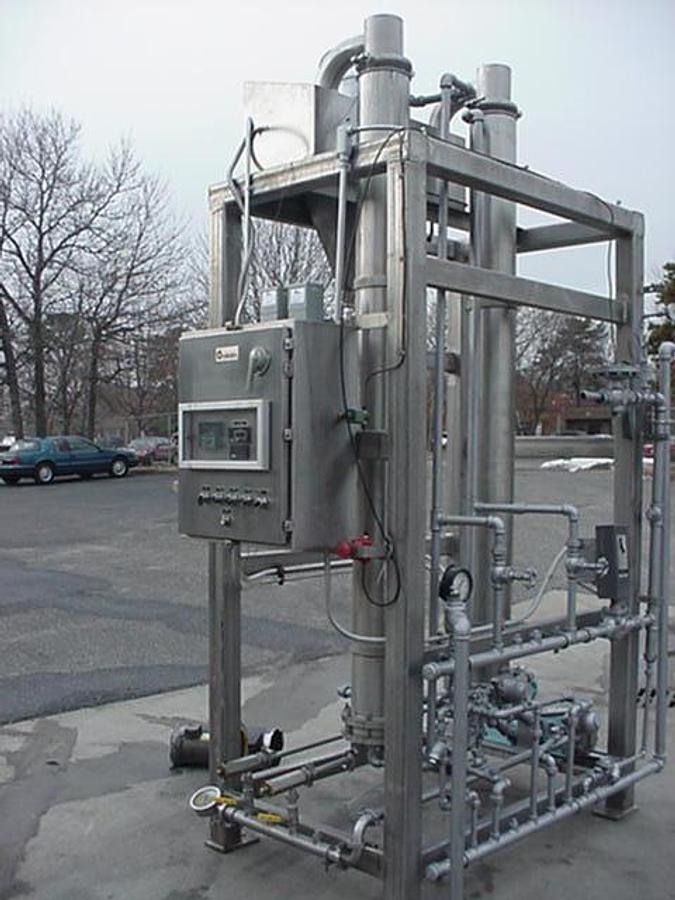
Evaporating equipment is used to increase the concentration of liquid solutions by removing water. Evaporators are used in the pharmaceutical, cosmetic, chemical and food industries, with juice concentrators a common application. Major varieties of evaporators include the falling film evaporator, scrape surface evaporator, and flash evaporator. Our stock includes Groen evaporator/concentrators and APV evaporating systems.
FAQ :
What types of used evaporators are available on the market?
Used evaporators come in several distinct designs, each built for different processing requirements. The most common types include falling film evaporators, rising film evaporators, forced circulation evaporators, wiped film (thin film) evaporators, flash evaporators, and multiple-effect evaporators. There are also MVR (mechanical vapor recompression) systems, which recover and reuse vapor energy to reduce steam consumption. Scrape surface evaporators handle viscous or fouling products that other designs struggle with. Juice concentrators are a particularly common subcategory, frequently found in food processing facilities. Used equipment inventories from specialty dealers often include units from established manufacturers like Groen and APV, covering a range of capacities and configurations.
The right type depends heavily on the product being processed. Falling film evaporators are widely used for heat-sensitive liquids like fruit juices and dairy products because they expose the product to heat for a very short time. Forced circulation units are better suited to scaling or crystallizing solutions. Multiple-effect evaporators use steam more efficiently by running several evaporation stages in sequence, making them a preferred choice for high-volume operations where energy costs matter. When sourcing used equipment, buyers should identify which evaporator design their process actually requires before evaluating specific machines, since the operating principles differ significantly between types.
What industries use evaporators, and how do I know which type fits my application?
Evaporators are used across a wide range of industries wherever liquid concentration, water removal, or solvent recovery is part of the process. The pharmaceutical industry uses them for concentrating active ingredients and removing solvents under vacuum. Food and beverage processors rely on them for juice concentrates, dairy products, sugar syrups, and tomato paste. Chemical manufacturers use evaporators for concentrating acids, salts, and specialty chemicals. Cosmetic manufacturers use them for botanical extracts and active ingredient concentration. Wastewater treatment facilities also use evaporation technology to reduce liquid waste volumes before disposal.
Matching the evaporator type to the application comes down to a few key factors: the thermal sensitivity of the product, its viscosity, whether it tends to foul or scale heating surfaces, and the required evaporation rate. Heat-sensitive products like fruit juices or enzymes need short residence times and low operating temperatures, which points toward falling film or wiped film designs. Viscous or crystallizing products need forced circulation or scraped surface units to keep the product moving across heat transfer surfaces. For food-grade and pharmaceutical applications, material of construction matters considerably. Stainless steel 316 or 316L is the standard for product-contact surfaces in those industries, while carbon steel may be acceptable for certain industrial chemical applications. Consulting with a dealer who specializes in process equipment can help buyers narrow down which used units are genuinely suitable for their specific product.
How is evaporator capacity measured, and how do I size one for my process?
Evaporator capacity is expressed as an evaporation rate, typically measured in pounds or kilograms of water (or solvent) removed per hour. This is distinct from the physical size of the vessel. A machine with a large tank volume might have a modest evaporation rate, while a compact falling film unit with extensive heat transfer surface area can process high volumes quickly. When evaluating used evaporators, the evaporation rate listed in the specifications is the primary sizing metric, not the tank capacity in gallons.
To size correctly, buyers need to know their feed flow rate, the inlet and target outlet concentrations, and the properties of the liquid being processed. For example, if a juice processor receives 10,000 pounds per hour of single-strength juice at 12 Brix and needs to concentrate it to 65 Brix, the required water removal can be calculated directly from those figures. That target evaporation rate then guides which used units are worth evaluating. Multiple-effect evaporators complicate this slightly because each effect contributes to the total evaporation, so a five-effect system has a much higher effective capacity per pound of steam consumed than a single-effect unit of similar physical size. Buyers should also factor in a reasonable margin above their current production needs, since running a unit at or above its rated capacity accelerates wear and reduces product quality.
How do I inspect a used evaporator before buying it?
Inspecting a used evaporator thoroughly is one of the most important steps in the buying process, and reputable dealers will accommodate in-person visits, live video walkthroughs, or detailed video recordings of the equipment. The inspection should cover the condition of heat transfer surfaces (tubes or plates), looking for scaling, pitting, corrosion, or prior repairs. Welds and seams on stainless steel units should be examined for cracks or signs of stress. Gaskets, seals, and any elastomeric components should be noted, as these are wear items that will likely need replacement. The condition of pumps, condensers, vacuum systems, and instrumentation should also be assessed, since these components affect whether the evaporator can be put into service without significant additional investment.
Buyers should request whatever documentation is available, including maintenance records, prior operating conditions, and any history of repairs or modifications. Understanding what product was previously run through the machine matters too, both for cleaning validation purposes (especially in food and pharmaceutical applications) and to assess whether the unit was used within its design parameters. Some used evaporators are still in production at the seller's facility, which allows for an in-person inspection at the actual plant. Keep in mind that most used equipment dealers do not have the permitting or infrastructure to run product through a machine during inspection, so functional testing of the full evaporation process is generally not possible. The inspection is about assessing mechanical condition and completeness, not a production trial. Buyers who have questions about a specific model's capabilities should also contact the manufacturer directly, since age and model generation can affect parts availability and technical support.
Are used evaporators covered by any warranty?
Warranties on used process equipment are handled very differently than on equipment purchased directly from a manufacturer. Manufacturers typically only extend warranty coverage on equipment they sell directly. Used equipment dealers generally sell machinery on an as-is basis, which places the responsibility for evaluating condition squarely on the buyer. This is standard practice across the used industrial equipment market and is not specific to evaporators.
Because there is no warranty safety net, due diligence before purchase becomes especially important. Buyers should prioritize dealers with a long track record of selling process equipment, particularly those who specialize in the relevant industry (food processing, pharmaceutical, chemical, etc.). Requesting an inspection, reviewing available maintenance documentation, and asking detailed questions about the machine's history are all ways to reduce risk. It is also worth contacting the equipment manufacturer before purchasing a used unit to understand what level of technical support, parts availability, and service documentation they can still provide for that specific model and age of machine. Older or discontinued models may have limited parts availability, which affects long-term operating costs and downtime risk.
What should I know about shipping and freight costs for a used evaporator?
Shipping costs for used evaporators vary considerably depending on the size and weight of the unit, the distance involved, and the level of packaging or crating required to protect the equipment in transit. Smaller bench-scale or pilot units may ship on a standard pallet, while large multi-effect evaporators can require custom wooden crates, specialized rigging equipment, and flatbed trucking. The cost of that packaging and rigging is typically separate from the freight charge itself, so buyers should ask dealers to itemize these costs to understand the full landed price of the equipment.
For larger evaporators, loading at the origin and unloading at the destination may require cranes or forklifts with significant capacity, and arranging that equipment is usually the buyer's responsibility unless the dealer explicitly includes it. Buyers should confirm what loading assistance is available at the dealer's facility and plan accordingly for receiving the equipment at their own site. International shipments add customs documentation, import duties, and potentially ocean freight or air freight considerations. Getting a complete picture of all logistics costs before finalizing a purchase prevents surprises and allows for an accurate comparison between different machines that may be priced similarly but differ in shipping complexity.
What does it mean when a used evaporator is described as a multiple-effect system?
A multiple-effect evaporator uses the vapor generated in one evaporation stage (called an effect) as the heat source for the next stage, rather than discarding that energy. In a single-effect system, steam is used once and the vapor produced by boiling the liquid is condensed and removed. In a two-effect system, that vapor is routed into the heating side of a second evaporation vessel, where it gives up its heat and condenses while the liquid in that second vessel boils at a lower pressure and temperature. This cascade continues through however many effects the system has. A five-effect evaporator, for example, can evaporate roughly five pounds of water for every pound of steam consumed, compared to approximately one pound of water per pound of steam in a single-effect unit.
This energy efficiency comes at the cost of higher capital investment and greater mechanical complexity. For high-volume operations running continuously, the steam savings justify the added complexity. For smaller or intermittent operations, a simpler single-effect unit may be more practical even if its energy consumption per unit of evaporation is higher. Used multiple-effect systems are available from dealers and can represent significant value compared to purchasing equivalent capacity as new equipment, but buyers should carefully inspect all effects, interconnecting piping, and the condensate return system, since the condition of each individual effect affects the performance of the whole system. The T.A.S.T.E. Model 40 five-effect, seven-stage evaporator used for juice production is an example of this type of complex, high-efficiency system that appears in the used equipment market.
What is a falling film evaporator and what is it used for?
A falling film evaporator concentrates liquids by distributing the feed as a thin film on the inside of vertical tubes or plates, where it flows downward by gravity while heat is applied to the outer surface. Because the liquid forms only a thin layer and moves continuously, the residence time at elevated temperature is very short, often just seconds. This makes falling film evaporators well suited to heat-sensitive products where prolonged exposure to heat would cause degradation, color change, or flavor loss. Fruit juice concentration is one of the most common applications, but falling film units are also used for dairy products, pharmaceuticals, and certain chemical solutions.
The design is relatively energy-efficient and handles thin, low-viscosity liquids well. It does not perform well with viscous, scaling, or crystallizing products, since the thin film can break down or the tubes can foul. Used falling film evaporators appear regularly in the market, often sourced from food processing or dairy facilities that have upgraded capacity or changed product lines. When evaluating a used falling film unit, the condition of the tube bundle is the most critical factor. Tubes that are pitted, scaled, or have been mechanically cleaned repeatedly may have reduced wall thickness, which affects both heat transfer efficiency and the structural integrity of the unit under vacuum.
What is a wiped film or thin film evaporator, and when is it the right choice?
A wiped film evaporator (also called a thin film evaporator) uses a rotating set of blades or wipers to spread the feed liquid into a very thin, continuously refreshed layer on a heated cylindrical surface. The mechanical wiping action keeps the product moving and prevents it from sticking or burning, which makes this design suitable for viscous, heat-sensitive, or fouling materials that would not process well in a falling film or forced circulation unit. Applications include concentrating botanical extracts, essential oils, resins, polymers, and certain pharmaceutical intermediates. The short residence time and the ability to operate under deep vacuum allow for evaporation at very low temperatures, preserving volatile or thermally fragile compounds.
Used wiped film evaporators from manufacturers like Groen are available through specialty used equipment dealers. The Groen five-tube stainless steel vertical thin film evaporator is one example of this type of machine that circulates in the used market. When inspecting a used wiped film unit, the condition of the wiper blades, the drive mechanism, and the heated surface itself are the primary concerns. Wiper blades are wear items and may need replacement. The heated surface should be checked for scoring, corrosion, or deposits that could affect heat transfer or product contamination. These machines tend to be more mechanically complex than other evaporator types, so a thorough inspection and parts availability check with the manufacturer are particularly important before purchase.
What payment terms should I expect when buying a used evaporator?
Payment practices in the used industrial equipment market are fairly consistent across dealers. Most require payment in full before the equipment is released for shipping. This is standard practice and reflects the nature of used machinery transactions, where the equipment is typically a one-of-a-kind item that is removed from available inventory once a sale is agreed upon. Wire transfer is the most common payment method for larger transactions, though dealers may accept other forms depending on the amount and the buyer's relationship with them.
Some dealers extend payment terms to repeat customers or established buyers with a history of transactions, but this is at the dealer's discretion rather than a standard offering. Buyers who are new to a particular dealer should expect to pay in full upfront. Because payment is typically required before shipping, it reinforces the importance of completing a thorough inspection before committing to a purchase. Once payment is made and the machine ships, the transaction is generally considered final. Buyers should also clarify with the dealer exactly what is included in the sale price, specifically whether ancillary components like pumps, condensers, control panels, and instrumentation are included or priced separately, since this affects the true cost of getting the evaporator into service.