Category
Manufacturer
Model
Used Case Packers and Sealers for Sale
Pre-Owned Case Packers, Erectors, and Case Sealers In Stock
Wohl Industries stocks used case packers and sealers for food, beverage, and consumer goods packagers. You get pre-owned case packers, case erectors, drop packers, and case sealers. Case erectors open and bottom-seal corrugated cases. Packers load bottles, jars, cans, and pouches into each case. Drop and wraparound packers group product for retail and club packs. Sealers tape or glue the top flaps at line speed. Buying used cuts your capital cost and lead time. We inspect every machine before we ship. We have sold processing and packaging equipment since 1968. Send us your case size and rate, and we match you to the right machine.
FAQ :
What is a case packer sealer and how does it work?
A case packer sealer is a packaging machine that automates two related tasks: loading products into corrugated or cardboard cases, and then sealing those cases for shipment or distribution. The packing stage typically involves arranging products in a specific pattern and placing them into an open case, either from the top, side, or by wrapping corrugated material around the product grouping. Once the case is loaded and closed, the sealing stage applies tape, hot glue, or staples to secure the flaps, creating a finished, shippable unit.
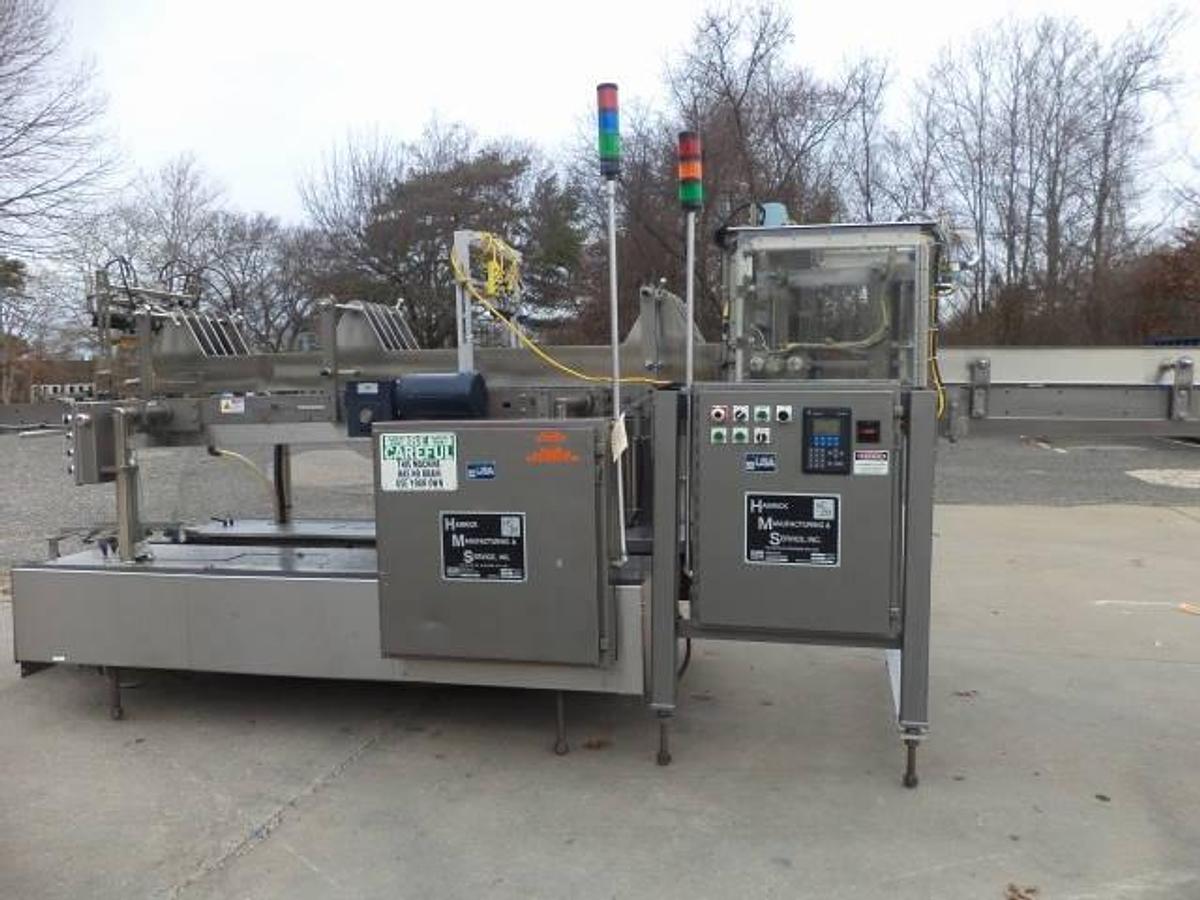
The mechanics vary considerably depending on the machine type. A top-load case packer drops or places products vertically into an open case from above, which works well for bottles, cans, and pouches. A wrap-around packer forms the case directly around the product group, producing a tighter, more compact package. Side-load configurations push products horizontally into a pre-erected case. Drop packers, like the Hamrick Model 360, use gravity to place fragile or uniform products into cases with minimal contact. In many production environments, a case packer and sealer are combined into a single integrated machine, or two separate machines are positioned in sequence on the same line.
What types of used case packers and sealers are commonly available on the market?
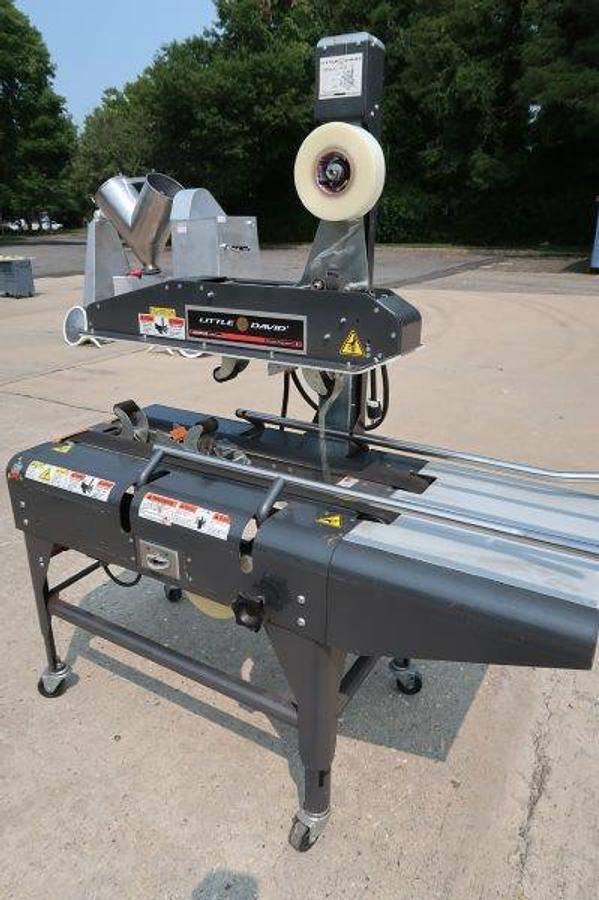
The used machinery market includes a wide range of case packer and sealer configurations, and understanding the differences helps buyers match equipment to their actual production requirements. Common categories include top-only case tapers, top-and-bottom case tapers, adjustable case sealers, portable case sealers on casters, automatic case packers, and combination case erector-sealer units. Brands that appear frequently in the used market include 3M-Matic, Highlight Industries, Bossar, Standard-Knapp, Package Machinery, Combi Packaging Systems, and Little David, among others.
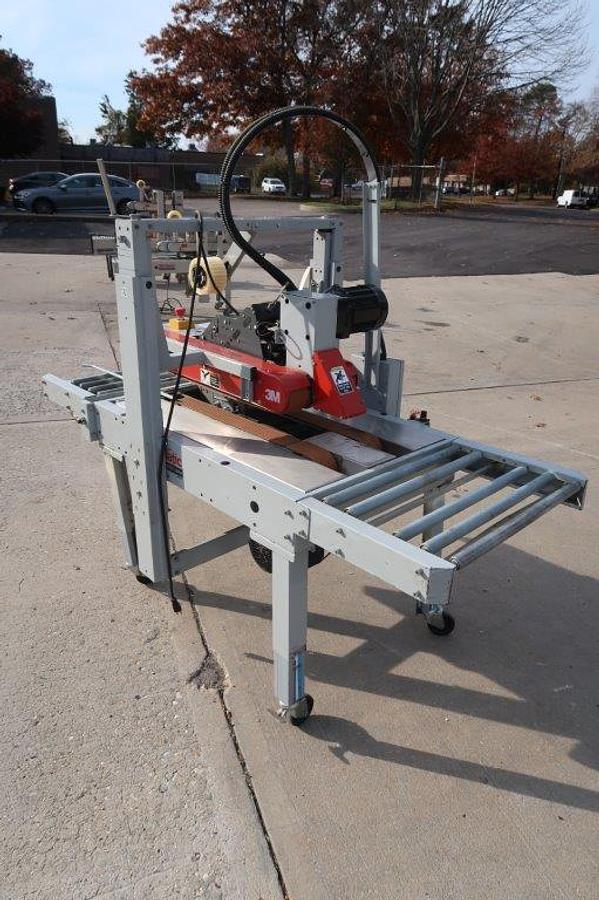
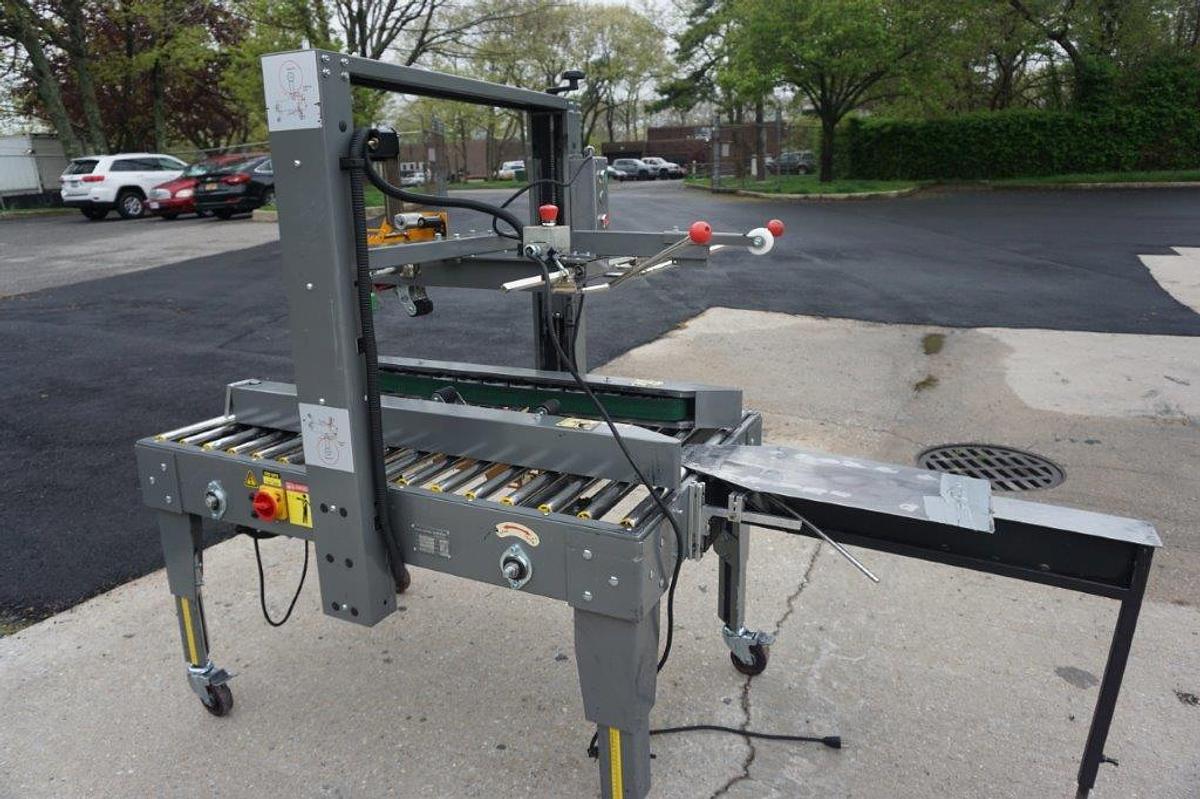
Top-only tapers, like the Interpack and Abel models, seal just the top flaps and are suited for lighter-duty or lower-volume operations. Top-and-bottom models seal both sets of flaps in a single pass, which is standard for most distribution environments. Adjustable case sealers, such as the 3M-Matic 200A and 700AKS, accommodate a range of case sizes without requiring separate tooling, making them popular for operations that run multiple SKUs. Fully automatic case packers, such as the Bossar BAP-40 and Standard-Knapp 806, handle higher throughput with less operator involvement. Buyers looking at used equipment will find machines across all of these categories, often at a fraction of the cost of purchasing equivalent equipment elsewhere.
What is the difference between a semi-automatic and fully automatic case packer sealer?
Semi-automatic case packers and sealers require an operator to handle some portion of the process, typically loading products into the case or positioning the case itself, while the machine handles sealing or a portion of the packing cycle. These machines are generally more compact, less expensive, and easier to integrate into smaller production environments. They are well-suited for operations running lower volumes, handling fragile or irregular products that benefit from human oversight, or facilities that need flexibility across a wide variety of case formats.
Fully automatic machines, by contrast, handle the entire sequence with minimal human intervention. They erect the case, load the product, close the flaps, and apply the seal in a continuous cycle. Throughput rates on fully automatic systems can reach dozens of cases per minute, making them the right choice for high-volume food, beverage, pharmaceutical, and consumer goods lines. The tradeoff is cost, complexity, and footprint. Used fully automatic case packers represent strong value for buyers who need the throughput but cannot justify the capital expense of purchasing equivalent equipment at list price. When evaluating either type on the used market, buyers should pay close attention to the machine's case size range, cases-per-minute rating, and the availability of parts and manufacturer support for that specific model and age.
What industries use case packers and sealers most heavily?
Case packers and sealers are found across a broad range of industries, but some sectors rely on them more heavily than others due to the volume, speed, and consistency required in their packaging operations. Food and beverage manufacturers are among the largest users, packaging everything from bottles and cans to pouches and cartons into shipping cases at high speed. Pharmaceutical companies use case packers to handle boxed medications and bottled products, often with strict requirements around case integrity and traceability. Household goods, cosmetics, and personal care product manufacturers also depend on case packing and sealing equipment to prepare finished goods for retail distribution.
Beyond those core sectors, e-commerce fulfillment operations have become significant users of case sealing equipment as order volumes have grown. Consumer electronics manufacturers use case packers to handle retail-ready packaging for products that require careful, consistent placement to prevent damage. The stainless steel construction found on machines like the Hamrick Model 360 is particularly relevant in food processing and pharmaceutical environments where sanitation standards require equipment that can be cleaned without corrosion risk. Buyers from any of these industries will find used case packing and sealing equipment available across a range of configurations, speeds, and price points.
How do I determine the right case packer sealer for my production line?
Matching a case packer or sealer to a production line requires evaluating several specific performance and physical parameters. The most important starting point is throughput: how many cases per minute does the line need to produce? This number should account for current volume and reasonable near-term growth. From there, buyers need to identify the range of case sizes they run, since some machines are fixed to a single case format while adjustable models, like the 3M-Matic series, accommodate a range of dimensions without significant retooling. Changeover time between SKUs is another factor worth examining closely, especially for operations that run multiple product types on the same line.
Beyond performance specs, physical integration matters. Machine footprint relative to available floor space, infeed and outfeed conveyor heights, electrical requirements (single-phase versus three-phase), and whether the machine is portable or fixed all affect how easily a piece of used equipment can be dropped into an existing line. Portable models on casters, such as the 3M-Matic 700AKS, offer more flexibility for facilities with changing layouts. Buyers should also consider the type of product being packed, since fragile items, irregular shapes, and products with specific orientation requirements may limit which packer configurations are suitable. Consulting with a dealer who specializes in packaging equipment and requesting a detailed inspection of any used machine before purchase is the most reliable way to confirm a good fit.
What should buyers look for when purchasing used case packing and sealing equipment?
Buying used case packing and sealing equipment requires more due diligence than purchasing off-the-shelf machinery, because the condition, history, and remaining service life of the machine are not standardized. The first step is to request a thorough inspection, either in person, via video walkthrough, or through detailed photographs provided by the dealer. Reputable used equipment dealers will accommodate these inspection requests and provide an accurate picture of the machine's current working condition. Some machines may still be installed and running in an active production facility, which offers the opportunity to observe the equipment under real operating conditions.
Beyond visual inspection, buyers should research the specific model and manufacturer to understand parts availability and the level of support the manufacturer currently provides for that machine. Older or discontinued models may have limited parts availability, which affects long-term maintenance costs. It is worth contacting the manufacturer directly to ask about their support posture for a given model before committing to a purchase. Buyers should also clarify the machine's electrical specifications, physical dimensions, and any tooling or change parts included with the sale. Used equipment is typically sold as-is, so the buyer carries the responsibility of evaluating condition carefully. Choosing a dealer with a long track record in packaging machinery specifically, rather than a general industrial equipment reseller, significantly reduces the risk of surprises after delivery.
What does a case sealer with extensions do differently than a standard model?
Case sealers with extensions, such as the 3M-Matic models listed with extensions on casters, are configured to handle a wider range of case lengths or widths than a standard fixed-bed machine. The extensions effectively expand the machine's infeed or outfeed support surface, which is useful when sealing longer cases that would otherwise tip or shift as they pass through the taping heads. This makes extended-bed models a practical choice for operations that pack larger format cases, bulk items, or products that require oversized corrugated packaging.
The addition of casters on some extended models adds portability, allowing the machine to be repositioned within a facility without requiring a forklift or significant labor. This is particularly useful in contract packaging environments or facilities that reconfigure their lines seasonally. When evaluating a used case sealer with extensions, buyers should confirm that the extension components are intact and undamaged, since these parts are sometimes removed or lost before a machine reaches the secondary market. The tape head condition, drive belt wear, and adjustment mechanisms for case height are the other primary points to assess during inspection of any used case sealer.
What is the typical cost of used case packers and sealers, and what factors affect pricing?
Pricing for used case packers and sealers spans a wide range depending on machine type, brand, age, condition, and complexity. Entry-level used case tapers and sealers, such as portable top-only models or basic single-phase units, can be found for a few hundred to a few thousand dollars. Mid-range adjustable case sealers from established brands like 3M-Matic typically fall in the low-to-mid thousands. Fully automatic case packers from manufacturers like Standard-Knapp, Bossar, or Combi Packaging Systems can command significantly higher prices, often ranging from tens of thousands of dollars upward depending on the model, configuration, and included change parts.
Several factors push prices up or down on the used market. Machines that are still running in active production at the time of sale generally command a premium over decommissioned equipment, since their operational status is easier to verify. Stainless steel construction, as seen on machines built for food or pharmaceutical environments, adds value compared to painted carbon steel alternatives. The inclusion of change parts, manuals, and spare parts with a machine also affects price. Age and parts availability are important counterweights: a well-maintained older machine from a manufacturer with limited current support may be priced attractively but carry higher long-term maintenance risk. Buyers should factor in shipping, rigging, and any refurbishment costs when calculating the true landed cost of a used machine.
How does shipping and delivery work for used case packing and sealing equipment?
Shipping used packaging machinery involves more planning than standard freight because of the size, weight, and mechanical sensitivity of the equipment. Most used case packers and sealers need to be properly palletized or crated before transport to prevent damage in transit. The level of packaging required, and therefore the cost, varies based on machine size, weight, and the distance being shipped. Larger or heavier machines may require custom crating and heavy-duty rigging for loading and unloading, which adds to the total cost. Buyers should ask dealers for a clear breakdown of packaging, rigging, and freight costs before finalizing a purchase so there are no surprises in the final landed price.
For very large machines or those being moved across significant distances, a specialized machinery moving company may be needed for both the origin loading and the destination unloading. Buyers who do not have a forklift or loading dock at their facility should address this before the machine ships, since improper unloading is a common source of damage. Some dealers can coordinate freight on behalf of the buyer, while others leave shipping arrangements to the buyer entirely. Clarifying this responsibility upfront is important. International shipments add customs documentation and potentially import duties to the equation, which should be factored into the overall cost analysis.
Can used case packers and sealers handle multiple box sizes, and how difficult is changeover?
Many case packers and sealers are designed with adjustability in mind, and this is one of the key specifications to evaluate when shopping the used market. Adjustable case sealers, like the 3M-Matic 200A and 700AKS, are built to accommodate a range of case heights, widths, and lengths through manual or semi-automatic adjustment mechanisms. These machines are popular in operations that run multiple SKUs because they reduce the need for separate dedicated equipment for each case format. The range of adjustability is defined by the machine's specifications, so buyers should confirm that the machine's listed case size range covers all the formats they currently run.
Changeover time varies considerably between machine models and configurations. Simple adjustable tapers may require only a few minutes to reset between case sizes using hand knobs and graduated scales. More complex automatic case packers may require change parts, tooling swaps, or recipe changes in a control system, which can take longer and requires trained operators. When evaluating used equipment, buyers should ask whether all change parts for the advertised size range are included with the machine, since missing change parts are a common issue with used packaging equipment and can be expensive or difficult to source after the fact. A machine that covers a wide case size range with fast, tool-free changeover is generally worth a higher price than a fixed-format alternative, particularly for contract packagers or operations with seasonal product variety.