Category
Subcategory
Manufacturer
Model
FAQ :
What types of bottle conveyors are available on the used equipment market?
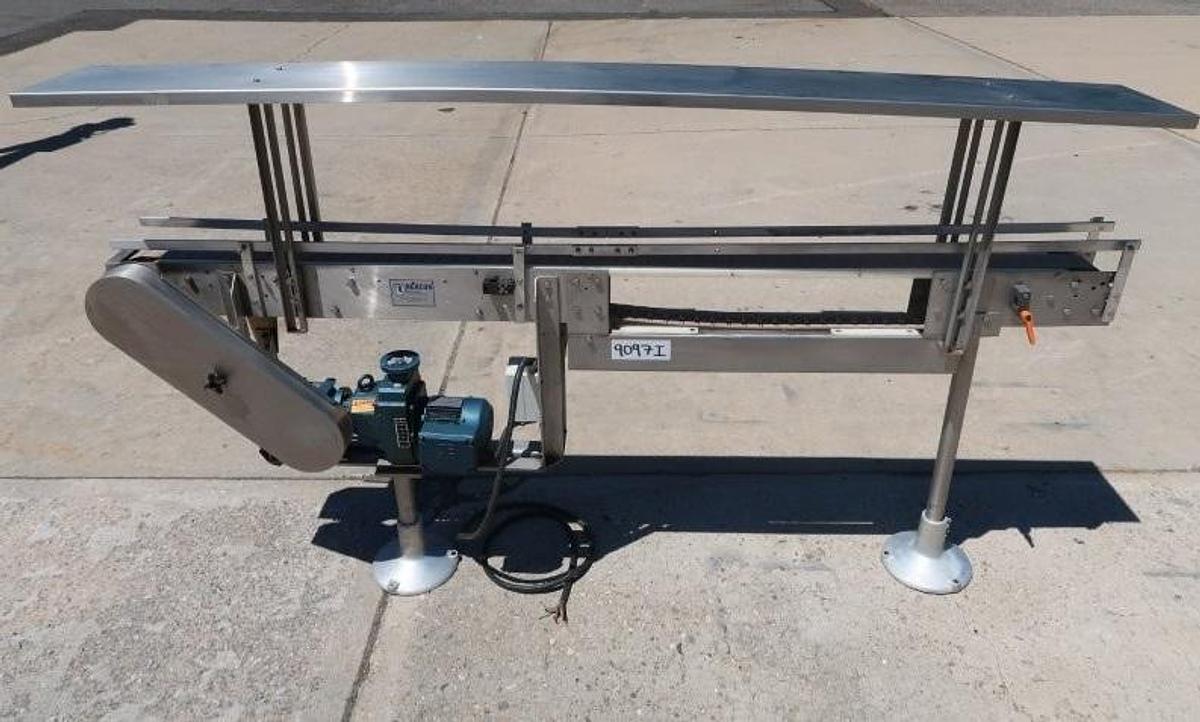
Used bottle conveyors come in several distinct configurations, each designed for specific production environments and bottle types. The most common types include flat belt conveyors, table-top chain conveyors, air conveyors (also called air-rinse or pneumatic conveyors), and roller conveyors. Flat belt and table-top chain conveyors are the workhorses of most bottling lines, handling everything from glass wine bottles to plastic water bottles. Air conveyors suspend lightweight plastic bottles by their neck rings and move them at very high speeds, making them popular in high-volume beverage operations. Stainless steel single-file conveyors, like the Nercon Engineering models that appear frequently on the used market, are particularly well-suited for food, beverage, and pharmaceutical lines where sanitation is a priority.
When shopping for a used bottle conveyor, the configuration you need depends heavily on your bottle type, line speed, and where the conveyor sits in your production sequence. A conveyor feeding a filling machine has different requirements than one used for accumulation or discharge after a labeler. Buyers should pay close attention to the conveyor's width and length specifications, since these directly determine which bottle sizes and neck finishes will run cleanly without tipping or jamming. A unit listed as 3-1/4 inches wide by 93 inches long, for example, is a fairly narrow single-file conveyor suited to smaller bottles in a compact line layout. Understanding these specs before purchasing saves significant time and money on installation and retrofitting.
What should I look for when buying a used bottle conveyor?
Buying a used bottle conveyor requires more due diligence than purchasing other types of production equipment, because conveyors accumulate wear across their entire length rather than in one concentrated area. The belt or chain surface is the first thing to evaluate. Look for cracking, fraying, missing links, or uneven wear patterns that could cause bottles to tip or jam. The drive motor and any variable frequency drive (VFD) components should be tested if at all possible, since these are the most expensive parts to replace. Frame condition matters too, especially on stainless steel units where welds, side rails, and mounting feet can corrode or crack over time in wet wash-down environments. Guide rails and their adjustment hardware should move freely and hold position without slipping.
Reputable used equipment dealers will typically accommodate in-person or video inspections so buyers can assess the machine's actual condition before committing. Some equipment may still be installed and running at the facility where it originated, which gives buyers the rare opportunity to see it operating under real production conditions. Keep in mind that most dealers are not set up to run actual product through a conveyor during an inspection, so buyers should ask detailed questions about the machine's service history, what product it ran, and how long it was in service. Consulting the original manufacturer about parts availability and technical support for a specific model and age is also a smart step, since older or discontinued models may have limited spare parts in circulation.
What bottle sizes and shapes can a used bottle conveyor handle?
A bottle conveyor's ability to handle specific sizes and shapes is determined primarily by its belt or chain width, the height and adjustability of its side guide rails, and the type of conveying surface. Narrow conveyors in the 3 to 4 inch width range are typically designed for single-file transport of smaller bottles, such as 8 to 32 ounce plastic or glass containers. Wider conveyors, sometimes 12 inches or more, can handle bulk accumulation of larger bottles or run multiple lanes simultaneously. Round, square, and oval bottle profiles all run differently on a conveyor, and guide rail geometry plays a big role in keeping non-round shapes stable and properly oriented through curves or transfers.
When evaluating a used bottle conveyor for a specific application, buyers should measure their actual bottle base diameter, height, and center of gravity, then compare those dimensions against the conveyor's listed specifications. Bottles that are tall and narrow relative to their base are prone to tipping, especially at transfers between conveyor sections or at speed changes. Some conveyors include adjustable guide rails with quick-release hardware that makes changeovers between different bottle sizes fast and repeatable, which is a valuable feature on a used machine. If the original guide rail hardware is missing or damaged, replacement parts may be available through the manufacturer or aftermarket suppliers, though buyers should confirm availability before purchasing a unit with incomplete tooling.
What materials are bottle conveyors made from, and why does it matter for food and beverage applications?
Stainless steel is the dominant frame and structural material for bottle conveyors used in food, beverage, and pharmaceutical production. Type 304 stainless steel is the most common grade, offering good corrosion resistance in wet environments and the ability to withstand the caustic cleaning chemicals used in food plant sanitation programs. Type 316 stainless is used in more aggressive environments, such as those involving saltwater, acidic products, or harsher sanitizers. The conveying surface itself varies: stainless steel table-top chain, plastic modular belting, and rubber or urethane flat belts are all common, each with different sanitation profiles and wear characteristics. Plastic modular belting, for example, can be disassembled link by link for deep cleaning, which is a significant advantage in high-sanitation environments.
For buyers sourcing used bottle conveyors for regulated industries, understanding the original material specifications is critical. FDA compliance, NSF certification, and USDA acceptance are designations that apply to specific belt and chain materials, not just the frame. A stainless steel frame conveyor with a non-food-grade belt is not necessarily suitable for direct food contact applications without a belt replacement. When inspecting or inquiring about a used unit, ask the dealer or check the manufacturer's documentation to confirm what belt or chain material was originally specified and whether it meets the standards required for your application. Replacing a belt on a used conveyor is often straightforward and cost-effective, making a well-maintained stainless steel frame unit a solid investment even if the belt itself needs to be swapped out.
What conveyor speed do I need, and how is speed controlled on bottle conveyors?
Conveyor speed is measured in feet per minute (FPM) or bottles per minute (BPM), and the right speed depends entirely on your line's throughput requirements and the speed of the equipment feeding into and out of the conveyor. A filling machine running at 100 bottles per minute needs a conveyor that can keep pace without creating a backlog or starving the filler of empty containers. Most production lines benefit from a conveyor that can run slightly faster than the rated machine speed to provide a buffer and prevent stoppages from cascading through the line. Typical bottle conveyor speeds range from around 20 FPM on slow accumulation sections to over 200 FPM on high-speed transfer sections in large beverage facilities.
Variable frequency drives (VFDs) are the standard method for adjusting conveyor speed on modern units, and their presence on a used machine is a significant advantage. A VFD allows operators to dial in exact speeds, ramp up or down gradually to prevent bottle tipping, and synchronize the conveyor with upstream and downstream equipment without mechanical adjustments. When evaluating a used bottle conveyor, confirm whether a VFD is included and whether it is functional. VFDs are expensive to replace, and an older drive may require a controls technician to reprogram it for your specific motor and application. If a used conveyor has a fixed-speed motor with no VFD, factor in the cost of adding one if your application requires speed flexibility.
How do I know if a used bottle conveyor will integrate with my existing filling or packaging line?
Integration compatibility comes down to four main factors: physical dimensions, conveyor height, belt speed range, and electrical specifications. Physical dimensions include the conveyor's overall length, width, and the height of the conveying surface, which must align with the infeed and discharge heights of your filler, capper, labeler, or other equipment. Most production line equipment is designed around a standard conveyor height of approximately 34 to 36 inches from the floor to the belt surface, but this varies by manufacturer and application. If the used conveyor you are considering has a fixed-height frame that does not match your existing equipment, you may need to fabricate risers or modify the legs, which adds cost and lead time to the installation.
Electrical compatibility is the other major consideration. Bottle conveyors in the United States typically run on 115V single-phase or 230/460V three-phase power, depending on motor size. Confirm the motor's voltage, phase, and horsepower requirements before purchasing, and make sure your facility has the appropriate electrical service available at the installation location. Communication interfaces matter too if you are running a semi-automated or fully automated line. Some used conveyors include control panels with start/stop buttons and speed controls that can be integrated into a line's PLC system, while others are standalone units with no external control capability. Asking the dealer for the original electrical schematics or motor nameplate data before purchase can prevent costly surprises during installation.
What are the typical price ranges for used bottle conveyors?
Used bottle conveyor prices vary widely based on length, width, construction material, brand, age, and overall condition. Short single-file stainless steel conveyors in the 6 to 10 foot range from reputable manufacturers like Nercon, Hytrol, or Intralox can sell anywhere from a few hundred dollars for basic units in fair condition to several thousand dollars for well-maintained machines with VFDs and full guide rail systems. Longer conveyors, accumulation tables, and multi-lane systems command higher prices, sometimes reaching $10,000 to $30,000 or more for premium stainless units in excellent condition with complete controls packages. Air conveyors for lightweight plastic bottles tend to be priced higher relative to their size because of the precision engineering involved in the neck-rail and air plenum systems.
Buyers should factor in more than just the purchase price when budgeting for a used bottle conveyor. Shipping costs for longer or heavier conveyor sections can be substantial, particularly if the machine requires specialized rigging for loading and unloading. Crating and palletizing requirements vary by dealer and machine size, and buyers should request a detailed breakdown of all freight and handling costs to understand the true landed cost before committing. If the conveyor needs a new belt, replacement guide rails, or electrical work upon arrival, those costs should be estimated in advance. A used conveyor purchased at a significant discount relative to a comparable unit can still represent excellent value even after accounting for these additional expenses, provided the frame and drive components are in solid condition.
What power requirements do bottle conveyors typically need?
The power requirements for a bottle conveyor depend on the length of the conveyor, the load it carries, the belt or chain type, and whether a variable frequency drive is part of the system. Short single-file conveyors handling lightweight plastic bottles often run on fractional horsepower motors, sometimes as small as 1/4 or 1/3 HP, powered by standard 115V single-phase circuits. Longer conveyors, heavier glass bottle applications, and accumulation sections typically require 1/2 HP to 2 HP motors running on 230V or 460V three-phase power. Very long conveyor systems or those with multiple drive zones can require even more electrical capacity, and the total amperage draw of all conveyor sections in a line should be calculated before installation to ensure the facility's electrical panel can handle the load.
When purchasing a used bottle conveyor, the motor nameplate is the most reliable source of electrical specifications. It will list voltage, phase, full load amperage, horsepower, and RPM, all of which are needed to confirm compatibility with your facility's power supply and to size any replacement VFD or starter correctly. If the motor nameplate is missing or illegible on a used unit, that is worth flagging during the inspection process. NEMA frame size information from the nameplate also helps when sourcing a replacement motor if the existing one is worn or damaged. Most standard NEMA frame motors used on conveyors are readily available through industrial supply channels, which makes motor replacement on a used conveyor a manageable repair rather than a major obstacle.
How should a used bottle conveyor be shipped, and what should buyers expect for freight costs?
Shipping a used bottle conveyor requires careful planning because these machines are long, sometimes awkwardly shaped, and can be damaged by improper handling during transit. Most dealers will palletize or crate the conveyor before shipping, but the level of packaging varies. A basic conveyor section might be strapped to a pallet with minimal protection, while a more complex unit with motors, controls, and guide rail assemblies may require a full wooden crate to protect components from shifting or impact damage. Buyers should ask the dealer specifically how the machine will be packaged and whether the packaging cost is included in the quoted price or billed separately. Heavier or larger conveyor systems may require a flatbed truck rather than standard LTL freight, which affects both cost and transit time.
Rigging is another cost that buyers sometimes overlook. Loading a heavy conveyor onto a truck at the dealer's facility and unloading it at the buyer's location may require a forklift, crane, or other lifting equipment. If the buyer's facility does not have a loading dock or forklift on site, arranging for a lift-gate truck or renting rigging equipment adds to the total cost. Buyers should request a complete landed cost estimate from the dealer that includes the purchase price, packaging or crating fees, freight charges, and any rigging costs at both ends of the shipment. Getting this information upfront prevents budget surprises and allows for an accurate comparison between multiple machines being considered at different price points.
What inspection process should buyers follow before purchasing a used bottle conveyor?
A thorough inspection is the single most important step in buying a used bottle conveyor, and reputable dealers will accommodate this through in-person visits, live video calls, or detailed video documentation of the machine. During an inspection, the focus should be on the conveying surface condition, the drive system, the frame integrity, and the completeness of the guide rail and adjustment hardware. Run your hand along the belt or chain to feel for uneven wear, stiff links, or damaged sections. Check the drive motor for signs of overheating, oil leaks, or unusual noise. Inspect the frame welds and side rails for cracks, corrosion, or impact damage, particularly at the ends where transfers occur. Confirm that all adjustment knobs, clamps, and brackets are present and functional.
Some used conveyors are still installed and operating at the facility where they originated, which presents a valuable opportunity to see the machine running under real production conditions. Even in this case, keep in mind that the dealer is unlikely to run your specific product through the machine during the inspection, as production facilities require different permitting and operating conditions than a typical equipment dealer environment. The goal of the inspection is to get an accurate picture of the machine's mechanical condition and completeness, not a full production trial. Supplementing the visual inspection with a review of the manufacturer's documentation, if available, and a conversation with the manufacturer about parts and support availability for that specific model will give buyers the most complete picture before making a purchasing decision.