Category
Subcategory
Manufacturer
Model
Exchangers-plate
APV Heat Exchanger, Alfa Laval, DeLaval, etc.
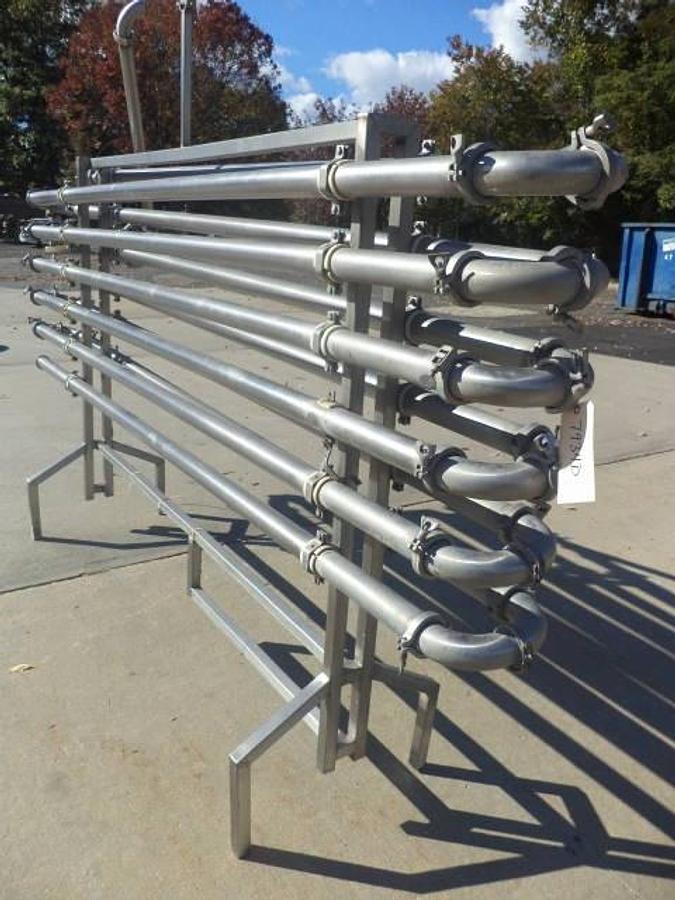
Plate heat exchangers and plate pasteurizers are used to cool or heat liquid products. Sanitary and stainless steel plate exchangers are available. Our stock of used plate heat exchangers includes APV plate heat exchangers, ALFA LAVAL, and DELAVAL brands for sale. We can sell exchangers with or without accessory pumping equipment.
FAQ :
What should I inspect before buying a used plate heat exchanger?
The most critical areas to evaluate are the condition of the plates themselves and the integrity of the gaskets. Plates should be free of pitting, corrosion, cracks, or warping, since any of these defects reduce thermal efficiency and can create cross-contamination risks in food, dairy, or pharmaceutical applications. Ask the dealer for documentation including plate count, pressure test results, and any available service history. If the unit has been in sanitary service, confirm whether it was cleaned-in-place (CIP) regularly and whether the stainless steel grade is appropriate for your application.
Gaskets are a separate concern and deserve close attention regardless of how good the plates look. Gaskets degrade over time from heat cycling, chemical exposure, and compression fatigue, and they will often need replacement even on a unit that is otherwise in solid condition. Factor that cost into your total budget before committing to a purchase. Reputable used equipment dealers will typically accommodate in-person or video inspections so you can assess the frame, port connections, tightening bolts, and overall structural condition before the unit ships. If the exchanger is still installed at a production facility, some dealers can arrange an inspection at the plant.
What brands of used plate heat exchangers are most reliable and widely available?
Alfa Laval, APV, GEA, Tranter, and DeLaval are consistently the most sought-after brands in the used plate heat exchanger market. Their reputation comes partly from build quality and partly from the fact that replacement parts, including plates and gaskets, are still manufactured and relatively accessible for many model lines. Alfa Laval in particular has an enormous installed base across dairy, food processing, and industrial applications, which means used units turn up frequently and support resources are widely available. APV has a similarly strong presence in sanitary and beverage processing.
When evaluating a specific model, it is worth contacting the manufacturer directly to confirm what level of support you can expect for that unit's age and model number. Older or discontinued models may have limited parts availability, which affects long-term maintenance costs. Dealers who specialize in heat transfer equipment tend to carry a higher concentration of these established brands, and their familiarity with the equipment means they can provide more accurate condition assessments than a general industrial surplus dealer.
How do I know if a used plate heat exchanger is compatible with my existing system?
Compatibility comes down to several technical parameters: flow rate capacity, operating pressure rating, temperature range, port size and configuration, and the material compatibility of the plates and gaskets with your process fluid. Before reaching out to a dealer, gather your system's design specifications so you can compare them directly against the exchanger's nameplate data or documentation. Port size matters for connecting to existing piping, and the frame size determines how many plates can be added or removed to adjust thermal capacity.
For sanitary applications in food, dairy, or beverage processing, also confirm that the unit is constructed to the appropriate hygienic standards, such as 3-A sanitary standards, and that the stainless steel grade is suitable for your cleaning chemicals and product. If you are replacing an existing unit, the model number of the outgoing exchanger is a useful starting point for identifying a compatible replacement. Dealers experienced in process equipment can often help cross-reference specifications across brands, and some units can be reconfigured by adjusting plate count to better match your duty requirements.
Can gaskets and plates be replaced on a used plate heat exchanger?
Yes, and this is one of the practical advantages of gasketed plate heat exchangers compared to welded or brazed designs. Gasketed units are designed to be disassembled, which means individual plates can be inspected, cleaned, or swapped out, and gaskets can be replaced without scrapping the entire frame. This repairability is a big reason why gasketed plate heat exchangers dominate the used equipment market. The frame itself, which includes the carrying bar, tightening bolts, and end plates, typically outlasts multiple sets of plates and gaskets when properly maintained.
The practical consideration is sourcing. Replacement plates and gaskets must match the specific model and frame, and availability varies depending on the brand and how long that model has been in production. Alfa Laval, APV, and GEA generally have better aftermarket parts availability than less common brands. Before purchasing a used unit, it is worth verifying that replacement gaskets are available for that model and getting a sense of their cost, since a full regasketing on a large unit can represent a meaningful portion of the purchase price. Some dealers or third-party suppliers offer compatible aftermarket gaskets at lower cost than manufacturer parts.
What is the typical lifespan of a plate heat exchanger, and does buying used significantly reduce its remaining service life?
A well-maintained plate heat exchanger frame can last 20 to 30 years or more in industrial service. The consumable components, primarily gaskets and sometimes individual plates, have shorter service lives and are expected to be replaced periodically. Gaskets in demanding applications may need replacement every 5 to 10 years, while plates in clean, non-corrosive service can last the life of the frame. This means that buying used does not necessarily mean buying something near the end of its useful life, provided the frame is in good structural condition and the consumables are assessed honestly.
The key variable is the service history. A unit that ran clean water or pasteurized dairy product with regular CIP cycles in a well-maintained facility is likely in far better shape than one that handled aggressive chemicals or was infrequently serviced. Requesting whatever documentation the seller has, including any maintenance logs, plate count records, or pressure test results, gives you the best picture of remaining service life. Dealers who specialize in sanitary or industrial process equipment tend to have more of this background information available than general surplus resellers.
Are used plate heat exchangers cleaned and tested before being sold?
Practices vary by dealer. Some used equipment dealers clean and perform basic inspections on units before listing them, while others sell equipment in as-found condition from a decommissioned facility. It is important to ask specifically what, if any, preparation work has been done before the unit was listed. Has it been disassembled and inspected? Was a pressure test performed? Are the plate count and configuration documented? These are reasonable questions to ask any seller.
One thing buyers should understand is that most used equipment dealers do not have the permitting or infrastructure to run actual product through a heat exchanger to simulate production conditions. Testing is generally limited to mechanical checks such as pressure testing for leaks and visual inspection of plates and gaskets. If the unit is still installed and running at a production facility at the time of sale, the dealer may be able to arrange an in-person or video inspection while the equipment is in operation, which provides a much stronger indication of its working condition. Buyers should factor the possibility of additional cleaning, regasketing, or plate replacement into their cost estimates when purchasing any used heat exchanger.
What flow rate and pressure ratings should I look for in a used plate heat exchanger?
The right flow rate and pressure ratings depend entirely on your application's design requirements. Plate heat exchangers are rated by their maximum allowable working pressure (MAWP), typically expressed in PSI or bar, and their thermal capacity is a function of plate count, plate geometry, and flow configuration. For most food and dairy applications, operating pressures in the range of 150 to 300 PSI are common, though some industrial units are rated significantly higher. The key is matching the unit's rated capacity to your process duty, not just finding a unit that is physically large enough.
When reviewing a used unit, ask for the nameplate data or any available documentation showing the design pressure, design temperature, and original plate count. Keep in mind that plate count on a used unit may have changed from its original configuration if plates were removed or added during its service life. If you need to adjust thermal capacity, additional plates of the correct type can sometimes be sourced separately, provided the frame has room to accommodate them. A dealer with deep experience in heat transfer equipment can help you evaluate whether a specific unit can be configured to meet your duty, or whether a different unit in their inventory would be a better fit.
What is the difference between a sanitary plate heat exchanger and an industrial one, and does it matter for a used purchase?
Sanitary plate heat exchangers are designed specifically for food, dairy, beverage, and pharmaceutical applications where product purity and cleanability are critical. They are built with food-grade stainless steel, typically 316L, and feature smooth internal surfaces, hygienic port connections, and gasket materials approved for food contact. Many are designed to meet 3-A sanitary standards. Industrial plate heat exchangers, by contrast, are built for process heating and cooling in applications like HVAC, chemical processing, or power generation, where cleanliness standards are less stringent and materials may differ.
For used purchases, the distinction matters because a unit that was in industrial service is not automatically suitable for sanitary use, even if it looks similar. The stainless steel grade, gasket materials, surface finish, and connection type all need to be verified. Conversely, a sanitary unit is generally over-engineered for industrial use and would work fine in that context. When browsing used inventory, look for listings that specify sanitary construction or stainless steel plate and frame design if your application involves food or beverage processing. Dealers who specialize in food and dairy processing equipment are more likely to have properly documented sanitary units with known service histories.
How does shipping and logistics work when buying a used plate heat exchanger?
Plate heat exchangers range from compact units that can ship on a standard pallet to large multi-section frames that require heavy rigging for loading and unloading. The total landed cost of a used heat exchanger includes not just the purchase price but also packaging, freight, and any rigging fees at origin and destination. Smaller units may ship adequately on a wooden pallet with proper blocking and strapping, while larger units typically require custom crating to prevent damage to the frame, port connections, and plate pack during transit.
Buyers should ask the dealer for a detailed breakdown of packaging and shipping costs before finalizing a purchase. For heavy units, a forklift or crane may be required at the receiving location, and that cost falls on the buyer. If the unit is being shipped internationally, additional considerations like export documentation, import duties, and compliance with destination country regulations apply. Getting clarity on all of these costs upfront prevents surprises and allows for an accurate comparison between different units that may be priced differently but have very different logistics costs.
What payment terms are typical when buying used plate heat exchangers from a dealer?
Most used equipment dealers require payment in full before a unit ships. This is standard practice in the used machinery industry and reflects the fact that used equipment transactions typically do not involve the same credit infrastructure as purchasing from a manufacturer or authorized distributor. Buyers who have an established relationship with a dealer may occasionally be offered payment terms, but first-time buyers should expect to pay in full prior to shipment.
Accepted payment methods vary by dealer but commonly include wire transfer and, in some cases, credit card for smaller purchases. Because used equipment is generally sold as-is without guarantees, the burden of due diligence falls on the buyer before payment is made. This makes the inspection process especially important. Taking the time to review available documentation, request photos or video of the unit, and arrange an in-person or virtual inspection before committing to payment is the best way to protect your investment. Choosing a dealer with a long track record in process equipment and a clear specialization in heat transfer equipment reduces risk considerably.