Category
Subcategory
Manufacturer
Model
Tote
Tote is a leading manufacturer of bulk handling systems that serve industries such as pharmaceuticals and chemicals. They are particularly recognized for their tote bins and containers, which are designed to improve material handling and storage efficiency in production lines.
FAQ:
What is tote bulk handling equipment and what industries use it?
Tote bulk handling equipment refers to a category of industrial machinery designed to move, lift, invert, empty, or store large containers holding bulk materials. The equipment category includes tote dumpers, tippers, stackers, dispensers, inverters, and conveyors, all purpose-built to work with intermediate bulk containers (IBCs) and tote bins that typically hold between 500 and 2,500 lbs of material. Manufacturers like Tote Systems have built specialized product lines around improving material handling efficiency and storage in production environments, and their equipment is recognized for addressing the specific demands of high-volume facilities.
The industries that rely on this type of equipment span a wide range of sectors. Pharmaceuticals and chemical manufacturing are among the most prominent users, largely because of strict handling requirements and the need for contained, contamination-free processing. Food and beverage processors, agricultural operations, plastics manufacturers, recycling facilities, and logistics and warehousing operations also depend heavily on tote bulk handling systems. The common thread across all these industries is the need to move large quantities of material efficiently, safely, and with minimal manual labor.
What is the difference between a tote dumper, a tote tipper, and a tote inverter?
These three terms are sometimes used interchangeably, but they describe slightly different actions and applications. A tote dumper lifts and tilts a container to discharge its contents into a hopper, conveyor, or processing equipment below. Dump angles typically range from 135 to 180 degrees, and the machine is engineered to control the rate of discharge. A tote tipper performs a similar function but is often associated with lower-profile or side-tipping designs, and may be used where headroom is limited or where a gentler pour angle is needed.
A tote inverter, by contrast, fully rotates the container to a fully upside-down position, usually to empty sticky, viscous, or densely packed materials that would not flow freely under a partial tilt. Inverters are common in pharmaceutical and food processing applications where complete product evacuation is critical and product loss is costly. When evaluating used equipment in any of these categories, buyers should pay close attention to the dump angle range, the platform dimensions relative to their specific container sizes, and the drive configuration, whether electric, hydraulic, or pneumatic, to confirm compatibility with their facility.
What materials are tote bulk handling equipment typically constructed from, and how does that affect durability and application suitability?
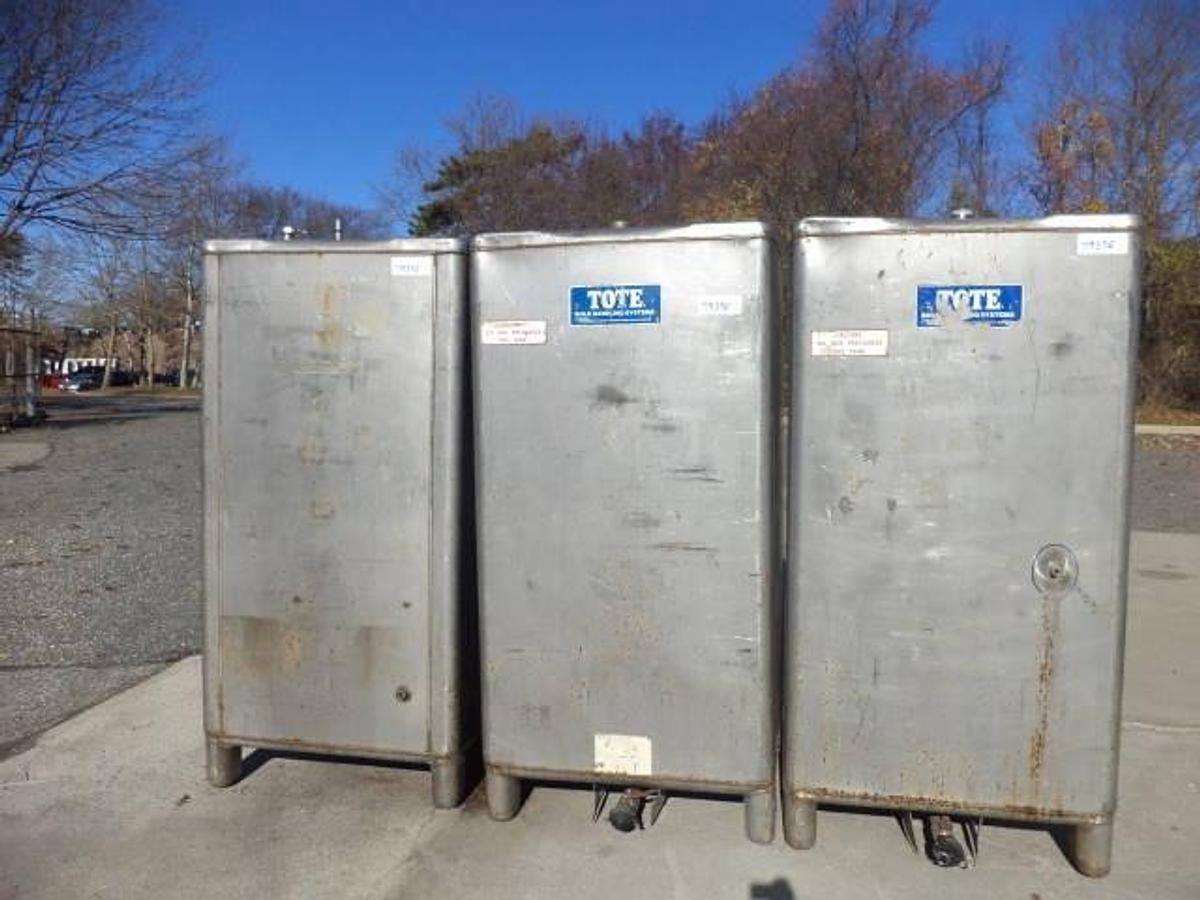
The two most common construction materials are stainless steel and carbon steel with a powder-coat or painted finish. Stainless steel, particularly 304 or 316 grade, is the standard for food processing, pharmaceutical, and chemical applications where sanitation is a regulatory requirement. It resists corrosion, tolerates frequent washdowns with caustic cleaning agents, and does not harbor bacteria in surface pits or weld seams the way carbon steel can over time. Stainless steel equipment like the 600-gallon stackable totes produced by Tote Systems commands a higher price point, but the material longevity in demanding environments justifies the investment.
Carbon steel with powder coating is the practical choice for general industrial, agricultural, recycling, and warehousing applications where sanitation standards are less stringent and cost efficiency is a priority. The coating provides reasonable corrosion resistance, but it is vulnerable to chipping and surface rust if the equipment is used in wet or chemically aggressive environments over time. When buying used equipment, buyers should inspect the condition of welds, surface coatings, and any contact points where material abrasion is heaviest, as these areas show wear first and can indicate how hard the machine was run during its prior service life.
What are the standard size and weight capacity ranges for tote bulk handling equipment?
Tote bins and containers used in bulk handling applications typically range from around 275 gallons on the smaller end up to 330 gallons for standard IBC totes, with larger custom or specialized bins reaching 600 gallons and beyond. Weight capacities for the handling equipment itself, meaning the dumpers, tippers, and conveyors designed to move these containers, commonly range from 1,000 lbs on lighter-duty models up to 4,000 lbs or more for heavy industrial configurations. The platform dimensions of the equipment matter just as much as the weight rating, since a machine rated for 2,000 lbs still needs a platform sized to accept the footprint of the specific container being used.
For buyers sourcing used equipment, it is worth verifying both the rated capacity and the platform dimensions against the actual containers in their facility before purchasing. A mismatch in platform size can make equipment unusable even if the weight rating is adequate. Cycle time is another specification worth reviewing, as some facilities have throughput requirements that demand faster lift and dump cycles than older or lower-tier machines can provide. Reviewing the original manufacturer's specification sheet alongside any inspection documentation gives the clearest picture of what a used machine can realistically handle.
What safety features should buyers look for when evaluating used tote bulk handling equipment?
Safety is one of the most important factors in evaluating any bulk material handling machine, and it deserves careful attention when buying used equipment because safety components can wear, be bypassed, or be removed during a machine's prior service life. Key features to look for include interlocked guarding that prevents operation when personnel are in the dump zone, load restraint systems that secure the container during lifting and tilting, and anti-runaway devices that prevent uncontrolled descent under hydraulic or mechanical failure. Emergency stop systems should be present and functional, and buyers should verify that all safety interlocks engage correctly during inspection.
From a compliance standpoint, equipment designed and manufactured to OSHA standards and, for equipment sold into international markets, CE certification, provides a baseline of design safety. However, it is important to understand that a used machine's compliance status reflects its condition at the time of manufacture, not necessarily its current state. Physical inspection, either in person or through a detailed video walkthrough, is the most reliable way to assess whether safety features are intact and operational. Buyers should also consult with the manufacturer of the specific machine to understand what replacement parts and service documentation are still available, since older models may have limited support.
Can used tote bulk handling equipment be integrated with existing conveyor or automated production systems?
Integration is possible in many cases, but it requires careful evaluation of both the used equipment's control architecture and the existing system's automation infrastructure. Many tote dumpers and tippers were built with basic relay-based or PLC controls that can be interfaced with modern conveyor and automation systems, provided the electrical specifications are compatible and the control logic can be adapted. Buyers planning to integrate used equipment into an automated line should obtain the electrical schematics and control documentation for the machine, and have a qualified controls engineer assess compatibility before purchase.
Mechanical integration, meaning how the discharge point of the tote dumper aligns with a receiving hopper, conveyor, or processing inlet, is equally important. The discharge height, angle, and opening dimensions need to match the downstream equipment. Some facilities fabricate custom transition chutes or adapters to bridge dimensional gaps, which adds cost but is a common and practical solution. Buyers should factor integration engineering costs into their total budget when sourcing used equipment for automated lines, since a lower purchase price can be offset by significant installation and adaptation expenses.
What drive configurations are available for tote bulk handling equipment, and how do they compare?
Tote dumpers and related bulk handling equipment are built around three primary drive systems: electric, hydraulic, and pneumatic. Electric drive systems are the most common in general industrial and food processing environments because they are clean, relatively quiet, and easy to control with variable speed or programmable logic. They are well-suited to facilities that already have adequate electrical infrastructure and where there is no risk of hydraulic fluid contamination affecting the product.
Hydraulic systems offer high force output relative to their physical size, making them a practical choice for very heavy loads or applications requiring precise, controlled movement under load. The trade-off is that hydraulic systems require maintenance of fluid levels, seals, and hoses, and a leak in a food or pharmaceutical environment can be a serious contamination event. Pneumatic systems are used in applications where compressed air is already available and where a clean, spark-free drive is required, such as in explosive or highly flammable material handling environments. When buying used equipment, the condition of the drive system, including motors, hydraulic cylinders and hoses, or pneumatic valves and actuators, should be a focal point of any inspection, as these components are often the most costly to repair or replace.
How should buyers inspect used tote bulk handling equipment before purchasing?
Inspections for used bulk handling equipment typically take three forms: in-person visits, virtual walkthroughs conducted over video call, or recorded video documentation provided by the seller. An in-person inspection is the most thorough option and allows a buyer or their technician to physically examine welds, structural components, drive systems, safety interlocks, and wear surfaces. Some equipment is still installed and operational at a facility when it goes up for sale, which creates an opportunity to observe the machine running under real production conditions, though this is not always possible since equipment may already be decommissioned.
For buyers who cannot travel, a detailed video inspection is a practical alternative. A thorough video should cover all structural points, moving components, control panels, safety devices, and any visible wear or damage. Buyers should prepare a specific list of questions and areas they want documented rather than relying on a generic walkthrough. It is also worth contacting the original equipment manufacturer directly to ask about the model's service history, available replacement parts, and any known issues associated with that generation of machine. Dealers who specialize in industrial and bulk handling equipment are generally better positioned to facilitate thorough inspections and provide accurate condition assessments than general surplus or auction platforms.
What should buyers expect to pay for used tote bulk handling equipment, and what factors affect pricing?
Pricing for used tote bulk handling equipment varies considerably based on equipment type, size, construction material, age, condition, and how specialized the machine is. A basic used tote dumper in carbon steel can sell for a fraction of its original list price if it has significant age or wear, while a stainless steel tote inverter or a large-capacity stacker in good working condition can still command a substantial price because of the material value alone and the limited supply of food-grade or pharmaceutical-grade used equipment on the market. Specialized configurations built for specific container sizes or integrated with custom controls also tend to hold value better than general-purpose machines.
Beyond the purchase price, buyers should account for the full landed cost of the equipment. Shipping, rigging for loading and unloading, freight packaging or crating, and any integration or refurbishment work required at the destination facility all add to the real cost of acquisition. Heavier machines require specialized rigging equipment at both ends of the shipment, which adds cost that should be clarified with the seller upfront. Getting a clear picture of all these costs before committing to a purchase helps avoid surprises and allows for a fair comparison between multiple machines at different price points.
What are the typical payment and shipping terms for purchasing used tote bulk handling equipment?
Most used industrial equipment dealers require payment in full before a machine is released for shipment. This is standard practice in the industry and reflects the nature of used equipment transactions, where machines are sold as-is and the seller needs to confirm funds before arranging logistics. Some dealers extend payment terms to established customers with a purchase history, but buyers sourcing from a dealer for the first time should expect to pay in full upfront. Wire transfer is the most common payment method for larger transactions, though other arrangements may be available depending on the dealer.
Shipping costs depend heavily on the size and weight of the equipment, the distance to the destination, and the level of packaging or crating required to protect the machine in transit. Smaller tote bins may ship on standard pallets, while larger dumpers, inverters, or stackers may require custom crating and heavy-duty rigging for both loading at the origin and unloading at the destination. Buyers should request a detailed breakdown of packaging, rigging, and freight costs from the seller before finalizing a purchase, so the full landed cost is understood. For very large or heavy machines, working with a freight broker experienced in industrial equipment moves can help identify the most cost-effective and safe transport options.