Category
Manufacturer
Model
Surekap
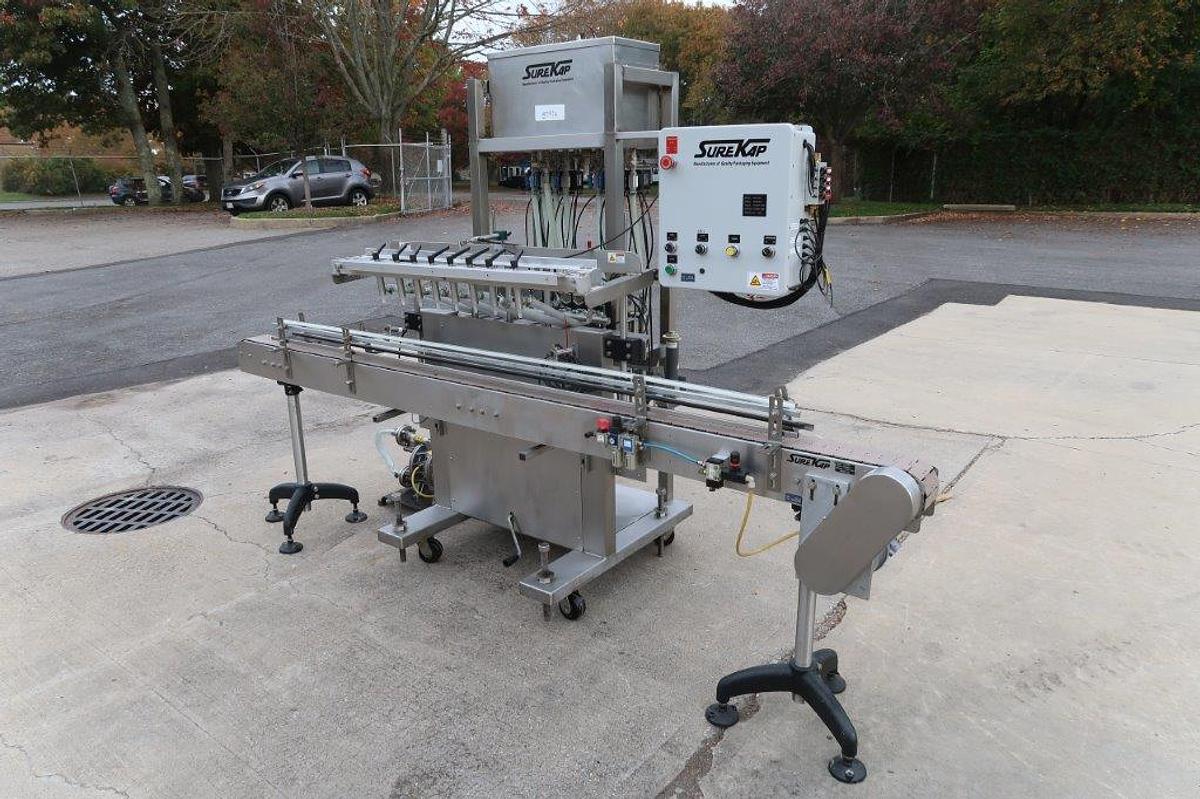
Surekap specializes in packaging machinery, particularly for the beverage and food industries. They are known for their cap sealing and labeling machines, which enhance the efficiency of packaging lines. Surekap’s equipment is designed for versatility and ease of operation, catering to various product types.
FAQ:
What types of caps and closures can Surekap capping machines handle?
Surekap capping machines are built to handle a wide range of closure types, which is one of the reasons they've become a go-to choice across multiple industries. The most common applications include screw caps, continuous thread closures, and tamper-evident caps. Spindle capper models, like the SK-6000 series, are particularly well-suited for applying plastic screw caps at consistent torque levels, which matters a great deal in industries like pharmaceuticals and nutraceuticals where regulatory standards demand repeatable, auditable results. Some models are also configured for snap caps and other specialty closures depending on the tooling installed.
The versatility of Surekap equipment extends to cap size range as well. Many models are designed with tooling changeover in mind, meaning operators can switch between different cap diameters without significant downtime. This makes them practical for contract packagers or facilities that run multiple SKUs on the same line. When evaluating a used Surekap machine, it's worth confirming which tooling is included with the unit, since changeover kits and additional spindle sets may or may not come with the machine as sold.
What industries commonly use Surekap capping machines?
Surekap has built a strong reputation across several packaging-intensive industries, with the beverage and food sectors being among the most prominent users. Bottled water, juices, sauces, condiments, and similar products are well-suited to the spindle capper designs that Surekap is known for. The machines are also widely used in personal care and household chemical applications, where consistent cap torque prevents leakage and maintains product integrity during shipping and retail display.
Pharmaceutical and nutraceutical manufacturers are another significant user base, drawn to Surekap's ability to apply precise and repeatable torque on child-resistant and tamper-evident closures. These industries often operate under strict quality control requirements, and the torque consistency that Surekap spindle cappers deliver makes them a practical fit for regulated production environments. The combination of stainless steel construction on many models and sanitary design features also makes them appropriate for facilities that require regular washdowns or operate under food-grade standards.
What is the difference between a spindle capper and a chuck capper, and which type does Surekap make?
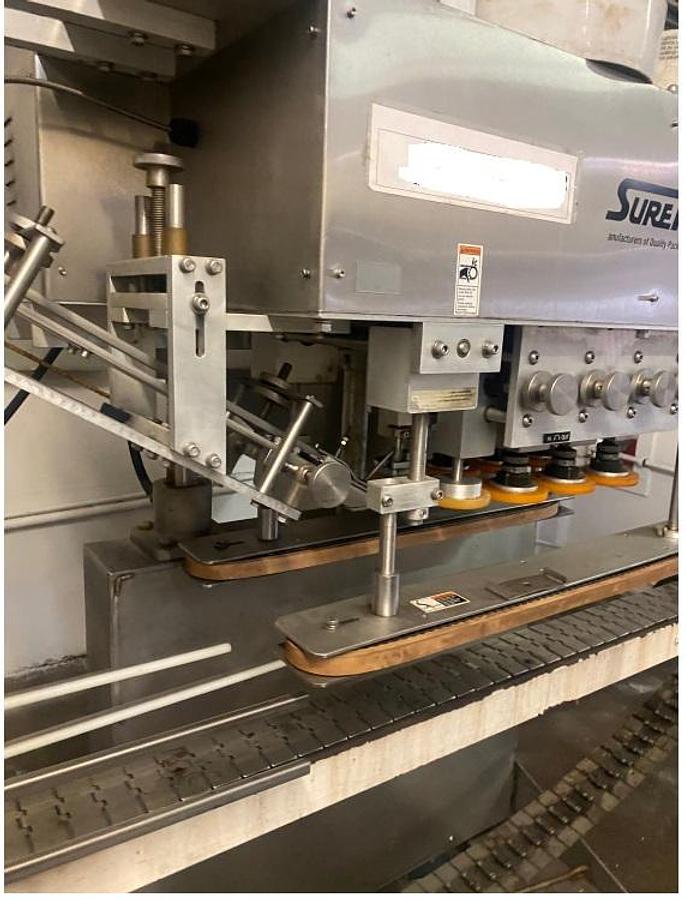
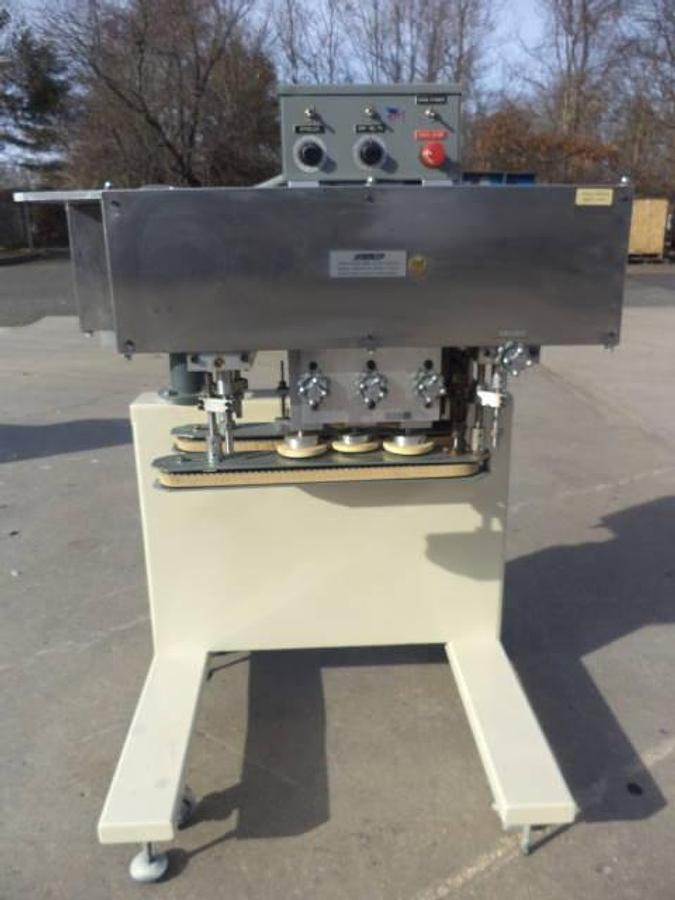
Spindle cappers and chuck cappers are the two most common types of automated capping equipment, and they work quite differently. A spindle capper uses a series of rotating discs (spindles) arranged in pairs to gradually tighten a cap as a bottle passes through on a conveyor. The cap is applied progressively rather than all at once, which makes spindle cappers fast and well-suited for continuous, high-volume production lines. A chuck capper, by contrast, uses a single chuck that descends onto each cap and applies torque in a single motion, making it more precise for applications requiring very specific torque values or for certain cap styles that don't respond well to spindle-style application.
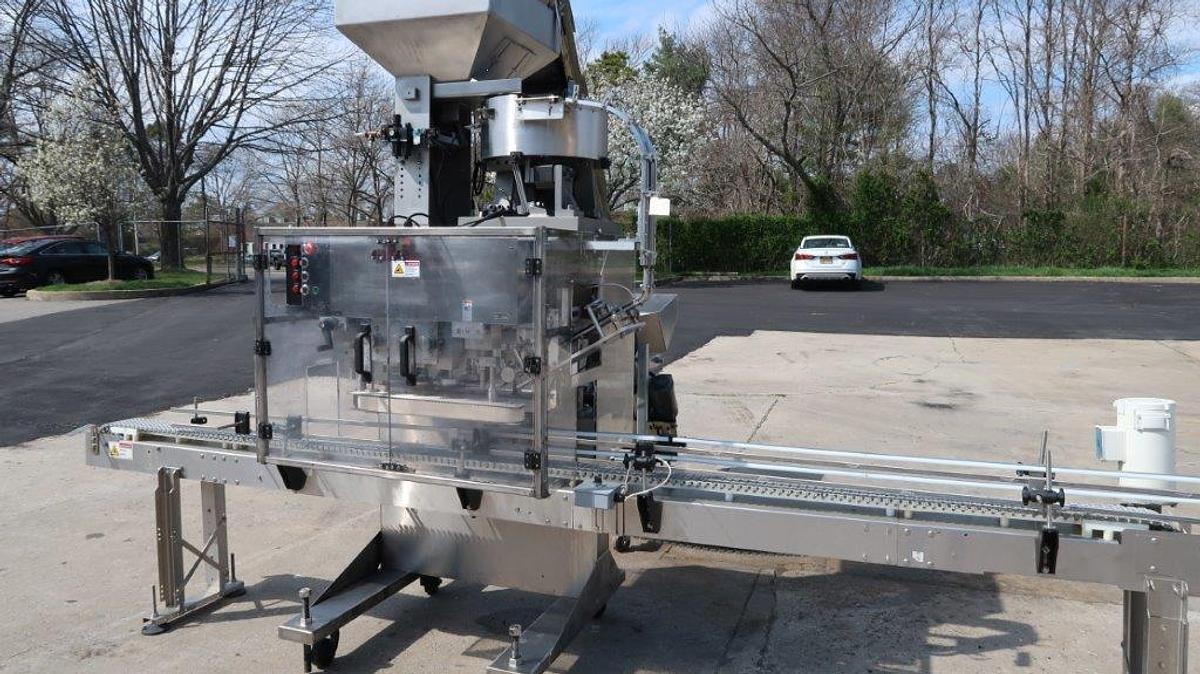
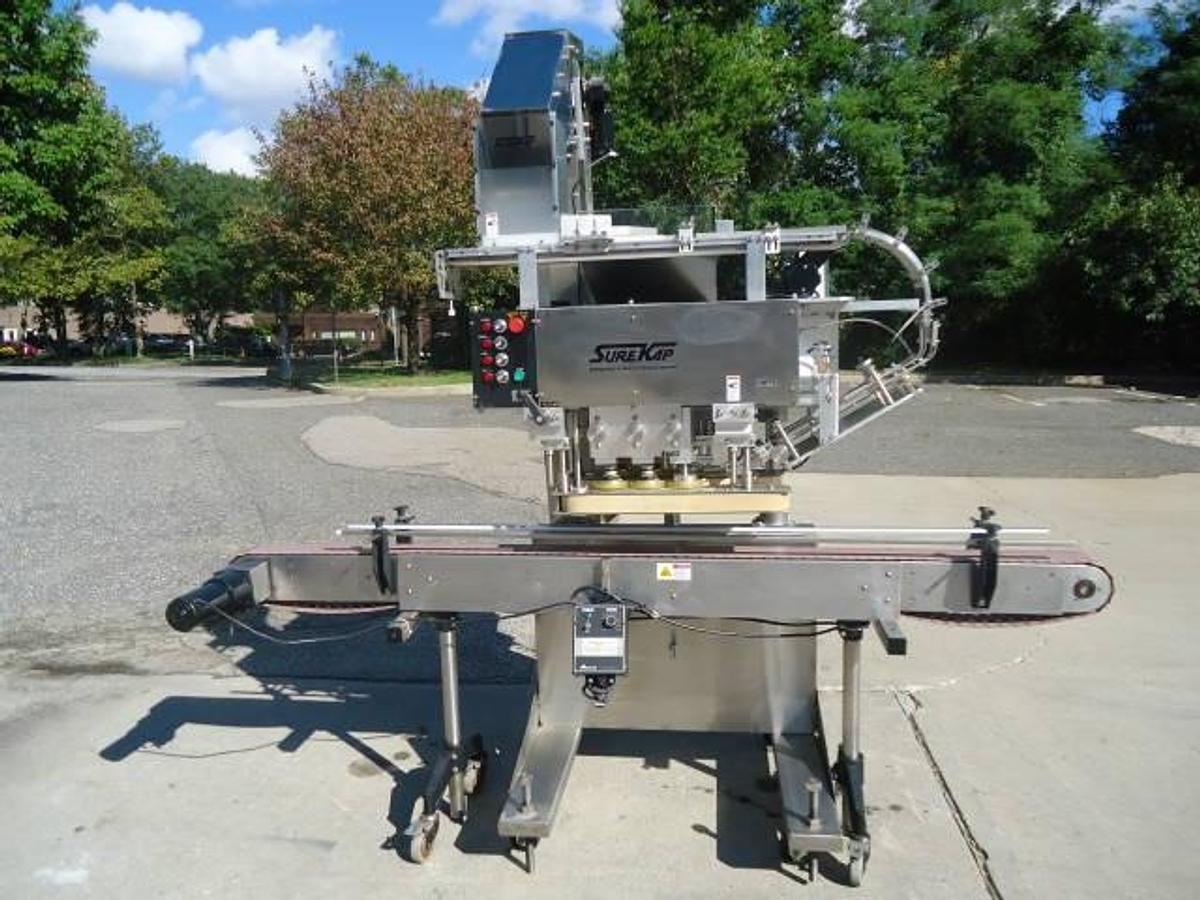
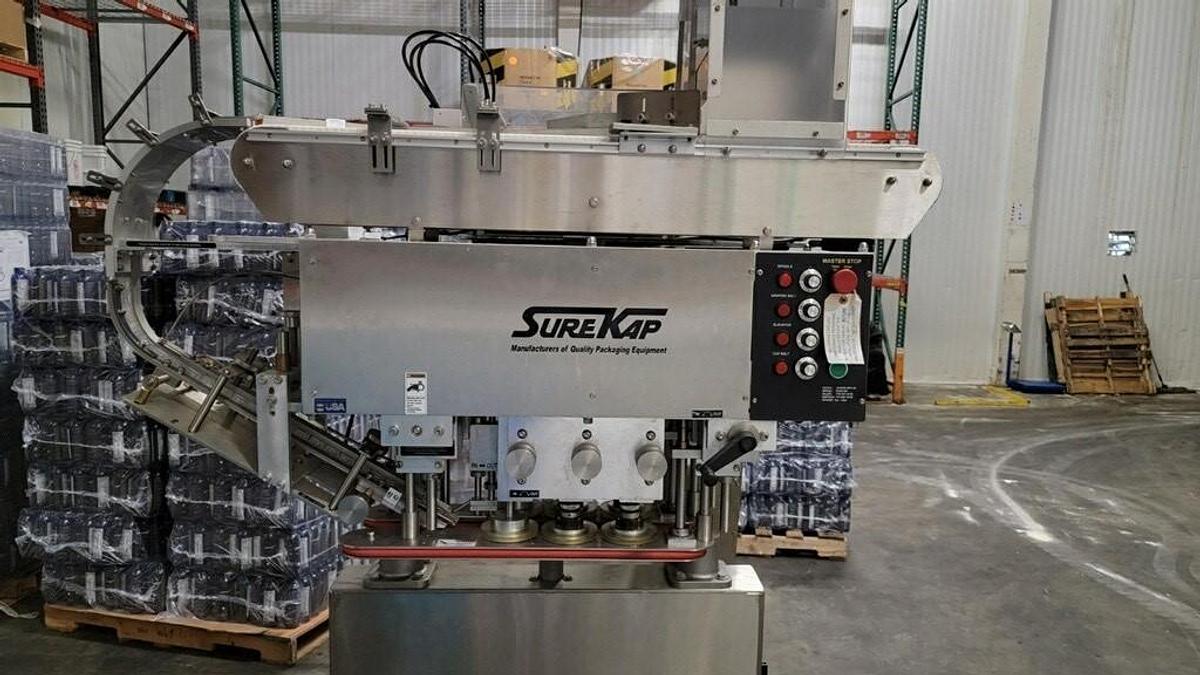
Surekap is primarily known for its spindle capper designs, with the SK-6000 series being one of the most recognized product lines. Models like the Six Spindle Capper and the Eight Spindle Capper are built for inline production environments and are often specified for beverage, food, and personal care lines where throughput is a priority. The six and eight spindle configurations allow for more gradual torque application across a longer contact zone, which helps maintain cap integrity without over-tightening. Used Surekap spindle cappers are frequently available on the secondary market and can represent a cost-effective way to add reliable capping capability to a packaging line.
How fast can a Surekap capping machine run in terms of bottles per minute?
Capping speed on Surekap machines varies depending on the specific model, the cap type being applied, and the bottle handling setup on the line. Generally speaking, Surekap spindle cappers in the SK-6000 series are capable of handling production rates that range from roughly 20 to 120 bottles per minute, depending on configuration and how well the upstream and downstream equipment is matched to the capper's throughput. Six-spindle models tend to be positioned for mid-range production speeds, while eight-spindle configurations are typically used on higher-speed lines where maintaining torque consistency at faster rates is a priority.
It's worth noting that actual throughput in a real production environment depends on more than just the capper itself. Bottle feeding consistency, conveyor speed, cap elevator performance, and the physical characteristics of the container all affect how fast a line can realistically run. When purchasing a used Surekap machine, it's a good idea to ask the seller about the production context the machine came from, including the speeds it was running at, since this can give a more realistic picture of what to expect in a similar application.
Are Surekap capping machines suitable for small-scale or startup production operations?
Surekap offers models across a range of production scales, and several of them are genuinely practical for smaller operations. The portable versions of the SK-6000 series, including models mounted on casters, are specifically designed with flexibility in mind. A portable six-spindle capper can be repositioned within a facility as needed and doesn't require a fixed conveyor installation, which makes it accessible for operations that are still building out their production infrastructure or that run smaller batch sizes at irregular intervals.
That said, even the smaller Surekap models are industrial-grade equipment, so they're built for consistent, repeated use rather than occasional light-duty applications. For a startup or small manufacturer, buying a used Surekap machine rather than purchasing new equipment can significantly reduce the capital outlay while still getting a machine with solid mechanical construction. The key is to inspect the machine carefully before purchase, since the condition of used equipment varies widely depending on how it was maintained and how many hours it ran in its previous production environment.
What should buyers look for when inspecting a used Surekap capping machine?
A thorough inspection is the most important step in buying any used capping machine, and Surekap equipment is no exception. The spindle discs and their associated drive components are the heart of the machine, so buyers should look closely at disc wear, belt condition, and whether the spindle assemblies run smoothly without wobble or excessive noise. On stainless steel models, checking for corrosion, weld integrity, and any signs of previous repairs or modifications is also worthwhile. The cap elevator, if included, should be examined for belt wear and motor function since it's a component that sees a lot of repetitive stress in production.
Reputable used equipment dealers will typically accommodate in-person inspections or provide video walkthroughs of the machine in its current state. Some machines may still be installed at an active production facility, in which case an inspection can sometimes be arranged at the plant. Keep in mind that most dealers are not set up to run actual production tests with product, since that requires different permitting and facility capabilities. The goal of an inspection is to get an accurate picture of the machine's mechanical condition and completeness, including confirming what tooling, change parts, and documentation are included with the sale.
What bottle sizes and shapes are compatible with Surekap spindle cappers?
Surekap spindle cappers are designed with adjustability as a core feature, and most models in the SK-6000 series can accommodate a meaningful range of bottle heights and diameters through mechanical adjustments to the spindle height, side belt guides, and infeed/outfeed components. Round bottles are the standard application, but many Surekap models can also handle non-round containers with the right setup and guiding hardware. Cap diameter compatibility is typically determined by the spindle disc size and spacing, and changeover to a different cap size usually involves swapping disc sets or adjusting the spindle gap.
When evaluating a used Surekap machine for a specific application, it's important to compare the machine's documented cap size range and bottle height range against the actual containers in your production line. If the listing includes specifications, review them carefully. If not, ask the seller for the machine's original spec sheet or model documentation, and cross-reference with Surekap's published specifications for that model. Contacting Surekap directly can also be useful for confirming compatibility and understanding what change parts or adjustments might be needed to run a specific bottle and cap combination.
What does the cap elevator do on a Surekap capping machine, and is it necessary?
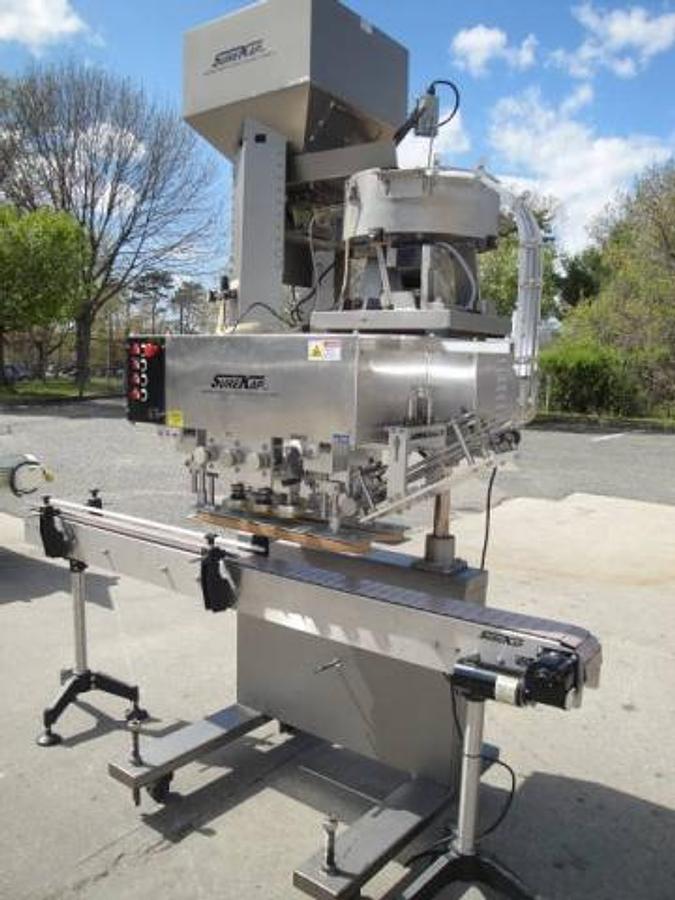
A cap elevator is an automated component that sorts and orients caps, then delivers them in a consistent, right-side-up position to the capping head or spindle area of the machine. Without an elevator, caps have to be manually placed on bottles before they reach the capper, which works fine for lower-speed semi-automatic operations but becomes a bottleneck on faster production lines. The elevator essentially automates the cap feeding step, allowing the capping machine to run continuously without an operator manually loading caps.
Several used Surekap models on the market are listed with cap elevators included, such as the Eight Spindle SS Capper with Cap Elevator and the SK6000-BF6 Six Spindle Screw Capper with Elevator. Whether a cap elevator is necessary depends on the production speed and staffing model of the operation. For a high-speed inline line, an elevator is essentially required to maintain throughput. For a smaller operation running at slower speeds, a machine without an elevator can still be a practical and cost-effective choice. When buying used, it's worth confirming whether the elevator is included, since purchasing one separately adds to the overall cost of the installation.
How does the payment and shipping process typically work when buying a used Surekap capping machine?
Most used equipment dealers require full payment before a machine is released for shipping. Some dealers may extend payment terms to established customers with a prior purchase history, but for first-time buyers, payment in full upfront is the standard expectation. It's a good practice to clarify payment terms, accepted payment methods, and any applicable fees before committing to a purchase, so there are no surprises at the point of transaction.
Shipping costs for capping machines depend heavily on the size and weight of the unit, the origin and destination, and the level of packaging required to protect the machine in transit. Smaller portable models on casters will have different freight requirements than a full inline capper with an integrated elevator and conveyor sections. Larger machines may require rigging services for loading and unloading, which adds to the total landed cost. Buyers should ask the seller specifically about how the machine will be packaged or crated, what rigging is needed, and for a freight estimate, so the full cost of getting the machine to the facility is understood before finalizing the purchase.
What level of support and parts availability should buyers expect for used Surekap machines?
Used capping machines are sold as-is, which means the responsibility for assessing condition and fitness for purpose falls on the buyer rather than the seller. This makes pre-purchase inspection especially important, as described elsewhere. On the parts and support side, the level of assistance available from Surekap as the manufacturer can vary depending on the age and model of the machine. Older or discontinued models may have limited parts availability, while more recent models in a current or recently discontinued product line are more likely to have replacement components accessible through the manufacturer or authorized distributors.
Before purchasing a used Surekap machine, it's advisable to contact Surekap directly to ask about parts availability for the specific model and serial number in question. The manufacturer can give a realistic picture of what support to expect, which components are still stocked, and whether technical documentation is available. Selecting a used equipment dealer with a long track record in the packaging machinery space also matters, since experienced dealers are more likely to have accurate information about the machine's history and condition, and some may be able to source common wear parts or direct buyers to appropriate service contacts.