Category
Manufacturer
Model
Quincy
Quincy is a leading provider of air compressor systems and vacuum pumps, catering mainly to the industrial manufacturing sector. They are particularly known for their rotary screw compressors and reciprocating air compressors, which are designed to optimize energy efficiency and performance.
FAQ:
What types of Quincy air compressors are available on the used market?
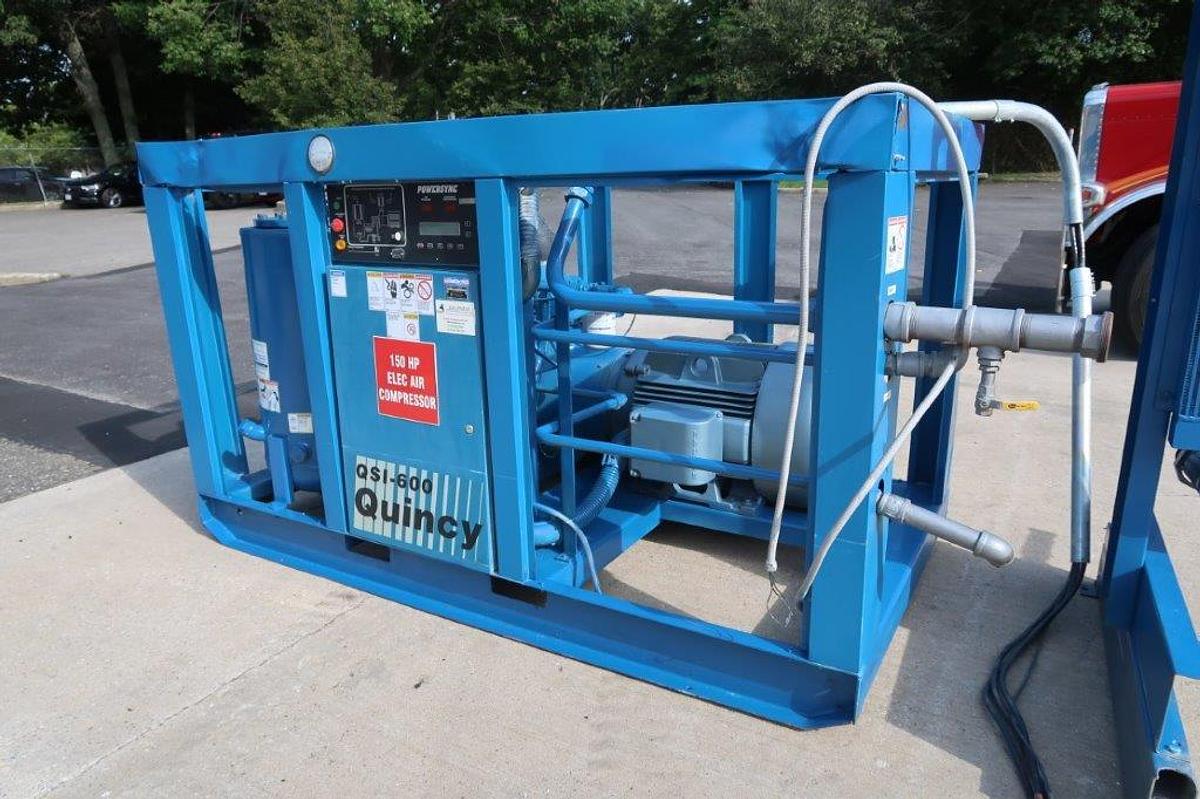
Quincy has built out several distinct product lines over its long manufacturing history, and most of them show up regularly on the used market. The most common types are reciprocating piston compressors and rotary screw compressors. Within the reciprocating category, you'll find models from the QT series (including the QT Pro, which uses splash-lubricated cast-iron cylinders) and the QR-25 series, which was built for heavy-duty continuous-duty cycles. The QP series covers splash-lubricated units aimed at moderate industrial use. On the rotary screw side, the QGS and QSI series handle larger industrial applications, with the QSI-600 being a well-known example at 150 HP, built for high-demand manufacturing environments.
Buyers looking at used Quincy equipment should identify which series fits their application before shopping. Reciprocating models tend to be better suited for intermittent-use settings like fabrication shops or maintenance operations, while rotary screw units are designed for facilities that need a steady, continuous supply of compressed air. Because Quincy has been manufacturing since 1920, there is a wide range of vintages available on the used market, from older workhorses that have decades of proven service to more recent models with updated efficiency features. Matching the right series and horsepower to the actual demand of the application is the most important step in evaluating any used Quincy unit.
What is the difference between a Quincy reciprocating compressor and a rotary screw compressor?
Reciprocating compressors, sometimes called piston compressors, work by drawing air into a cylinder and compressing it with a piston on each stroke. Quincy's reciprocating models, like the QT and QR-25 series, are well-suited for applications where air demand is intermittent. They build pressure in a receiver tank, the compressor cycles on and off as needed, and the design is relatively straightforward to service. Cast-iron cylinders and splash lubrication on models like the QT Pro contribute to a long service life, and these units are a practical choice for machine shops, auto repair facilities, and similar environments where air demand is moderate and not continuous.
Rotary screw compressors use two meshing helical screws to compress air in a continuous flow rather than in discrete strokes. This makes them far better suited to high-demand, continuous-duty industrial environments where a large volume of compressed air is needed around the clock. Quincy's QGS and QSI series fall into this category. Rotary screw units tend to run quieter and at lower temperatures than reciprocating models under sustained load, but they are more mechanically complex and carry a higher purchase price, even on the used market. The right choice depends entirely on the duty cycle and volume requirements of the application. A facility running air-powered tools all day will typically benefit more from a rotary screw unit, while a shop with sporadic air demand can get excellent results from a well-maintained used reciprocating Quincy.
How long do Quincy air compressors typically last?
Quincy compressors have a strong reputation for longevity, and it is not unusual to find used units with 20 to 30 years of service life when they have been properly maintained. The cast-iron construction used across much of the Quincy line, particularly in reciprocating models, is a major factor in that durability. Cast iron handles heat and wear better than aluminum or lighter alloys, which matters significantly in a machine that cycles thousands of times per day. The QR-25 series in particular was engineered with extended service intervals and long-term reliability as explicit design goals, and many of those units have proven that out in real industrial settings.
For buyers considering used Quincy equipment, the expected service life is one of the strongest arguments for the brand. A well-maintained used Quincy with 10 or 15 years of prior service can still have a decade or more of productive life ahead of it, which makes the cost-per-year calculation very favorable compared to lower-quality alternatives. That said, actual remaining life depends heavily on how the machine was maintained, the operating environment, and how hard it was run relative to its rated capacity. Requesting service records, asking about oil change intervals, and arranging an inspection to assess the condition of wear components like valves, rings, and belts are all worthwhile steps before purchasing any used compressor.
What should I inspect before buying a used Quincy air compressor?
A thorough inspection is the most important thing a buyer can do before committing to a used Quincy compressor. The starting point is the mechanical condition of the pump and motor. On reciprocating models, that means checking for excessive blow-by at the valves, listening for unusual knocking or rattling during operation, and examining the condition of the belts, pulleys, and belt guard. On rotary screw units, the condition of the air-oil separator, inlet valve, and screw element itself are the critical items. Hours of operation, if available from a control panel or service log, give useful context for how much life has been used.
Beyond the pump and motor, the receiver tank deserves close attention on any reciprocating unit. Tanks can develop internal corrosion, particularly if moisture separators were not regularly drained, and a compromised tank is a safety issue, not just a maintenance one. Buyers should also look at the condition of electrical components, the pressure switch, safety relief valves, and any integrated dryers or filters. Reputable used equipment dealers will typically accommodate in-person inspections or video walkthroughs of the machine so buyers can assess condition before purchasing. Some equipment may still be in service at the facility where it is being sold, which allows for observation under actual operating conditions. Keep in mind that most dealers do not have production permits to run full load tests, so inspection will focus on visual and mechanical assessment rather than full production simulation.
What CFM and PSI ratings are common in used Quincy air compressors?
Quincy's product line covers a wide range of flow and pressure ratings, which is part of why the brand appears across so many different industrial settings. On the lighter end, smaller reciprocating models in the QT series might deliver 5 to 15 CFM at 90 PSI, appropriate for small shops or maintenance applications. Mid-range industrial reciprocating units step up considerably, with some QR-25 configurations delivering 30 to 60 CFM or more. Rotary screw models like the QGS series span a broad range depending on horsepower, with units from 5 HP to 30 HP covering roughly 20 to 125 CFM at standard pressures. Larger QSI series units, such as the 150 HP QSI-600, are built for high-volume industrial production environments with significantly higher flow rates.
When evaluating CFM and PSI on a used unit, buyers should pay attention to both the rated delivery pressure and the actual CFM at that pressure, since compressor output drops as pressure increases. It is also worth noting that CFM ratings on used machines should be verified against actual performance where possible, as worn valves, rings, or seals can reduce delivered CFM below the nameplate specification. Matching the compressor's output to the peak demand of the tools or processes it will serve, with some headroom built in, is the standard approach for sizing. Undersizing a compressor leads to excessive cycling and premature wear, while a unit that is significantly oversized for the application may not be the most economical choice even at a used equipment price.
Are used Quincy air compressors suitable for industrial applications?
Quincy has been a recognized name in industrial compressed air since 1920, and the brand's product line was built specifically for demanding manufacturing and production environments. The rotary screw series, including the QGS and QSI models, are designed for continuous-duty industrial use and are found in automotive manufacturing, food processing, general fabrication, and a wide range of other industrial settings. The larger reciprocating models in the QR-25 line were similarly built to handle high-cycle industrial workloads. Because Quincy equipment was engineered with industrial service in mind from the start, used units that have been well maintained can continue to perform reliably in production settings.
For buyers sourcing used industrial compressors, Quincy's long manufacturing history also has a practical benefit: parts and technical documentation are generally available for a wide range of model years. This matters for used equipment because the ability to source replacement valves, rings, separators, or control components directly affects the long-term serviceability of a machine. Buyers should consult with Quincy or authorized service providers to confirm parts availability for a specific model and serial number before purchasing, since older or discontinued configurations may have more limited support. Selecting a used equipment dealer who specializes in industrial compressed air equipment, and who has a verifiable track record in the industry, reduces the risk of acquiring a machine with undisclosed mechanical issues.
What is the typical price range for used Quincy air compressors?
Used Quincy compressor pricing varies considerably based on model, horsepower, condition, and age. Smaller reciprocating models from the QT or QP series in good working condition might be found in the range of a few hundred to a couple thousand dollars, making them accessible for small shops or buyers with moderate air demands. Mid-range industrial reciprocating units with higher horsepower and larger tanks step up from there, typically landing somewhere between two thousand and six or seven thousand dollars depending on configuration and condition. Rotary screw units, which carry a higher price even when used, can range from several thousand dollars for smaller HP models up to ten thousand dollars or more for larger industrial configurations.
It is important to factor in the total landed cost when evaluating any used compressor purchase, not just the listed price. Shipping, rigging, and crating costs can add meaningfully to the final number, particularly for heavier industrial units that require specialized loading and unloading equipment. Buyers should ask dealers for a detailed breakdown of packaging and freight costs before committing to a purchase. Additionally, any deferred maintenance or parts that need replacement upon installation should be estimated in advance. A used Quincy in excellent condition at a slightly higher price is often a better value than a lower-priced unit that requires significant work to return to reliable service.
What should buyers know about shipping a used Quincy air compressor?
Shipping a used industrial air compressor involves more logistical considerations than most freight shipments. The weight and footprint of Quincy compressors, particularly rotary screw models and larger reciprocating units, means they typically require proper palletization or crating to prevent damage in transit. The level of packaging required depends on the size and configuration of the unit, and costs will vary accordingly. Buyers should ask the dealer specifically how the machine will be packaged and what that packaging cost includes before finalizing the purchase.
For larger or heavier units, rigging is often required at both the origin and destination. Loading a 150 HP rotary screw compressor onto a flatbed or freight carrier requires equipment and expertise that goes beyond standard pallet jack handling, and the same applies on the receiving end. Rigging costs are typically separate from freight costs and should be confirmed in advance so there are no surprises in the final landed price. Buyers should also confirm whether the dealer handles freight coordination or whether the buyer is responsible for arranging their own carrier. Most used equipment dealers require full payment before the machine ships, so having all cost components clearly understood before payment is made is an important part of the purchasing process.
How does buying a used Quincy compressor compare to buying a used compressor from a lesser-known brand?
Brand reputation carries real practical weight in the used equipment market, particularly for compressed air systems. Quincy's history of manufacturing industrial compressors since 1920 means there is a large installed base of machines, a well-documented service history across many model lines, and a network of service technicians familiar with the equipment. When something needs to be repaired or rebuilt on a Quincy, the likelihood of finding someone with hands-on experience is higher than it would be for a less common brand. That serviceability factor is not trivial when evaluating total cost of ownership on a used machine.
By contrast, buying a used compressor from a lesser-known or discontinued brand can create real challenges down the road. Parts may be harder to source, technical documentation may be limited, and finding a qualified technician may require more effort and cost. Quincy's longevity as a manufacturer also means that buyers can contact the company directly to ask about parts availability and service support for a specific model and serial number before purchasing. That kind of manufacturer support is not guaranteed for every used equipment brand. For buyers who want a used industrial compressor with a reasonable expectation of long-term supportability, Quincy's track record makes it a sensible choice to evaluate.
What questions should I ask a used equipment dealer before buying a Quincy compressor?
Going into a used equipment purchase with a clear list of questions significantly reduces the risk of an unpleasant surprise after delivery. Start with the basics: What is the model and serial number? What is the approximate age and known service history? Are there any maintenance records available? Has the machine been in continuous service, or has it been sitting idle? A compressor that has been sitting unused for an extended period can develop issues with seals, valves, and internal components that would not be apparent from a visual inspection alone, so understanding the recent operational history matters.
Beyond history, ask specifically about the inspection options available. Reputable dealers will typically offer in-person visits, video walkthroughs, or photo documentation of the machine in its current state. If the equipment is still installed at a production facility, ask whether an in-person inspection can be arranged at that location. Find out exactly what the total cost will be, including the machine price, any rigging at origin, packaging, freight, and any rigging required at the destination. Ask about payment terms and the process for resolving any discrepancies between the machine's described condition and what is actually received. Selecting a dealer with a long track record of selling industrial compressed air equipment, and one who is transparent about the machine's condition and limitations, is the most reliable way to make a sound used equipment purchase.