Category
Manufacturer
Model
Patterson
Patterson provides a wide array of manufacturing equipment, particularly focusing on the food and beverage industry. They are known for their efficient bottling and canning systems that improve production lines.
FAQ:
What types of industrial blenders does Patterson Industries manufacture?
Patterson Industries produces a range of heavy-duty industrial blending equipment designed for demanding production environments. Their lineup includes ribbon blenders, double cone tumbling blenders, paddle blenders, and related mixing systems. Each design serves a different blending application: ribbon blenders excel at dry powder and granule mixing, double cone tumblers are well-suited for gentle blending of fragile or free-flowing materials, and paddle blenders handle a broader range of consistencies including pastes and semi-solids.
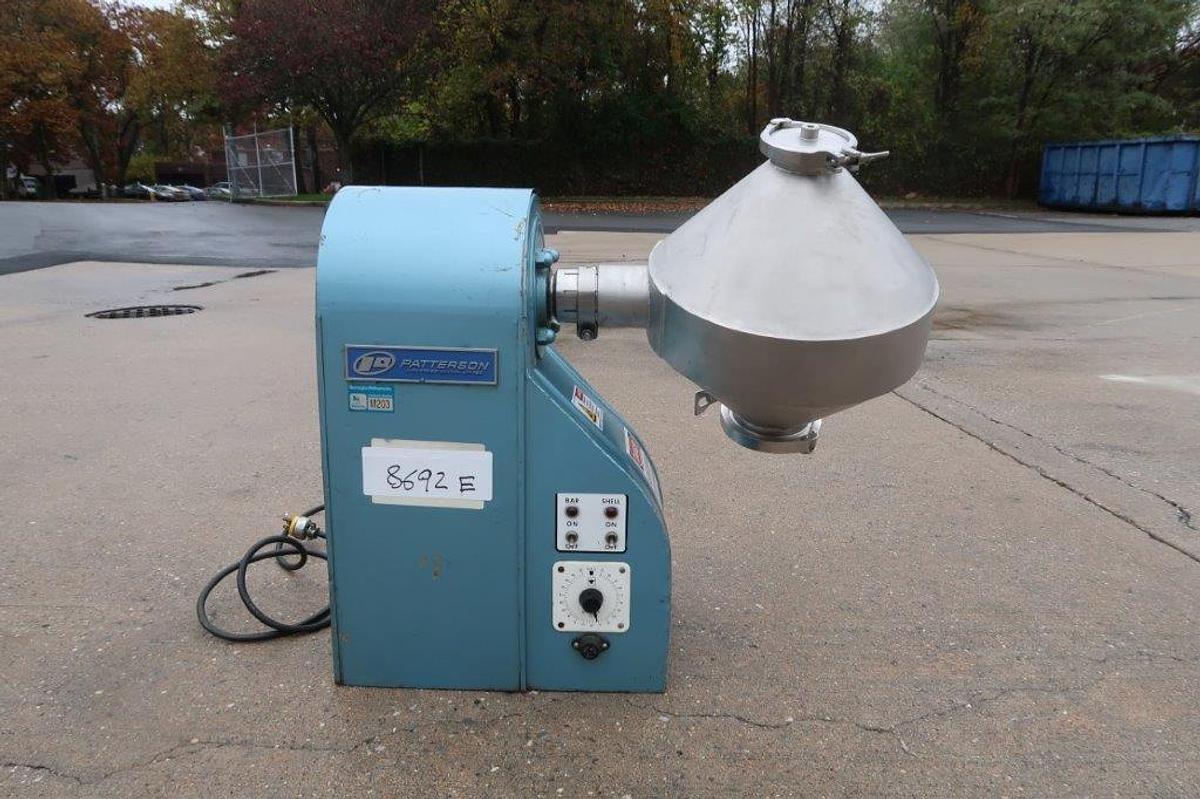
Patterson ribbon blenders are particularly well-regarded in production settings for their ability to achieve uniform blends in relatively short cycle times. The double cone tumbling blender, available in configurations as small as 1 cubic foot for tabletop or pilot-scale use, is a good example of their range spanning from small-batch to full production scale. Used Patterson blenders appear across a wide variety of configurations, so buyers can often find a unit sized and designed for their specific process without purchasing a purpose-built machine.
What capacity ranges are available in used Patterson industrial blenders?
Patterson industrial blenders cover a wide spectrum of batch sizes, from compact laboratory and pilot-scale units to large-volume production machines. On the smaller end, units like the 1 cubic foot double cone tumbling blender are used for product development, testing, or small-batch specialty production. Mid-range units typically fall in the 50 to 200 cubic foot range, which suits most medium-scale food, chemical, or pharmaceutical manufacturing operations. At the high end, Patterson ribbon blenders can exceed 500 cubic feet, handling bulk production runs for industries like agriculture, plastics, and bulk chemicals.
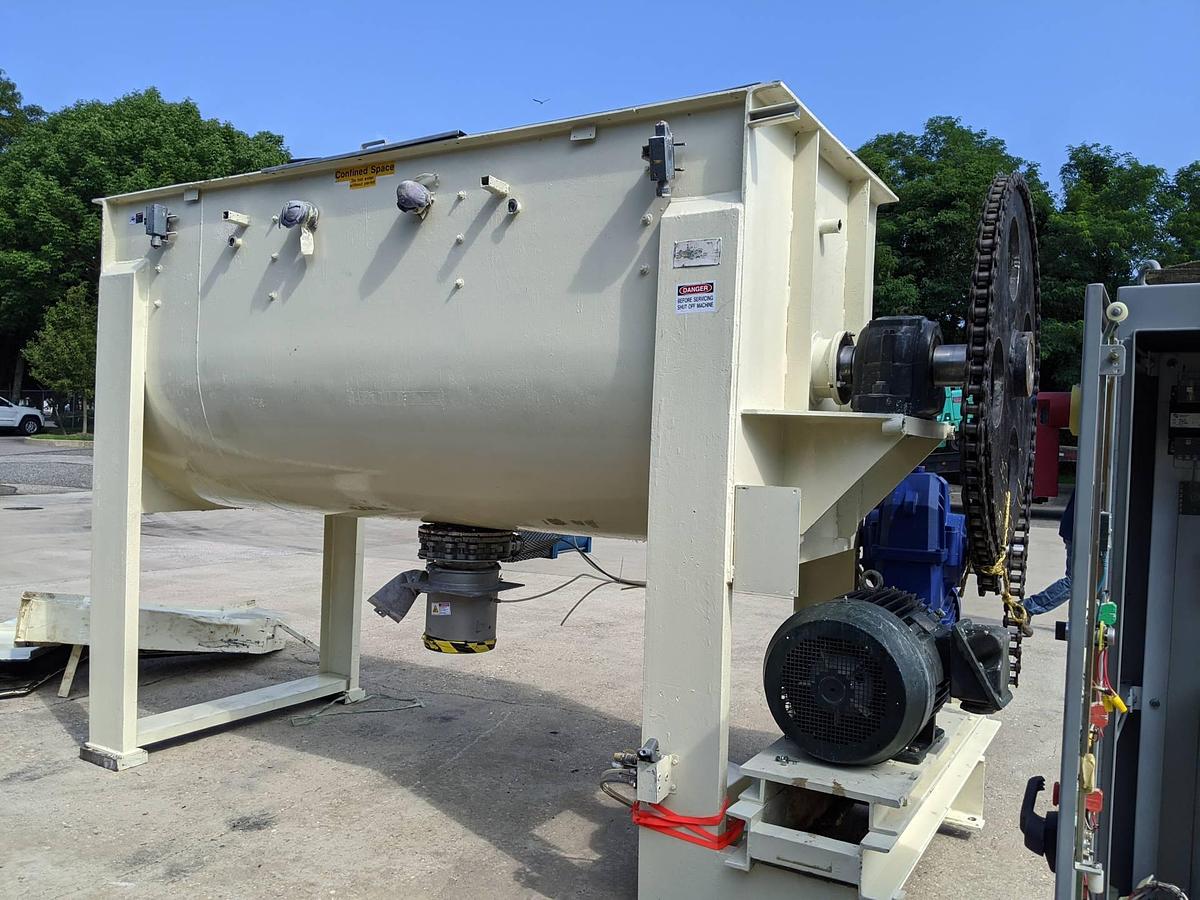
When shopping for used Patterson blenders, buyers will find that capacity directly affects price, footprint, and motor requirements. A 165 cubic foot double ribbon blender with a 60 HP motor, for example, represents a serious production asset suited for high-throughput applications. A 200 cubic foot stainless double ribbon blender steps that up further. Matching the blender's working capacity to your actual batch size is important, since running a machine significantly under or over its designed capacity can affect blend quality and equipment longevity.
What industries commonly use Patterson industrial blenders?
Patterson industrial blenders are used across a broad range of manufacturing sectors. Food and beverage processing is one of the most common applications, where Patterson equipment handles dry ingredient blending, seasoning mixes, powdered beverages, and similar products. Pharmaceutical manufacturers rely on Patterson blenders for uniform mixing of active ingredients and excipients, where blend consistency directly affects product quality and regulatory compliance. Chemical processing, cosmetics, plastics compounding, and agricultural products like fertilizers and animal feeds are also well-established application areas.
The stainless steel construction found on many Patterson models makes them suitable for sanitary environments where cross-contamination and cleanability are priorities. This is why used Patterson blenders are frequently sought by food processors and pharmaceutical operations looking to add capacity without the lead time and cost associated with ordering purpose-built equipment. The versatility of ribbon and tumbling blender designs also means a single machine can sometimes serve multiple product lines with relatively minor changeovers between runs.
Do used Patterson industrial blenders meet food-grade or sanitary standards?
Many Patterson industrial blenders are built with stainless steel contact surfaces and construction details intended for sanitary or food-grade applications. Stainless steel models, particularly those with polished interior finishes, are commonly used in food processing and pharmaceutical environments where cleanability and material compatibility are critical. Features like crevice-free welds, sanitary discharge valves, and smooth interior surfaces are typical on Patterson equipment designed for these industries.
That said, buyers of used equipment should carefully evaluate any specific machine against the standards required for their application, such as FDA guidelines or 3-A Sanitary Standards. A used machine may have wear, modifications, or prior use history that affects its suitability for regulated environments. Requesting a thorough inspection, reviewing available documentation, and consulting with your quality or regulatory team before purchase is the responsible approach. Reputable used equipment dealers will typically accommodate in-person or video inspections so buyers can assess the condition of product-contact surfaces and overall machine integrity before committing.
What should buyers inspect when purchasing a used Patterson industrial blender?
Buying a used industrial blender requires a more hands-on evaluation process than purchasing new equipment. Key areas to inspect include the condition of the mixing ribbons or paddles (looking for wear, bending, or missing sections), the integrity of welds and seams on the blender shell, the condition of shaft seals and bearings, and the state of the drive system including the motor, gearbox, and any belt or chain components. On stainless steel units, checking for pitting, corrosion, or surface damage to product-contact areas is especially important for food or pharmaceutical applications.
Reputable used equipment dealers will typically offer in-person inspections, video walkthroughs, or photo documentation of machines. Some equipment may still be installed at a production facility, where a live inspection can be arranged. Keep in mind that most dealers are not set up to run production tests with actual product, as that requires permitting and operational infrastructure beyond what a resale operation maintains. Buyers should ask specific questions about the machine's service history, any known repairs, and whether the electrical components have been tested. Consulting with the manufacturer about parts availability and support for the specific model and age of the unit is also a smart step before finalizing a purchase.
What materials can Patterson industrial blenders process?
Patterson industrial blenders are designed to handle a wide variety of materials depending on the blender type. Ribbon blenders are particularly effective with dry powders, granules, and free-flowing solids, and can also handle light pastes or materials with small amounts of liquid added during the blend cycle. Double cone tumbling blenders work well with free-flowing dry materials that require gentle handling, such as fragile granules or materials that cannot tolerate the shear forces of a ribbon agitator. Paddle blenders offer more flexibility for cohesive or heavier materials.
Material compatibility also depends on the construction of the specific unit. Stainless steel models are appropriate for food ingredients, pharmaceutical compounds, cosmetic powders, and many chemical products. Carbon steel construction may be found on units designed for less sensitive industrial applications like agricultural products, fertilizers, or certain plastic compounds. Buyers should match the blender's material of construction and agitator design to the specific properties of their product, including bulk density, particle size, moisture sensitivity, and any abrasive or corrosive characteristics that could affect equipment wear over time.
How does a double ribbon blender differ from a double cone tumbling blender?
A double ribbon blender uses a horizontal trough with a central shaft fitted with inner and outer helical ribbons that move material in opposite directions simultaneously. This counter-current flow creates a highly efficient mixing action that achieves uniform blends in relatively short cycle times. Double ribbon blenders are the preferred choice for high-volume dry blending of powders, granules, and similar materials, and they can also incorporate liquids into a dry blend through spray nozzles. The 165 cubic foot and 200 cubic foot Patterson models are examples of production-scale ribbon blenders suited for demanding throughput requirements.
A double cone tumbling blender works on an entirely different principle. The vessel itself rotates, tumbling the material inside through gravity rather than using an agitator. This gentle action is well-suited for fragile materials, blends requiring minimal heat generation, or products where avoiding particle attrition is important. The tradeoff is that tumble blenders generally require longer cycle times and are less effective with cohesive or sticky materials. The 1 cubic foot Patterson tabletop double cone unit illustrates the smaller-scale, pilot or specialty-batch end of this category. Choosing between the two designs comes down to material characteristics, required batch size, blend time targets, and the physical properties the product can tolerate during processing.
What is the typical price range for used Patterson industrial blenders?
Pricing for used Patterson industrial blenders varies considerably based on capacity, blender type, construction material, motor size, and overall condition. Small pilot-scale units like a 1 cubic foot tabletop double cone blender can be found at a fraction of the cost of production-scale equipment. Mid-range units in the 50 to 165 cubic foot range, particularly stainless steel ribbon blenders with significant horsepower, represent a meaningful capital investment but still typically sell well below the cost of comparable purpose-built equipment.
Large-capacity units such as a 200 cubic foot stainless double ribbon blender occupy the higher end of the used market for this category. Buyers should factor in not just the purchase price but also the full landed cost, which includes rigging, crating or packaging, freight, and any installation or recommissioning work required at the destination facility. Getting a clear picture of all these costs upfront helps avoid surprises and allows for an accurate comparison against alternative options. Contacting the selling dealer directly for current pricing and a detailed freight estimate is the most reliable way to establish what a specific unit will actually cost to put into service.
What are the shipping and logistics considerations for buying a used industrial blender?
Industrial blenders are heavy, bulky pieces of equipment that require careful handling from the point of sale through final installation. Smaller tabletop units may ship on a standard pallet with appropriate blocking and bracing, but mid-size and large ribbon blenders typically require custom crating or skidding to prevent damage to the trough, ribbons, shaft, and drive components during transit. Shipping costs vary based on the level of packaging required, the freight carrier selected, and the distance between the seller and the buyer's facility.
Larger machines, particularly those in the 100 to 200 cubic foot range, may require specialized rigging equipment for loading at the seller's location and unloading at the destination. This can involve forklifts, cranes, or flatbed transport depending on the machine's dimensions and weight. Buyers should ask the selling dealer for a detailed breakdown of packaging, rigging, and freight costs before finalizing the purchase so the full landed cost is understood. Some machines may still be installed at a production facility, which adds coordination requirements for disconnection, rigging out, and loading. Factoring in these logistics costs early in the evaluation process prevents the total cost of the acquisition from coming in higher than expected.
What payment terms should buyers expect when purchasing used industrial blending equipment?
Used industrial equipment transactions typically require full payment prior to shipment. This is standard practice across the used machinery industry and reflects the nature of the transaction: once a machine ships, the seller has limited recourse if payment issues arise. Buyers who are unfamiliar with a particular dealer should expect to pay in full before the equipment leaves the seller's facility. Wire transfer is a common payment method for transactions of this size, though specific accepted payment methods vary by dealer.
Some dealers extend payment terms to established customers with a history of prior transactions, but this is the exception rather than the rule for first-time buyers. Buyers financing the purchase through a third-party lender should confirm the timeline for fund disbursement and communicate it clearly with the dealer to avoid delays in shipping. It is also worth clarifying at the outset whether the quoted price is for the machine only or includes any packaging, rigging, or other services, since additional costs billed separately can affect the total amount due before the equipment ships.