Category
Manufacturer
Model
FAQ:
What is a vacuum dissolver and how does it work?
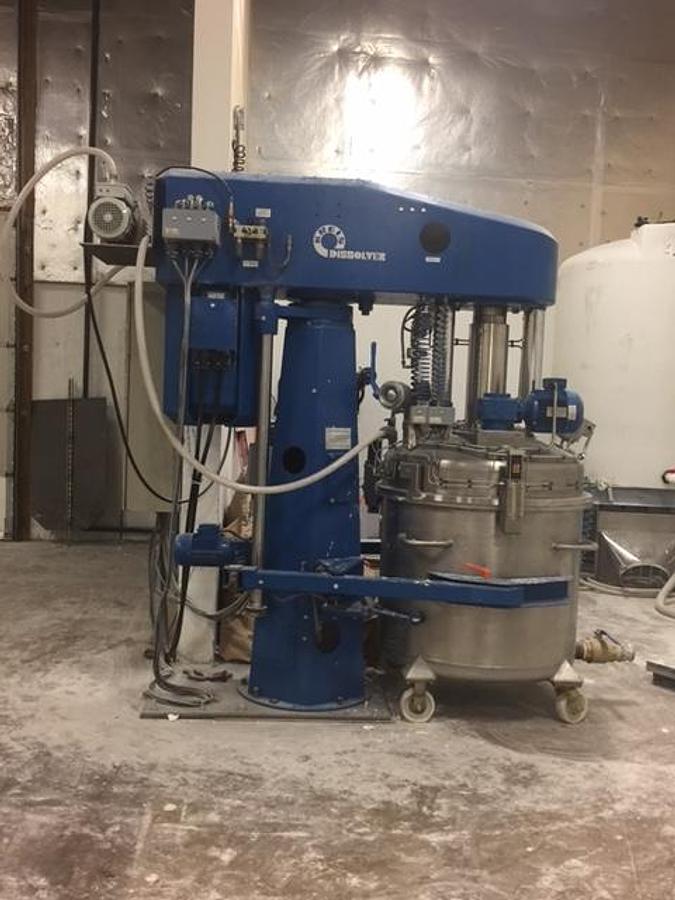
A vacuum dissolver is an industrial mixing machine that combines high-speed dispersion with a sealed, low-pressure environment. During operation, the vessel is evacuated to create a vacuum, which prevents air from being drawn into the product as the high-speed disperser blade agitates the material. The result is a bubble-free, homogeneous mixture with minimal oxidation. This is fundamentally different from open-vessel dissolvers, where the mixing action itself can whip air into the product and cause foaming or inconsistent texture.
The vacuum function serves two purposes. First, it removes any air or moisture already present in the raw materials before mixing begins. Second, it maintains that air-free environment throughout the entire dispersion cycle, which is critical for formulations that are sensitive to oxidation or require precise rheological properties. Vacuum dissolvers are typically equipped with a jacketed vessel for temperature control, a variable-speed disperser shaft, and a vacuum pump system, all integrated into a single production unit.
What is a Niemann Kreis vacuum dissolver used for?
Niemann Kreis vacuum dissolvers are used to produce high-quality dispersions, solutions, and emulsions where air entrapment and oxidation must be strictly controlled. Common applications include manufacturing paints and industrial coatings, pressure-sensitive and structural adhesives, printing inks, sealants, and specialty resins. The vacuum environment is particularly valuable in these applications because even small air bubbles can cause surface defects, pinholes, or reduced bond strength in the finished product.
Beyond coatings and adhesives, these machines are also used in cosmetic and personal care manufacturing (for creams, gels, and pigment dispersions), pharmaceutical processing, and the production of electronic materials such as encapsulants and potting compounds. Any formulation that requires a smooth, consistent texture free of entrapped gas is a candidate for vacuum dissolver processing. The combination of high-shear dispersion and vacuum capability makes Niemann Kreis equipment a practical choice for producers who cannot tolerate variability in product quality.
What industries commonly use Niemann Kreis vacuum dissolvers?
Niemann Kreis vacuum dissolvers are most heavily used in the coatings and paints industry, where precise pigment dispersion and bubble-free finishes are non-negotiable production requirements. Adhesives and sealant manufacturers rely on them for the same reason, as air voids in a cured adhesive layer can dramatically reduce shear and peel strength. Printing ink producers also use vacuum dissolvers to achieve the fine particle size distributions and consistent viscosity profiles that high-speed printing presses demand.
The pharmaceutical and cosmetics industries use vacuum dissolvers for formulations where oxidation would degrade active ingredients or alter product stability. Electronic component manufacturers use them to process encapsulants, underfills, and conductive pastes where a single air bubble can cause a component failure. The common thread across all these industries is a need for repeatable, high-quality dispersion in a controlled atmosphere, which is exactly what a vacuum dissolver is designed to deliver.
What vessel capacities are available for Niemann Kreis vacuum dissolvers?
Niemann Kreis vacuum dissolvers have been manufactured across a wide range of vessel sizes to suit different production scales. Laboratory and pilot-scale units typically start at a few liters, allowing formulators to develop and test products before scaling to full production. Mid-range production models cover capacities from roughly 50 liters up to several hundred liters, and large-scale industrial units can reach several thousand liters depending on the model configuration.
The used market reflects this range. For example, the Niemann Kreis VKDV model is available with 400-liter change cans, which is a common production-scale configuration suited to batch manufacturing in coatings, adhesives, and similar industries. Change cans (also called interchangeable vessels) allow operators to swap vessels between batches without cleaning the entire machine, which improves throughput and reduces downtime. Buyers evaluating a specific used unit should confirm the actual working capacity, since nominal vessel volume and usable fill volume can differ based on the product's viscosity and the required headspace for vacuum operation.
What should buyers know about purchasing a used Niemann Kreis vacuum dissolver?
Buying a used Niemann Kreis vacuum dissolver can offer significant cost savings compared to purchasing equivalent new equipment, but the process requires careful due diligence. Because used machines are sold as-is, the buyer bears responsibility for verifying the machine's condition before committing to a purchase. The most important step is arranging an inspection, either in person at the seller's facility or via a detailed video walkthrough. A thorough inspection should cover the condition of the disperser shaft and blade, the integrity of the vacuum seals, the function of the vacuum pump, the condition of the vessel and jacket, and the state of any electrical controls or variable-speed drives.
Buyers should work with reputable used equipment dealers who specialize in process and mixing equipment, as they are more likely to have accurate technical knowledge of the machine and its history. It is also worth contacting the manufacturer directly to understand what level of parts and technical support is available for the specific model and age of the machine being considered, since older models may have limited parts availability. Shipping and rigging costs for large dissolvers can be substantial, so getting a full landed-cost estimate before finalizing a purchase is essential.
What is the typical price range for a used Niemann Kreis vacuum dissolver?
Pricing for used Niemann Kreis vacuum dissolvers varies considerably based on vessel size, model configuration, age, and overall condition. Smaller or older units in basic condition can be found at relatively modest prices, while larger production-scale models with change cans, jacketed vessels, and modern variable-speed controls command significantly higher prices. The 400-liter VKDV configuration, for example, represents a mid-to-large production scale and would typically fall in the upper portion of the used price range for this equipment category.
Because used equipment prices fluctuate with market availability and demand, buyers should contact dealers directly for current pricing on specific units. It is also worth factoring in the cost of any refurbishment, replacement seals or blades, electrical updates, and shipping when comparing prices across different listings. A machine listed at a lower price but requiring significant reconditioning may not represent better value than a higher-priced unit that is ready to run. Buyers who are unfamiliar with this equipment type are often better served by engaging a process equipment specialist who can help evaluate whether the asking price reflects the machine's actual condition.
How does vacuum dispersion reduce oxidation during mixing?
Oxidation during mixing occurs when oxygen in the surrounding air reacts with sensitive components in the formulation. In a standard open-vessel dissolver, the high-speed rotation of the disperser blade creates a vortex that continuously draws fresh air into the product. For formulations containing oxidation-sensitive resins, pigments, or active ingredients, this constant air exposure can degrade quality, shorten shelf life, or cause color shifts and viscosity changes that make the product unusable.
A vacuum dissolver eliminates this problem by evacuating the vessel before and during mixing. With oxygen removed from the headspace and from within the product itself, the chemical reactions that cause oxidative degradation simply cannot proceed at the same rate. This is especially important in pharmaceutical manufacturing, high-performance adhesives, and specialty coatings where even minor oxidative changes can push a batch out of specification. The sealed vacuum environment also prevents solvent evaporation during mixing, which helps maintain consistent formulation ratios and reduces volatile organic compound emissions in the production environment.
What are change cans and why do they matter on a vacuum dissolver?
Change cans are interchangeable mixing vessels designed to be lifted in and out of the dissolver's main frame without disassembling the machine. Rather than cleaning a fixed vessel between every batch, operators can remove a used can, send it for cleaning or filling with the next product, and immediately load a fresh can into the machine. This system dramatically reduces the time the dissolver sits idle between batches and allows a single machine to handle multiple different products or formulations in the same production shift.
On a vacuum dissolver, change cans must be engineered to form an airtight seal with the machine's lid and vacuum system, which adds mechanical complexity compared to the change cans used on standard open-vessel dissolvers. The sealing surfaces, clamps, and gaskets on both the can and the machine lid are therefore important inspection points when evaluating a used unit. Worn or damaged sealing components will prevent the machine from achieving the vacuum levels needed for proper operation and will need to be replaced before the machine can be used in production. The 400-liter change can configuration on the Niemann Kreis VKDV is a practical setup for mid-to-large batch production environments.
What should buyers expect regarding inspections of used vacuum dissolvers?
Reputable used equipment dealers typically offer buyers the option to inspect machines in person, through a live video call, or via detailed video recordings of the equipment. The goal of any inspection is to get an accurate picture of the machine's current condition, including the mechanical components, electrical systems, and any wear items that may need attention before the machine goes back into production. For a vacuum dissolver specifically, the inspection should include a close look at the disperser shaft, blade, and bearings, the vacuum pump and associated plumbing, the vessel and jacket integrity, lid seals and gaskets, and the condition of the variable-speed drive and control panel.
It is worth noting that most used equipment dealers do not operate production facilities and therefore cannot run actual product through the machine as part of an inspection. Testing is generally limited to running the machine unloaded to verify that the motor, drive, and vacuum system function as expected. If a machine is still installed at a production facility where it has been in active use, it may be possible to arrange an inspection there, which offers the additional benefit of seeing the machine operate under real production conditions. Buyers should clarify the inspection options available for any specific unit before making a purchasing decision.
What are typical shipping and logistics considerations for a used vacuum dissolver?
Vacuum dissolvers are heavy, precision machines, and shipping them requires more planning than standard freight. The machine and its associated change cans must be properly secured, palletized, or crated to prevent damage to sealing surfaces, the disperser assembly, and any attached instrumentation during transit. The level of packaging required depends on the size of the machine, the shipping distance, and the mode of transport. Larger units may need to be loaded with a forklift or crane and transported on flatbed trailers, which adds rigging costs on both the loading and unloading ends.
Buyers should ask the dealer for a detailed breakdown of all costs involved in getting the machine from its current location to the destination facility. This includes domestic freight or international shipping charges, export crating if applicable, customs duties for cross-border purchases, and any rigging or crane fees at the delivery site. These costs can be substantial for large industrial equipment and should be factored into the total acquisition cost before comparing prices across different listings. Most dealers require full payment before a machine is released for shipment.