Category
Manufacturer
Model
Mrm
Mrm is known for its expertise in manufacturing equipment for the food processing industry, particularly in the area of meat processing. Their machinery is designed to improve efficiency and product quality.
FAQ:
What is an MRM filling machine and what industries use them?
MRM is a manufacturer with a strong track record in filling and packaging equipment, particularly for liquid, fragrance, and food-grade applications. Their machines are built around rotary filling platforms that deliver consistent fill volumes across high-speed production runs. Common machine types in the MRM lineup include rotary pressure gravity fillers, positive displacement fillers, and time-and-pressure systems, each suited to different product viscosities and container formats. The Versa-Fil series, for example, is a well-regarded positive displacement filler that pairs with a Waukesha pump for handling thicker or more viscous products.
The industries that rely on MRM filling equipment span food and beverage processing, fragrance and cosmetics, household chemicals, and pharmaceutical manufacturing. The rotary design of most MRM machines makes them a practical choice for mid-to-high volume production environments where fill accuracy and throughput consistency matter. Used MRM machines are frequently sought after by contract packagers and manufacturers looking to expand capacity without the lead times associated with ordering new equipment from a manufacturer.
What types of products can MRM filling machines handle?
MRM filling machines are designed to handle a fairly wide range of product types, and the specific model determines what viscosity range is practical. Gravity-fed models like the 8-spout rotary pressure gravity filler work well with free-flowing liquids such as water-based beverages, cleaning solutions, and thin oils. Time-and-pressure models handle a broader viscosity range, making them suitable for products like sauces, lotions, and light gels. Positive displacement models, including the Versa-Fil series with a Waukesha pump, are specifically built for thicker, more viscous products or those that require precise volumetric fills regardless of product consistency.
Fragrance and cosmetic fills are another area where MRM machines have a proven history, as evidenced by dedicated fragrance filler models in the product line. These machines are built to handle the precision required for small-volume fragrance fills where even minor inconsistencies affect product quality. Buyers sourcing used MRM equipment should identify their product's viscosity, fill volume requirements, and any sanitation standards (such as food-grade or pharmaceutical compliance) before selecting a specific model, since the filler type directly impacts whether the machine is appropriate for their application.
What fill volume ranges do MRM filling machines typically support?
Fill volume capability varies by machine model and the type of filling system used. Rotary positive displacement fillers like the Versa-Fil series are known for their accuracy across a defined volume range, and the number of fill heads (six, eight, twelve, or sixteen spouts depending on the model) affects both the range and the output rate. Machines with more spouts generally handle smaller individual fill volumes at higher throughput, while fewer-spout configurations may accommodate larger container fills. The 16-spout rotary liquid filler, for instance, is built for high-speed, consistent fills across many containers simultaneously.
When evaluating a used MRM machine, buyers should request the machine's documented fill range from the dealer and confirm whether the changeover parts for their target container size are included with the sale. Many rotary fillers require format-specific tooling (such as nozzles, star wheels, or guides) that may or may not accompany a used machine. Clarifying this upfront avoids unexpected costs and delays when integrating the equipment into an existing production line.
Are MRM filling machines suitable for small businesses or primarily large-scale production?
MRM filling machines are generally engineered for mid-to-high volume production environments. Their rotary multi-head designs are built around throughput efficiency, meaning the machines perform best when running continuously at scale rather than in short, intermittent batches. A 12-spout or 16-spout rotary filler, for example, is designed to keep pace with automated conveyor lines and high-cycle packaging operations. For a small business producing a few hundred units per day, the capital cost and footprint of a rotary MRM filler may exceed what the operation actually needs.
That said, the used equipment market does make MRM machines more financially accessible to smaller operations that are scaling up. A business transitioning from manual or semi-automatic filling to a fully automated rotary system can acquire a used MRM machine at a fraction of the cost of comparable equipment purchased directly from a manufacturer. The key consideration is whether the business has the production volume to justify the machine's size and the technical staff to operate and maintain it. Buyers with lower volume needs might also look at whether a smaller-spout MRM model (such as a six-head configuration) better matches their current throughput requirements.
What should buyers know about purchasing a used MRM filling machine?
Buying used filling equipment requires more due diligence than purchasing from a manufacturer, since the machines have production history and the condition can vary significantly based on how they were maintained. The most important step is arranging a thorough inspection before committing to a purchase. Reputable used equipment dealers will offer in-person inspections, video walkthroughs, or video captures of the machine so buyers can assess its current condition. In some cases, the machine may still be installed at a production facility where an inspection can be arranged directly at the plant, giving buyers a chance to see the equipment in its operational context.
Buyers should also consult with MRM or its authorized service network to understand what parts and technical support are available for the specific model and age of the machine they are considering. Older models may have limited parts availability, which affects long-term serviceability. Used filling machines are typically sold as-is, so the responsibility for verifying condition falls on the buyer. Selecting a dealer with a long history of selling filling and packaging machinery, and one that specializes in this category of equipment, significantly reduces the risk of acquiring a machine that does not meet production expectations.
How does a rotary filling machine differ from a linear filling machine?
Rotary filling machines, which make up the core of the MRM product line, operate by moving containers along a circular path where each fill head engages the container at a specific point in the rotation. This continuous circular motion allows the machine to fill many containers simultaneously without stopping the line, which is why rotary fillers are associated with high-speed, high-volume production. The MRM 8-spout, 12-spout, and 16-spout configurations reflect this design, with each additional spout adding to the machine's throughput capacity.
Linear fillers, by contrast, move containers in a straight line and typically fill them in batches or one at a time, making them better suited to lower-volume applications or operations that require frequent product changeovers. Rotary machines require more floor space and generally have higher changeover complexity, but they offer a lower cost-per-unit at high volumes. For buyers evaluating used MRM rotary fillers, the throughput advantage is a primary reason to choose this style of machine, provided the production volume justifies the investment and the physical footprint fits within the facility.
What does explosion-proof (XP) mean on a filling machine, and when is it required?
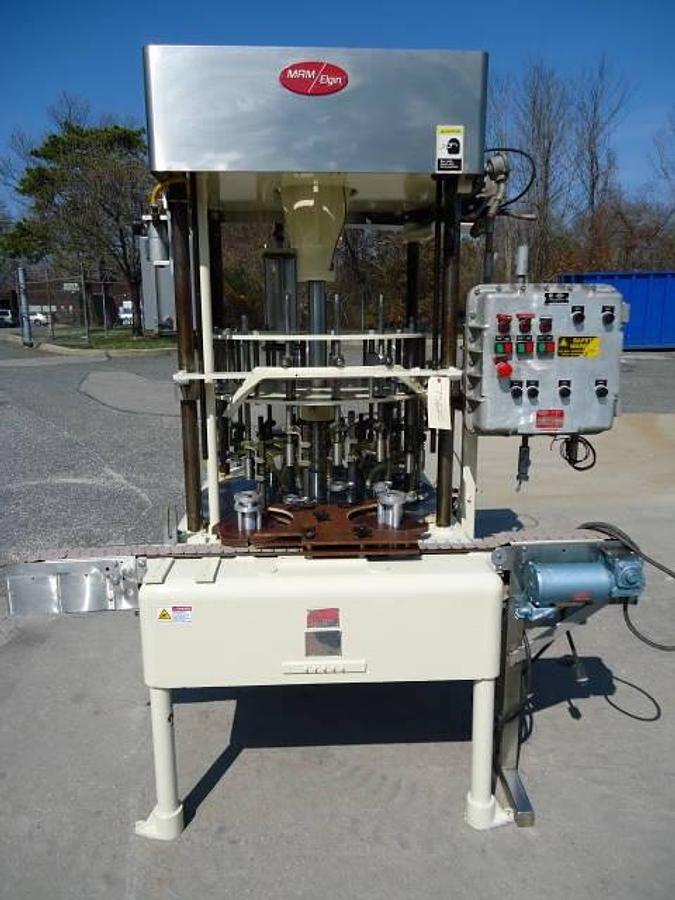
Explosion-proof (XP) designation on a filling machine means the electrical components and enclosures are specifically designed and certified to prevent ignition in environments where flammable vapors, gases, or dust may be present. The MRM 16-spout rotary liquid filler listed as explosion-proof is built for applications where the product being filled, or the ambient environment, presents a combustion risk. Fragrances, alcohol-based products, flammable solvents, and certain chemical formulations fall into this category. In the United States, explosion-proof equipment must meet standards set by organizations such as the National Electrical Code (NEC) and is often required by OSHA and local fire codes in facilities handling Class I or Class II hazardous materials.
For buyers filling non-flammable products like water-based beverages or food sauces, an XP machine is not necessary and adds cost without benefit. However, for fragrance manufacturers, distilleries, and chemical processors, the XP rating is a non-negotiable safety and compliance requirement. When purchasing a used explosion-proof filler, buyers should verify that the XP certifications and ratings are still intact and that no modifications have been made to the electrical components that would compromise the original certification. Consulting with a qualified electrical engineer or the machine manufacturer before putting an older XP machine back into service in a hazardous location is a sound precaution.
What are the typical costs involved in buying a used MRM filling machine?
The purchase price of a used MRM filling machine varies based on the model, spout count, age, condition, and included accessories. A six-head rotary filler will generally cost less than a 12 or 16-spout configuration, and machines that include conveyors, pumps, or additional format parts command higher prices than bare machines sold without ancillary components. Positive displacement fillers with Waukesha pumps, like the Versa-Fil series, tend to carry a premium due to the value of the pump itself. Buyers should research comparable machines on the market to develop a realistic price expectation before negotiating.
Beyond the purchase price, buyers should account for the full landed cost of the equipment. Shipping charges depend on the machine's size and weight, the level of crating or palletization required to protect it in transit, and whether specialized rigging is needed for loading and unloading at either end. Larger rotary fillers may require a forklift, crane, or professional rigger, which adds to the total cost. Additionally, buyers should budget for any refurbishment, parts replacement, or installation work needed before the machine enters production. Asking the dealer for a detailed breakdown of packaging, rigging, and freight costs upfront prevents surprises when calculating the true cost of acquisition.
What inspection options are available when buying a used filling machine?
Used equipment dealers typically offer several inspection options to help buyers evaluate a machine before purchase. In-person inspections are the most thorough, allowing a buyer or their technician to physically examine the machine, check for wear on contact parts, inspect welds and seals, review the condition of motors and drives, and assess overall cleanliness. Some machines may still be installed at the facility where they were last used, in which case the dealer can often arrange an inspection at that location. This is particularly valuable because the buyer may be able to see the machine in its installed state, even if it is no longer running production.
For buyers who cannot travel, video inspections and recorded walkthroughs are a practical alternative. A reputable dealer will capture detailed footage of the machine, including close-ups of wear points, serial number plates, and any visible damage or repair history. It is worth noting that most used equipment dealers do not have the permitting or infrastructure to run actual production through a machine, so functional testing with live product is generally not available. Buyers should use the inspection to assess mechanical condition, verify that critical components are present and intact, and identify any parts that may need replacement before the machine is put back into service.
How should buyers evaluate the compatibility of a used MRM filling machine with their existing production line?
Compatibility evaluation should cover several dimensions before a purchase decision is made. First, the machine's container handling specifications, including bottle diameter range, height range, and neck finish, need to match the containers the buyer intends to run. Rotary fillers use star wheels, guides, and infeed screws that are sized for specific container formats, and these parts may or may not be included with a used machine. Buyers should confirm exactly what format tooling comes with the machine and whether additional changeover parts are available for their specific containers.
Beyond container compatibility, buyers should assess the machine's speed and output against their production targets, verify that the fill heads and pump type are appropriate for their product's viscosity, and check that the machine's electrical specifications (voltage, phase, and frequency) match their facility's power supply. Integration with upstream and downstream equipment, such as cappers, labelers, and conveyors, also needs to be planned. Consulting with a packaging line integrator or a technician experienced with MRM equipment is a practical step for buyers who are less familiar with the technical specifications, particularly when purchasing a machine that will anchor a larger automated line.