Category
Manufacturer
Model
Legion
Legion focuses on providing packaging solutions for the food and beverage industries, particularly in flexible packaging. Their machines are designed for speed and efficiency, accommodating various product types. Legion’s commitment to innovation helps manufacturers stay competitive in the market.
FAQ:
What sizes do Legion jacketed kettles typically come in?
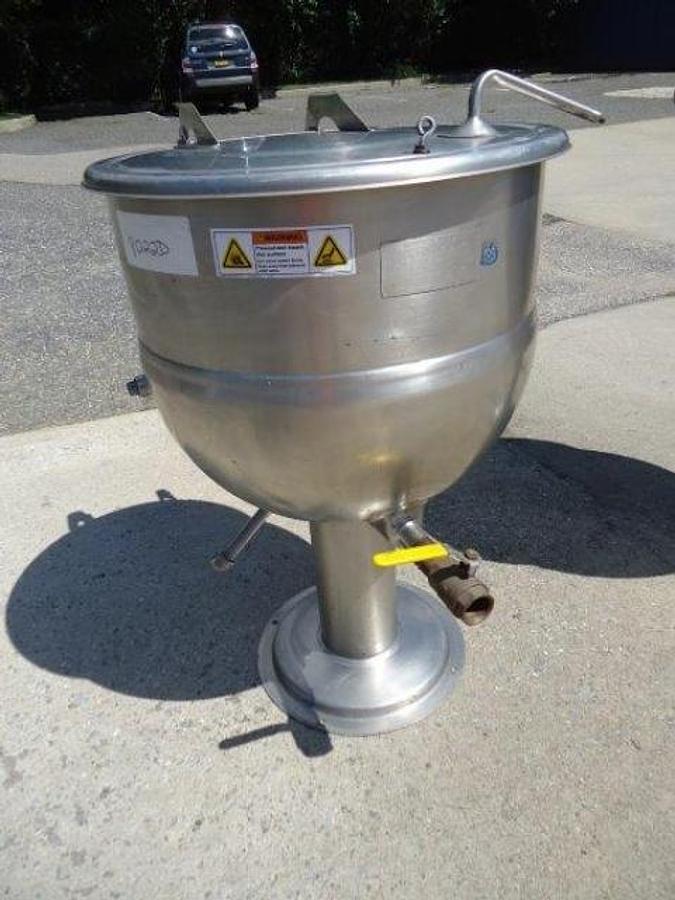
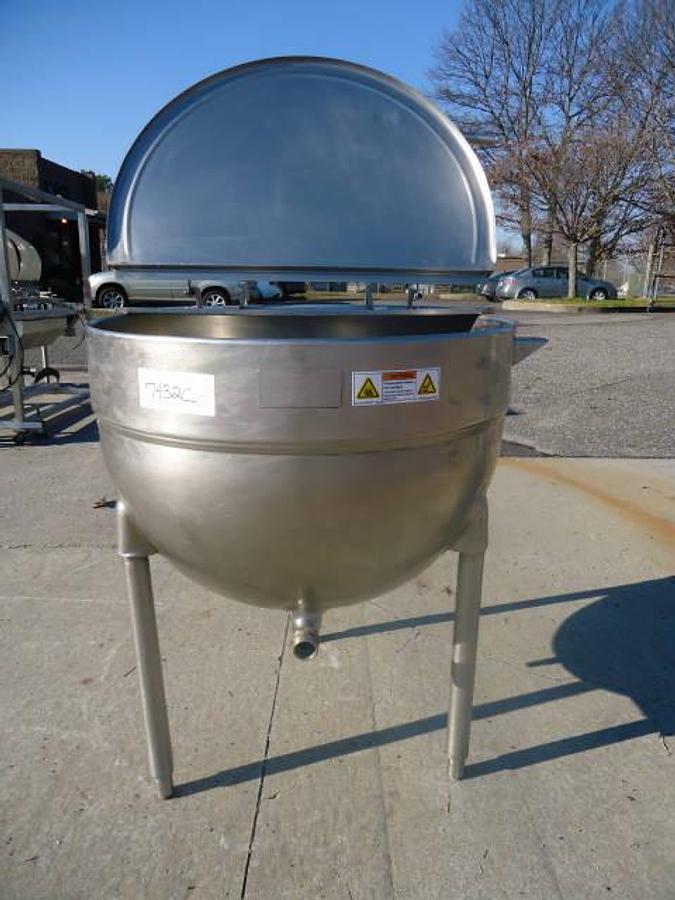
Legion jacketed kettles are produced across a wide range of capacities, making them practical for everything from small-batch food production to large-scale commercial and industrial processing. Common sizes run from compact 20-quart electric units up through 20, 30, 40, 60, and 80-gallon models, with industrial configurations reaching 500 gallons or more depending on the application. Used Legion kettles available on the market tend to reflect this same range, so buyers can often find a capacity that fits their specific production volume without purchasing a unit that is over- or under-sized.
When evaluating size, it is worth considering not just current batch volumes but also headspace requirements. Jacketed kettles are generally filled to around 80% of rated capacity to allow for proper mixing and to prevent boilover during heating cycles. A 60-gallon kettle, for example, is realistically suited to batches in the 45 to 50-gallon range. Listings for used Legion kettles will typically specify the nominal gallon capacity, and buyers should confirm actual working volume with the seller before purchasing.
What is a jacketed kettle and how does it work?
A jacketed kettle is a double-walled cooking or processing vessel where a heating medium, most commonly steam or hot water, circulates through the space between the inner and outer walls. This indirect heat transfer method distributes heat evenly across the entire cooking surface rather than concentrating it at a single point the way direct-flame or electric-element cooking does. The result is more consistent temperature control, reduced risk of scorching, and better product quality for heat-sensitive foods, sauces, soups, confections, and similar products.
Steam-jacketed models are rated by jacket pressure, which directly affects the maximum temperature achievable at the cooking surface. Legion kettles are commonly rated at 30, 35, or 40 PSI jacket pressure, which corresponds to steam temperatures in the range of 274 to 287 degrees Fahrenheit. This makes them suitable for pasteurization, cooking, and reduction processes that require sustained, precise heat. Direct steam kettles, by contrast, inject steam into the product itself, which adds moisture and is generally limited to applications where that is acceptable, such as blanching vegetables. Jacketed designs avoid product dilution entirely.
What materials are Legion jacketed kettles constructed from?
Legion jacketed kettles are built primarily from stainless steel, with 304 and 316 stainless steel being the most common grades found across their product line. Type 304 stainless is the standard food-grade material used in the majority of commercial cooking equipment, offering good corrosion resistance and ease of sanitation. Type 316 stainless steel contains added molybdenum, which provides superior resistance to chlorides and acidic ingredients, making it the preferred choice for processing tomato-based products, citrus, brines, and certain pharmaceutical or chemical applications.
Used Legion kettles sold on the secondary market will typically have the stainless grade specified in the listing. A 60-gallon Legion kettle constructed from 316 stainless, for instance, commands a premium over a comparable 304 unit because of its broader chemical compatibility. Buyers processing highly acidic or chloride-heavy products should prioritize 316 SS models. In all cases, stainless steel construction supports compliance with FDA food contact surface requirements and makes sanitation straightforward, which is a primary reason jacketed kettles in food processing facilities are almost universally built from this material.
Do Legion jacketed kettles come with agitators or mixers?
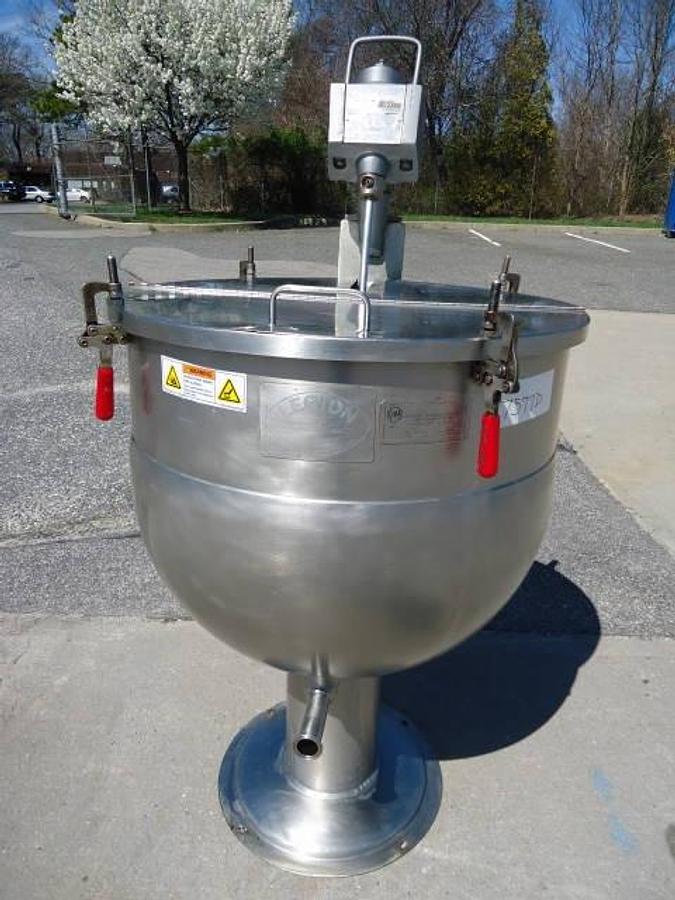
Some Legion jacketed kettle models are equipped with agitators or mixers, while others are offered without any mixing mechanism. The presence of an agitator depends on the specific model and configuration. For example, certain 60-gallon Legion kettles have been paired with Lightnin agitators, which are a well-regarded brand of industrial mixing equipment. Agitators are particularly important for viscous products or any recipe where settled solids or uneven heat distribution could lead to scorching on the kettle walls.
When shopping for used Legion kettles, buyers should confirm whether an agitator is included and, if so, what type it is. Anchor, paddle, and high-shear agitator styles each suit different product viscosities and mixing requirements. A kettle used for thin soups or sauces may function well without mechanical agitation, relying on convection currents from the jacket heat. Thicker products like jams, confections, or starched gravies almost always benefit from continuous agitation to maintain product consistency and prevent hotspots. Reviewing the listed specifications carefully and asking the seller about the agitator's condition and motor rating is a reasonable step before committing to a purchase.
What is the typical lifespan of a steam-jacketed kettle?
A well-maintained steam-jacketed kettle can remain in productive service for 20 to 40 years or more. The longevity of these vessels is one reason the used market for them is active and well-supplied. Stainless steel construction is inherently resistant to corrosion, and the jacketed design has no combustion components or heating elements inside the product zone that are subject to burnout or fouling. The main wear points over time tend to be the steam trap, pressure relief valves, gaskets, and any mechanical agitator components, all of which are generally serviceable or replaceable.
The actual lifespan in practice depends heavily on how the kettle was operated and maintained. Units that were regularly descaled, had their jacket pressure tested on schedule, and had seals and valves serviced tend to hold up far better than those that were neglected. Buyers considering a used Legion kettle should ask about the maintenance history where available, inspect the interior cooking surface for pitting or heavy discoloration, and check the condition of the jacket fittings and any agitator shaft seals. An in-person or video inspection arranged through the seller is the most reliable way to assess the actual condition of a used unit before purchase.
What should buyers inspect before purchasing a used Legion jacketed kettle?
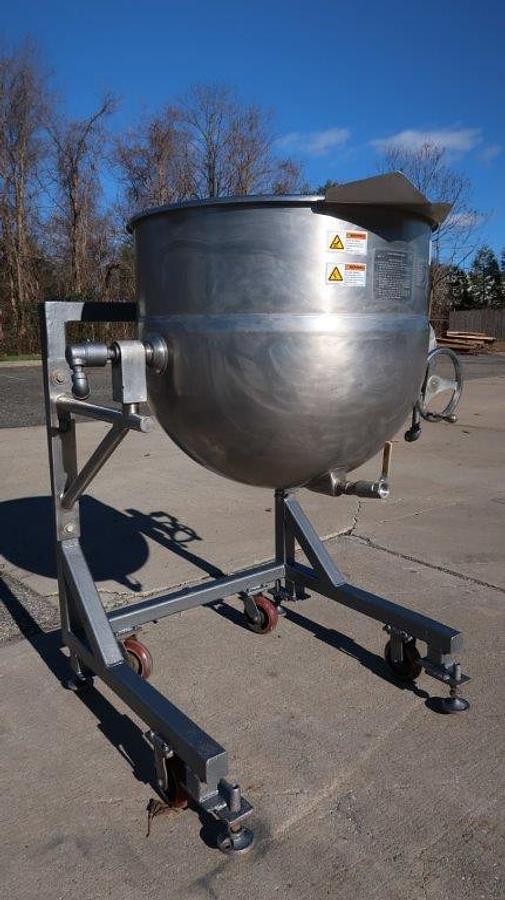
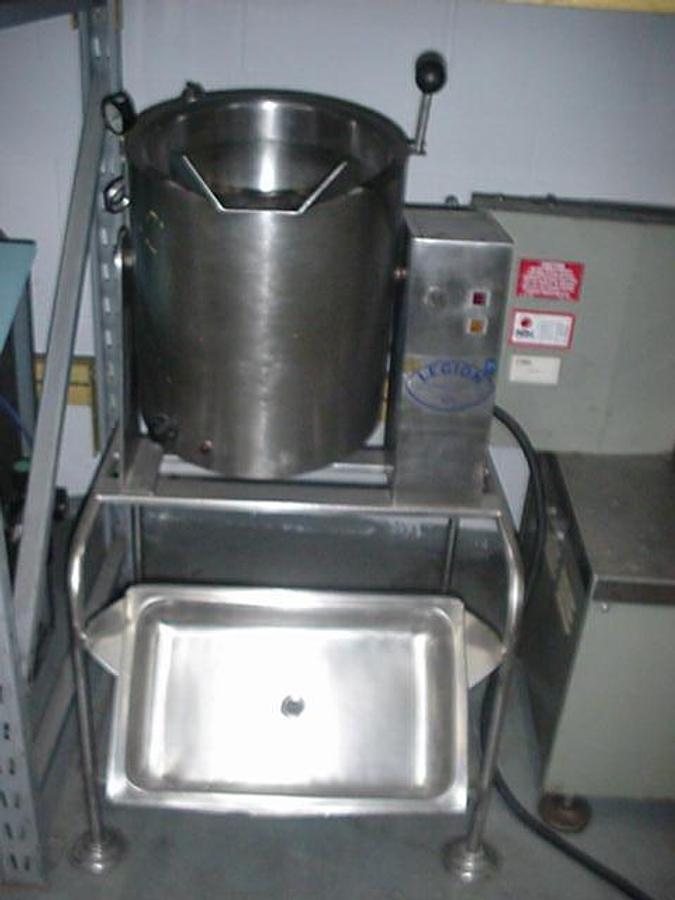
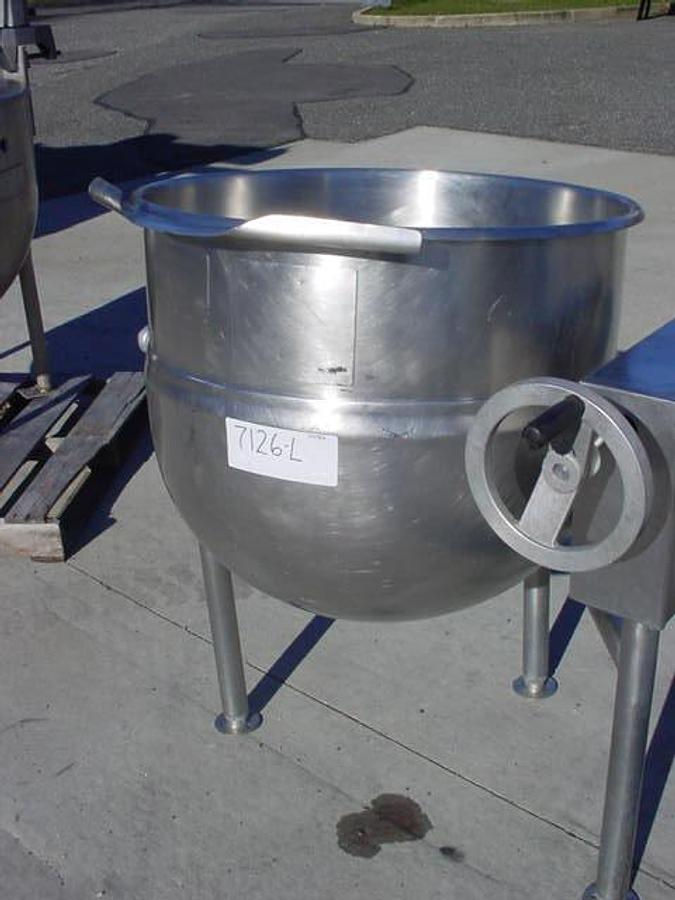
Buying a used jacketed kettle requires a more deliberate inspection process than purchasing new equipment, since the buyer assumes responsibility for the machine's condition at the point of sale. Used equipment is typically sold as-is, so the inspection is the buyer's primary tool for assessing value and risk. Key areas to examine include the interior cooking surface for pitting, weld repairs, or heavy scale buildup; the jacket connections and steam fittings for signs of corrosion or prior leaks; and the agitator shaft and seals if the unit includes a mixer. Any tilt mechanism on portable or tilt-style kettles should be checked for smooth, controlled operation.
Reputable used equipment dealers will generally accommodate in-person visits to their facility, or arrange video inspections that walk through the machine in detail. In some cases, a kettle may still be installed at the production facility where it was used, allowing the buyer to see it in its operating environment. Keep in mind that most equipment dealers are not set up to run production tests, as that requires food-grade permitting beyond what a resale operation typically holds. Buyers should also contact Legion directly or consult a qualified service technician to determine parts availability and manufacturer support for the specific model and age of the unit they are considering.
Can jacketed kettles be used for both heating and cooling?
Yes, jacketed kettles can serve dual heating and cooling functions when the jacket is designed and plumbed to accommodate both steam and chilled water. In a heating-only configuration, the jacket is connected to a steam supply line. In a dual-service setup, the same jacket can receive chilled water or glycol solution from a refrigeration system, allowing the operator to rapidly cool a product after cooking without transferring it to a separate vessel. This is particularly valuable in dairy, confectionery, and pharmaceutical applications where precise temperature control across the full cooking and cooling cycle is critical to product quality.
Not every Legion jacketed kettle is configured for cooling service out of the box. Buyers interested in using a unit for cooling as well as heating should confirm that the jacket is rated for the pressures involved in the cooling system and that the inlet and outlet connections are appropriately sized and positioned. Used kettles may have been plumbed only for steam in their previous application, so some modification or additional plumbing work may be needed to integrate a cooling supply. Discussing the intended use case with the seller and, if necessary, with a process equipment contractor before purchase will help avoid surprises during installation.
What industries commonly use Legion jacketed kettles?
Legion jacketed kettles have a long history of use across food processing, institutional food service, brewing, dairy, pharmaceutical manufacturing, and chemical processing. In food production, they are used for cooking sauces, soups, gravies, jams, confections, and a wide range of other products that benefit from controlled, even heat. Institutional kitchens in hospitals, schools, and correctional facilities have relied on them for high-volume cooking of everything from oatmeal to stews. Craft brewers and beverage producers use jacketed kettles for mashing, wort boiling, and syrup production.
The pharmaceutical and nutraceutical industries use jacketed kettles for mixing, dissolving, and heating active ingredients where temperature precision and sanitary construction are non-negotiable. The same stainless steel construction and indirect heating method that makes these kettles ideal for food also suits laboratory-scale chemical processing where contamination control and repeatable temperature profiles matter. This cross-industry versatility is part of why used Legion kettles hold their value reasonably well on the secondary market and why buyers from very different backgrounds are often looking for the same models.
What are typical shipping and logistics considerations for buying a used jacketed kettle?
Jacketed kettles are heavy, often awkward pieces of equipment that require more careful handling than standard pallet freight. Smaller units in the 20 to 40-gallon range may ship on a standard pallet with proper blocking and strapping, but larger kettles, particularly tilt models or those with agitator drives, often need custom crating to protect fittings, agitator shafts, and control components during transit. The cost of packaging, rigging, and freight will vary depending on the kettle's size and weight, the origin and destination, and whether liftgate service or dock-to-dock delivery is required.
Buyers should ask the seller for a detailed breakdown of all costs involved in getting the equipment to their facility, including loading, crating or palletization, freight, and any unloading requirements on the receiving end. Larger kettles may require a forklift or crane for unloading, which is an added cost the buyer needs to plan for. Getting a full landed cost before finalizing a purchase is important, since freight on a large jacketed kettle can add a meaningful amount to the total investment. Most used equipment dealers require full payment prior to shipment, so confirming all costs upfront avoids any surprises after the transaction is complete.
Where are Legion jacketed kettles manufactured?
Legion Industries has historically manufactured its jacketed kettles in the United States. The company built its reputation over decades supplying the domestic food service and food processing industries, and American manufacturing was a consistent part of its identity during its most active production years. This domestic origin is relevant to buyers of used equipment because it generally means parts, technical documentation, and service support are more accessible than they would be for imported equipment with limited North American distribution networks.
For buyers purchasing a used Legion kettle, the manufacturing origin matters primarily in the context of parts sourcing and manufacturer support. Contacting Legion directly before purchasing a specific used unit is a practical step, as the company can advise on the level of support available for a given model, what replacement parts are still stocked or available, and whether the age of the unit affects serviceability. Older models may have limited parts availability, while more recent production runs are likely better supported. This kind of due diligence is especially important with used equipment, where the buyer carries the responsibility of verifying the machine's condition and supportability before completing the purchase.