Category
Manufacturer
Model
Kryospray
Kryospray focuses on providing advanced spray drying technology for the food and pharmaceutical sectors. Their equipment is designed to enhance the preservation of sensitive materials, making it ideal for producing powdered products. Kryospray’s systems are recognized for their efficiency and precision in creating high-quality end products.
FAQ:
What is a Kryospray freeze tunnel and how does it work?
A Kryospray freeze tunnel is a cryogenic freezing system that uses liquid nitrogen (LIN) or liquid carbon dioxide (LCO2) sprayed directly onto food products moving along a conveyor belt. The cryogenic refrigerant contacts the product surface and causes near-instantaneous freezing through direct heat absorption as the liquid converts to gas. This process is commonly referred to as Individual Quick Freezing, or IQF, because each piece of product freezes individually rather than in a mass or block.
The speed of freezing is the defining characteristic of this technology. Because the product surface temperature drops so rapidly, ice crystal formation within the food's cellular structure is kept extremely small. Larger ice crystals, which form during slower mechanical freezing, rupture cell walls and cause texture degradation, moisture loss, and color changes upon thawing. Kryospray tunnels are designed to preserve the integrity of sensitive products by minimizing that cellular damage, which is why they are widely used in applications where appearance and texture are critical to the end product's value.
What types of food products are best suited for processing in a Kryospray freeze tunnel?
Kryospray freeze tunnels are used across a wide range of food categories, but they are particularly well-suited for products where texture, moisture retention, and appearance directly affect consumer perception and market value. Seafood, poultry portions, and red meat cuts are among the most common applications because these proteins are highly sensitive to the cell damage caused by slow freezing. Bakery items, including partially baked rolls and dough products, also benefit from cryogenic freezing since rapid surface crust formation helps maintain shape and structure.
Fruits, vegetables, and ready-prepared meals are other strong candidates. Soft fruits like strawberries and raspberries, for example, are notoriously difficult to freeze well using mechanical systems because their high water content makes them prone to collapse during thawing. Cryogenic tunnels address this by locking in structure before significant ice crystal growth can occur. The flexibility of the conveyor-based system also allows processors to run multiple SKUs through the same tunnel across a single shift, making it practical for operations with varied product lines.
How do Kryospray freeze tunnels compare to mechanical IQF freezers?
The core difference between cryogenic tunnels like those made by Kryospray and mechanical IQF freezers comes down to freezing speed, startup time, capital cost, and ongoing operating cost. Mechanical freezers use refrigerant-based compressor systems to generate cold air that circulates around the product. They are slower to reach target temperatures, typically requiring several hours of pre-cooling before production can begin, and they involve higher upfront capital investment and more complex maintenance requirements. However, their operating costs per kilogram of product are generally lower once the system is running continuously.
Cryogenic tunnels reach operating temperatures within minutes, which makes them highly practical for short production runs, flexible scheduling, and facilities that do not freeze product continuously throughout the day. The tradeoff is that liquid nitrogen and liquid CO2 are consumable inputs with ongoing purchase costs tied to market pricing. For operations running high volumes continuously, mechanical systems may offer a better cost-per-kilogram over time. For operations prioritizing product quality, rapid startup, or lower initial capital outlay, cryogenic tunnels are often the preferred choice. Many food processors actually run both types of equipment and allocate product accordingly.
Does a Kryospray freeze tunnel use liquid nitrogen or liquid CO2?
Kryospray freeze tunnels are designed to operate with cryogenic refrigerants, and both liquid nitrogen (LIN) and liquid carbon dioxide (LCO2) are used in this category of equipment, depending on the specific model and application. Liquid nitrogen operates at approximately -196 degrees Celsius, making it the colder of the two options and the preferred choice for products requiring the most rapid freezing or the lowest final temperatures. Liquid CO2 operates at around -78 degrees Celsius and is sometimes preferred for certain applications where extremely low temperatures are not required or where CO2 supply infrastructure is already in place.
The choice between the two refrigerants affects not only freezing performance but also consumption rates, supply logistics, and operating costs. Liquid nitrogen is more widely available in most industrial markets and is the more commonly specified refrigerant for cryogenic food freezing tunnels. Buyers evaluating used Kryospray equipment should confirm which refrigerant a specific machine was designed and configured for, as this will determine compatibility with their existing gas supply setup and affect the total cost of operation.
What are the typical throughput capacities available for Kryospray freeze tunnels?
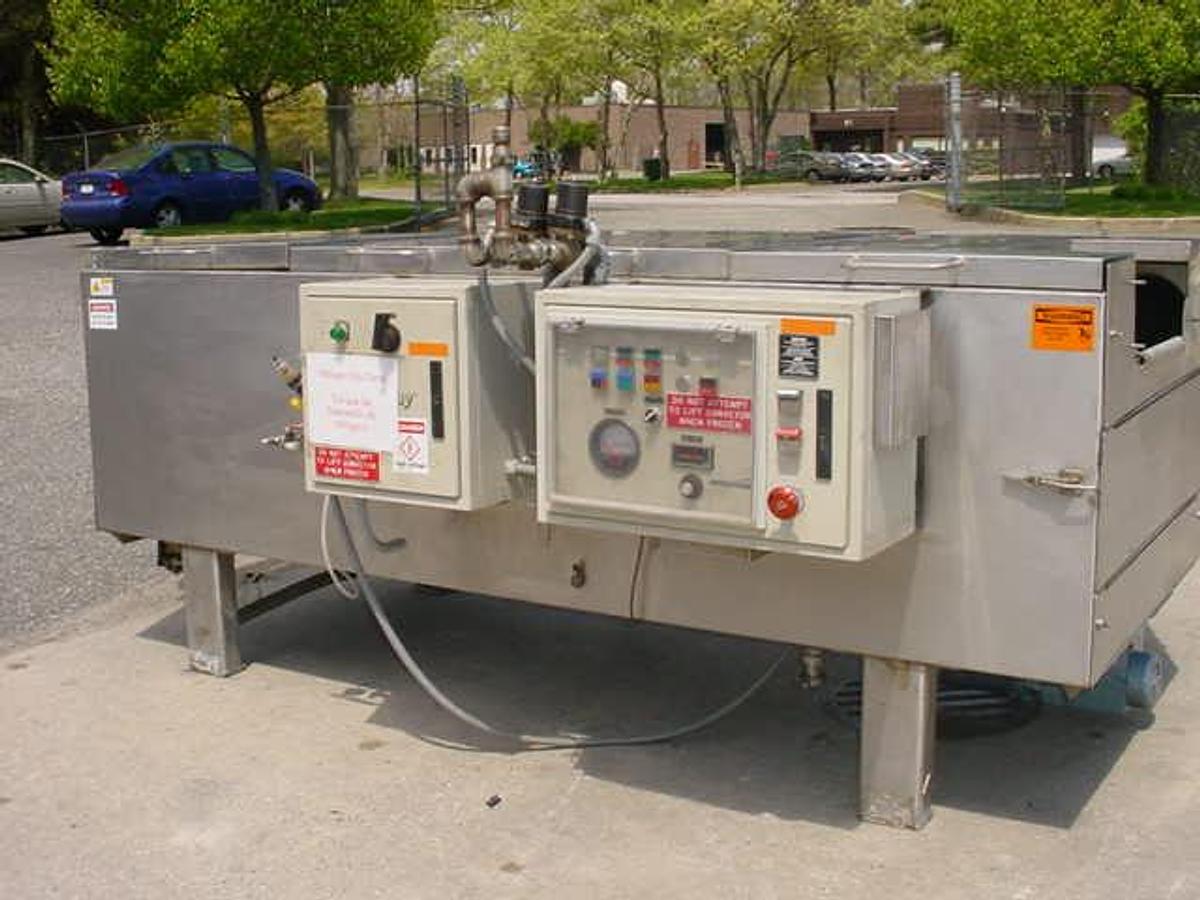
Throughput capacity in cryogenic freeze tunnels is determined by several factors working together: conveyor belt width, tunnel length, belt speed, product loading density, and the target final product temperature. Kryospray produced tunnels across a range of sizes to serve different production scales. The Kryospray Model 2150, for example, is a 13-foot tunnel, which places it in a mid-range footprint suitable for smaller batch operations or facilities with limited floor space. Larger tunnel configurations extend to much greater lengths to accommodate higher-volume continuous production.
Belt speed is the primary variable operators adjust to control dwell time inside the tunnel, and therefore the degree of freezing achieved. Slower belt speeds increase dwell time for products that require deeper freezing, while faster speeds handle lighter freezing tasks or products with higher surface-area-to-mass ratios. Buyers assessing a specific used Kryospray tunnel should evaluate the combination of tunnel length and belt width together, as these two dimensions set the upper limit of production capacity regardless of how belt speed is adjusted.
How much cryogenic gas does a Kryospray freeze tunnel consume per kilogram of product?
Gas consumption is one of the most important operating cost variables for any cryogenic freeze tunnel, and it varies considerably depending on product type, initial product temperature, target final temperature, loading density on the belt, and the specific tunnel configuration. As a general industry reference point, liquid nitrogen consumption for food freezing applications commonly falls in a range of roughly 0.5 to 1.5 kilograms of LIN per kilogram of product, though products with high water content or those requiring very low final temperatures can push consumption higher.
For buyers evaluating a used Kryospray tunnel, understanding gas consumption is a critical part of calculating total cost of ownership. The purchase price of the equipment is only one component; the ongoing cost of liquid nitrogen or CO2 supply, which is tied to volume contracts and market pricing, can represent a significant portion of total production cost per unit. It is advisable to consult with a cryogenic gas supplier early in the evaluation process to model expected consumption against current gas pricing for the specific products and volumes the buyer intends to run.
What are the installation and utility requirements for a Kryospray freeze tunnel?
Installing a cryogenic freeze tunnel involves several utility and facility considerations beyond simply placing the machine on the production floor. Electrical supply requirements vary by model but typically involve three-phase power for conveyor drive motors and control systems. Ventilation is a critical safety requirement: liquid nitrogen displaces oxygen as it vaporizes, and enclosed production spaces must have adequate ventilation and oxygen depletion monitoring systems to protect workers. Facilities transitioning from mechanical refrigeration to cryogenic equipment often need to install or upgrade their ventilation systems before commissioning the tunnel.
Cryogenic gas supply infrastructure is the other major installation consideration. Liquid nitrogen or CO2 is stored in bulk vacuum-insulated tanks located outside the facility and piped to the tunnel through insulated supply lines. Buyers need to assess whether existing gas supply infrastructure is in place or whether a new bulk storage system needs to be installed, which adds to the total project cost. Floor loading capacity should also be reviewed for larger tunnels, as the equipment itself plus any accumulated frost or ice can add significant weight. Consulting with a qualified cryogenic systems engineer before installation is a standard step in the commissioning process.
How quickly can a Kryospray freeze tunnel reach operating temperature and begin production?
One of the most practical operational advantages of cryogenic freeze tunnels over mechanical refrigeration systems is startup time. A cryogenic tunnel can typically reach its target operating temperature within a matter of minutes after cryogenic gas flow begins, compared to mechanical systems that may require two to four hours of pre-cooling before production can start. This rapid startup capability makes cryogenic tunnels particularly well-suited for facilities running multiple short production runs per day, processing seasonal products, or operating in environments where production scheduling is unpredictable.
The fast startup also translates to lower energy waste during idle periods. Mechanical systems often need to remain partially running to avoid long pre-production delays, while a cryogenic tunnel can be shut down completely between runs and brought back to temperature quickly when needed. For smaller operations or co-manufacturing facilities handling diverse product lines across a single shift, this flexibility can have a meaningful impact on both scheduling efficiency and the cost of production downtime.
What should buyers look for when inspecting a used Kryospray freeze tunnel before purchasing?
Inspecting a used cryogenic freeze tunnel requires attention to both mechanical condition and food-safety-related wear. Key areas to examine include the condition of the conveyor belt, which in cryogenic environments is typically a stainless steel mesh or modular plastic belt rated for extreme cold. Belt damage, deformation, or worn drive components can be costly to replace and should factor into price negotiations. The tunnel enclosure itself should be inspected for insulation integrity, as degraded insulation increases gas consumption and reduces freezing efficiency. Spray nozzle condition is also important, since clogged or damaged nozzles produce uneven freezing across the belt width.
Control systems and electrical components deserve close attention on older equipment. Programmable logic controllers and temperature management systems may be based on discontinued platforms, which can complicate troubleshooting and parts sourcing. Buyers should request detailed information about the machine's production history, the last date it was in active service, and any known repairs or modifications. Reputable used equipment dealers will typically accommodate in-person or video inspections, and some machines may still be installed and operational at a production facility where the equipment can be observed running. It is also worth contacting the manufacturer directly to understand what level of technical support and parts availability exists for the specific model under consideration.
What are the typical shipping and logistics considerations for purchasing a used Kryospray freeze tunnel?
Freeze tunnels are large, heavy pieces of industrial equipment, and the logistics of moving them from a seller's facility to a buyer's production site require careful planning. Depending on tunnel length and construction, these machines may need to be partially disassembled for transport. Proper palletization or custom crating is essential to prevent damage to the conveyor system, spray manifolds, and control panels during transit. Shipping costs will vary based on the level of packaging required, the origin and destination locations, and whether the machine needs to be rigged out of a facility using a forklift or crane.
Buyers should request a full breakdown of packaging, rigging, and freight costs from the dealer before finalizing a purchase, since the landed cost of the equipment can differ substantially from the listed price. Larger tunnels may require flatbed freight or specialized heavy equipment transport, and rigging fees for loading and unloading at both ends of the shipment are typically additional charges. Most used equipment dealers require full payment prior to shipment. Understanding all of these cost components upfront allows buyers to make an accurate comparison between different machines listed at different prices.