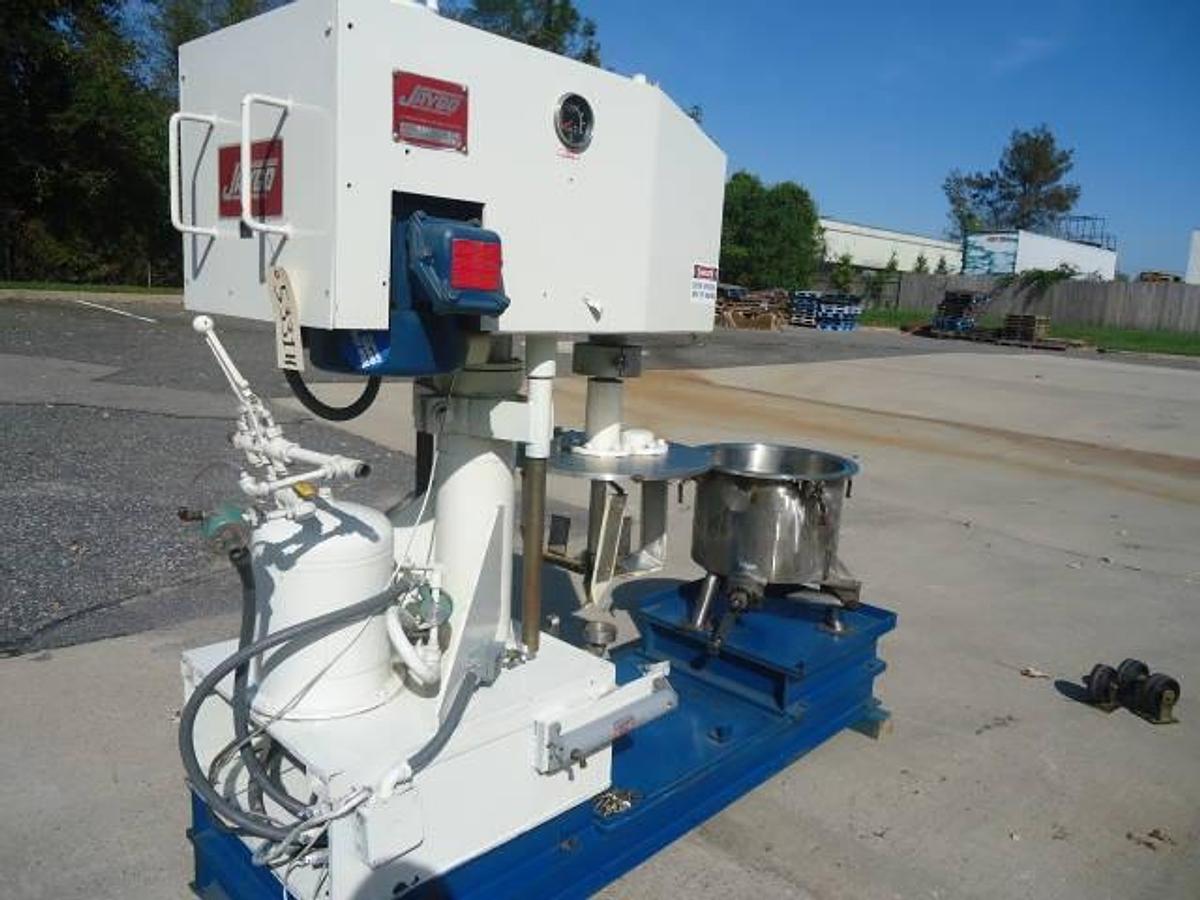
Category
Subcategory
Manufacturer
Model
Jaygo
Jaygo specializes in manufacturing equipment for the chemical and pharmaceutical industries. They are particularly known for their range of mixing and blending machines, including high shear mixers and vacuum dryers, which are designed to meet stringent industry standards.
FAQ:
What types of mixing equipment does Jaygo manufacture?
Jaygo produces a fairly broad range of mixing and blending machinery, with particular strength in high shear mixers, ribbon blenders, paddle blenders, cone screw mixers, tumble blenders, and vacuum dryers. Their high shear mixers are especially well regarded in industries where particle size reduction, emulsification, or homogenization is critical. The vacuum dryer line is a natural complement to their mixing equipment, allowing processors to handle wet blending and drying within a contained, controlled environment.
Beyond these core product categories, Jaygo has historically offered both standard catalog configurations and custom-engineered solutions for buyers with unique processing requirements. This flexibility made them a go-to supplier for facilities with non-standard batch sizes, unusual material properties, or specific regulatory constraints. Because of this engineering depth, used Jaygo equipment tends to vary considerably in configuration, so buyers should pay close attention to model numbers, shaft configurations, motor horsepower, and any specialized features when evaluating a specific machine.
What industries is Jaygo mixing equipment designed for?
Jaygo built its reputation primarily in the chemical and pharmaceutical industries, where mixing equipment must meet stringent cleanliness, containment, and process consistency standards. Their machines are frequently found in facilities producing active pharmaceutical ingredients, specialty chemicals, cosmetics, and personal care products. The sanitary design options and compliance with GMP and cGMP standards made Jaygo equipment a practical choice for regulated manufacturing environments where documentation and cleanability matter as much as raw mixing performance.
That said, Jaygo mixers also appear in food processing, nutraceutical production, and certain polymer or adhesive manufacturing applications. The stainless steel construction common across much of their product line translates well to any process requiring corrosion resistance, easy washdown, or contamination control. Buyers from outside the pharma sector often find that Jaygo machines are overbuilt for their needs in the best possible way, meaning the equipment holds up well under demanding production schedules and tends to have a long usable lifespan.
What should I look for when buying used Jaygo mixing equipment?
When evaluating a used Jaygo mixer or blender, start with the basics: model number, serial number, vessel capacity in liters or gallons, motor horsepower, and the condition of the drive system and seals. These details tell you whether the machine fits your process requirements and help you source any parts that may need replacement. Pay close attention to the interior surface condition of the vessel, particularly on stainless steel units, since pitting, weld repairs, or heavy discoloration can indicate aggressive chemical exposure or inadequate cleaning practices over the machine's service life.
Beyond the physical condition, ask about any included accessories such as control panels, variable frequency drives, heating or cooling jackets, and vacuum systems. These components add significant value and can be expensive to source separately. It is also worth contacting Jaygo or an authorized service provider to ask about parts availability for the specific model you are considering, since older or discontinued configurations may have limited support. Requesting an in-person or video inspection before purchase gives you the clearest picture of what you are actually getting.
What mixing capacities are available in used Jaygo equipment?
Jaygo produced equipment across a wide range of batch sizes, from small laboratory and pilot-scale units in the range of a few liters or gallons up to large production-scale machines handling hundreds of gallons per batch. This range made them a practical supplier for companies that needed to scale a process from R&D through full commercial production, sometimes using the same equipment family at different sizes. On the used market, you will find everything from compact 10-gallon dual shaft mixers suited for development work or small-batch specialty production to much larger ribbon blenders and cone screw mixers designed for high-volume manufacturing.
When shopping for a used Jaygo unit, match the vessel capacity to your actual batch requirements with some room to spare. Running a mixer at or near its maximum rated capacity continuously tends to accelerate wear on seals, bearings, and drive components. If your target batch size is, say, 50 gallons, a machine rated for 75 to 100 gallons will generally give you better longevity and more flexibility as your production needs change. Capacity is typically stated in both working volume and total vessel volume, so confirm which figure applies when comparing machines.
How does high shear mixing differ from other blending methods, and when is Jaygo high shear equipment the right choice?
High shear mixing uses a rotor-stator assembly or similar mechanism to apply intense mechanical energy to a product, breaking down particle agglomerates, reducing droplet size in emulsions, or dispersing solids into liquids far more efficiently than a conventional paddle or ribbon blender can. The result is a finer, more uniform mixture in a shorter cycle time. This makes high shear mixers the right tool when you need tight particle size distribution, stable emulsions, or complete wetting of powders into liquids. Jaygo built a strong reputation in this category, and their high shear units are frequently sought after on the used market because of their mechanical durability and the precision of their engineering.
By contrast, ribbon blenders and paddle blenders are better suited to dry blending, gentle wet granulation, or applications where shear-sensitive materials could be damaged by intense mechanical action. Cone screw and tumble blenders are preferred for fragile or free-flowing powders where minimal product degradation is essential. Choosing the right mixing principle matters more than brand loyalty, so buyers should define their process requirements first and then match the equipment type accordingly. A used Jaygo high shear mixer is an excellent investment for the right application, but it is not a universal substitute for other blending technologies.
Why is used Jaygo equipment considered a reliable option compared to lesser-known brands?
Jaygo built equipment to meet the demanding requirements of pharmaceutical and chemical manufacturing, which means their machines were engineered with tighter tolerances, higher-grade materials, and more robust drive systems than many general-purpose mixers. Stainless steel construction, sanitary welds, and compliance with GMP standards were standard features rather than optional upgrades on much of their product line. This level of build quality translates directly into longer service life, which is why Jaygo equipment remains functional and productive well into its second or third decade of use in many facilities.
For buyers in the used equipment market, brand pedigree matters because it affects parts availability, the pool of technicians familiar with the equipment, and the reliability of the machine after purchase. A well-maintained Jaygo mixer from a reputable dealer is a known quantity in a way that an obscure brand simply is not. The active secondary market for Jaygo equipment also means that pricing tends to be more transparent and that comparable sales data exists to help buyers assess whether a given asking price is reasonable.
What should buyers understand about inspecting used mixing equipment before purchase?
Inspections are a critical step in any used equipment purchase, and reputable dealers will typically offer in-person inspections, video walkthroughs, or detailed photo documentation of a machine's current condition. The goal is to get an honest picture of the equipment's working order before any money changes hands. For mixing equipment specifically, a thorough inspection should cover the condition of the vessel interior, the integrity of seals and gaskets, the state of the agitator or rotor assembly, and the functionality of any controls or variable speed drives included with the machine. If the equipment is still installed at a production facility, it may be possible to observe it running, which gives additional confidence in the drive system and mechanical components.
Keep in mind that most used equipment dealers do not have production facilities capable of running actual product through a machine, so a full process trial is generally not possible in a dealer's warehouse. What you can reasonably expect is a dry run of the drive system, visual confirmation of the vessel and agitator condition, and documentation of any known issues. Buyers should also ask whether the machine was decommissioned from active service or has been in storage, since long periods of inactivity can affect seals, lubricants, and electrical components in ways that are not immediately visible.
Are spare parts and replacement components readily available for Jaygo mixers?
Parts availability is one of the practical considerations that often gets overlooked until a machine needs maintenance. For Jaygo equipment, it is worth contacting the manufacturer or an authorized service provider directly to ask about availability for the specific model and serial number you are considering. Jaygo's focus on the pharmaceutical and chemical industries means their equipment was built to last, but the age of a particular machine and whether that model is still in active production can significantly affect how easy it is to source wear items like seals, gaskets, rotor-stator assemblies, and drive components.
For older or discontinued Jaygo models, buyers may find that some parts need to be fabricated to spec or sourced through specialty suppliers rather than ordered directly. This is not necessarily a dealbreaker, but it should factor into your total cost of ownership calculation. Consulting with a qualified mixing equipment service technician before purchase can help you identify which components are likely to need replacement in the near term and whether those parts are readily available. Stainless steel vessels and structural components are rarely the issue; it is the wear parts and proprietary drive components that require the most diligence.
What are the typical payment and shipping considerations when purchasing used mixing equipment?
Most used equipment dealers require payment in full before a machine ships, which is standard practice in the industry. Some dealers extend terms to repeat customers or established buyers, but first-time purchases are almost universally handled on a prepaid basis. Buyers should clarify accepted payment methods early in the process and confirm that all documentation, including any available service records or technical manuals, will be transferred at the time of sale.
Shipping costs for mixing equipment can vary considerably depending on the size and weight of the machine, the destination, and the level of packaging or crating required to protect it in transit. Smaller lab-scale mixers may ship on a standard pallet, while larger production units often require custom crating and heavy-duty rigging for both loading at the origin and unloading at the destination. These rigging and freight costs can add up to a meaningful portion of the total purchase price, so buyers should request a detailed breakdown of all landed costs before committing to a purchase. Getting a clear picture of packaging, freight, and any required unloading equipment at your facility prevents surprises when the machine arrives.
What is the difference between a dual shaft mixer and a single shaft mixer, and which applications call for each?
A dual shaft mixer combines two independent agitators operating in the same vessel, typically pairing a high shear rotor-stator with a low-speed anchor or paddle agitator. This configuration lets the machine handle tasks that a single agitator cannot accomplish efficiently on its own, such as dispersing a powder into a viscous liquid while simultaneously keeping the bulk material in motion to prevent settling or channeling. The result is faster, more uniform mixing across a wider range of viscosities. Jaygo produced dual shaft mixers in various configurations, and these units are particularly valued in cosmetic, pharmaceutical, and specialty chemical applications where product consistency is critical.
Single shaft mixers are simpler in design and generally better suited to lower-viscosity applications or processes where shear sensitivity is a concern. They are easier to clean, have fewer mechanical components to maintain, and typically cost less to purchase and operate. For many straightforward blending tasks, a single shaft unit is entirely adequate. The choice between dual and single shaft comes down to the viscosity range of your product, the degree of dispersion or emulsification required, and how much process flexibility you need. When evaluating a used dual shaft mixer like those Jaygo produced, confirm that both drive systems are functional and that the seals and bearings on each shaft are in acceptable condition.