Category
Manufacturer
Model
Harland
Harland provides manufacturing equipment primarily for the food and pharmaceutical industries. They are recognized for their high-quality filling and sealing machines that ensure product safety and compliance with industry standards.
FAQ:
What types of labeling equipment does Harland manufacture?
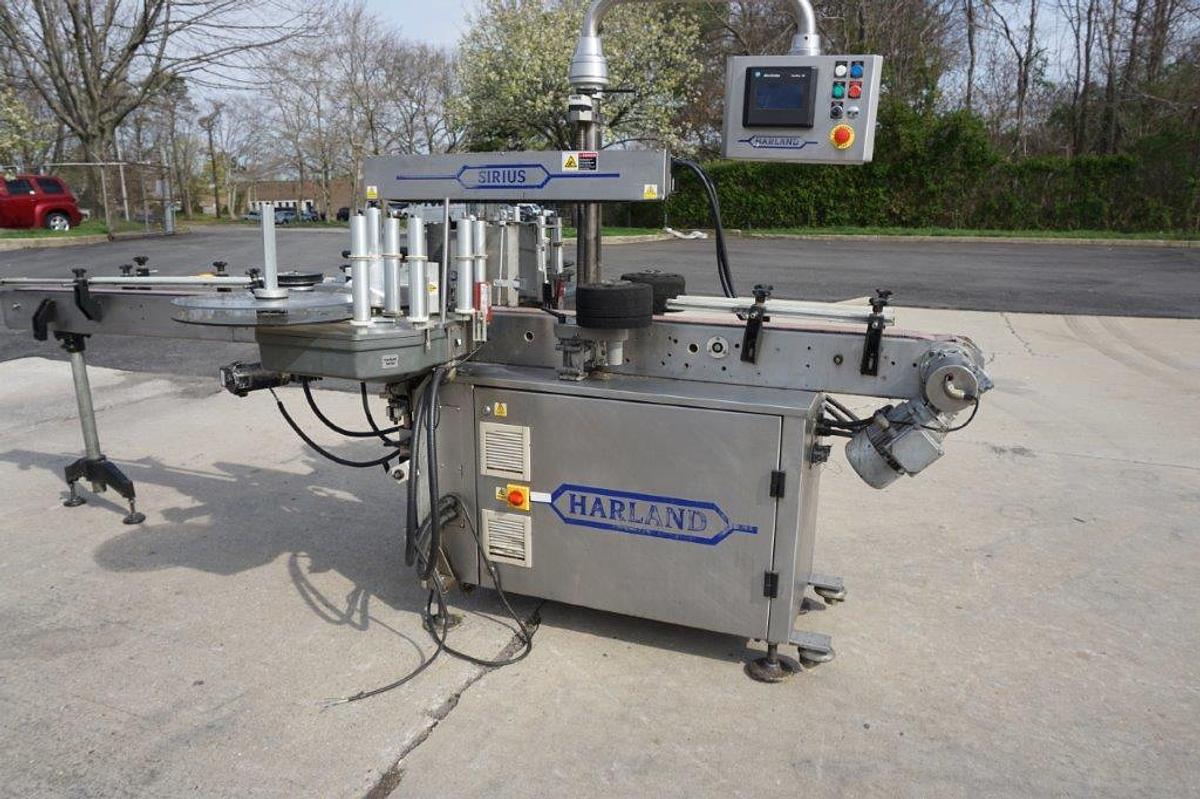
Harland produces labeling equipment primarily designed for the food and pharmaceutical industries, with a focus on pressure sensitive label application. Their product line includes front and back labelers, which apply labels to two sides of a container in a single pass, as well as spot and wrap-around labelers. The Harland "Sirius" series is one of their more recognized models, designed to handle both spot labeling and full wrap-around label application, and it can be configured with an integrated coder for date, lot, or batch marking.
Pressure sensitive labeling is a widely used method in both food and pharmaceutical packaging because it accommodates a broad range of container shapes, materials, and label stocks without requiring heat or adhesive activation at the point of application. Harland machines in this category are built to meet the compliance and accuracy demands of regulated industries, where label placement consistency is critical for both product safety and regulatory inspection.
What industries are Harland labeling machines best suited for?
Harland labeling equipment is recognized for serving the food and pharmaceutical industries, two sectors that place particularly high demands on labeling accuracy, repeatability, and compliance with regulatory standards. In food production, proper labeling is required for ingredient disclosure, allergen warnings, and traceability. In pharmaceutical manufacturing, label placement and legibility are subject to strict oversight from agencies like the FDA, making reliable, consistent application equipment essential.
Beyond those two primary industries, pressure sensitive labeling machines of the type Harland produces are also commonly used in cosmetics, nutraceuticals, and general consumer goods packaging. Any production environment that requires high-volume, repeatable label application to bottles, jars, tubes, or similar containers would find this type of equipment relevant. Buyers sourcing used Harland equipment should consider whether the machine's speed, label size range, and container compatibility align with their specific production requirements before purchasing.
What is the difference between a spot labeler and a wrap-around labeler?
A spot labeler applies a label to one specific area of a container, typically the front, back, or top, without the label wrapping around the full circumference. This is common for flat-sided containers or applications where only partial coverage is needed. A wrap-around labeler, by contrast, applies a single label that encircles the entire container, which is standard for cylindrical bottles and cans. Some machines, like the Harland Sirius series, are designed to handle both functions, giving packaging lines flexibility across different container formats and label configurations.
The choice between spot and wrap-around application depends on container geometry, label design, and production requirements. Wrap-around labeling generally requires more precise tension control and container rotation mechanisms to ensure smooth, bubble-free application. Front-and-back labeling systems, another common configuration, use two separate label heads to apply labels to opposite sides of a container simultaneously, which is efficient for products that require distinct front and back label content, as is typical in food and beverage packaging.
What should buyers know about purchasing used Harland labeling equipment?
Buying used labeling equipment requires more due diligence than purchasing from a manufacturer, because the machines are sold as-is and the condition can vary significantly based on how the equipment was maintained, how many production hours it accumulated, and how long it may have sat idle. Buyers should request detailed photos, video demonstrations, or an in-person inspection before committing to a purchase. Reputable used equipment dealers will typically accommodate virtual or on-site inspections, and in some cases the machine may still be installed and running at a production facility where a live inspection can be arranged.
It is also worth contacting Harland or their authorized service network directly to understand what level of technical support, spare parts, and documentation is available for the specific model and age of machine being considered. Older models may have limited parts availability, which can affect long-term serviceability. Buyers should factor in not just the purchase price but also the cost of shipping, any required rigging, installation, and potential refurbishment when calculating the true landed cost of the equipment.
Are replacement parts and technical support still available for used Harland labeling machines?
Parts and support availability for used labeling equipment depends heavily on the age and model of the machine. For older Harland labelers, some components may no longer be available directly from the manufacturer, which means buyers may need to source parts through third-party suppliers, machine shops capable of fabricating wear components, or other used equipment channels. Before purchasing, it is advisable to consult directly with Harland to get a clear picture of what support, documentation, and parts they can still provide for the specific model in question.
This is one of the most important pre-purchase steps for any used industrial labeling machine. Mechanical components like label heads, drive belts, sensors, and applicator pads are subject to wear and will eventually need replacement. If a machine is no longer supported by the manufacturer, buyers should assess whether the mechanical design is straightforward enough for a qualified technician to service using generic components. Dealers who specialize in packaging equipment are often a useful resource for identifying serviceability issues and locating parts for machines that are no longer in active production.
What label application speeds can industrial pressure sensitive labeling machines typically achieve?
Industrial pressure sensitive labelers cover a wide range of speeds depending on the design and intended application. Entry-level or semi-automatic machines may apply labels at rates of 20 to 60 containers per minute, while high-speed inline systems designed for large-scale production can reach 300 to 600 containers per minute or more. The actual throughput for any given machine depends on container size, label dimensions, label placement complexity, and whether the system is integrated with upstream and downstream conveyor equipment.
For machines like the Harland Sirius, which is designed for both spot and wrap-around application in food and pharmaceutical settings, the speed capability would need to be verified against the specific machine's documentation or confirmed through inspection and testing. Used equipment listings often include rated speeds from the manufacturer's specifications, but actual performance in a new production environment can vary based on the condition of the machine, the label stock being used, and how well the equipment is calibrated and maintained after installation.
What is the typical price range for used industrial labeling equipment?
Used industrial labeling equipment spans a broad price range depending on the type of machine, its age, condition, and the complexity of its features. Basic semi-automatic benchtop or standalone labelers can be found for a few hundred to a few thousand dollars. Mid-range inline pressure sensitive labelers with automatic feed and container handling typically sell in the range of five thousand to twenty thousand dollars on the used market. High-speed or highly automated systems with integrated coding, vision inspection, or multi-head configurations can exceed fifty thousand dollars even in used condition.
For a machine like the Harland Sirius or similar pressure sensitive labelers designed for pharmaceutical or food production, pricing will depend on factors like the machine's rated speed, its mechanical condition, the availability of spare parts, and whether it comes with documentation such as operating manuals or maintenance records. Buyers should also account for shipping, rigging, and any refurbishment costs when evaluating total acquisition cost. Requesting an itemized quote from the dealer that covers all of these elements is a practical step before finalizing any purchase decision.
How should used labeling equipment be inspected before purchase?
The goal of any pre-purchase inspection is to get an accurate, honest picture of the machine's current mechanical condition. For used labeling equipment, this means examining the label feed mechanism, applicator head, drive system, sensors, and any integrated coding or printing components for signs of wear, damage, or missing parts. Buyers who cannot visit in person should ask the dealer for a detailed video walkthrough that shows the machine running, ideally applying labels to a container similar to what the buyer intends to run. Static photos alone are rarely sufficient to assess mechanical condition.
It is worth noting that most used equipment dealers do not have production facilities, so they are generally not able to run actual product through a machine for a full production test. What they can typically do is power the machine on, demonstrate mechanical movement, and show the condition of key components. If the machine is still installed at a manufacturing facility prior to decommissioning, there may be an opportunity to observe it in active production, which provides a much more complete picture. Buyers should ask the dealer specifically about the machine's history, including how long it was in service, what products it ran, and whether any major repairs or modifications were made.
What are the typical shipping and logistics considerations for buying used labeling equipment?
Shipping industrial labeling equipment requires more planning than standard freight because these machines can be heavy, have protruding components, and contain precision mechanical parts that are sensitive to impact and vibration. Proper packaging is critical. Depending on the size and weight of the machine, the dealer may ship it on a standard pallet, in a custom wooden crate, or in its original shipping container if one is available. Buyers should ask the dealer specifically how the machine will be packaged and what that packaging is designed to protect against, since inadequate crating is one of the most common causes of transit damage.
For larger or heavier machines, professional rigging may be required for both loading at the dealer's location and unloading at the buyer's facility. Rigging costs are typically not included in the equipment price and should be confirmed upfront. Freight costs will vary based on distance, machine weight and dimensions, and the freight class assigned to the shipment. Buyers should request a fully itemized landed cost from the dealer that includes the equipment price, packaging, rigging, and freight so there are no surprises. Some dealers work with preferred freight carriers experienced in handling industrial machinery, which can reduce the risk of damage in transit.
What payment terms are typical when buying used industrial labeling equipment?
Most used equipment dealers require full payment before a machine is released for shipping. This is standard practice in the industry because used machinery transactions do not carry the same manufacturer-backed protections as purchasing directly from a factory, and dealers typically cannot hold machines for extended periods without financial commitment from the buyer. Payment is commonly accepted by wire transfer, though some dealers may accept other forms depending on the transaction size and the buyer's relationship with the seller.
Buyers who are new to a particular dealer should expect to pay in full prior to shipment. Some dealers extend payment terms to repeat customers or established business accounts, but this is not the norm for first-time transactions. Before sending payment, buyers should ensure they have completed their inspection, reviewed any available documentation on the machine, and received a clear written description of what is included in the sale, such as manuals, spare parts, tooling, or change parts for different container sizes. Getting all of this in writing before payment protects both parties and reduces the potential for disputes after the machine ships.