Category
Manufacturer
Model
Fryma
Fryma is known for its high-quality equipment for the food and cosmetic industries, specializing in processing machines like mixers and emulsifiers. Their products are designed to enhance product consistency and quality.
FAQ:
What types of Fryma equipment are commonly available on the used market?
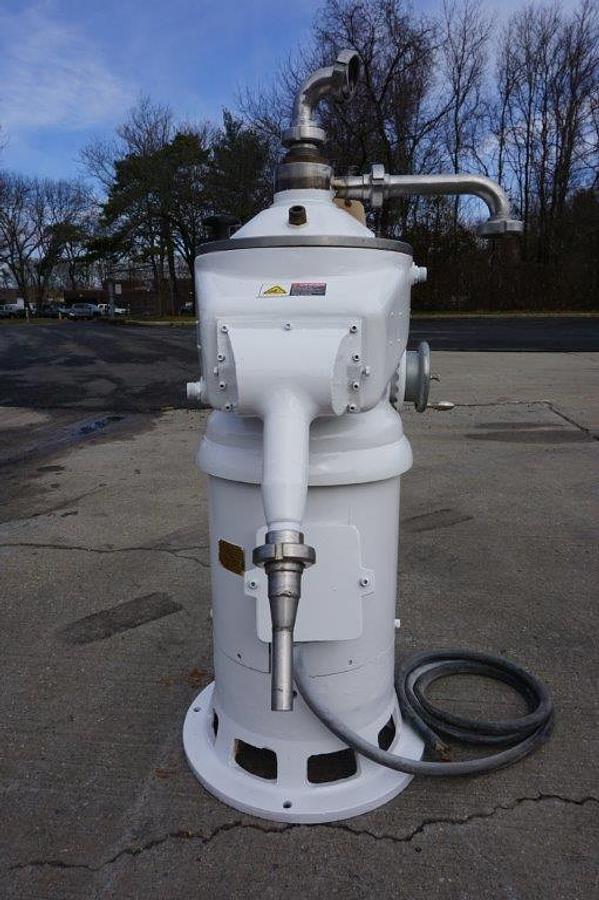
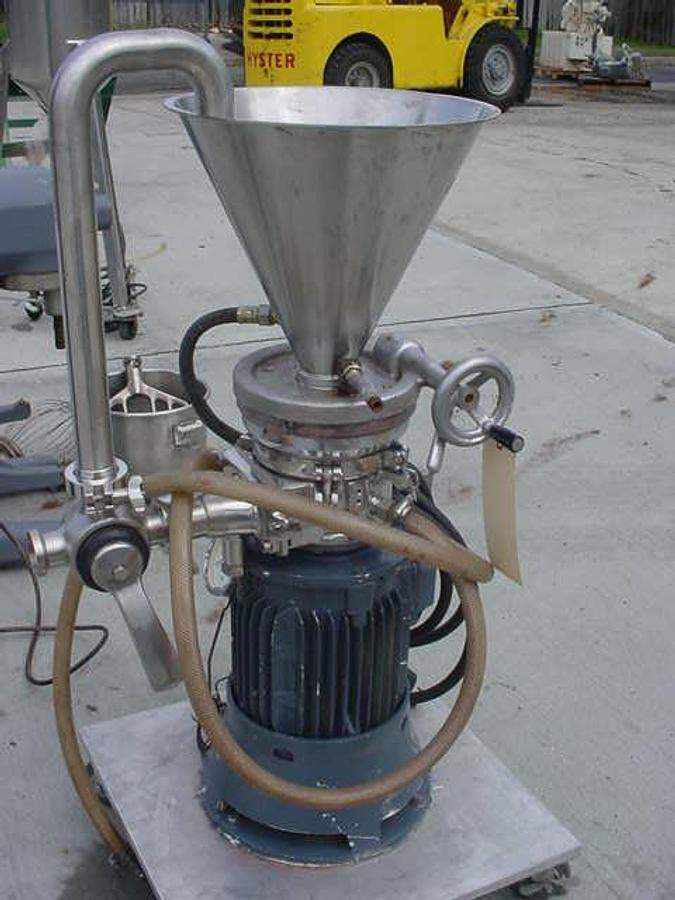
Used Fryma equipment spans several distinct product categories, reflecting the brand's focus on precision processing for food, cosmetic, and pharmaceutical applications. The most frequently listed machines include corundum stone mills (available in various diameter sizes such as 180mm, 250mm, and 360mm), colloid mills, vacuum processing units, homogenizing and de-aeration mixers, and Coball mills. Specific models like the VME-20 homogenizing/de-aeration mixer, the VME-250 vacuum processing unit, and the MK-95 corundum stone mill appear regularly in used equipment inventories. Many of these machines are constructed from 316L stainless steel, which makes them particularly sought after by buyers operating in regulated or sanitary production environments.
Beyond the individual mill and mixer categories, Fryma's vacuum processing systems and scraped surface heat exchangers also surface on the used market, though less frequently than the milling and homogenizing lines. Motor sizes across the corundum stone mill range tend to run from 30 HP (or roughly 30 kW) up to 55 kW for larger diameter units. Buyers looking for a specific configuration should check listings carefully for diameter, motor rating, material of construction, and jacket availability, as these details significantly affect suitability for a given application. Jacketed models, like the Fryma Ms12 Coball Mill, offer temperature control during processing, which is critical for heat-sensitive formulations.
What industries use Fryma processing equipment?
Fryma processing equipment has a strong foothold in three primary industries: food production, cosmetics manufacturing, and pharmaceuticals. In food applications, the colloid mills and corundum stone mills are used for grinding, emulsifying, and homogenizing products like nut butters, sauces, condiments, and dairy-based preparations. The fine particle reduction these machines achieve is difficult to replicate with less specialized equipment, which is why food manufacturers producing high-viscosity or particle-sensitive products tend to seek out Fryma machines specifically.
In cosmetics and personal care, Fryma vacuum homogenizers and mixers are used to produce creams, lotions, gels, and ointments with consistent texture and stable emulsions. The pharmaceutical sector relies on the same homogenizing and mixing technology for topical formulations, suspensions, and other semi-solid dosage forms. Fryma equipment is particularly valued in regulated industries because much of it was built to comply with Good Manufacturing Practice (GMP) standards, meaning the machines feature sanitary design, smooth internal surfaces, and materials that resist corrosion and contamination. This GMP-compliant construction is a major reason why used Fryma machines retain strong demand even after years of service.
What is the difference between Fryma Koruma and Fryma Maschinen models?
The distinction between Fryma Koruma and Fryma Maschinen largely comes down to the era in which a machine was produced and the corporate history behind the brand. Fryma Maschinen AG was the Swiss-origin entity that built the brand's early reputation for high-precision colloid mills, mixers, and emulsification systems. Over time, through a series of acquisitions and corporate restructuring, the brand evolved into what became known as Fryma Koruma, which continued producing similar equipment lines under updated branding. Buyers searching for used machines may encounter listings under either name depending on the age of the unit.
For practical purchasing purposes, the difference matters most in two areas: parts availability and documentation. Older Fryma Maschinen units may have a longer service history, which can mean more wear but also more documented maintenance records if the previous owner was diligent. Fryma Koruma machines, being from a later production period, may have better parts availability from the manufacturer and more accessible technical support. Regardless of which generation a buyer is considering, it is worth contacting the manufacturer directly to confirm what level of support, spare parts, and technical documentation is available for a specific model and serial number before completing a purchase.
How should a buyer verify the condition of used Fryma equipment before purchasing?
Verifying the condition of used processing equipment requires a structured approach, and Fryma machines are no exception. The most reliable method is an in-person inspection at the location where the machine is currently stored or still in operation. During an inspection, a buyer or their qualified technician should examine the condition of contact surfaces (particularly for stainless steel integrity and absence of pitting or corrosion), check seals and gaskets, review the condition of motors and drives, and assess any jacketed components for leaks or damage. If travel is not feasible, many reputable dealers can arrange video inspections or provide detailed video walkthroughs of the machine, which allow buyers to assess cosmetic and mechanical condition remotely.
Beyond the visual inspection, buyers should request all available documentation, including maintenance logs, calibration certificates, and any Factory Acceptance Test (FAT) records from the machine's production history. These records give insight into how the machine was used, how frequently it was serviced, and whether it was ever subjected to out-of-spec operating conditions. It is also worth noting that most used equipment dealers do not have the permitting or production infrastructure to run actual product through a machine during inspection, so buyers should set realistic expectations about what a functional test can demonstrate. Consulting with the manufacturer about the specific model's known wear points and recommended inspection criteria is a practical additional step before finalizing any purchase.
Are spare parts readily available for used Fryma machines?
Parts availability for Fryma equipment varies depending on the model, its age, and the current state of manufacturer support for that particular line. For machines that are relatively recent or belong to product lines that Fryma Koruma (the current brand successor) still actively supports, buyers generally have a reasonable path to sourcing wear parts like seals, grinding stones, rotor-stator components, and gaskets either directly from the manufacturer or through authorized distributors. Corundum grinding stones, for example, are a consumable component on Fryma stone mills and have historically been available through the manufacturer's service network.
For older Fryma Maschinen units, parts availability becomes less predictable. Some components may need to be custom fabricated, sourced from third-party suppliers, or harvested from donor machines. Before purchasing any used Fryma machine, it is advisable to contact the manufacturer with the model number and serial number to get a clear picture of what parts are stocked, what lead times look like, and whether technical support is still offered for that specific unit. This due diligence can prevent a situation where a buyer acquires a machine only to discover that a critical wear component is no longer manufactured. Factoring parts availability into the total cost of ownership is an important step that buyers sometimes overlook when evaluating used processing equipment.
What should buyers know about shipping used Fryma processing equipment?
Shipping used Fryma equipment involves more logistical planning than most buyers initially anticipate, particularly for larger units like vacuum processing systems or industrial-scale stone mills. The first consideration is packaging: machines need to be properly palletized or crated to prevent damage during transit, and the level of packaging required will directly affect shipping costs. Smaller mills may ship on a standard pallet with adequate bracing, while larger or heavier units often require custom wooden crates or engineered skids to protect precision components like grinding surfaces, seals, and drive assemblies.
For heavier equipment, rigging is an additional cost that buyers should factor into their total landed price. Loading a large Fryma vacuum processing unit or a 360mm stone mill onto a freight carrier typically requires a forklift or crane at both origin and destination, and if the buyer's facility is not equipped for this, third-party rigging services will be needed. Buyers should ask the dealer for a complete breakdown of packaging, rigging, and freight costs before committing to a purchase so there are no surprises at delivery. International shipments add further complexity through customs documentation, import duties, and compliance with country-specific equipment import regulations, all of which should be clarified with the dealer and a freight forwarder before the transaction is finalized.
What are typical payment terms when buying used Fryma equipment from a dealer?
Payment practices in the used industrial equipment market tend to follow a fairly consistent pattern. Most dealers require full payment before a machine is released for shipping, which protects the seller from non-payment after the equipment has left their facility. This is standard practice across the industry and applies to the majority of transactions regardless of the equipment type or price point. Wire transfer is the most common payment method for equipment purchases of this scale, though some dealers may accept other forms depending on the transaction size and buyer relationship.
Buyers who have an established history with a particular dealer may occasionally be offered extended terms or other arrangements, but first-time buyers should plan to pay in full prior to shipment. For higher-value purchases like a Fryma vacuum processing unit or a large-diameter stone mill, buyers should also consider the timing of payment relative to their inspection process. It is generally advisable to complete any inspections, whether in-person or via video, and resolve any outstanding questions about the machine's condition before submitting payment. Rushing payment before completing due diligence is one of the more common missteps buyers make in used equipment transactions.
What is a Fryma corundum stone mill and what is it used for?
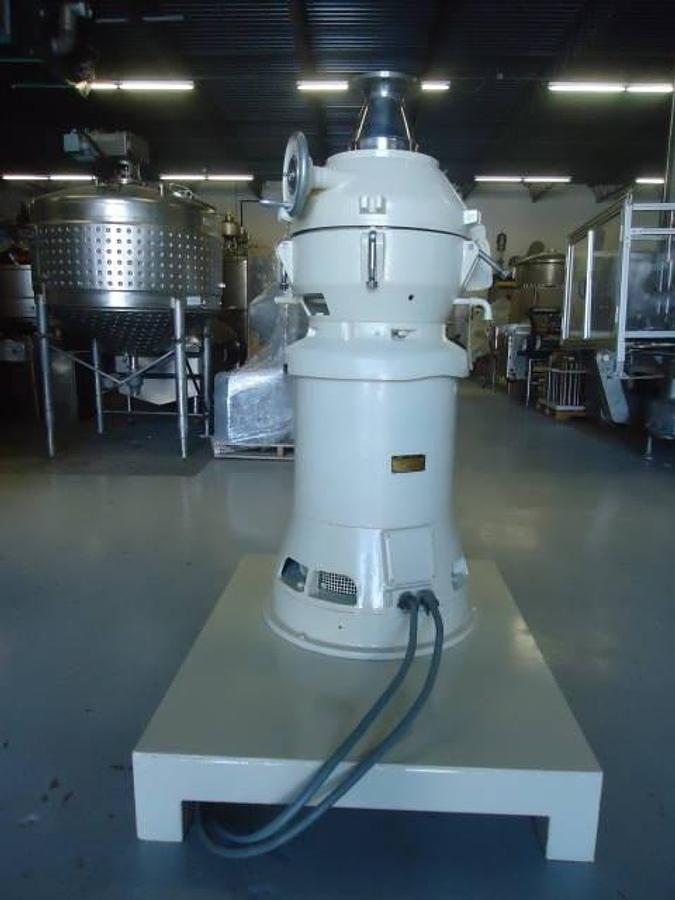
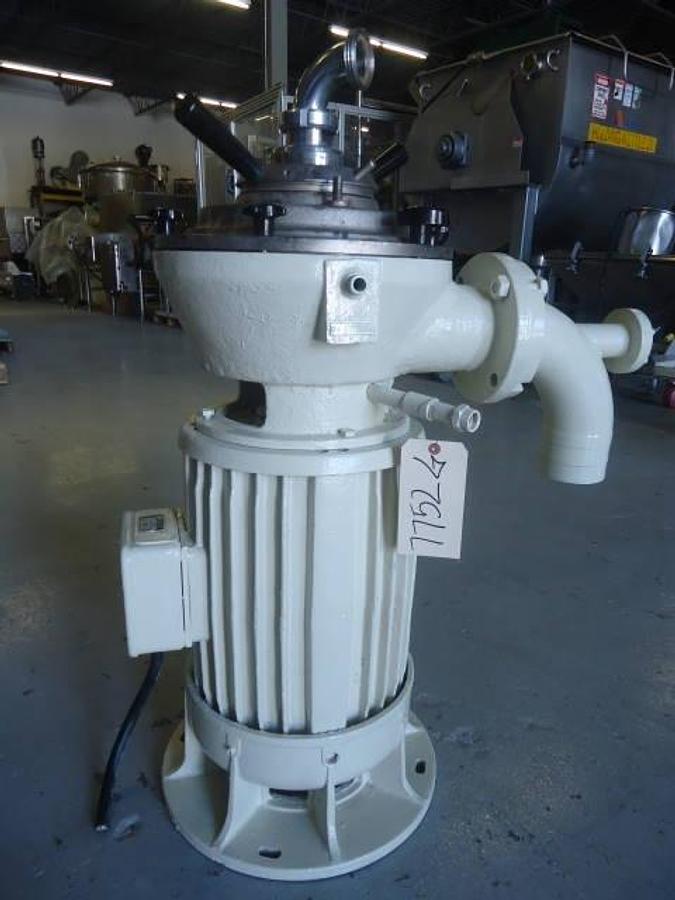
A Fryma corundum stone mill is a type of wet grinding machine that uses two precisely machined corundum (aluminum oxide) grinding discs to reduce particle size in liquid or semi-liquid materials. One disc rotates at high speed while the other remains stationary, and the product passes through the narrow, adjustable gap between them. The corundum material is extremely hard and chemically inert, making it well suited for grinding applications where contamination from metal wear particles would be unacceptable. This design allows for very fine and consistent particle reduction, which is why these mills are used in food, cosmetic, and pharmaceutical processing.
Common applications for Fryma corundum stone mills include the production of tahini, nut butters, mustard, pharmaceutical suspensions, pigment dispersions, and cosmetic creams. The gap between the grinding discs is adjustable, giving operators control over the fineness of the grind. Used Fryma corundum stone mills are available in a range of sizes defined by grinding disc diameter, with 180mm, 250mm, and 360mm being among the most commonly listed configurations on the used market. Motor sizes scale with disc diameter, ranging from approximately 30 HP for mid-size units up to 55 kW for the larger 360mm models. Stainless steel construction is standard on most Fryma stone mills, supporting use in food-grade and sanitary processing environments.
What is a Fryma vacuum processing unit and how does it work?
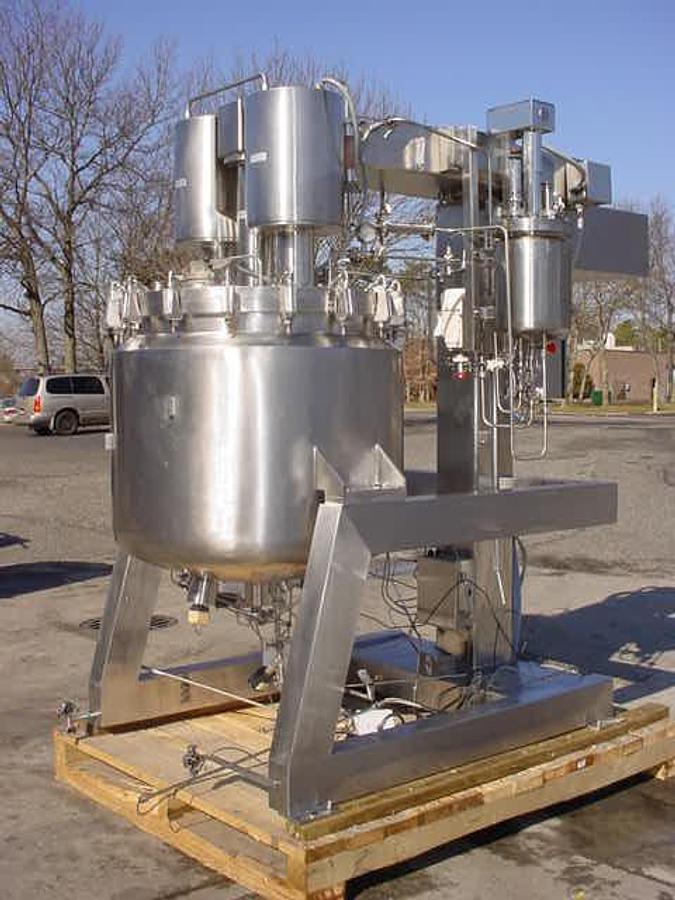
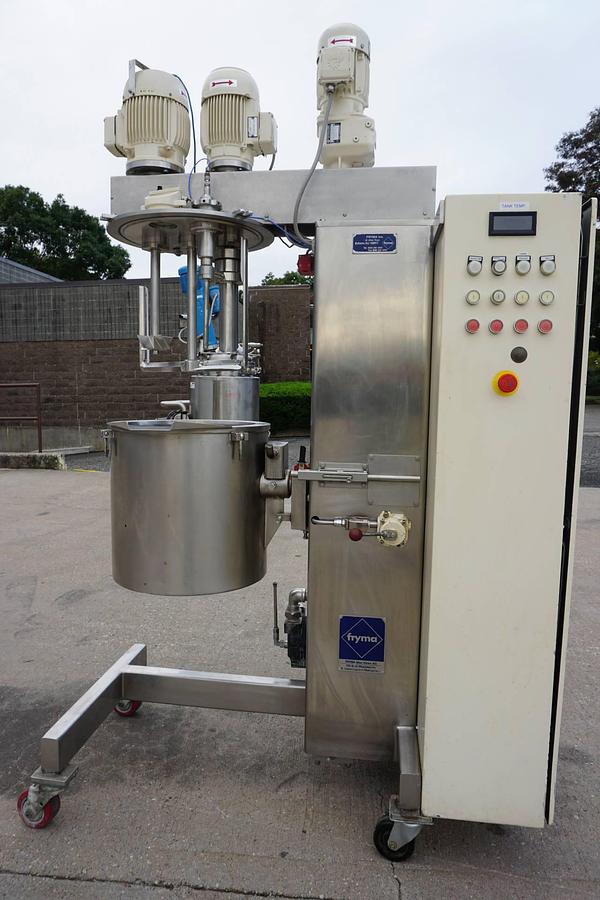
A Fryma vacuum processing unit is a multi-function mixing and homogenizing system designed to produce emulsions, creams, gels, and suspensions under vacuum conditions. The vacuum environment serves a specific purpose: it removes air from the product during mixing, which prevents oxidation, reduces foaming, and improves the stability and shelf life of the finished product. This is especially important in cosmetic and pharmaceutical manufacturing, where air entrapment can compromise product texture, appearance, and efficacy. The VME-250 and similar Fryma vacuum processing units combine a homogenizing mixer with a de-aeration function in a single integrated system.
These units typically feature a jacketed vessel that allows heating or cooling of the product during processing, a high-shear homogenizer for emulsification, and an anchor or paddle agitator for bulk mixing. The combination of vacuum, temperature control, and high-shear homogenization in one system makes Fryma vacuum units particularly efficient for producing stable oil-in-water or water-in-oil emulsions. Used models like the Fryma VME-20 (a smaller-scale unit) and the VME-250 (a larger production-scale system) are constructed in 316L stainless steel, which meets the material requirements of most food-grade and pharmaceutical processing applications. Buyers evaluating these systems should pay close attention to the condition of the vacuum seals, homogenizer components, and jacket integrity during any pre-purchase inspection.
What is a Fryma Coball mill and how does it differ from a stone mill?
A Fryma Coball mill is a bead mill, which means it uses small grinding media (beads or balls) contained within a milling chamber to achieve fine particle size reduction through impact and shear forces. The product is pumped through the chamber while the beads are agitated at high speed, creating intense mechanical energy that breaks down particles. This differs fundamentally from a corundum stone mill, which grinds material between two stationary and rotating disc surfaces. Coball mills are generally capable of achieving finer particle sizes than stone mills and are particularly effective for dispersing pigments, active pharmaceutical ingredients, and other materials that require very tight particle size distribution.
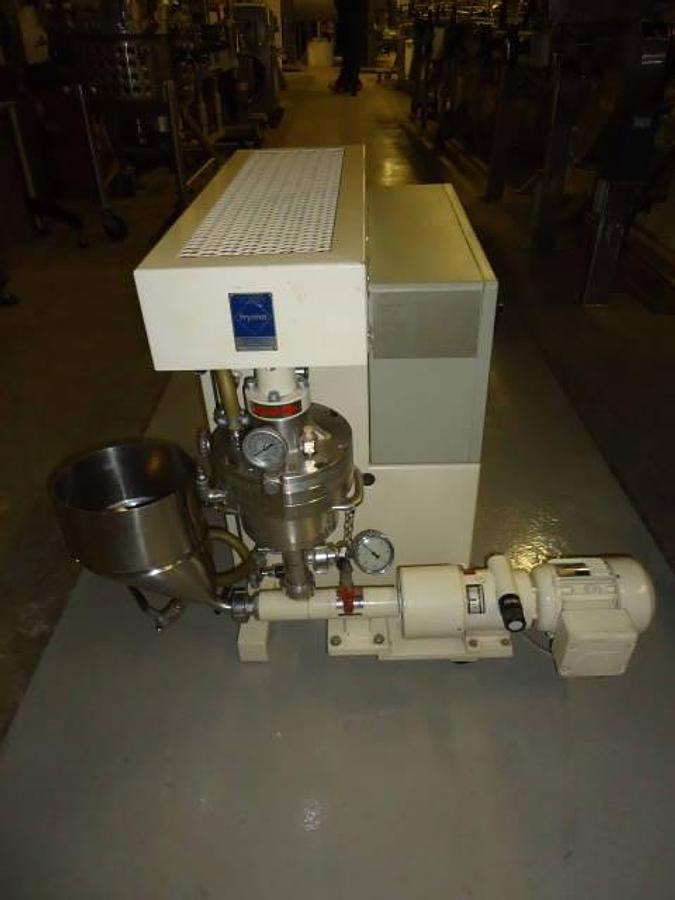
The Fryma Ms12 Coball Mill, for example, features a jacketed design that allows temperature control during the milling process, which is critical for heat-sensitive materials. The jacketing prevents the heat generated by the high-energy milling action from degrading the product. Coball mills are commonly used in pharmaceutical manufacturing for producing suspensions and dispersions, in the ink and coatings industry for pigment grinding, and in cosmetics for fine dispersion of active ingredients. When evaluating a used Coball mill, buyers should pay particular attention to the condition of the milling chamber, the grinding media (which may need replacement), and the mechanical seals, as these are the components most subject to wear during normal operation.