Category
Manufacturer
Model
Frazier & Son
Frazier & Son is a well-respected manufacturer of material handling equipment, focusing on the pharmaceutical and food industries. Their product line includes high-performance conveyors and storage solutions designed to optimize production workflows.
FAQ:
What is a Frazier & Son bucket elevator used for?
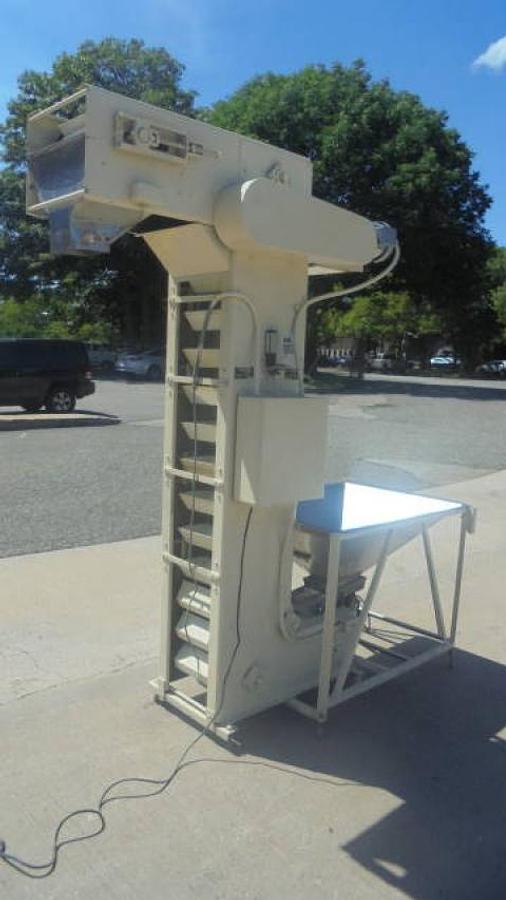
Frazier & Son bucket elevators are vertical conveying systems designed to lift bulk materials from a lower point to a higher discharge point. The brand has a strong reputation in both pharmaceutical and food processing industries, where precise, gentle material handling is critical. Their "Whiz-Lifter" line, for example, is built to move free-flowing granular or powdered materials vertically with minimal product degradation, making them a common choice in production environments where contamination control and workflow efficiency matter.
Beyond food and pharma, bucket elevators from this manufacturer also see use in agricultural and general industrial settings, moving materials like grain, seeds, and other bulk solids from floor level up to bins, hoppers, silos, or downstream processing equipment. The core advantage of a bucket elevator over other conveying methods is its ability to achieve significant vertical lift in a compact footprint, which is especially valuable in facilities where floor space is limited. Discharge height is one of the primary specifications buyers look at, and used Frazier & Son units have been found with discharge heights ranging from roughly 17 feet on smaller models up to much taller configurations for commercial-scale applications.
What should I inspect when buying a used Frazier & Son bucket elevator?
Buying a used bucket elevator requires a thorough mechanical inspection because wear is distributed across several components that are costly to replace. The most critical areas to examine are the boot section (the lower housing where material is scooped up), the head pulley at the top, the belt or chain that carries the buckets, and the condition of the buckets themselves. Worn or cracked buckets reduce capacity and can cause spillage inside the casing. Belt condition is equally important since a degraded belt can fail under load, and replacement belts for older or discontinued models can sometimes be difficult to source. Bearings at both the head and boot shaft should be checked for play, heat damage, or corrosion.
Beyond the mechanical components, buyers should look closely at the casing for dents, corrosion, or holes that would allow product leakage or contamination, which is especially significant in food and pharmaceutical applications where sanitary integrity is required. The drive motor and any associated gearbox should be inspected for oil leaks, unusual noise, and proper alignment. Reputable used equipment dealers will typically accommodate in-person or video inspections so buyers can assess the machine's condition before committing to a purchase. If the equipment is still installed at a facility, it may be possible to observe it running, though most dealers are not set up to conduct full production-level tests on their premises.
What are the key specifications to compare when shopping for a used bucket elevator?
The two most fundamental specifications are discharge height and capacity. Discharge height determines whether the elevator can physically clear the storage structure or receiving vessel it feeds into, and this measurement needs to match the layout of the receiving facility precisely. Capacity is typically expressed in bushels per hour (BPH) for agricultural applications or in pounds or tons per hour for industrial uses. Common farm-scale units handle anywhere from 1,500 to over 10,000 BPH, while industrial units vary widely depending on the material's bulk density and bucket volume. Getting these two numbers right before evaluating anything else saves a lot of time.
Beyond height and capacity, buyers should compare bucket size and spacing, belt or chain width, head shaft speed (measured in RPM), and the motor horsepower required to drive the unit at rated capacity. The type of material being handled also affects which specifications matter most. For pharmaceutical or food applications, casing material (stainless steel versus carbon steel) and the ease of cleaning the interior are important factors. For grain, abrasion resistance of the buckets and the boot section liner tends to be the priority. Matching the elevator's specifications to the actual application requirements, rather than simply buying the largest or tallest available unit, leads to better long-term performance and lower operating costs.
What industries commonly use Frazier & Son material handling equipment?
Frazier & Son has built its reputation primarily in the pharmaceutical and food processing industries, where material handling equipment must meet strict standards for cleanliness, product integrity, and consistent throughput. In these environments, bucket elevators and conveyors are used to move powders, granules, tablets, capsules, and other processed materials between production stages without introducing contamination or causing excessive product breakage. The brand's focus on these regulated industries means their equipment is generally built to tighter tolerances and with materials compatible with sanitary requirements.
Outside of pharma and food, Frazier & Son equipment also appears in general industrial and agricultural settings where vertical conveying of bulk solids is needed. Grain handling is a common application, with bucket elevators moving corn, soybeans, wheat, and similar commodities from receiving pits up to storage bins or processing lines. The versatility of the bucket elevator design means a single machine can often handle a range of free-flowing materials, making used units attractive to buyers across multiple industries. When evaluating a used machine for a specific application, it is worth checking the construction materials and prior use history to confirm the equipment is appropriate for the intended product.
How does leg height affect the selection of a bucket elevator?
Leg height, which is the distance from the boot (bottom) of the elevator to the discharge point at the head, is one of the most application-specific measurements in bucket elevator selection. The elevator must be tall enough to clear whatever structure it is feeding, whether that is a storage bin, a silo, a processing vessel, or an elevated conveyor. If the leg height is even slightly too short, the entire machine becomes unusable for that application without costly modifications. Standard heights for farm and light industrial units often fall in the 17-foot to 30-foot range, while commercial grain facilities may require legs of 60 feet, 80 feet, or taller.
Buyers shopping the used market need to measure their available vertical clearance and required discharge height before looking at specific listings. A unit like the 17-foot Frazier & Son Whiz-Lifter suits smaller-scale operations or facilities with lower headroom, while taller configurations are necessary for feeding elevated bins or multi-story processing equipment. Keep in mind that a taller elevator also requires a more substantial support structure and foundation, which adds to the total installation cost. When reviewing used equipment listings, confirm whether the listed height refers to total machine height or discharge height specifically, as these measurements can differ depending on how the manufacturer defines them.
What drive and motor configurations are typically used with bucket elevators?
Most bucket elevators are driven by an electric motor connected to the head shaft through a gear reducer, which steps down the motor's high RPM to the slower shaft speed needed to keep buckets moving at the correct velocity without spilling material. Direct-coupled gear reducers are the most common arrangement because they are compact and reliable, but V-belt drives between the motor and reducer are also widely used and offer the ability to adjust speed ratios by swapping sheaves. The head shaft speed is a critical parameter because running buckets too fast causes material to be thrown past the discharge chute (a condition called "legging over"), while running too slow reduces capacity.
Motor horsepower requirements vary considerably based on the elevator's capacity, leg height, and the bulk density of the material being handled. A small 17-foot unit handling light pharmaceutical powders may require only a fractional or single-digit horsepower motor, while a tall high-capacity grain elevator can require 20, 30, or more horsepower. When purchasing a used bucket elevator, buyers should confirm that the existing motor and drive components are included in the sale and are in serviceable condition, since sourcing a replacement motor or custom gear reducer adds cost and lead time. It is also worth verifying that the electrical specifications (voltage, phase, and frequency) of the existing motor are compatible with the power available at the installation site.
How readily available are replacement parts for used Frazier & Son bucket elevators?
Parts availability for any used machine depends heavily on the age and model of the equipment, and bucket elevators are no exception. For common wear items like buckets, belting, and bucket bolts, there is generally a healthy aftermarket supply because these components are fairly standardized across the industry. Buckets, in particular, are often interchangeable between brands as long as the bolt pattern, width, and projection dimensions match, which means buyers are not always limited to manufacturer-specific parts. Belt and chain replacements are similarly available from industrial supply distributors, provided the width and specification are documented.
For more model-specific components like head pulleys, boot shafts, custom casings, or proprietary drive assemblies, availability can be harder to predict. Before purchasing a used Frazier & Son elevator, it is worth contacting the manufacturer directly to ask about parts support for the specific model and approximate age of the unit. Manufacturers can typically indicate whether a model is still supported, which parts are stocked, and which may require fabrication or long lead times. This conversation is especially important for equipment destined for regulated industries like food or pharmaceuticals, where downtime for parts procurement can have significant production consequences. Selecting a used equipment dealer who specializes in material handling equipment and has familiarity with the brand can also help buyers anticipate parts challenges before they arise.
What should buyers understand about shipping a used bucket elevator?
Bucket elevators present real logistical challenges because of their height and the number of individual components involved. Tall units are almost always disassembled into sections (casing sections, head assembly, boot assembly, and drive components) for transport, and each section needs to be properly packaged or crated to prevent damage in transit. The head assembly, which contains the head pulley, shaft, and bearings, deserves particular care since these are precision components that can be damaged by rough handling. Buyers should ask the dealer specifically how the equipment will be packaged and what crating or palletization is included in the quoted price, because shipping charges vary significantly based on the level of protection provided.
For larger or heavier units, rigging equipment such as forklifts or cranes may be required to load the machine at the dealer's location and to unload it at the destination. These rigging costs are typically the buyer's responsibility unless otherwise negotiated, and they can add meaningfully to the total landed cost of the equipment. Freight for industrial machinery is usually quoted on a freight-class or dimensional-weight basis, and oversized sections may require flatbed or specialized transport. Getting a complete picture of packaging, rigging, and freight costs before finalizing a purchase helps avoid surprises and allows for an accurate comparison between different available units.
What payment terms do used equipment dealers typically require for machinery purchases?
The standard practice among used equipment dealers is to require full payment before the equipment ships. This is different from the terms buyers might expect when purchasing from a manufacturer on credit, and it reflects the nature of the used machinery market where each piece of equipment is a one-of-a-kind asset that cannot be restocked if a transaction falls through. Payment is commonly accepted by wire transfer, though some dealers also accept certified funds. Credit card payments, if accepted at all, are usually limited to smaller purchases or deposits.
Some dealers extend payment terms to established repeat customers with whom they have a track record, but buyers making their first purchase from a dealer should expect to pay in full prior to shipment. This makes it especially important to complete any desired inspection, confirm all specifications, and clarify shipping and rigging costs before submitting payment. Taking time to verify the dealer's reputation, length of time in business, and specialization in the relevant equipment category is a reasonable step before committing funds to any used machinery purchase.
How can buyers verify the condition of a used bucket elevator before purchasing?
Reputable used equipment dealers typically offer several inspection options to help buyers assess a machine's condition before committing to a purchase. In-person inspections allow a buyer or their representative to examine the equipment directly, check for visible wear, measure key dimensions, and review the overall state of components like the belt, buckets, bearings, and casing. Where the equipment is still installed at a production facility, it may be possible to arrange an inspection through the dealer and the plant owner, and in some cases the machine may still be running, which provides an opportunity to observe it in operation.
For buyers who cannot travel, video inspections or detailed photo documentation are common alternatives. A thorough video walkthrough can capture bucket condition, casing integrity, drive components, and any visible damage or corrosion that would affect the purchase decision. It is worth asking the dealer to capture specific areas of concern, such as the boot section interior, the head pulley, and any welds or structural connections on taller units. Keep in mind that most used equipment dealers are not licensed production facilities and cannot run the machine through a full production test with actual material, so inspection findings combined with the machine's documented history form the basis for the buyer's assessment of its condition and suitability.