Category
Manufacturer
Model
FAQ:
What is a Fills-All Kaps-All filling machine?
Fills-All and Kaps-All are legacy brand names associated with liquid filling and capping equipment designed for small to mid-size production environments. The machines are built around a piston-fill system, where a set of pistons draws product from a supply tank and dispenses precise, repeatable volumes into containers moving along a conveyor. The combined naming reflects the two core functions these machines were designed to handle: filling containers to a set volume and then applying caps, either as separate units or as part of an integrated line.
These machines became popular in industries like cosmetics, nutraceuticals, food and beverage, and pharmaceuticals because they offered a practical way to automate filling and capping without requiring a full-scale production line. A single integrated setup reduces the floor space needed and eliminates the handoff between two separate pieces of equipment. Because the brand has been around for decades, used Fills-All and Kaps-All machines appear regularly on the secondary equipment market, making them accessible to smaller operations that need reliable filling capacity without the cost of purchasing current-production machinery.
What types of products can a Fills-All Kaps-All piston filler handle?
Piston fillers like those made under the Fills-All and Kaps-All brands are best suited for liquid and semi-liquid products. This includes thin free-flowing liquids such as water, juice, and alcohol-based products, as well as thicker or more viscous materials like lotions, creams, sauces, gels, and syrups. The piston mechanism works by drawing a measured volume of product into a cylinder and then pushing it out into the container, which means it can handle a fairly wide viscosity range without losing fill accuracy.
Products with small particulates, such as salsas or dressings with chunks, can sometimes be run through piston fillers as well, depending on the valve and nozzle configuration. These machines are generally not designed for dry powder filling, which requires a different fill mechanism such as an auger or volumetric cup filler. Buyers sourcing a used Fills-All or Kaps-All machine should confirm the specific valve type and cylinder size on the unit they are evaluating, since different configurations suit different product types, and a used machine may have been set up specifically for the product its previous owner ran.
What container sizes and types are compatible with Fills-All Kaps-All filling machines?
Fills-All and Kaps-All piston fillers are generally built to accommodate a range of container sizes, which is one of the reasons they appealed to operations running multiple SKUs. Fill volume is typically adjustable by changing the piston stroke length, allowing the same machine to fill smaller containers like one-ounce bottles and scale up to larger containers depending on the cylinder capacity. Container diameter and height adjustments are made through guide rails and height mechanisms on the conveyor section of the machine.
Compatible container types include round bottles, jars, and tubes made from glass or plastic, which are the most common formats in cosmetics, food, and pharmaceutical packaging. Non-round containers can sometimes be run with the right guide rail setup, but round containers are the most straightforward to handle on these machines. When evaluating a used unit, buyers should ask about the fill range the machine is currently configured for and whether changeover parts for other container sizes are included with the sale, since those components are often specific to the machine and may not be easy to source separately.
What is the typical production speed of a Fills-All Kaps-All automatic filling machine?
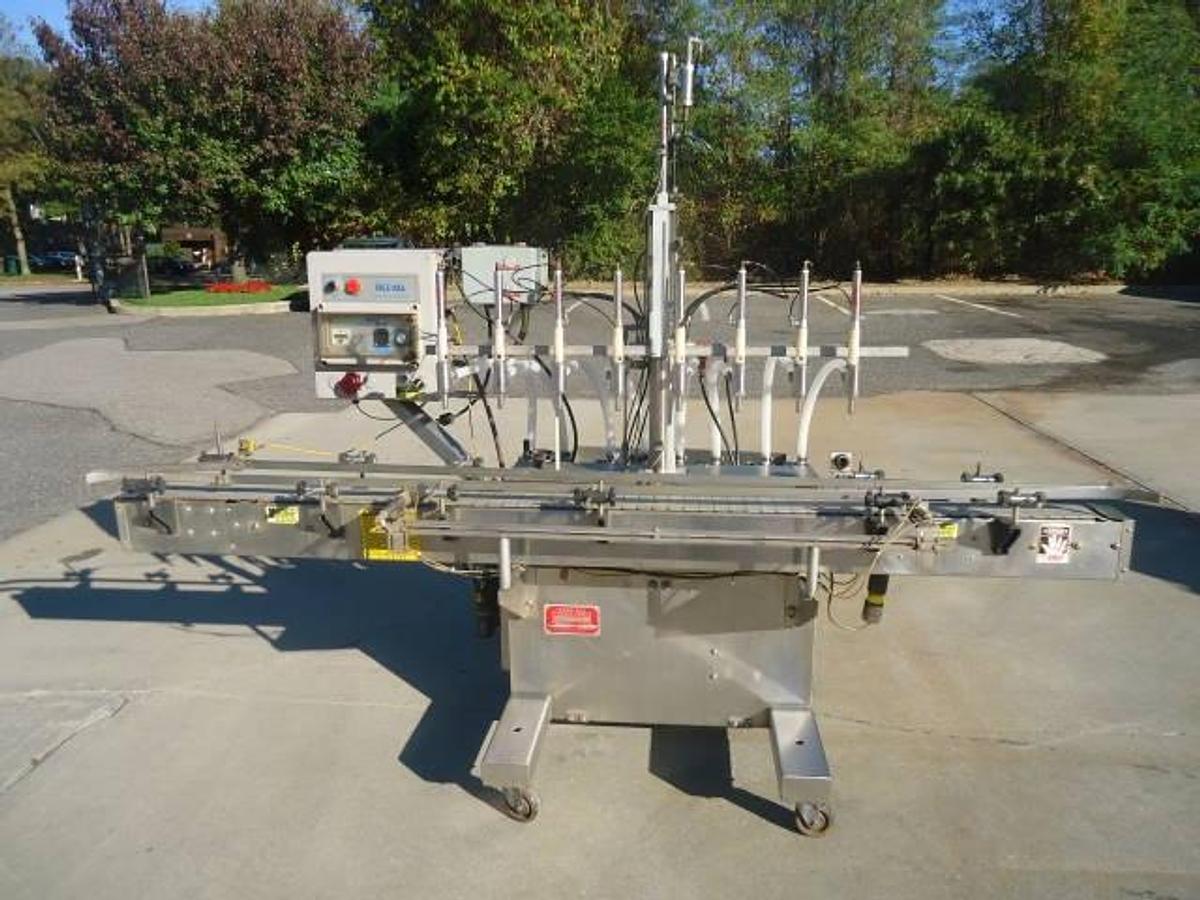
Production speed on an automatic Fills-All or Kaps-All piston filler depends on several factors: the number of fill heads, the fill volume per container, the viscosity of the product, and the conveyor speed. An 8-head automatic piston filler, for example, can fill multiple containers simultaneously per cycle, which significantly increases throughput compared to a single-head or semi-automatic unit. In general, multi-head automatic piston fillers in this class are capable of filling anywhere from 20 to 60 or more containers per minute under the right conditions, though actual output in a given production environment will vary.
Thicker products slow cycle times because the piston takes longer to draw and dispense viscous material. Smaller fill volumes per container allow faster cycling than large fills. When reviewing a used machine, buyers should ask the seller about the production rates the machine was achieving in its previous application, keeping in mind that used equipment dealers typically cannot run live product tests at their facility due to permitting and production requirements. Getting specifics on the number of heads, cylinder volume, and the product it was last used for gives a more accurate picture of what realistic output to expect.
Does a Fills-All Kaps-All machine handle both filling and capping, or are those separate units?
The Fills-All and Kaps-All names refer to two distinct but often paired pieces of equipment. Fills-All refers to the filling side of the operation, while Kaps-All refers to capping. These machines were designed to work together as part of an integrated packaging line, but they are separate mechanical units. In some configurations they are sold together as a combined line, and in other cases they are sold individually. A buyer looking for a complete fill-and-cap solution should confirm whether a listing includes both the filler and the capper, or just one of the two.
Having filling and capping handled by equipment from the same manufacturer and era simplifies integration, since the conveyor speeds and container handling are designed to work in sequence. That said, a used Fills-All filler can also be paired with a capper from a different manufacturer if the line speeds and container specs are compatible. When evaluating used listings, it is worth asking whether the machines were running together in their previous facility, since a matched set that was already integrated and running in production is generally easier to reinstall than two machines that were never paired.
What is the typical price range for a used Fills-All Kaps-All filling machine?
Pricing for used Fills-All and Kaps-All equipment varies considerably based on the model, number of fill heads, overall condition, age, and whether the listing includes a capper, conveyor, or other ancillary components. A basic semi-automatic unit in average condition will typically be priced lower than a multi-head automatic filler with a full conveyor system that was recently in production. In the used equipment market, machines in this category can range from a few thousand dollars for simpler or older units to $20,000 or more for well-maintained automatic multi-head systems with associated equipment included.
Buyers should also factor in costs beyond the purchase price. Shipping, rigging, and any required refurbishment or parts replacement will add to the total landed cost. Because used equipment is sold as-is, a thorough inspection before purchase is critical to understanding what the machine will actually cost to get into production. Requesting a detailed condition report, photos, and a video walkthrough from the seller helps avoid surprises. Consulting with a used equipment dealer who specializes in packaging machinery gives buyers a better sense of fair market value for a specific model and configuration.
What should a buyer inspect before purchasing a used Fills-All Kaps-All machine?
Used filling equipment is sold as-is, which means the responsibility for assessing condition falls entirely on the buyer. Before committing to a purchase, buyers should request a thorough inspection of the machine, either in person, via video call, or through detailed video footage provided by the seller. Key areas to evaluate include the condition of the pistons and cylinders, the state of the seals and gaskets (which wear over time and contact product directly), the integrity of the fill nozzles and valves, the operation of the conveyor, and the condition of any electrical components and controls.
If the machine is still installed at a production facility, an in-person inspection may allow the buyer to see it running, which is the most informative scenario. Machines that have been decommissioned and moved to a dealer's warehouse can still be evaluated mechanically, but live product testing is generally not possible at a dealer facility due to permitting constraints. Buyers should also contact the manufacturer or a qualified technician familiar with the brand to understand parts availability for the specific model, since older machines may have components that are harder to source. Selecting a dealer with a long track record in packaging equipment and a willingness to facilitate a thorough inspection is one of the most important steps in managing the risk of a used equipment purchase.
Is a used Fills-All Kaps-All machine suitable for food, pharmaceutical, or cosmetic production?
Fills-All and Kaps-All machines have historically been used across cosmetics, nutraceuticals, food and beverage, and pharmaceutical packaging environments. Whether a specific used unit is suitable for a regulated application depends on the machine's construction materials, its current condition, and the regulatory requirements of the buyer's industry. Machines intended for food or pharmaceutical use typically require product-contact surfaces made from stainless steel and components that meet sanitary design standards, allowing for thorough cleaning and avoiding contamination risks.
Buyers in regulated industries should verify the materials of construction on any used machine they are considering, since older units may have components that do not meet current FDA or GMP standards without modification or replacement. It is also worth consulting with a process engineer or compliance specialist familiar with the buyer's specific application before finalizing a purchase. A used machine that was previously running in a compliant food or pharmaceutical facility is generally a stronger candidate for similar use than one that was used in a non-regulated environment, though a full assessment of its current condition is still required regardless of its history.
What maintenance does a Fills-All Kaps-All filling machine require?
Piston filling machines require regular maintenance to stay accurate and sanitary. The most frequent maintenance tasks involve the seals and gaskets on the pistons and valves, which wear through normal use and direct contact with product. These components should be inspected regularly and replaced on a schedule based on run hours and the type of product being filled. Abrasive or acidic products accelerate wear, while thinner, neutral liquids are generally easier on seals. Keeping a stock of replacement seals for the specific machine model is a practical step for any operation running these machines.
Beyond seals, the fill nozzles and valves should be cleaned thoroughly after each production run to prevent product buildup that can affect fill accuracy or create contamination risks. The conveyor drive components, guide rails, and any mechanical adjustments should be lubricated and inspected periodically as well. For a used machine, it is a good idea to do a full inspection and preventive maintenance pass before putting it into production, replacing any seals or wear parts that show age or deterioration regardless of whether they are currently failing. Contacting the manufacturer directly to ask about parts availability and any known maintenance considerations for the specific model is a useful step, particularly for older units where documentation may be limited.
What are the shipping and payment considerations when buying a used Fills-All Kaps-All machine?
Used filling machines are substantial pieces of equipment, and the cost and logistics of getting them from the seller to the buyer's facility deserve careful attention. Shipping costs depend on the size and weight of the machine, the distance involved, and the level of packaging required. Smaller units may ship on a standard pallet, while larger automatic fillers with conveyors may require custom crating to prevent damage in transit. Rigging costs for loading and unloading heavier machines at origin and destination can add meaningfully to the total landed cost, and buyers should ask for a detailed breakdown of all these charges before finalizing a purchase.
On the payment side, most used equipment dealers require full payment prior to shipping. Some dealers extend payment terms to established repeat customers, but buyers purchasing from a dealer for the first time should expect to pay in full upfront. Understanding the full landed cost, including the machine price, packaging, freight, rigging, and any applicable taxes or import duties, gives a clearer picture of the actual investment before committing. Buyers should ask the seller directly about all of these cost components and get them in writing to avoid unexpected charges.