Category
Manufacturer
Model
Erweka
Erweka specializes in pharmaceutical testing equipment, focusing on dissolution testers and tablet hardness testers. Their machines are essential for quality control in drug manufacturing, ensuring compliance with regulatory standards. Erweka’s commitment to precision and reliability has made it a trusted partner for pharmaceutical manufacturers.
FAQ:
What types of Erweka pharmaceutical equipment are commonly available on the used market?
Erweka manufactures a broad range of pharmaceutical testing and tablet processing equipment, and most of these product categories appear regularly on the used market. Common listings include tablet hardness testers, friability testers, disintegration testers, dissolution testers from the DT series, oscillating granulators, three roll mills, and fluid bed dryers. Erweka's dissolution testers are particularly sought after because they are referenced in USP, EP, and JP pharmacopeial testing methods, making them directly applicable to regulatory submissions. Tablet hardness and friability testers are also in steady demand as standard quality control instruments in solid dosage manufacturing.
Beyond the core testing instruments, Erweka produces lab-scale processing equipment such as the tabletop three roll mill and oscillating granulator, which are useful for small-batch development work. These smaller benchtop units tend to be popular purchases for R&D labs and university pharmaceutical programs that need reliable, precision instruments without the footprint or cost of full production-scale machinery. When searching the used market, buyers should pay attention to the specific model number and generation, since Erweka has updated several product lines over the decades and parts availability can vary by age and model.
What is Erweka's background and why is it considered a trusted brand in pharmaceutical equipment?
Erweka is a German pharmaceutical equipment manufacturer with over 70 years of history specializing in tablet testing and processing instruments. The company built its reputation on precision engineering and strict adherence to the quality standards required by regulated pharmaceutical manufacturing environments. Its dissolution testers, in particular, became industry reference instruments because they were designed to meet the exact specifications outlined in major pharmacopeias including the United States Pharmacopeia (USP), the European Pharmacopoeia (EP), and the Japanese Pharmacopoeia (JP). That level of alignment with regulatory frameworks made Erweka equipment a default choice for quality control labs in drug manufacturing facilities worldwide.
The brand's longevity also means there is a large installed base of Erweka machines across pharmaceutical companies globally, which has practical implications for used equipment buyers. A large installed base generally supports better parts availability and a wider pool of technicians familiar with the equipment. Pharmaceutical manufacturers who already operate Erweka instruments in their facilities often prefer to add used Erweka units rather than introduce a different brand, since it simplifies training, maintenance protocols, and documentation. This consistent demand is one reason Erweka equipment holds its value reasonably well on the secondary market compared to lesser-known brands.
Is Erweka equipment GMP compliant, and what documentation should buyers request?
Erweka designs its equipment to support GMP (Good Manufacturing Practice) compliance, and many of its instruments are built to satisfy the requirements of regulated pharmaceutical environments under FDA, EMA, and ICH guidelines. The dissolution testers and tablet testing instruments are engineered to meet pharmacopeial apparatus specifications, which is a prerequisite for use in GMP-regulated quality control labs. However, GMP compliance in practice is not simply a feature of the machine itself. It also depends on how the equipment is installed, calibrated, maintained, and documented within the buyer's quality system.
For used Erweka equipment specifically, buyers should request any available documentation that accompanied the machine during its prior service life. This can include calibration certificates, maintenance logs, qualification records such as IQ/OQ/PQ documentation, and any previous audit findings related to the equipment. Not every used machine will come with a complete documentation history, so buyers should assess what records are available before purchase and plan accordingly for any requalification work their quality team may require. Consulting directly with Erweka's service organization about the specific model is also advisable, since the manufacturer can clarify what current support, spare parts, and calibration services are available for older units, which directly affects a facility's ability to maintain the instrument in a compliant state.
What should buyers know about inspecting used Erweka equipment before purchasing?
Inspecting used pharmaceutical equipment before committing to a purchase is one of the most important steps a buyer can take, and reputable used equipment dealers will typically accommodate in-person visits, video walkthroughs, or recorded video inspections of the machine. For Erweka instruments like dissolution testers and tablet hardness testers, a visual and functional inspection should cover the physical condition of the unit, the state of wear on contact parts, the condition of the control panel and display, and whether all included accessories such as vessels, paddles, baskets, or punch sets are present. Missing accessories can add meaningful replacement cost to the total acquisition price.
It is worth noting that most used equipment dealers do not have pharmaceutical production permits, which means they cannot run actual drug product or dissolution media through the machine as part of a demonstration. What they can typically do is power the unit on, cycle through operational modes, and demonstrate mechanical function. Some Erweka machines may still be installed at an active pharmaceutical facility at the time of sale, in which case the dealer may be able to arrange an inspection at that location where the equipment can be observed in actual production use. Buyers should ask the dealer specifically where the machine is located and what level of operational demonstration is possible, then factor that into their assessment of the equipment's condition and their own requalification planning.
How do Erweka dissolution testers align with USP and pharmacopeial testing requirements?
Erweka's DT series dissolution testers have been widely used as reference instruments for pharmacopeial dissolution testing because they are engineered to meet the precise mechanical and dimensional specifications defined in USP Apparatus 1 (basket) and Apparatus 2 (paddle) methods, as well as corresponding specifications in the European Pharmacopoeia and Japanese Pharmacopoeia. These specifications govern parameters such as vessel dimensions, spindle rotation speed, temperature control accuracy, and vessel concentricity, all of which directly affect the reproducibility and regulatory acceptability of dissolution test results. Erweka's focus on precision manufacturing made its dissolution equipment a consistent choice for labs that submit dissolution data to regulatory agencies.
For buyers considering used Erweka dissolution testers for regulated applications, the key question is whether the specific unit can be brought back into a validated, pharmacopeially compliant state. This involves mechanical inspection, calibration against reference standards, and in many facilities a formal requalification process. Contacting Erweka directly to verify that calibration services and any required spare parts are still available for the model in question is a practical first step. Older models may have limited manufacturer support, which can affect a lab's ability to maintain USP compliance documentation over the long term. Buyers should weigh this against the cost savings of purchasing used versus a more recent model with fuller support availability.
What are the typical use cases for Erweka three roll mills and oscillating granulators in pharmaceutical settings?
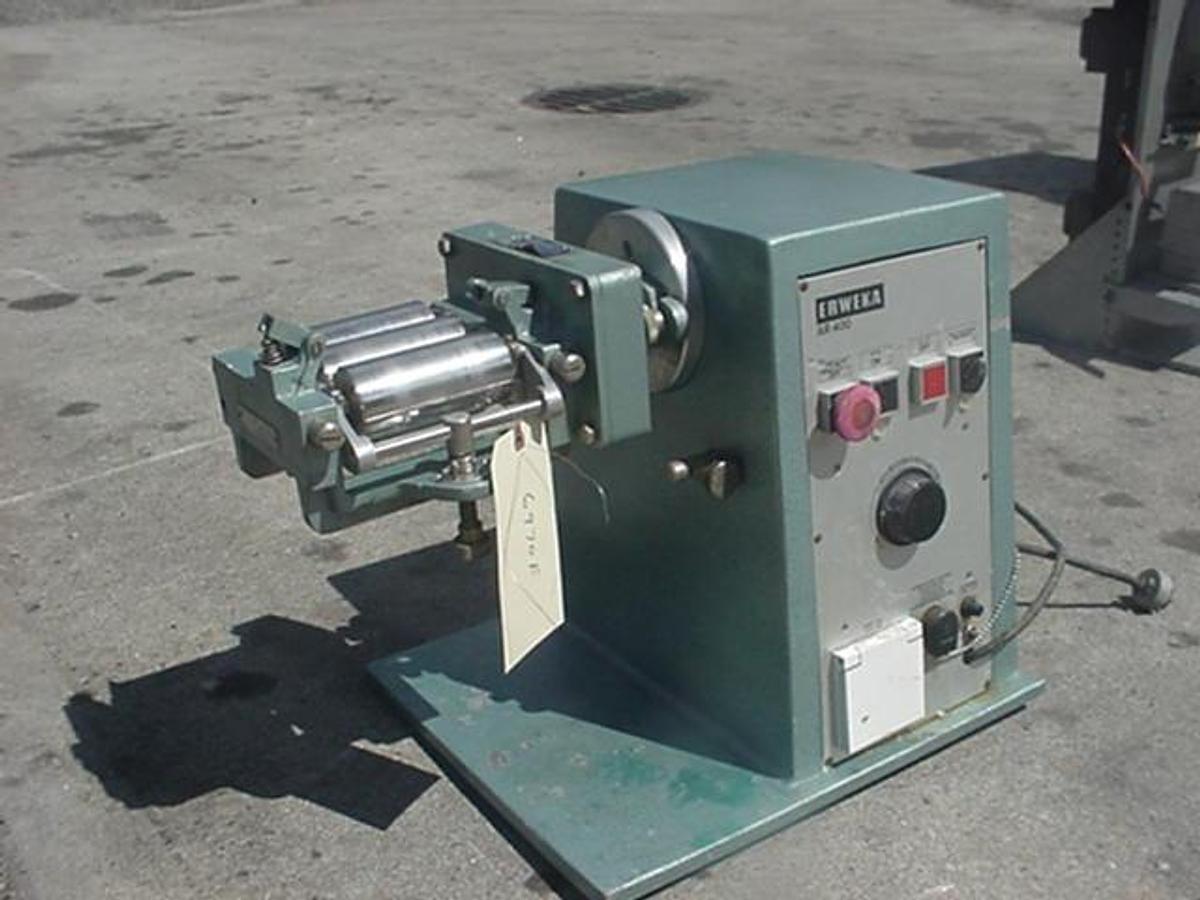
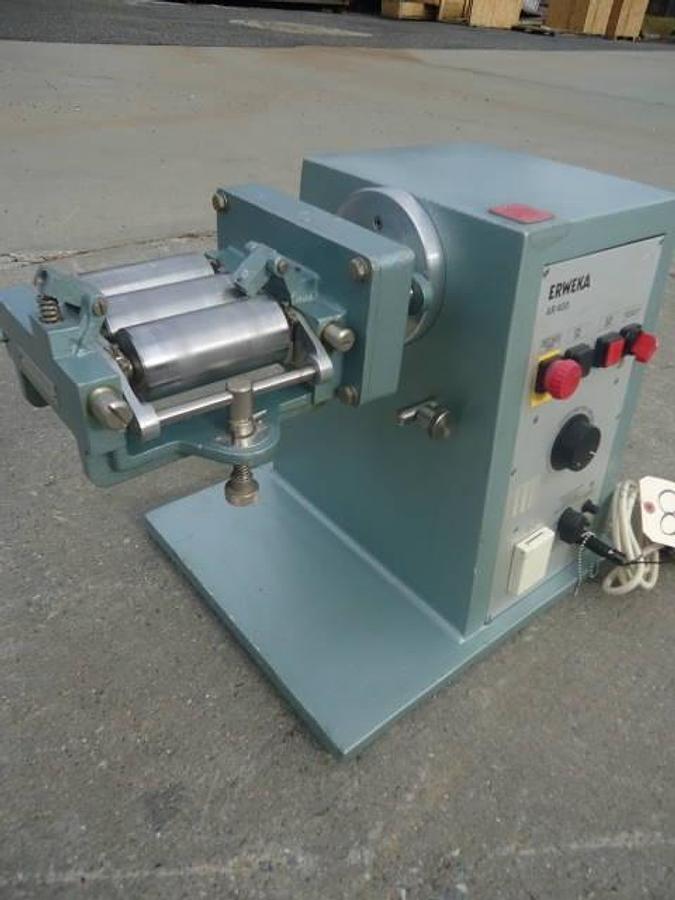
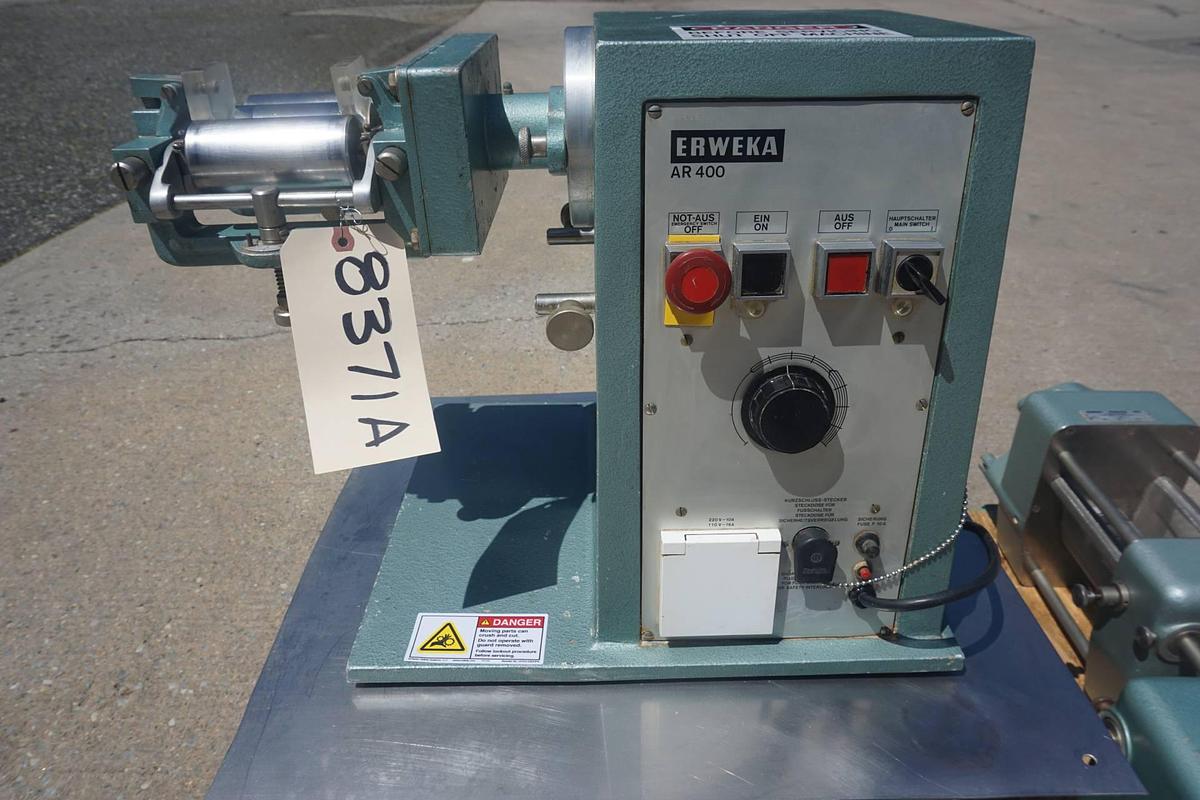
Erweka's three roll mills are compact, bench-scale mixing and dispersing instruments used primarily in pharmaceutical R&D and small-batch production settings. The three roll mill works by passing material through the gaps between three horizontally positioned, counter-rotating rollers, which creates intense shear forces that disperse and homogenize viscous materials. In pharmaceutical applications, this equipment is commonly used for mixing ointments, creams, gels, and suppository bases, as well as for dispersing pigments and active ingredients into semi-solid formulations. The lab-scale versions, such as the 2-inch by 4-inch and 2-inch by 4.5-inch models, are sized for development and small-scale compounding work rather than high-volume production.
Erweka's oscillating granulators are used in the granulation step of solid dosage form manufacturing, where they break down moist or dry masses into granules of controlled particle size by forcing material through a screen using an oscillating rotor. Granulation is a critical step in tablet and capsule manufacturing because it improves powder flow, compressibility, and content uniformity. Lab-scale oscillating granulators are frequently used during formulation development to simulate the granulation process before scaling up to production equipment. When purchasing used versions of either instrument, buyers should inspect the condition of the rolls or screens closely, since these contact parts are subject to wear and may need replacement, which should be factored into the total cost of acquisition.
Are replacement parts and consumables available for used Erweka equipment?
Parts availability for used Erweka equipment depends primarily on the age and model of the specific machine. Erweka, as an established manufacturer with decades of history, maintains parts support for many of its product lines, but the depth of that support diminishes for older or discontinued models. Before purchasing a used Erweka instrument, buyers are strongly encouraged to contact Erweka's service organization directly and confirm what spare parts, consumables, and calibration support are available for the specific model number and serial number range they are considering. This is especially important for dissolution testing equipment, where components like vessel sets, spindles, temperature probes, and drive assemblies are subject to wear and must meet pharmacopeial specifications.
For some Erweka instruments, particularly the more widely used dissolution and tablet testing platforms, a secondary market for parts and consumables exists through third-party suppliers. Tablet hardness tester jaws, friability drum screens, and dissolution vessel sets are examples of components that may be sourced from compatible third-party vendors when manufacturer parts are unavailable or cost-prohibitive. Buyers should also ask the used equipment seller whether any spare parts, extra accessories, or service documentation are included with the machine, since these additions can significantly reduce the cost and effort of putting the equipment back into service. A unit sold with a full vessel set, calibrated probes, and a service history is meaningfully more valuable than one sold as a bare instrument with no supporting materials.
What should buyers understand about shipping and logistics for used Erweka pharmaceutical equipment?
Shipping pharmaceutical instruments like Erweka dissolution testers, tablet hardness testers, and granulators requires careful packaging to prevent damage to precision components during transit. Dissolution testers in particular contain sensitive drive mechanisms, temperature control systems, and electronics that can be damaged by vibration or impact if the equipment is not properly secured. Reputable used equipment dealers will package machines on pallets or in custom crates depending on the size and fragility of the unit. The level of packaging directly affects shipping cost, and buyers should ask for a detailed breakdown of palletization or crating charges, freight costs, and any rigging fees before finalizing a purchase.
Larger or heavier Erweka equipment may require forklift handling or specialized rigging for loading at the seller's facility and unloading at the buyer's location. These rigging services carry additional costs that vary based on equipment weight, site accessibility, and whether a loading dock is available at either end of the shipment. Buyers should confirm their own facility's receiving capabilities before the equipment ships, since an unexpected need for a crane or specialized unloading equipment at the destination can create delays and added expense. Getting a full landed cost estimate, covering packaging, rigging, freight, and any applicable import duties for international shipments, before agreeing to purchase is the most reliable way to avoid cost surprises.
What payment terms are typical when purchasing used Erweka equipment from a dealer?
Most used pharmaceutical equipment dealers require full payment prior to releasing a machine for shipment. This is standard practice in the used equipment industry and reflects the fact that once a machine leaves the seller's facility, the transaction is effectively complete. Buyers should expect to pay in full before the equipment is packaged and loaded, and should factor this into their procurement planning, particularly for larger purchases that may require internal purchase order approval or capital expenditure authorization. Wire transfer is the most common payment method for used equipment transactions of significant value.
Some dealers may offer payment terms to established repeat customers with whom they have a prior transaction history, but this is the exception rather than the rule for first-time buyers. Buyers who require financing for equipment purchases should explore third-party equipment financing options independently, as most used equipment dealers are not set up to provide direct financing. Before sending any payment, buyers should ensure they have completed their inspection process and are satisfied with the condition and documentation of the equipment, since used equipment is typically sold as-is and payments are generally non-refundable once a transaction is finalized.
How does buying used Erweka equipment compare to purchasing from the manufacturer?
Purchasing used Erweka equipment from a secondary market dealer offers a significantly lower acquisition cost compared to buying a current model directly from the manufacturer, which is the primary driver for most buyers in this market. For pharmaceutical companies operating under tight capital budgets, R&D labs running small-scale experiments, or contract manufacturers looking to expand capacity without major capital outlay, used equipment can deliver the same core functionality at a fraction of the price. Erweka's reputation for precision manufacturing means that well-maintained used units can remain serviceable for many years beyond their initial sale, making the secondary market a practical sourcing channel.
The trade-offs are real, however, and buyers should go in with clear expectations. Used equipment is sold as-is, without the coverage that accompanies a purchase from a manufacturer. The buyer takes on responsibility for verifying condition through inspection, and any requalification, calibration, or repair costs after purchase fall to the buyer. Additionally, older Erweka models may have limited manufacturer support for parts or software updates, which can create complications in regulated environments that require documented maintenance and calibration trails. Buyers who need a fully validated, immediately deployment-ready instrument for a GMP environment should carefully weigh the requalification costs and timeline against the purchase price savings before deciding between a used unit and a current model with full manufacturer support.