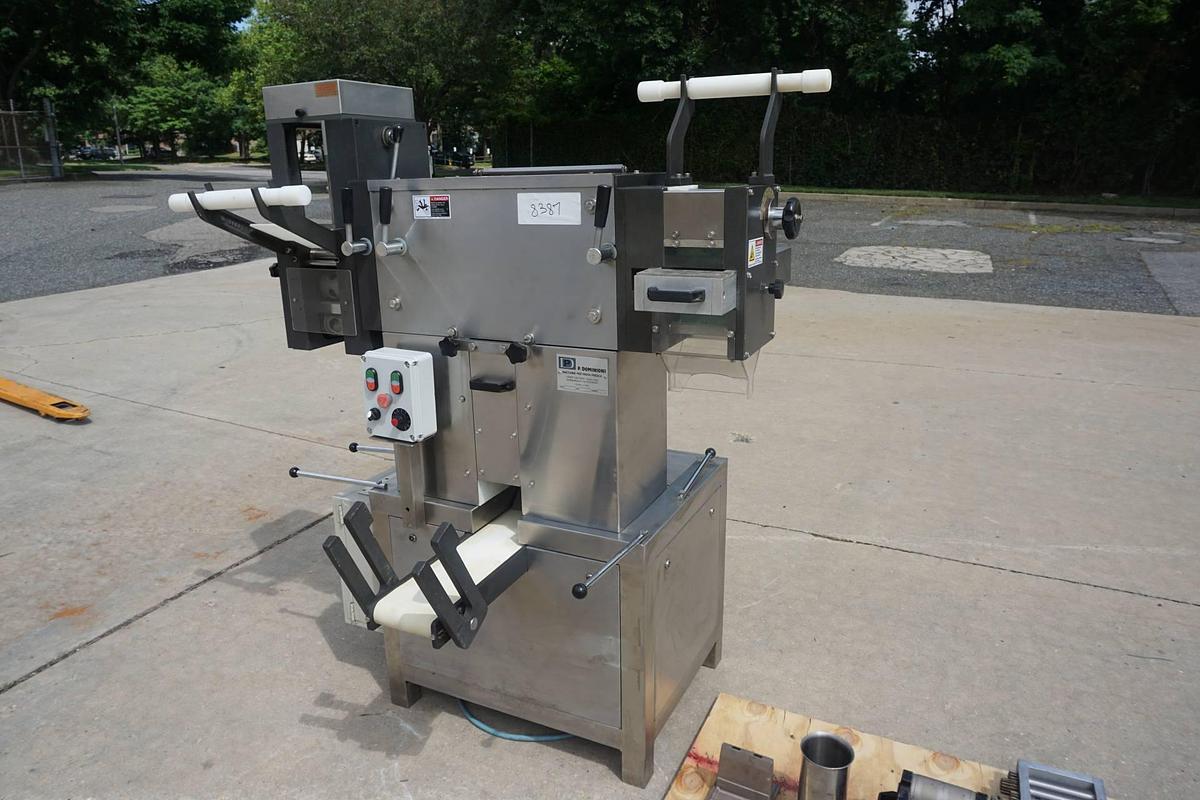
Category
Manufacturer
Model
Dominioni
Dominioni specializes in pasta-making machinery, providing equipment for both artisanal and industrial-scale pasta production.
FAQ:
What types of pasta can Dominioni machines produce?
Dominioni pasta machines are built to handle a wide range of pasta formats, from long cuts like spaghetti, tagliatelle, and pappardelle to short shapes such as rigatoni, penne, and fusilli. Many models also accommodate stuffed pasta production, including ravioli and tortellini, making them versatile enough to serve restaurants, specialty pasta shops, and small to mid-size food manufacturers. The A120 Combo, for example, combines sheeting, cutting, and ravioli-making functions in a single unit, which is a practical configuration for operations that need to switch between formats without investing in separate machines.
The variety of pasta shapes a Dominioni machine can produce depends largely on the dies used. Interchangeable dies are a core feature of the Dominioni lineup, allowing operators to swap between formats relatively quickly. Bronze dies are particularly popular among artisans and chefs because they impart a slightly rough, porous texture to the pasta surface, which helps sauces cling more effectively. Teflon-coated dies produce a smoother finish and tend to release dough more easily, which can be useful in higher-volume production runs. Having access to both die types gives operators flexibility to match their output to the preferences of their customers.
Is Dominioni pasta making equipment suitable for artisan shops, or is it designed only for industrial-scale production?
Dominioni has built a reputation for producing machinery that serves both ends of the production spectrum. Their equipment is used in artisan pasta shops and restaurants where quality and versatility take priority, as well as in semi-industrial facilities where consistent output and durability are the main concerns. This dual positioning is one of the reasons Dominioni machines remain in demand on the used equipment market long after their initial purchase, since the build quality tends to hold up well across years of regular use.
For smaller operations, models like the A120 Combo are particularly well-suited because they consolidate multiple production steps into one machine, reducing the footprint and capital required to produce a variety of pasta types. Larger facilities may gravitate toward dedicated sheeting or finishing machines like the RV540, which are designed to handle higher throughput as part of a broader production line. Buyers should assess their daily production volume and the range of pasta formats they intend to offer before selecting a specific model, as the right choice depends heavily on those operational factors.
What is the typical production capacity of Dominioni pasta machines?
Production capacity on Dominioni machines varies considerably depending on the model and configuration. Artisan-oriented machines are generally designed to produce anywhere from 20 to 80 kilograms of fresh pasta per hour, which is well-suited for a busy restaurant or a retail pasta shop with steady daily demand. Semi-industrial models can push well beyond that range, with some configurations capable of producing several hundred kilograms per hour when paired with appropriate drying and packaging equipment.
When evaluating a used Dominioni machine, it is worth considering not just the rated capacity of the unit but also its current mechanical condition, since output can be affected by wear on key components like the extrusion screw, dies, and cutting mechanisms. Asking the seller for details on the machine's service history and the conditions under which it was last operated can give a clearer picture of what to expect in practice. For buyers running a production-focused business, arranging a video inspection or in-person viewing to assess the machine's condition before purchase is a reasonable step.
What should buyers know about purchasing used Dominioni pasta machinery?
Buying used pasta machinery from a reputable dealer is a practical way to access Italian-engineered equipment at a fraction of the cost of a comparable machine purchased through a manufacturer's distribution channel. Dominioni machines are known for their durable construction, often featuring stainless steel components that resist corrosion and hold up well in food production environments, which means well-maintained used units can still deliver years of reliable service. That said, used equipment is sold as-is, so the buyer takes on the responsibility of assessing the machine's condition before committing to a purchase.
Reputable used equipment dealers will typically accommodate in-person inspections, virtual walkthroughs, or video captures of the machine in its current state. Some machines may still be installed in an active production facility, while others will have been decommissioned. It is important to note that most equipment dealers do not have the permitting required to run actual pasta production on-site, so testing with live product is generally not possible. Buyers should also contact Dominioni directly to understand what level of parts availability and technical support can be expected for a specific model and age of machine, as this can vary.
What is the price range for used Dominioni pasta making machines?
Pricing for used Dominioni pasta machinery depends on several factors, including the model, age, configuration, and overall condition of the equipment. Entry-level combo machines designed for artisan or small-scale production tend to be priced lower than dedicated industrial sheeters or finishing machines, which are more complex and carry higher replacement costs for components. As a general reference point, used artisan-grade pasta machines from established Italian manufacturers can range from a few thousand dollars to well over twenty thousand dollars depending on capacity and features.
Beyond the purchase price itself, buyers should factor in the full landed cost of the equipment, which includes packaging, crating, freight, and any rigging required for loading and unloading. Larger or heavier machines may require specialized lifting equipment at both origin and destination, which adds to the total expense. Asking the dealer for a complete breakdown of these costs before finalizing a purchase helps avoid surprises and allows for a more accurate comparison between available options.
What is the difference between bronze dies and Teflon dies on pasta machines, and which is better?
The choice between bronze and Teflon dies is one of the more meaningful decisions in pasta production, and it comes down to the texture and character of the finished product. Bronze dies create a slightly rough, matte surface on extruded pasta because the metal has a naturally porous texture that grips the dough as it passes through. This roughness is highly valued in artisan and restaurant settings because it allows sauces to adhere more effectively to the pasta surface, which improves the eating experience. Pasta made through bronze dies is widely considered the standard in traditional Italian production and is often marketed as a premium product.
Teflon-coated dies, by contrast, produce pasta with a smoother, slightly glossy surface because the non-stick coating reduces friction during extrusion. This makes the dies easier to clean and can support faster production cycles, which is why they are sometimes preferred in higher-volume industrial settings where throughput is the priority. For buyers evaluating a used Dominioni machine, understanding which type of dies are included with the purchase and whether additional dies are available is worth clarifying with the seller, as the die inventory can significantly affect the range of products the machine can produce right away.
How does stainless steel construction affect the value and longevity of pasta making equipment?
Stainless steel is the material of choice in food production equipment for good reason. It resists corrosion from moisture, dough acids, and cleaning chemicals, which are all constant factors in a pasta production environment. Machines built with stainless steel contact surfaces and structural components tend to maintain their hygiene standards more easily over time and are far less likely to harbor bacteria in surface pitting or rust. For buyers in regulated food production settings, stainless steel construction is often a requirement for compliance with local food safety standards.
From a resale and longevity standpoint, stainless steel construction is also a strong indicator of a machine's remaining useful life. A well-maintained Dominioni machine built with stainless steel components can remain in productive service for many years, which is part of why these machines hold their value on the secondary market. When inspecting a used unit, buyers should look closely at the condition of all stainless surfaces, particularly around the extrusion head and cutting area, where wear and residue buildup are most common. Surface condition is a reasonable proxy for how well the machine was maintained overall.
What is the Dominioni RV540 Finishing Machine used for?
The Dominioni RV540 is a finishing machine designed to handle the post-extrusion or post-cutting stages of pasta production. Finishing machines in a pasta production line typically perform functions such as surface treatment, drying preparation, or length cutting to bring the pasta to its final form before packaging or drying. In a complete production setup, a finishing machine like the RV540 works in coordination with a sheeter or extruder, handling the pasta after it has been formed and ensuring it meets the dimensional and surface standards required before the next stage.
For buyers considering a used RV540, it is useful to understand where in a production line this machine would fit and whether it is compatible with the other equipment already in use or planned for purchase. Finishing machines are often more specialized than combo units, so they tend to be a better fit for operations that are scaling up or building out a dedicated production line rather than a small shop looking for an all-in-one solution. Consulting with the seller about the machine's previous application and production history can help determine whether it aligns with the intended use.
What should buyers ask a dealer before purchasing used pasta machinery?
Before committing to a used pasta machine purchase, buyers should ask the dealer several practical questions to get a clear picture of what they are buying. Key areas to cover include the machine's age and production history, the reason it was taken out of service, whether any components have been replaced or repaired, and what condition the dies, cutting blades, and extrusion components are in. Buyers should also ask whether an inspection is available, either in person or via video, and whether the machine is currently installed in a working facility or has been decommissioned.
On the logistics side, buyers should request a full breakdown of packaging, crating, freight, and rigging costs to understand the total landed price. Most reputable dealers require full payment prior to shipping, so understanding payment terms upfront is important. It is also worth contacting the manufacturer directly to ask about parts availability and technical support for the specific model and production year, since older machines may have limited parts availability that could affect long-term serviceability. Choosing a dealer who specializes in food processing equipment and has a verifiable track record in the industry reduces the risk that comes with buying used machinery.
How does the Dominioni A120 Combo differ from buying separate sheeting, cutting, and ravioli machines?
The A120 Combo integrates three production functions into a single machine: pasta sheeting, cutting, and ravioli forming. For operations with limited floor space or capital, this kind of combined unit offers a meaningful practical advantage. Rather than sourcing, installing, and maintaining three separate machines, an operator can run multiple pasta formats from one piece of equipment. The tradeoff is that a combo machine typically cannot run all three functions simultaneously at the same throughput that dedicated machines could achieve independently, so it is better suited to smaller batch production or operations that rotate between formats rather than running continuous high-volume output.
From a used equipment standpoint, combo machines like the A120 can represent strong value because they consolidate functionality that would otherwise require a larger investment and more complex line setup. Buyers should inspect all three functional areas of the machine carefully during any pre-purchase evaluation, since each section has its own wear points. The sheeting rollers, cutting blades, and ravioli mold components should all be assessed for wear, alignment, and cleanliness. A machine that has been used heavily for one function may show more wear in that section than the others, which is worth factoring into the purchase decision.