Category
Manufacturer
Model
FAQ:
What is a nitrogen freeze tunnel and how does it work?
A nitrogen freeze tunnel is a cryogenic freezing system that moves food products on a conveyor belt through an insulated enclosure where liquid nitrogen (LIN) is injected and vaporized. Liquid nitrogen boils at approximately -196 degrees Celsius, which means the freezing environment inside the tunnel is dramatically colder than anything a mechanical refrigeration system can achieve. As products travel through the tunnel, they are exposed to a controlled flow of extremely cold nitrogen gas, which freezes the surface and core of the product in a fraction of the time required by conventional methods. The speed of this process is what makes cryogenic tunnels attractive to high-volume food processors.
The rapid freezing rate has a direct impact on product quality. When food freezes slowly, water molecules inside the cells have time to form large ice crystals that puncture cell walls and cause moisture loss during thawing. Cryogenic freezing creates much smaller ice crystals, which preserves cellular structure, texture, and moisture content far more effectively. This translates to less drip loss after thawing, better appearance, and a product that more closely resembles its fresh state. For processors selling products by weight, the reduction in drip loss alone can represent meaningful revenue recovery over the course of a production year.
What food products and industries are best suited for nitrogen freeze tunnels?
Nitrogen freeze tunnels are used across a wide range of food categories where quality preservation during freezing is a commercial priority. Seafood and shellfish are among the most common applications because the delicate texture of fish fillets, shrimp, and scallops degrades quickly with slow freezing. Poultry and meat processors use cryogenic tunnels to lock in moisture and maintain appearance, particularly for individually quick frozen (IQF) portions. Bakery products, including par-baked breads, pastries, and dough pieces, benefit from the rapid crust-setting that cryogenic temperatures provide. Ready meals, fruits, and vegetables are also well-suited to the process, especially when producers need to maintain visual appeal and texture through the freeze-thaw cycle.
Beyond food processing, cryogenic tunnel technology is occasionally applied in pharmaceutical and nutraceutical manufacturing where temperature-sensitive compounds need to be frozen quickly and uniformly. That said, food processing represents the dominant market for this equipment. The technology is particularly valuable in operations where product throughput is high, cycle times are tight, and quality differentiation matters commercially. Processors who sell premium or branded frozen products tend to prioritize cryogenic freezing over mechanical alternatives because the end-product quality difference is visible to consumers and measurable in reduced customer returns and complaints.
How do the operating costs of a nitrogen freeze tunnel compare to mechanical freezing systems?
Operating cost comparisons between cryogenic and mechanical freezing depend heavily on local liquid nitrogen pricing, production volume, and the specific products being frozen. Cryogenic systems consume liquid nitrogen continuously during operation, and LIN is an ongoing consumable cost that mechanical refrigeration systems do not have. In regions where industrial gas pricing is high or supply logistics are complex, the per-kilogram cost of cryogenic freezing can exceed that of mechanical alternatives over time. This is why many processors evaluate total cost of ownership carefully before committing to cryogenic equipment, factoring in not just the equipment acquisition cost but the long-term gas supply agreement that often accompanies it.
On the other side of the ledger, cryogenic tunnels have lower capital costs than comparable-capacity mechanical spiral or belt freezers, require less floor space, have fewer moving parts to maintain, and can reach operating temperature in minutes rather than hours. For operations running multiple short production shifts or freezing a diverse mix of products with different cycle requirements, the operational flexibility of a nitrogen tunnel can offset the higher consumable cost. Reduced drip loss is another financial factor worth quantifying: if a processor freezes products sold by weight and cryogenic freezing reduces moisture loss by even one to two percent compared to mechanical freezing, that recovered weight across thousands of kilograms of annual production can represent significant additional revenue. A thorough cost analysis should account for all of these variables rather than focusing solely on the price of liquid nitrogen.
What throughput capacities are typically available for Air Products nitrogen freeze tunnels?
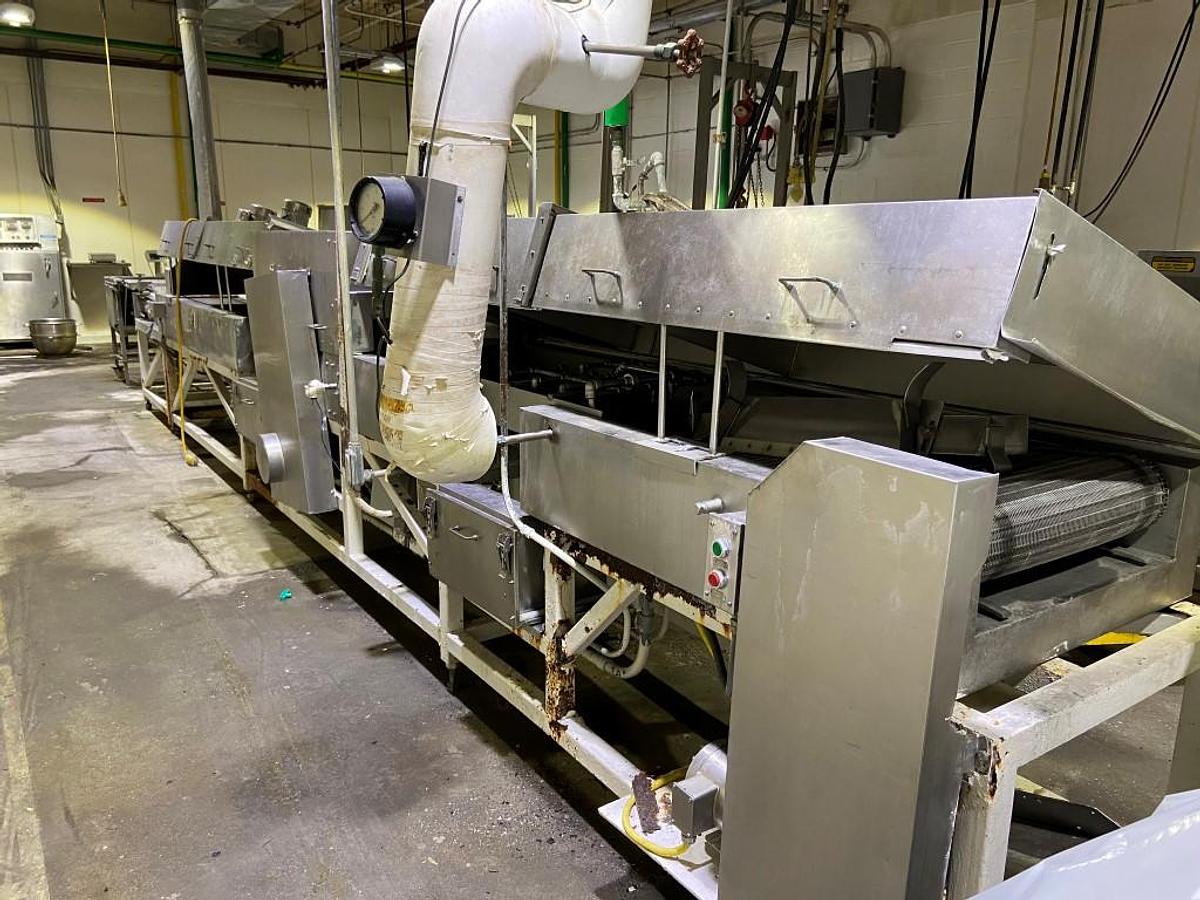
Air Products has produced nitrogen freeze tunnels across a range of sizes and throughput capacities to serve different production scales. Smaller tunnel configurations are suited to lower-volume specialty processors or operations with limited floor space, while larger industrial models are designed for continuous high-volume production environments. The used Air Products tunnels that appear on the market reflect this range, with units varying significantly in belt width, tunnel length, and the resulting freezing capacity they can deliver. For example, tunnels with a 42-inch belt width and a 38-foot length represent a substantial production-scale machine capable of handling meaningful throughput in a commercial food processing facility.
Actual throughput in kilograms per hour depends on multiple factors beyond the physical dimensions of the tunnel: the product being frozen, its initial temperature, the target core temperature, the depth of the product layer on the belt, and the belt speed setting. Thin, individually placed items like shrimp or burger patties will pass through faster than a thick, dense product like a whole chicken portion. Prospective buyers evaluating a used nitrogen tunnel should ask the seller for any available production records or specifications that indicate what the machine was processing and at what throughput in its previous installation, as this provides the most practical indication of real-world capacity for a similar application.
How quickly does a nitrogen freeze tunnel reach operating temperature compared to mechanical systems?
One of the practical advantages of cryogenic nitrogen tunnels is their startup speed. Because liquid nitrogen vaporizes immediately upon injection and does not rely on a refrigeration cycle to pull heat out of a closed system, a nitrogen freeze tunnel can reach its target operating temperature in a matter of minutes after startup. This is a meaningful operational benefit for food processors who run multiple production shifts, change product lines frequently, or need to start and stop freezing operations without long lead times. There is no compressor warm-up period, no refrigerant charge to stabilize, and no extended cooldown phase before the tunnel is ready to accept product.
Mechanical freezers, including spiral freezers and plate freezers, typically require anywhere from 30 minutes to several hours to reach stable operating temperatures depending on their size and design. During that startup window, energy is being consumed without any product being frozen. For operations where production schedules are variable or where the freezer sits idle between shifts, the rapid startup capability of a cryogenic tunnel reduces wasted energy and allows more responsive production scheduling. This characteristic also makes nitrogen tunnels attractive as backup or overflow freezing capacity alongside a primary mechanical system, since they can be brought online quickly when production demand spikes.
What should buyers know about purchasing a used Air Products nitrogen freeze tunnel?
Buying a used nitrogen freeze tunnel requires more due diligence than purchasing standard mechanical processing equipment, partly because the cryogenic components and insulation integrity are critical to the machine's performance. Prospective buyers should arrange a thorough inspection, either in person or via detailed video, to assess the condition of the conveyor belt and drive system, the insulated tunnel body, the liquid nitrogen injection manifolds, and the control panel. Any signs of insulation degradation, corrosion on stainless surfaces, or damage to the LIN supply connections should be noted and factored into the evaluation. Reputable used equipment dealers who specialize in food processing machinery will typically accommodate inspection requests and can provide documentation on the machine's history where available.
Because used equipment is sold as-is, buyers carry the responsibility of assessing the machine's condition and suitability for their application. It is worth contacting Air Products directly to ask about parts availability and technical support for the specific model being considered, since older models may have limited manufacturer support. Buyers should also budget for any reconditioning, replacement of wear components, and installation costs beyond the purchase price. Shipping a large stainless tunnel requires proper rigging and crating, and those logistics costs can be substantial for machines of this size. Getting a clear picture of the total landed and installed cost before committing to a purchase is essential to making a sound investment decision.
What safety features are typically included with nitrogen freeze tunnels?
Nitrogen freeze tunnels operate with liquid nitrogen, which introduces specific safety considerations that the equipment is designed to manage. Because nitrogen is an inert gas that displaces oxygen, a key safety concern in any cryogenic freezing installation is oxygen deficiency in the surrounding work area. Well-designed nitrogen tunnels include oxygen monitoring systems that trigger alarms and shut off LIN supply if ambient oxygen levels drop below safe thresholds. Proper ventilation of the production area is also a standard requirement in any installation using cryogenic equipment. These systems are not optional add-ons but fundamental safety infrastructure for operating this type of freezer.
Other safety features typically found on nitrogen freeze tunnels include emergency stop controls accessible from multiple points along the tunnel, temperature monitoring systems that track conditions inside the freezing zone, and interlocks that prevent LIN injection if the conveyor belt is not running. The tunnel enclosure itself is insulated to contain the cold environment and minimize condensation and frost accumulation in the surrounding area. When evaluating a used machine, buyers should verify that all safety systems are present and functional, and should ensure that their facility's ventilation and oxygen monitoring infrastructure meets the requirements for safe cryogenic operation before commissioning the equipment.
What is the typical footprint of an Air Products nitrogen freeze tunnel?
Nitrogen freeze tunnels are generally more compact than mechanical spiral freezers of comparable capacity, which is one reason they appeal to processors with limited floor space. The physical footprint is determined primarily by the tunnel length and belt width. Air Products has produced tunnel freezers in configurations ranging from relatively compact units around 20 feet in length to larger production-scale models approaching and exceeding 40 feet. A 38-foot tunnel with a 42-inch belt width, for example, occupies a linear run of floor space roughly equivalent to a modest production line, but the width of the machine itself is relatively narrow compared to a spiral freezer.
Beyond the tunnel footprint itself, installations require additional clearance for LIN supply lines and storage tanks, access space along the sides for maintenance, and adequate ventilation infrastructure. The LIN storage tank is typically located outside the building or in a designated area with appropriate safety clearances, and the supply line runs into the production area to connect to the tunnel. Buyers should work with a qualified cryogenic equipment installer to plan the full installation layout, including all ancillary equipment and safety systems, before finalizing a facility plan. The compact nature of the tunnel body is an advantage, but the complete installed system requires thoughtful space planning.
How does the liquid nitrogen supply relationship work when operating a nitrogen freeze tunnel?
Liquid nitrogen is a consumable that must be continuously supplied to keep a cryogenic freeze tunnel operating, and managing that supply is a core operational consideration for any processor using this technology. LIN is typically delivered by tanker truck and stored in an insulated cryogenic storage vessel on-site. The storage tank feeds the tunnel through an insulated supply line, and the rate of consumption varies based on the product load, tunnel settings, and ambient conditions. Processors need to monitor tank levels and coordinate deliveries to ensure uninterrupted production, since running out of LIN mid-shift brings freezing operations to a halt immediately.
Air Products, as a major global industrial gas supplier, has historically bundled gas supply agreements with equipment sales, meaning that purchasers of Air Products freezing equipment were often also entering a long-term LIN supply relationship with the company. Buyers of used Air Products tunnels on the secondary market are not bound by any prior supply agreement and are free to source liquid nitrogen from any industrial gas supplier. This can be an advantage, as it allows buyers to negotiate competitive LIN pricing based on their volume and location. Before purchasing a used tunnel, it is worth getting LIN pricing quotes from multiple suppliers in the region to accurately model the ongoing operating cost of the equipment.
What should buyers ask a used equipment dealer before purchasing a nitrogen freeze tunnel?
Before committing to a used nitrogen freeze tunnel, buyers should gather as much information as possible about the machine's history and current condition. Key questions include: What product was the tunnel freezing in its previous installation, and at what throughput? How long was the machine in service? Was it decommissioned from active production or taken out of a facility that closed? Is the control panel complete and functional? Are the conveyor belt and drive components intact? What is the condition of the insulated tunnel body and LIN injection system? Asking for photographs or a video walkthrough of the machine is a reasonable starting point, but an in-person or live video inspection is strongly preferred for a capital purchase of this size.
Buyers should also ask about logistics and total landed cost. Questions worth raising include: How will the machine be prepared for shipping, and what crating or packaging is included? What rigging will be required for loading and unloading, and who is responsible for those costs? Is the machine available for inspection at its current location, and can it be seen in its installed state? What documentation, including manuals, wiring diagrams, or maintenance records, is available with the machine? Reputable dealers who specialize in food processing equipment will have straightforward answers to these questions and will support a reasonable inspection process. Dealers who are unwilling to accommodate inspection requests or who cannot provide basic documentation should be approached with caution.