Category
Subcategory
Manufacturer
Model
FAQ:
What is A&D Weighing and why are their electric scales well regarded?
A&D Company, Limited is a Japanese precision measurement manufacturer with over four decades of experience producing weighing and measurement equipment. The company has built a strong reputation across a wide range of industries, including laboratory research, industrial production, medical facilities, and retail trade. Their electric scales are known for combining accurate measurement technology with durable construction, which has made them a frequently specified brand in demanding commercial and scientific environments.
A&D's product catalog covers a broad spectrum of weighing needs, from analytical balances capable of measuring in fractions of a milligram to heavy-duty industrial floor scales rated for hundreds of kilograms. This versatility means buyers in very different industries often look to A&D as a single-brand solution for multiple weighing applications. Used A&D electric scales are particularly sought after because the brand's build quality tends to hold up well over time, making pre-owned units a practical option for buyers who want reliable performance without paying the price of a recently manufactured machine.
What types of A&D electric scales are available on the used equipment market?
The used market for A&D electric scales is fairly diverse because A&D manufactures equipment across several distinct product categories. Buyers commonly encounter analytical balances (such as the GX and GF series), precision balances, compact bench scales, industrial platform scales, postal and shipping scales, moisture analyzers, and medical-grade scales. Each category is designed for a different range of capacities and readability levels, so the right type depends heavily on the application.
Used A&D electric scales listed by reputable dealers are typically described by their model number, capacity, and readability, which are the three most important specifications for matching a scale to a specific task. Single-phase electric balance and scale units are among the most commonly listed configurations. When shopping for a used A&D scale, it is worth cross-referencing the model number against A&D's published specification sheets to confirm the unit's original rated capacity, division size, power requirements, and any certifications it may have carried when it was first placed into service.
What weight capacities and readability levels do A&D electric scales typically offer?
A&D electric scales span an extremely wide range of capacities and readability values, which is one reason the brand appears across so many industries. On the high-precision end, A&D analytical balances can read to 0.0001 grams (0.1 mg) with capacities typically ranging from 120 grams to 520 grams. Precision balances step down in resolution but step up in capacity, often reading to 0.01 grams with capacities up to several kilograms. Industrial and bench scales can handle capacities from a few kilograms up to several hundred kilograms, with readability measured in grams or even tens of grams depending on the model.
For buyers evaluating a used A&D scale, the two most critical specifications are the maximum capacity (the largest load the scale can legally and accurately measure) and the readability or division size (the smallest increment displayed). These two figures together determine whether a particular unit is appropriate for a given task. A laboratory needing to weigh small chemical samples has very different requirements than a food manufacturer checking package weights on a production line, and A&D's product range reflects that reality. Always verify both figures from the model's specification documentation before purchasing a used unit.
Are A&D electric scales NTEP certified for legal-for-trade use in the United States?
Many A&D electric scale models carry NTEP (National Type Evaluation Program) certification, which is administered by the National Conference on Weights and Measures (NCWM) in the United States. NTEP certification is a legal requirement for scales used in commercial trade transactions where goods are bought or sold by weight, such as in grocery stores, butcher shops, shipping operations, and farmers markets. A scale without NTEP approval cannot legally be used for those purposes in most U.S. jurisdictions.
When buying a used A&D scale intended for trade use, it is essential to confirm that the specific model holds an active NTEP Certificate of Conformance and that the unit itself is in compliance with applicable Handbook 44 requirements. NTEP certificates are tied to specific model configurations, so modifications or damage to a unit can affect its legal status. Buyers should ask the dealer for the model number and check the NTEP database directly to verify certification status. Not all A&D scales are NTEP certified, particularly analytical and laboratory balances, which are designed for scientific measurement rather than commercial trade.
What is the difference between A&D precision balances and A&D industrial scales?
A&D precision balances and A&D industrial scales serve fundamentally different purposes, and the distinction matters a great deal when selecting a used unit. Precision balances and analytical balances are designed for high-accuracy measurement of relatively small samples. They typically feature enclosed weighing chambers to shield against air currents, internal or external calibration weights, and readability down to 0.001 grams or finer. These instruments are built for laboratory, pharmaceutical, gemological, and research applications where accuracy takes priority over ruggedness.
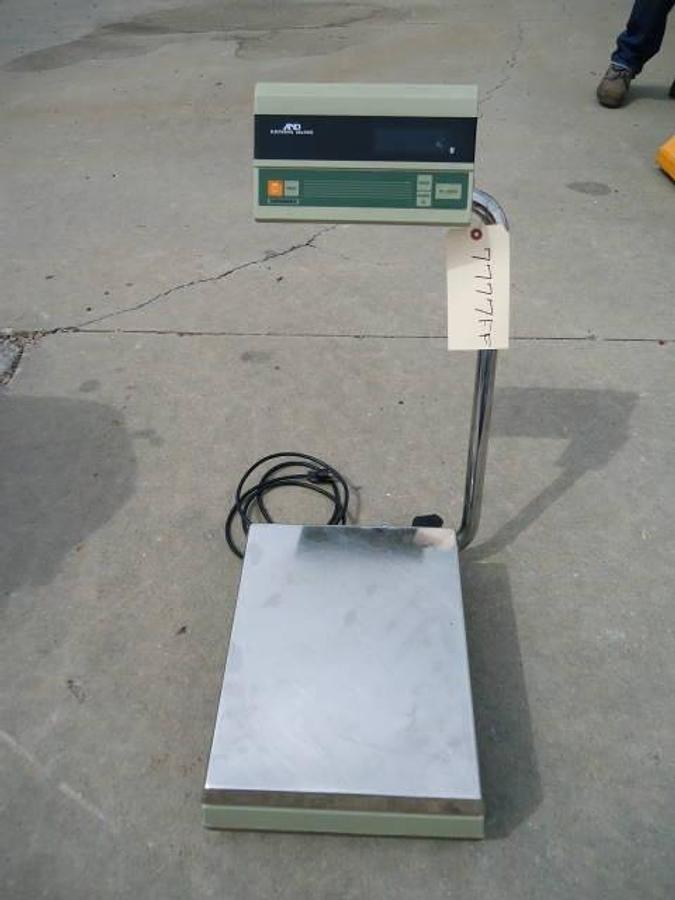
A&D industrial scales, by contrast, are built for high-capacity, high-throughput environments where durability and speed matter more than microgram-level accuracy. Industrial platform scales, bench scales, and counting scales in the A&D lineup are designed to handle heavier loads, resist dust and moisture (many carry IP ratings for ingress protection), and withstand the physical demands of factory floors, warehouses, and shipping docks. The readability on industrial models is coarser, often in 1-gram, 2-gram, or 5-gram increments, but the capacity can reach hundreds of kilograms. Choosing between the two categories starts with identifying the weight range and the accuracy level the application actually requires.
Can A&D electric scales be used for laboratory or scientific applications?
A&D has a well-established presence in laboratory and scientific settings, primarily through its analytical balance and precision balance product lines. The GX series, for example, features internal automatic calibration, a motorized draft shield, and readability to 0.0001 grams, making it suitable for pharmaceutical compounding, chemical analysis, quality control testing, and academic research. The GF series offers similar precision with external calibration at a lower price point. Both are widely used in university labs, industrial R&D departments, and regulated manufacturing environments.
Used A&D laboratory balances can represent good value for research institutions, teaching labs, or small businesses that need accurate measurement equipment but have limited budgets. Before purchasing a used analytical balance, buyers should consider the condition of the internal calibration mechanism, the state of the draft shield, and whether the unit has been serviced or calibrated recently. It is also worth consulting with A&D directly about parts and technical support availability for the specific model, since older or discontinued models may have limited support options. A reputable used equipment dealer should be able to provide a video or in-person inspection to show the unit's current operating condition.
Are A&D electric scales compatible with external printers, computers, or data collection systems?
Most A&D electric scale models include at least one data output interface, and many include multiple connectivity options. RS-232C serial ports have been a standard feature on A&D scales for many years, allowing connection to printers, computers, and data loggers. More recent models also include USB ports, and some support RS-485 for multi-device network configurations. A&D has historically provided free PC software (WinCT) that works with their RS-232C and USB-connected scales to capture weight data directly into spreadsheet applications or dedicated data management programs.
For buyers integrating a used A&D scale into an existing workflow, the key is to match the scale's available interface to the receiving system. RS-232C connections require a serial port or a USB-to-serial adapter on the host computer. The communication parameters (baud rate, data bits, parity) need to match between the scale and the software. Documentation for A&D scale communication protocols is generally available from A&D's support resources, which is helpful when setting up older used units. Buyers should ask the dealer to confirm which interface ports are present and functional on the specific unit being purchased.
What power options do A&D electric scales typically use?
A&D electric scales generally run on AC power through an external adapter, and many models also support battery operation for portability. The AC adapter requirement varies by model, with most bench and analytical units designed for standard single-phase AC power (100-240V on many models, though some older units are voltage-specific). Industrial platform scales with large displays or high-capacity load cells may draw more power and are typically AC-only. The listing description of "single phase" on used A&D electric scales refers to this standard AC power configuration.
Battery operation, where supported, usually relies on rechargeable internal batteries or standard AA cells, and the scale's display will typically indicate when battery power is low. For buyers purchasing a used A&D scale, it is worth confirming that the correct AC adapter is included with the unit, since A&D adapters are model-specific and using the wrong voltage or polarity can damage the electronics. If the adapter is missing, the model number can be used to source a compatible replacement. Dealers should be able to clarify what accessories are included with a particular used unit before purchase.
What should buyers look for when inspecting a used A&D electric scale before purchasing?
Inspecting a used A&D electric scale carefully before committing to a purchase is important because, like all used equipment, these machines are sold as-is. The most critical things to assess are the condition of the load cell (the internal sensor that generates the weight reading), the display, the keypad or touchpad, the pan or platform surface, and any connectivity ports. Visible damage to the weighing pan, corrosion on contact surfaces, or a cracked display housing can all indicate heavier wear or prior misuse. For analytical balances, the draft shield glass and the internal calibration mechanism deserve particular attention.
Reputable used equipment dealers will typically accommodate in-person inspections at their facility, or provide video walkthroughs and recorded demonstrations of the scale powering on and displaying a reading. Some units may still be installed in an active production facility, in which case the dealer can often arrange an inspection at the site. Keep in mind that most equipment dealers do not have the permits or production setup needed to run a full product test, so the inspection will generally confirm that the unit powers on, the display functions, and the controls respond, rather than a calibrated accuracy verification. Buyers who need certified accuracy should plan to have the scale professionally calibrated after purchase and installation.
What should buyers understand about shipping and payment for used A&D electric scales?
Shipping costs for used A&D electric scales depend on the size and weight of the unit, the packaging required to protect it in transit, and the destination. Compact bench scales and analytical balances are relatively straightforward to palletize and ship via standard freight carriers. Larger industrial platform scales may require custom crating, and heavy units may need forklift or rigging services for loading and unloading, which adds to the total landed cost. Buyers should request a detailed shipping quote that breaks out packaging, freight, and any rigging fees so there are no surprises.
For payment, most used equipment dealers require full payment before a machine is released for shipping. Some dealers extend terms to established repeat customers, but this is not the norm for first-time buyers. Wire transfer and credit card are common payment methods. It is a good practice to confirm all details in writing before submitting payment, including the specific model and serial number of the unit, what accessories are included, the agreed shipping terms, and the packaging method that will be used to protect the scale during transit.