Category
Manufacturer
Model
A&B Process
A&B Process Systems is a leader in providing exceptional processing equipment to the food processing and pharmaceutical industries. They are particularly known for their state-of-the-art stainless steel vessels and process modules, which are integral to safe and effective production operations.
FAQ:
What types of equipment does A&B Process Systems manufacture?
A&B Process Systems is a Wisconsin-based manufacturer that specializes in stainless steel process equipment for sanitary and regulated production environments. Their product line covers a wide range of processing needs, including sanitary tanks, jacketed pressure vessels, mixing systems, ribbon blenders, heat exchangers, clean-in-place (CIP) systems, and fully integrated process skids. The equipment is fabricated primarily from 304 and 316L stainless steel, which provides the corrosion resistance and durability required in demanding production settings.
The company is particularly well regarded for its sanitary vessels and process modules, which are designed to support safe, contamination-free production. A&B also produces custom-engineered solutions alongside standard catalog equipment, giving facilities the flexibility to match equipment to specific process requirements. Used A&B Process equipment appears regularly on the secondary market, covering everything from individual tanks and blenders to complete skid-mounted process systems.
What industries use A&B Process Systems equipment?
A&B Process Systems equipment is designed primarily for industries where sanitary construction, regulatory compliance, and material purity are non-negotiable. The food processing, beverage, and dairy industries are among the most common users, relying on A&B vessels, mixers, and CIP systems to meet strict hygiene and food safety standards. The pharmaceutical and biotech sectors are also major users, given the equipment's compatibility with FDA-grade materials and its ability to meet the contamination control requirements of drug and biologic manufacturing.
Because A&B equipment is built to meet standards like 3-A Sanitary Standards and ASME code requirements, it is well-suited for any application where product integrity, cleanability, and regulatory traceability matter. Facilities processing nutraceuticals, cosmetics, and specialty chemicals also frequently use A&B equipment for similar reasons. When purchasing used A&B Process machinery, buyers from these industries should verify that the specific unit meets the standards relevant to their application, as configurations and certifications can vary by model and build year.
What sanitary and regulatory standards does A&B Process equipment meet?
A&B Process Systems equipment is built to comply with several of the most recognized sanitary and safety standards in the food and pharmaceutical industries. This includes 3-A Sanitary Standards, which govern the design and construction of equipment that contacts food and beverage products, as well as ASME code compliance for pressure vessels. Materials used in product-contact surfaces are typically 316L stainless steel, which is compatible with FDA requirements for food-grade and pharmaceutical-grade applications.
For buyers purchasing used A&B Process equipment, it is worth verifying the documentation associated with a specific machine, including any original data plates, ASME stamps, or 3-A certification markings. A reputable used equipment dealer should be able to provide available documentation and allow inspection of the unit so buyers can assess its current condition relative to their compliance needs. Consulting directly with A&B Process Systems or a qualified process engineer can also help determine whether a particular used unit is appropriate for a regulated production environment.
Why is 316L stainless steel important in process equipment for food and pharmaceutical applications?
316L stainless steel is the material of choice for product-contact surfaces in food, beverage, dairy, and pharmaceutical equipment because of its superior corrosion resistance compared to standard 304 stainless steel. The addition of molybdenum in 316L gives it better resistance to chlorides and acidic cleaning agents, which are common in sanitary production environments. The low carbon content (the "L" designation) reduces the risk of carbide precipitation during welding, which helps maintain corrosion resistance at weld joints. These properties make 316L surfaces easier to clean, less prone to harboring bacteria, and more durable over long service lives.
In regulated industries, material traceability matters as well. A&B Process Systems uses 316L stainless steel extensively in their vessels and process modules, and mill certifications are typically generated at the time of fabrication. When evaluating used A&B Process equipment, buyers should ask whether any available material documentation accompanies the unit. While documentation may not always be available for older equipment on the secondary market, the physical condition of the stainless steel surfaces, including weld quality, surface finish, and absence of pitting or corrosion, is a key factor to assess during inspection.
What should buyers inspect when purchasing used A&B Process equipment?
Buying used process equipment requires a more hands-on evaluation than purchasing from a manufacturer, since each machine has its own service history and condition. For A&B Process vessels and tanks, key inspection points include the condition of interior product-contact surfaces (looking for pitting, corrosion, scratches, or weld repairs), the integrity of gaskets and seals, the condition of agitator shafts and mechanical seals, and the functionality of any heating or cooling jackets. For blenders and mixing systems, the drivetrain, ribbon flights, and discharge valve condition are worth close examination.
Most reputable used equipment dealers will accommodate in-person inspections at their facility, or can provide video walkthroughs and detailed photo sets if travel is not practical. Some equipment may still be located at the facility where it was last in production, which can allow buyers to see it in a working context. Keep in mind that used equipment dealers typically do not have the permits or production infrastructure to run actual product trials, so functional testing is generally limited to dry runs or mechanical checks. Buyers should factor inspection findings into their purchase decision, and may want to consult with a qualified process engineer or the equipment manufacturer to assess the condition of a specific unit.
What is a jacketed sanitary tank, and what is it used for?
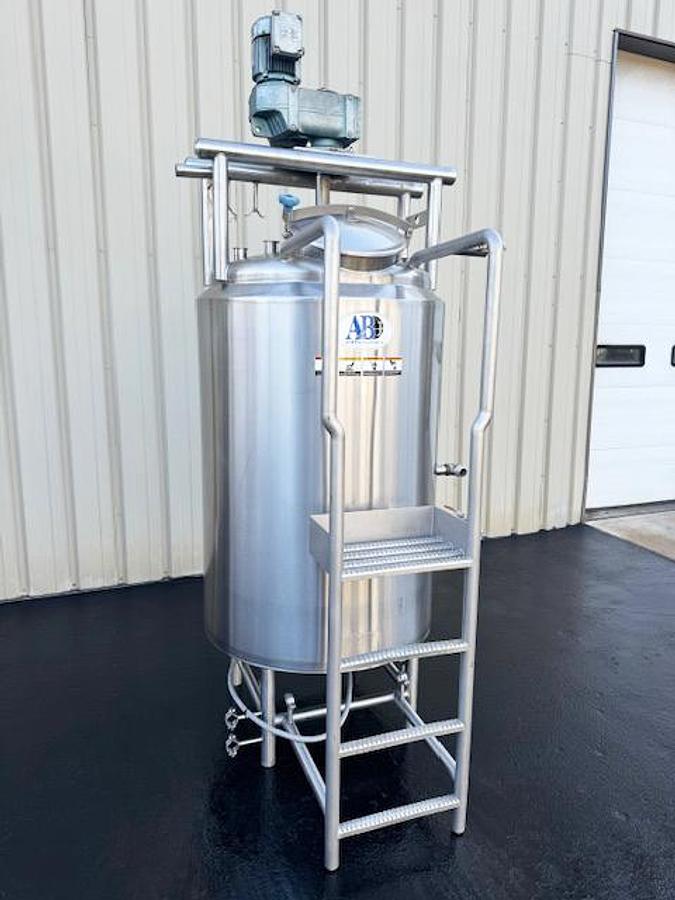
A jacketed sanitary tank is a vessel constructed with an outer shell surrounding the main tank body, creating a space (the jacket) through which a heating or cooling medium, such as steam, hot water, or glycol, can circulate. This design allows precise temperature control of the product inside the tank without direct contact between the heating or cooling medium and the product itself. Jacketed tanks are used extensively in food processing, dairy, pharmaceutical, and chemical manufacturing for applications like cooking, blending, fermenting, pasteurizing, cooling, and holding temperature-sensitive products.
A&B Process Systems produces jacketed sanitary tanks in various capacities and configurations, including units with scraper agitators designed to keep viscous products moving and prevent them from sticking to the vessel walls. A 250-gallon jacketed tank with a scraper agitator, for example, is a common piece of equipment in facilities processing sauces, creams, gels, or other thick-bodied products. On the used equipment market, jacketed tanks are among the more sought-after items because they represent significant capital investment when purchased from a fabricator, and a well-maintained used unit can provide years of additional service at a fraction of the cost.
What is a double ribbon blender and what applications is it suited for?
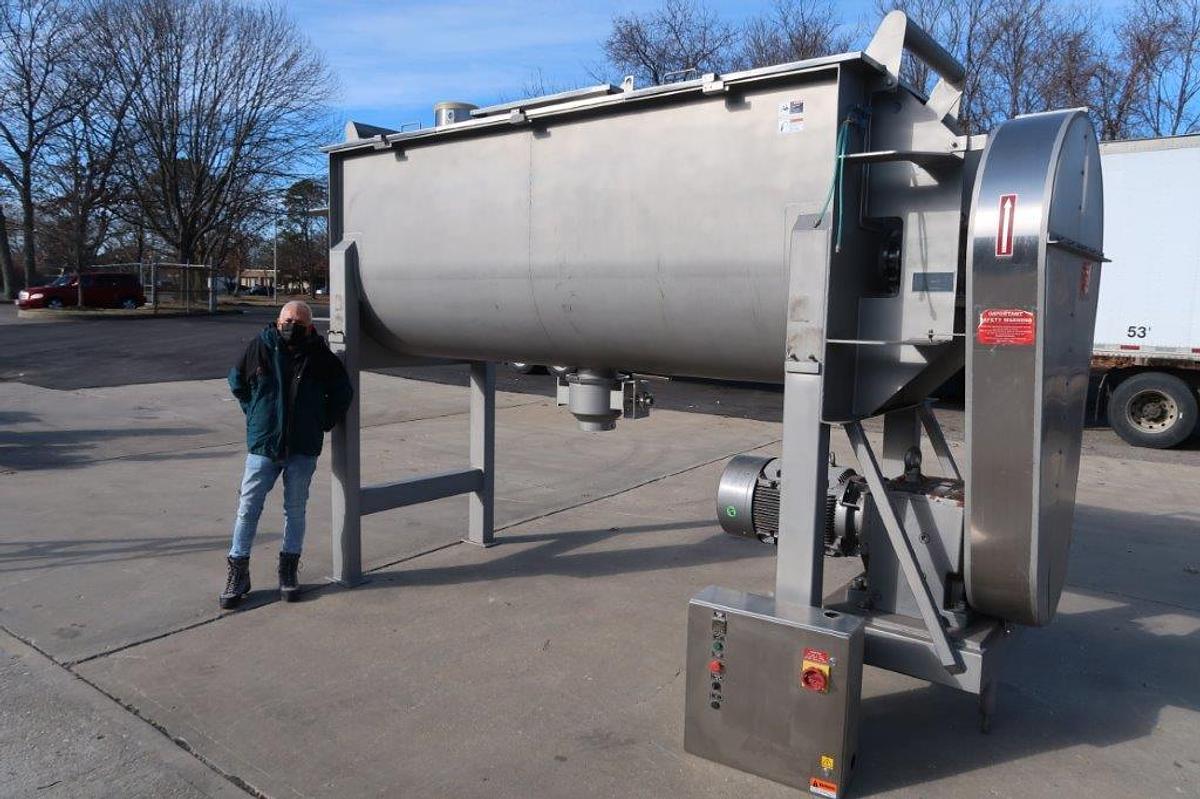
A double ribbon blender is a type of dry or semi-dry mixing equipment that uses two helical ribbons mounted on a central shaft inside a U-shaped trough. The outer ribbon moves material in one direction along the trough while the inner ribbon moves it in the opposite direction, creating a counterflow mixing action that produces thorough, consistent blending in relatively short cycle times. The geometry of the ribbons ensures that material at the edges and center of the trough is continuously exchanged, minimizing dead zones and achieving uniform blending across the entire batch.
Double ribbon blenders are widely used in food processing, nutraceutical manufacturing, chemical processing, and pharmaceutical applications for blending powders, granules, flakes, and other dry or semi-moist materials. Stainless steel construction, as found in A&B Process ribbon blenders, is standard for food-grade and pharmaceutical-grade applications because it is easy to clean and does not contaminate the product. A 120 cubic foot ribbon blender with a 40HP drive, for instance, is sized for mid-to-large batch production and is a significant piece of equipment. Used ribbon blenders in good condition can represent substantial savings compared to having a similar unit fabricated, making the secondary market an attractive option for facilities looking to expand or replace blending capacity.
How does buying used A&B Process equipment compare to purchasing from the manufacturer?
Purchasing used A&B Process equipment through the secondary market typically offers a significant cost advantage over commissioning a comparable unit directly from the fabricator. Stainless steel process vessels, blenders, and custom skids represent substantial capital expenditures, and a used unit in good working condition can often be acquired for a fraction of the fabrication cost. Lead times are another consideration: having a unit custom-built can take months depending on the fabricator's schedule and the complexity of the build, while used equipment is generally available for immediate purchase and shipment.
The trade-off is that used equipment is sold as-is, without the assurances that come with a brand-new fabrication. Buyers take on the responsibility of thoroughly inspecting the equipment and understanding its condition before committing to a purchase. Selecting a reputable used equipment dealer with a demonstrated history in the food processing and pharmaceutical equipment space is important, as they are more likely to accurately represent the condition of the machinery and accommodate proper inspections. Buyers should also contact A&B Process Systems directly to understand what level of technical support, spare parts availability, and documentation they can expect for a particular model and age of equipment, since older units may have limited manufacturer support.
What are typical shipping and logistics considerations when buying used process equipment?
Shipping used process equipment involves more planning than standard freight because of the size, weight, and sensitivity of the machinery involved. Smaller items like individual tanks or blenders may be palletized and shipped via standard LTL freight, but the packaging must be substantial enough to prevent movement and damage in transit. Larger or more complex equipment, including multi-component skids or heavy vessels, often requires custom crating and heavier-duty rigging for safe loading and unloading. Rigging costs, which cover the labor and equipment needed to move heavy machinery at both the origin and destination, are typically a separate charge from freight.
Buyers should ask the dealer for a detailed breakdown of all costs associated with getting the equipment to their facility, including palletization or crating fees, rigging at the point of origin, freight charges, and any rigging or unloading costs at the destination. These costs can add meaningfully to the total landed price of the equipment and should be factored into the purchasing decision from the start. For international shipments, customs documentation, import duties, and compliance with destination-country regulations add another layer of complexity that buyers should address with their freight forwarder or customs broker before finalizing a purchase.
What payment terms should buyers expect when purchasing used process equipment?
Used equipment dealers typically require full payment before releasing equipment for shipment. This is standard practice across the industry and reflects the nature of the secondary market, where transactions are generally final and equipment is sold as-is. Payment is usually accepted by wire transfer, though some dealers may accept other forms of payment depending on the transaction size and the buyer's relationship with the dealer. Buyers should confirm accepted payment methods with the dealer before proceeding.
Some dealers extend payment terms to repeat customers or established buyers with a track record of transactions, but this is not the norm for first-time purchases. Because full payment is typically required upfront, buyers have a strong incentive to conduct thorough due diligence before committing, including arranging inspections, reviewing available documentation, and confirming shipping and rigging costs. Understanding the total landed cost of the equipment, including freight and any additional fees, before making payment helps avoid surprises and ensures the purchase fits within the buyer's budget.