Category
Manufacturer
Model
FAQ:
What is a ribbon blender and how does it work?
A ribbon blender is an industrial mixing machine designed to blend dry powders, granules, and bulk solids into a uniform mixture. The core of the machine is a horizontal trough that houses a dual helical ribbon agitator. This agitator consists of two sets of ribbons, one outer and one inner, that rotate on a central shaft. The outer ribbon moves material in one direction along the length of the trough, while the inner ribbon moves it in the opposite direction. This opposing flow creates a constant, controlled counter-current that folds and turns the material repeatedly until a homogenous blend is achieved.
The efficiency of this design is one reason ribbon blenders are so widely used across food processing, pharmaceutical manufacturing, and chemical production. Most batches reach a thorough, uniform blend in roughly 10 to 15 minutes, depending on the density and flow characteristics of the materials involved. The horizontal trough design also makes loading and discharging straightforward, and the large open volume of the trough allows for high-capacity batches without sacrificing blend quality. For applications where heat transfer is needed during mixing, jacketed trough designs allow a heating or cooling medium to circulate around the outside of the trough, giving operators precise temperature control throughout the blend cycle.
What is Young Industries known for in the blending equipment market?
Young Industries is a well-regarded American manufacturer of bulk solids handling and processing equipment, with a long history of producing equipment for demanding industrial environments. The company has built a reputation for heavy-duty construction and reliable performance in industries that handle dry powders and granular materials at scale. Their ribbon blenders are particularly recognized for solid fabrication quality, with stainless steel construction that meets the sanitary requirements of food, pharmaceutical, and chemical applications.
Young ribbon blenders are often specified for applications where durability and consistent blending performance matter over many years of production use. Features like jacketed troughs, high-horsepower drive systems, and stainless steel contact surfaces reflect the company's focus on industrial-grade equipment built to handle high-volume, continuous production environments. Because of this build quality, used Young ribbon blenders remain in demand on the secondary equipment market long after their initial installation, as buyers recognize that well-maintained units can continue delivering reliable performance for years after the first owner has decommissioned them.
What does a jacketed ribbon blender do, and when is that feature necessary?
A jacketed ribbon blender has a double-wall trough construction, where a hollow space between the inner and outer walls allows a heating or cooling medium, typically hot water, steam, or chilled water, to circulate around the blending chamber. This gives operators the ability to raise or lower the temperature of the material during the mixing process without removing it from the blender. The result is a single piece of equipment that can blend and condition a product simultaneously, which reduces processing time and the number of separate steps in a production line.
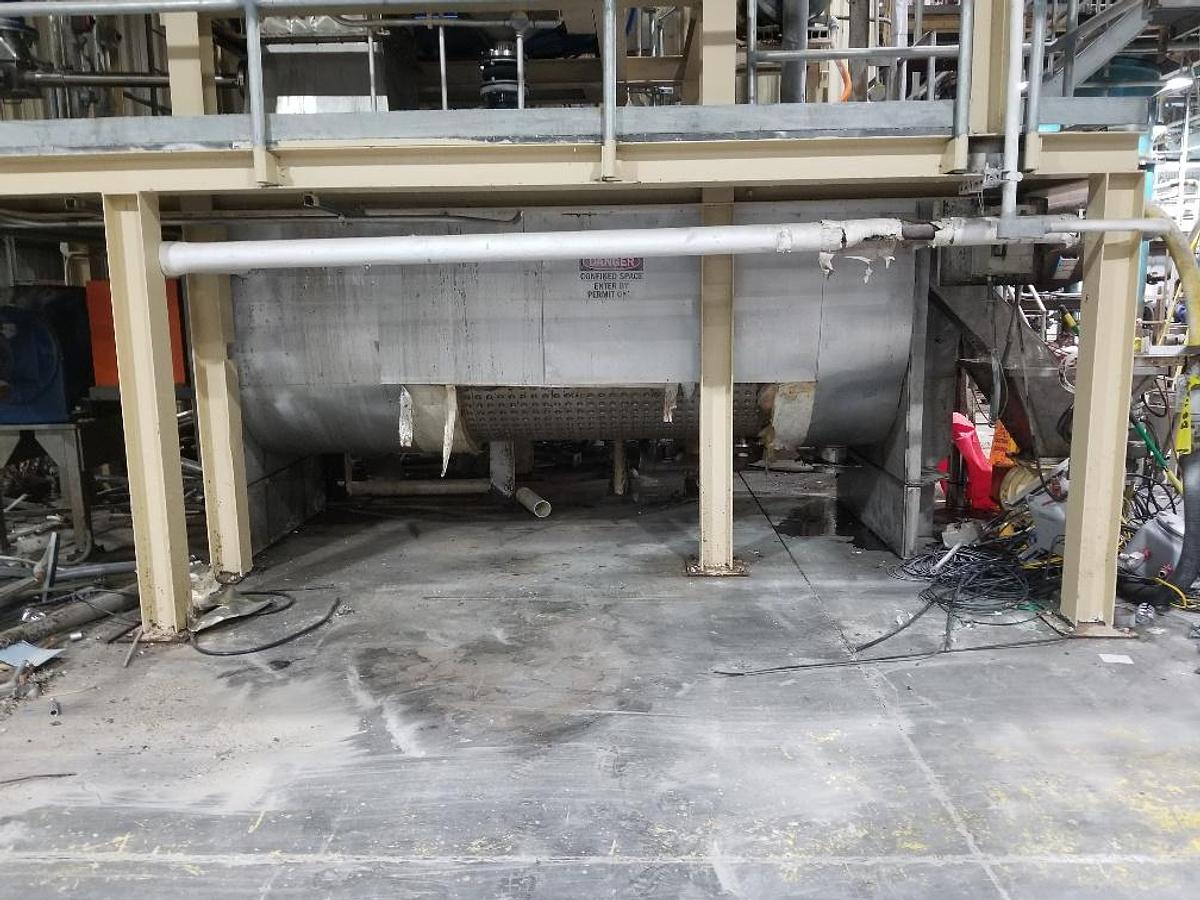
This feature is necessary in a range of specific applications. In food processing, jacketed blenders are used to melt and incorporate fats or to dry materials slightly during mixing. In chemical processing, some reactions or coating processes require a controlled temperature environment to achieve the desired result. Pharmaceutical manufacturers may use jacketed blenders to maintain temperature-sensitive active ingredients within a safe processing range. The 200 cubic foot Young double ribbon blender listed as a used unit includes a jacketed trough, making it suitable for any of these temperature-controlled blending applications at a large production scale.
What capacity ribbon blender does a production facility typically need?
Selecting the right blender capacity depends on batch size requirements, the bulk density of the materials being processed, and the number of batches a facility needs to run per shift. Ribbon blenders are generally filled to around 60 to 70 percent of their rated volumetric capacity to allow proper material movement during mixing. Running a blender significantly over or under that fill range can reduce blend uniformity and put unnecessary stress on the drive system. For a 200 cubic foot blender, that means practical batch sizes in the range of roughly 120 to 140 cubic feet of material per cycle.
For context, a 200 cubic foot ribbon blender is a large industrial unit suited to high-volume production environments. Facilities processing hundreds or thousands of pounds of dry ingredients per hour, such as large food manufacturers, agricultural chemical producers, or bulk supplement companies, are typical users of equipment at this scale. Smaller pilot or specialty production operations often work with units in the 10 to 50 cubic foot range. When evaluating a used blender, it is worth calculating actual batch weight requirements based on material bulk density, since a 200 cubic foot trough may hold anywhere from a few thousand to well over ten thousand pounds depending on how dense the product is.
What materials can be processed in a ribbon blender?
Ribbon blenders are well suited to a wide range of dry and semi-dry materials. Common applications include blending powdered spices, flour-based mixes, protein powders, dry chemical compounds, fertilizers, pigments, pharmaceutical excipients, plastic resins, and agricultural products. The ribbon agitator handles free-flowing granules and powders particularly well, and with appropriate modifications, ribbon blenders can also incorporate small amounts of liquid spray into a dry batch, which is useful for applications like coating granules or adding a liquid binder to a powder mix.
Material characteristics like particle size, bulk density, abrasiveness, and moisture sensitivity all influence how a ribbon blender should be configured. Highly abrasive materials may require wear-resistant coatings or hardened contact surfaces. Sticky or hygroscopic materials may need the jacketed option to keep temperatures controlled and prevent clumping during mixing. Stainless steel construction, particularly 304 or 316L grades, is preferred for food-grade and pharmaceutical materials because it resists corrosion, does not react with the product, and can be cleaned and sanitized effectively between batches. A used stainless steel ribbon blender in good condition can handle the same range of materials as it did when it was first put into service, provided the contact surfaces are intact and free of pitting or contamination.
Is a used ribbon blender suitable for food-grade or pharmaceutical applications?
A used ribbon blender can absolutely be suitable for food-grade or pharmaceutical applications, but it requires careful evaluation before purchase. The key factors are the material of construction, the condition of all product-contact surfaces, and whether the design meets current sanitary standards for the intended application. Stainless steel construction, polished interior welds, and a cleanable discharge valve are the baseline requirements for most food and pharmaceutical environments. A used unit that was originally built to food-grade standards and has been maintained properly can meet those same requirements in a new facility.
Buyers considering a used ribbon blender for regulated applications should pay close attention during any inspection to the condition of the trough interior, the ribbon agitator, shaft seals, and the discharge assembly. Surface pitting, corrosion, or damaged seals can create areas where product accumulates and cleaning becomes difficult, which is a problem in any sanitary production environment. Requesting detailed photos or a video walkthrough of the interior before purchase is a reasonable step, and most reputable used equipment dealers will accommodate that kind of inspection. It is also worth consulting with the equipment manufacturer to confirm that the specific model and age of the unit can still be supported with replacement seals, gaskets, and other wear parts.
What horsepower motor is typically required for a large ribbon blender?
Motor horsepower requirements for a ribbon blender scale with both the capacity of the trough and the density and viscosity of the materials being processed. For large industrial ribbon blenders in the 100 to 200 cubic foot range, motors in the 30 to 75 horsepower range are common. The 200 cubic foot Young ribbon blender available as a used unit is equipped with a 60 HP motor, which is appropriate for that trough size and reflects the heavy-duty nature of the machine. Undersizing the motor for a given blender capacity leads to overloading, overheating, and premature drive component wear, so matching horsepower to the application is important.
The type of materials being blended also affects how much power is actually drawn during operation. Light, free-flowing powders place relatively little load on the drive, while dense, cohesive, or semi-moist materials can draw significantly more power. When evaluating a used ribbon blender, it is worth verifying that the motor and gearbox are in good working condition and that the horsepower rating is appropriate for the intended materials. Replacement motors are generally available for standard industrial frame sizes, but confirming the gearbox ratio and output speed is also important to ensure the agitator will turn at the correct RPM for the application.
What should a buyer inspect before purchasing a used ribbon blender?
A thorough inspection of a used ribbon blender should cover both the mechanical components and the condition of all product-contact surfaces. On the mechanical side, the key areas to check are the motor, gearbox, drive coupling, shaft seals, and end bearings. Signs of oil leaks from the gearbox, unusual wear on the coupling, or damaged shaft seals are all items that will require attention before the machine goes back into production. The discharge valve should operate smoothly and seal completely, since a leaking or sticking discharge valve causes product loss and can create safety hazards.
For the product-contact surfaces, buyers should look closely at the condition of the trough interior, the ribbon agitator, and the end walls. Pitting, corrosion, cracks in welds, or signs of heavy abrasive wear can affect both blend quality and cleanability. On jacketed units, it is also worth asking whether the jacket has been pressure tested and whether there is any history of leaks. Most reputable used equipment dealers will offer in-person inspections, virtual walkthroughs, or detailed video documentation of the machine so buyers can assess its condition before committing to a purchase. Keep in mind that used equipment dealers typically do not have the production permits or facility setup to run actual product through the machine, so functional testing is generally limited to confirming that motors run and agitators turn freely.
What are the typical shipping and logistics considerations for a large ribbon blender?
A 200 cubic foot ribbon blender is a large, heavy piece of equipment that requires careful planning to move safely. The machine will need to be properly prepared for transit, which typically involves draining any fluids from the gearbox or jacket, securing the agitator shaft to prevent movement, and either palletizing or crating the unit to protect it from damage during loading, transport, and unloading. The level of packaging required affects the shipping cost, and buyers should ask the seller specifically what preparation is included in the quoted price and what additional crating or rigging charges may apply.
For a machine of this size and weight, standard freight carriers are not sufficient. A flatbed or specialized heavy equipment carrier will be needed, and rigging equipment such as a forklift or crane will be required at both the origin and destination for safe loading and unloading. Buyers should factor in the cost of unloading and positioning the machine at their facility when calculating the total landed cost. It is also worth confirming the machine's dimensions and weight with the seller so that the receiving facility can confirm that doorways, floor load ratings, and available lifting equipment are adequate before the shipment arrives.
What payment terms do used equipment dealers typically require for machinery purchases?
The standard practice among used equipment dealers is to require full payment before a machine is released for shipment. This applies to most transactions, particularly for buyers purchasing from a dealer for the first time. The reasoning is straightforward: once a large piece of industrial equipment is loaded and shipped, reversing the transaction is complicated and costly for both parties, so dealers protect themselves by confirming payment is complete before the machine leaves their facility or the seller's plant.
Some dealers may offer extended payment terms to established customers with a history of repeat purchases, but this is not the norm for first-time buyers. Accepted payment methods vary by dealer but commonly include wire transfer, certified funds, or other methods that provide confirmed, cleared payment before shipment is arranged. Buyers should also be aware that the purchase price of the equipment is typically separate from shipping, rigging, and any applicable taxes or fees, so it is worth getting a full breakdown of all costs before finalizing a purchase to avoid surprises at the time of payment.