Category
Manufacturer
Model
Wooshin
FAQ:
What is a pyramid tea bag machine and how does it differ from flat tea bag equipment?
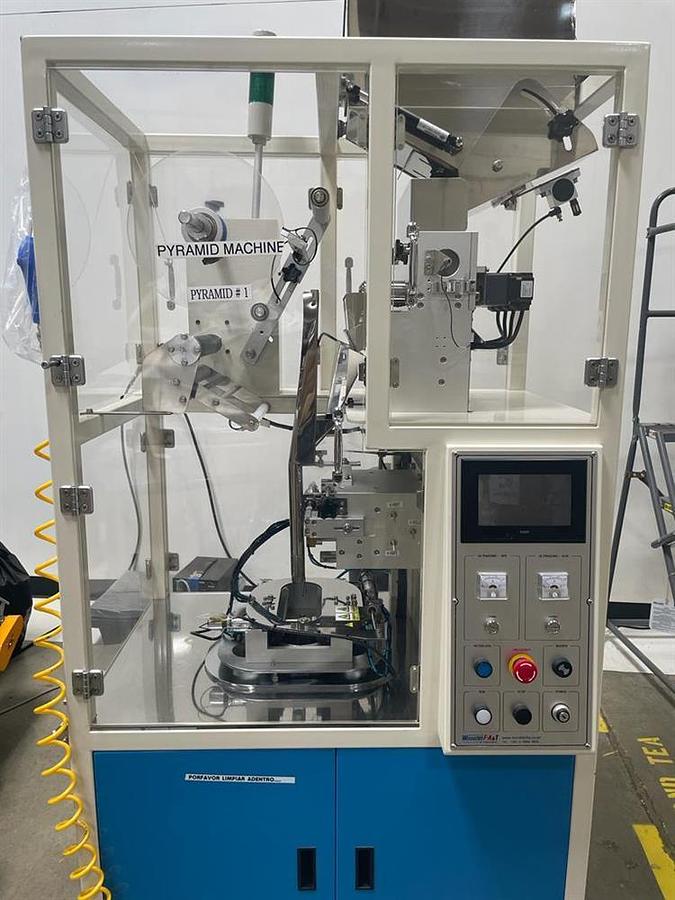
A pyramid tea bag machine is specialized packaging equipment that forms, fills, and seals three-dimensional tetrahedral or pyramid-shaped bags in a single automated process. Unlike flat or pillow-style tea bag machines, pyramid machines must handle a more complex bag geometry, which requires different forming collars, sealing mechanisms, and material handling systems. The pyramid shape allows loose-leaf tea and herbal blends to expand more fully during steeping, which is why pyramid bags are considered a premium product and typically command higher retail prices than their flat counterparts.
The mechanical differences are significant enough that flat tea bag equipment cannot be converted to produce pyramid bags. Pyramid machines use a vertical or rotary forming system to shape the mesh material into a three-dimensional pocket before filling and sealing. Because the sealing process involves joining multiple angled seams rather than two straight edges, the sealing temperature range and consistency are especially important technical factors to evaluate when purchasing this type of equipment.
Who manufactures Wooshin tea bag machines and what is the company's background?
Wooshin is a South Korean manufacturer with a long-standing presence in the tea bag machinery sector. South Korea has developed a strong industrial equipment manufacturing base, and Wooshin has built a recognized reputation in Asian and international packaging equipment markets, particularly for pyramid-style tea bag machines. Their equipment is used by tea producers ranging from mid-scale regional brands to larger commercial operations that require consistent, repeatable bag formation at speed.
When evaluating used Wooshin equipment, the manufacturer's country of origin matters for practical reasons. South Korean industrial machinery tends to be built to international export standards, which generally means reasonable parts availability and documentation in English. That said, buyers of used machines should contact Wooshin or an authorized service contact directly to confirm what level of technical support, spare parts, and documentation is available for the specific model they are considering, since older models may have more limited support than current production units.
What production speeds can be expected from a Wooshin Pyramid Tea Bag Machine?
Industrial pyramid tea bag machines, including models produced by Wooshin, typically operate in a range of 30 to 100 or more bags per minute depending on the specific model, the bag size, and the fill material being used. Entry-level or older models tend to run at the lower end of that range, while higher-tier commercial models are engineered for sustained output at faster speeds. Actual throughput in a production environment can vary based on factors like fill weight consistency, material reel quality, and how well the machine has been maintained.
For used equipment specifically, rated production speed should be verified during inspection rather than taken at face value from a specification sheet. Mechanical wear, worn sealing elements, or out-of-spec forming components can reduce real-world output below the machine's rated capacity. Buyers should request a video demonstration or, where possible, arrange an in-person inspection to observe the machine running at or near its rated speed. If the machine is still in active production at a facility, that is an especially useful opportunity to assess actual throughput under real conditions.
What bag materials is a Wooshin Pyramid Tea Bag Machine compatible with?
Pyramid tea bag machines are designed to work with mesh-type materials that can be heat-sealed to form the bag seams. Traditional machines were built around nylon mesh, which seals cleanly and consistently. However, buyer demand has shifted considerably toward biodegradable and food-grade alternatives, including PLA (polylactic acid) mesh and cornstarch-based materials, driven by both consumer health concerns and sustainability requirements in retail markets. Non-woven food-grade fabrics are also used in some pyramid bag applications.
Material compatibility is one of the most important technical factors to confirm before purchasing a used Wooshin machine. Older models may have been calibrated specifically for nylon and may require sealing temperature adjustments, new sealing elements, or other modifications to run PLA or cornstarch mesh reliably. Buyers should verify which materials the specific used unit was running in production, and consult with a qualified technician or the manufacturer to understand what, if any, modifications are needed to switch to a different material type. Testing with the intended material during inspection is the most reliable way to confirm compatibility.
What fill weight range can a pyramid tea bag machine typically handle?
Most commercial pyramid tea bag machines are designed to handle fill weights in a range of roughly 1.5 grams to 5 grams per bag, with the most common standard fills for loose-leaf tea sitting between 2 and 3 grams. Some machines are adjustable across a wider range, while others are optimized for a narrower fill window. The fill weight range a machine can handle accurately depends on the design of the dosing or auger system, and on how well that system has been maintained over time.
For used equipment, fill weight accuracy and consistency should be tested during inspection by running a sample batch and weighing individual bags. Worn dosing components can cause significant variation between bags, which affects both product quality and cost-per-bag economics. Buyers should ask the seller specifically what fill weight range the machine was running in production, as this gives a practical indication of how the machine performs within a real application rather than just against a manufacturer's specification.
What are the typical power requirements for a Wooshin Pyramid Tea Bag Machine?
Pyramid tea bag machines in the commercial class generally operate on three-phase power, with voltage requirements that vary by model and the market the machine was built for. South Korean industrial equipment is commonly configured for 220V or 380V three-phase power at 60Hz, reflecting Korean domestic standards. Machines exported to European or other international markets may be configured differently. Buyers outside South Korea should confirm the exact voltage, phase, and frequency specifications of any used Wooshin unit before purchase to determine whether electrical modifications or a transformer will be required.
Beyond voltage compatibility, buyers should also factor in the machine's amperage draw and whether their facility's electrical infrastructure can support it without panel upgrades. Compressed air requirements are another consideration, as many pyramid tea bag machines use pneumatic components for bag handling or sealing functions. Confirming all utility requirements before the machine ships avoids costly surprises during installation. A qualified electrician or machinery installation specialist familiar with packaging equipment should review the machine's specifications against the facility's capabilities before committing to a purchase.
Do pyramid tea bag machines include automatic counting or outer envelope packaging functions?
Some pyramid tea bag machine models are sold as standalone bag-forming and filling units, while others are configured as integrated lines that include downstream functions such as automatic bag counting, individual envelope insertion, and outer carton or box packaging. Whether a given used machine includes these functions depends entirely on the specific model and how it was originally configured and sold. Higher-end commercial configurations often include an enveloping station that places each filled pyramid bag into a printed paper or foil envelope before counting and cartoning.
When evaluating a used Wooshin machine, buyers should clarify exactly which components and downstream modules are included in the sale. A machine listed as a pyramid tea bag machine may refer only to the forming, filling, and sealing unit, with counting and packaging handled by separate equipment. If the listing includes additional modules, those should each be inspected individually, as secondary components like envelope feeders or counters can have their own wear and maintenance histories that are independent of the main machine's condition.
How long does a product changeover take on a pyramid tea bag machine?
Changeover time on pyramid tea bag machines varies depending on whether the operator is switching tea types, changing fill weight, changing bag size, or switching to a different mesh material. A simple product changeover involving only a different tea blend with the same fill weight and bag size can often be completed in under 30 minutes, primarily involving cleaning the dosing system and flushing any residual product. Changing bag size or switching to a different material typically takes longer, potentially several hours, because it may require swapping forming collars, adjusting sealing parameters, and recalibrating the dosing system.
For used equipment, changeover complexity can be greater if the machine's documentation is incomplete or if some of the tooling for alternative bag sizes was not included in the sale. Buyers should ask specifically what tooling, forming collars, and spare parts are being sold with the machine, and whether operating documentation or setup guides are available. Missing tooling or documentation can significantly increase the time and cost of running a changeover, particularly for operators who are not already experienced with that specific machine model.
What should buyers inspect when evaluating a used Wooshin Pyramid Tea Bag Machine?
A thorough inspection of a used pyramid tea bag machine should cover several key areas. The sealing elements are among the most critical components to assess, since worn or damaged sealing bars directly affect bag integrity and can cause product freshness issues or seal failures on the line. The forming collar and bag geometry components should be checked for wear or deformation that could affect the consistency of the pyramid shape. The dosing or filling system should be inspected for wear that might cause fill weight variation. Electrical panels, wiring, and pneumatic lines should be reviewed for signs of damage or improvised repairs.
Reputable used equipment dealers will accommodate in-person inspections, virtual walkthroughs, or detailed video captures of the machine to give buyers an accurate picture of its current condition. If the machine is still installed at a production facility, an in-person inspection may allow observation of the machine running under actual production conditions, which is the most reliable assessment available. Keep in mind that most used equipment dealers do not have the permitting or infrastructure to run full production tests with actual product, so buyers should plan their inspection strategy accordingly and consider involving a qualified technician who has experience with packaging machinery of this type.
What are typical payment and shipping considerations when purchasing a used pyramid tea bag machine?
Most used equipment dealers require full payment prior to shipping. Some dealers may offer payment terms to established repeat customers, but buyers purchasing for the first time should expect to pay in full before the machine is released for shipment. Given the value of commercial packaging equipment, buyers should use payment methods that provide a clear transaction record and work with dealers who have a verifiable track record in the packaging or food equipment industry.
Shipping costs for a machine of this type can be substantial and vary based on the machine's weight and dimensions, the origin and destination, and the level of packaging required to protect it in transit. Pyramid tea bag machines should be properly palletized or crated to prevent damage during freight handling. Larger or heavier configurations may require specialized rigging for loading and unloading, which adds to the total landed cost. Buyers should request a detailed breakdown of packaging, rigging, and freight charges from the seller before finalizing a purchase to understand the full cost of getting the machine to their facility.