Category
Manufacturer
Model
FAQ:
What is a ribbon blender and how does it work?
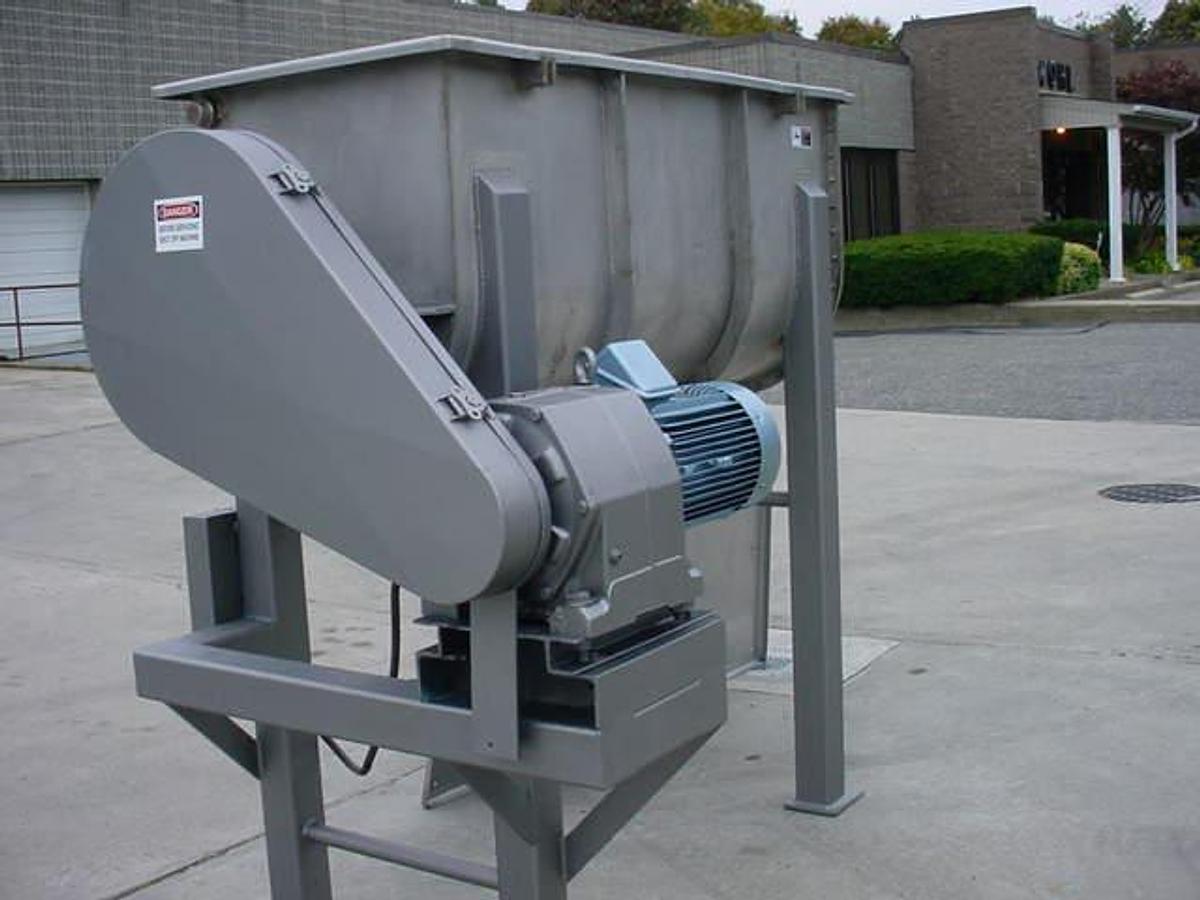
A ribbon blender is an industrial mixing machine that uses a double helical ribbon agitator mounted on a central shaft inside a horizontal trough. The inner ribbon moves material in one direction while the outer ribbon moves it in the opposite direction, creating simultaneous radial and lateral movement throughout the batch. This counter-current action produces thorough, homogeneous blending without requiring high-shear forces, which makes it well-suited for dry powders, granules, and certain wet or paste-like materials.
The agitator is driven by a motor and gearbox assembly, with the ribbon typically running at relatively low RPM to keep the mixing action gentle. Batch sizes are loaded through top-mounted inlets, and the finished blend is discharged through a bottom outlet valve. The simplicity of the design means there are relatively few moving parts, which contributes to the machine's durability and straightforward maintenance requirements. Used ribbon blenders remain popular in processing facilities precisely because the fundamental mechanical design holds up well over years of production use.
What industries commonly use ribbon blenders?
Ribbon blenders are workhorses across a wide range of processing industries. Food manufacturing is one of the largest application areas, covering dry seasoning blends, baking mixes, protein powders, coffee blends, and animal feed. Pharmaceutical and nutraceutical producers rely on ribbon blenders for blending active ingredients with excipients before tableting or encapsulation. Chemical manufacturers use them for fertilizers, detergents, pigments, and specialty compounds. Agricultural processing facilities also use ribbon blenders extensively for seed coatings and crop protection product blending.
The machine's ability to handle a broad variety of bulk solids without degrading fragile particles makes it adaptable across these sectors. For food and pharmaceutical applications, stainless steel contact surfaces are the standard choice to meet hygiene and regulatory requirements. In general industrial or agricultural settings, carbon steel construction is often sufficient and more cost-effective. Because ribbon blenders are so widely used, the used equipment market for these machines is active, and units from established manufacturers like Westwood tend to retain functional value long after their initial installation.
What sizes and capacities are available for used Westwood ribbon blenders?
Ribbon blenders as a product category span a wide capacity range, from compact laboratory-scale units of around 1 cubic foot up to large industrial units exceeding 500 cubic feet. Westwood manufactured blenders across multiple size ranges to serve different production volumes. A commonly available size in the used equipment market is the 20 cubic foot model, which is a mid-range capacity well-suited for batch production in food processing, nutraceuticals, and specialty chemicals. A 10 HP motor driving a 20 cubic foot stainless steel double ribbon blender represents a practical balance between throughput and energy consumption for many facilities.
When evaluating capacity, buyers should consider not just the total trough volume but the working fill capacity, which is typically 40 to 60 percent of the rated volume for dry blending applications. Overfilling a ribbon blender reduces mixing efficiency and can strain the drive components. Used Westwood units available on the market may vary in size, so it is worth confirming the exact cubic footage, motor horsepower, and trough dimensions with the selling dealer before making a purchasing decision. Inspecting the agitator clearances and shaft seals is also advisable, as these wear over time in production environments.
What construction materials are used in ribbon blenders for food and pharmaceutical applications?
For food-grade and pharmaceutical blending, 304 stainless steel is the most common material for all product-contact surfaces, including the trough, ribbon agitator, shaft, and discharge valve. In applications requiring higher corrosion resistance, such as blending materials with acidic or chloride-containing ingredients, 316L stainless steel is preferred because of its improved resistance to pitting and chemical attack. Stainless steel construction allows for thorough cleaning and sanitization between batches, which is critical in regulated industries. Interior surfaces are often polished to a specific Ra finish to reduce product adhesion and facilitate washdown.
For general industrial applications outside of food and pharma, carbon steel construction is a common and cost-effective alternative. Carbon steel blenders are appropriate for blending dry chemicals, fertilizers, pigments, and similar materials where contamination from minor surface oxidation is not a concern. When purchasing a used ribbon blender, confirming the construction material is an important step, particularly if the intended application involves food ingredients or pharmaceutical compounds. Stainless steel units like the Westwood 20 cubic foot double ribbon blender command a premium in the used market because of their broader application compatibility and longer service life in sanitary environments.
What should buyers inspect when evaluating a used ribbon blender?
A thorough inspection of a used ribbon blender should cover several key areas. The ribbon agitator itself should be examined for wear, bending, or cracks, particularly at the welds where the ribbons attach to the cross-arms and central shaft. Clearance between the ribbon tips and the trough wall is critical: too much gap reduces blending efficiency, while contact between the ribbon and trough indicates wear or misalignment. The shaft seals and end-plate seals should be checked for deterioration, as leaking seals allow product to migrate into the bearings and drive components. The discharge valve should open and close cleanly without sticking or leaking.
On the mechanical side, the motor, gearbox, and drive components should be inspected for unusual noise, excessive vibration, or signs of overheating. Reputable used equipment dealers typically accommodate in-person inspections, virtual walkthroughs, or video captures of the machine so buyers can assess condition before committing to a purchase. Some equipment may still be installed in an active production facility, where an inspection can be arranged through the dealer. Keep in mind that most dealers do not have the production permits or setup required to run actual product through the machine during an inspection, so buyers should assess mechanical condition and physical wear carefully and factor in any reconditioning costs when evaluating the overall value.
What is the typical price range for a used ribbon blender?
Pricing for used ribbon blenders varies considerably based on capacity, construction material, motor size, and overall condition. Small carbon steel units in the 5 to 10 cubic foot range can be found for a few thousand dollars, while larger stainless steel industrial blenders in the 50 to 200 cubic foot range often sell for anywhere between $15,000 and $60,000 or more depending on age, condition, and included accessories. Mid-range units, such as a 20 cubic foot stainless steel double ribbon blender with a 10 HP drive, typically fall somewhere in the $8,000 to $25,000 range in the used market, though actual pricing depends heavily on the specific seller, machine history, and current demand.
Buyers should also factor in the total landed cost beyond the purchase price. Shipping and rigging for a machine of this size can add several hundred to several thousand dollars depending on distance, packaging requirements, and whether a crane or forklift is needed for loading and unloading. Asking the dealer for a full breakdown of packaging, freight, and rigging costs before finalizing a purchase helps avoid unexpected expenses. Compared to buying a comparable machine built to current specifications, a well-maintained used ribbon blender from an established manufacturer can represent significant savings while still delivering reliable production performance.
How does a double ribbon agitator differ from a single ribbon design?
A double ribbon agitator consists of two helical ribbons: an outer ribbon and an inner ribbon, both mounted on the same central shaft but configured to move material in opposite directions simultaneously. The outer ribbon typically moves product toward the center of the trough, while the inner ribbon moves it toward the ends. This opposing flow creates a constant counter-current circulation that blends material both axially along the length of the trough and radially across its cross-section. The result is a faster, more uniform blend compared to a single ribbon, which moves material in only one primary direction.
Single ribbon designs are simpler and less expensive, but they can leave dead zones at the ends of the trough where material accumulates without being fully recirculated. Double ribbon blenders largely eliminate this problem, making them the preferred choice for applications where blend uniformity is critical, such as pharmaceutical excipient blending or seasoning mixes where even minor inconsistency affects product quality. For most commercial and industrial processing applications, the double ribbon configuration is the standard, which is why the majority of used Westwood ribbon blenders available on the market are described as double ribbon units.
What are the typical shipping and delivery considerations for a used ribbon blender?
Shipping a used ribbon blender requires careful planning because these machines are heavy, often weigh several thousand pounds, and have components that can be damaged if not properly secured for transit. The machine should be palletized or crated to a standard appropriate for its size and weight, and the level of packaging required directly affects freight costs. A 20 cubic foot blender with its motor and drive assembly can easily weigh 1,500 to 3,000 pounds or more, which puts it in the category of freight requiring a flatbed or specialized LTL carrier rather than standard parcel shipping.
For larger or heavier blenders, rigging equipment such as forklifts or cranes may be needed for both loading at the origin and unloading at the destination, and those costs are typically separate from the base freight charge. Buyers should ask the selling dealer for a complete breakdown of packaging, rigging, and freight costs before finalizing the purchase so the full landed cost is clear. Transit times vary based on carrier, distance, and scheduling, but domestic shipments within the continental United States typically take one to two weeks once the machine is packaged and ready to ship. International shipments involve additional logistics, customs clearance, and potentially longer lead times.
What payment terms should buyers expect when purchasing used industrial equipment?
Most used equipment dealers require full payment prior to releasing a machine for shipment. This is standard practice in the industry because used machinery transactions involve unique items that cannot simply be restocked if a buyer backs out after shipping is arranged. Payment is typically accepted by wire transfer, though some dealers may accept other forms of cleared funds. Credit terms are generally not extended to first-time buyers, though established customers with a history of transactions may occasionally be offered different arrangements at the dealer's discretion.
Buyers should treat the purchase of used industrial equipment with the same diligence they would apply to any significant capital acquisition. Verifying the dealer's reputation, reviewing any available documentation on the machine, completing a thorough inspection before payment, and understanding the full landed cost including freight and rigging are all important steps. Selecting a dealer with a long track record of selling processing equipment in the relevant industry adds an important layer of confidence when full payment is required upfront. Asking questions about the machine's history, any known issues, and what documentation is available helps buyers make informed decisions before funds are transferred.
Can a used ribbon blender be integrated into an existing processing line?
Used ribbon blenders can generally be integrated into existing processing lines, but the integration process requires careful evaluation of several factors. The machine's footprint, inlet and outlet dimensions, and discharge valve configuration need to be compatible with the surrounding equipment and facility layout. The electrical requirements, including motor voltage, phase, and amperage draw, must match the available power supply at the installation site. A 10 HP motor, for example, typically draws around 14 amps at 460V three-phase, so the facility's electrical panel and wiring need to accommodate that load. If the existing line uses automated controls or a PLC system, the blender's drive components may need to be interfaced with that system by an electrical contractor.
Mechanical integration points like inlet chutes, pneumatic conveyors, or downstream packaging equipment will need to be adapted to the blender's specific inlet and outlet dimensions. Most ribbon blenders use a standard bottom discharge valve, but the valve size and connection type can vary between models and manufacturers. Taking accurate measurements of the machine before purchase, and comparing them against the installation space and adjacent equipment, helps avoid costly modifications after delivery. Many buyers also consult with a process engineer or equipment integrator when retrofitting a used machine into an established production line to ensure the installation meets safety and operational requirements.