Category
Manufacturer
Model
Werner
Werner specializes in custom manufacturing equipment for various industries, including food processing. They are known for their innovative designs and solutions that cater to specific client needs.
FAQ:
What types of food processing equipment does Werner manufacture?
Werner is known for producing custom-engineered food processing equipment, with a focus on solutions designed around specific production requirements rather than off-the-shelf configurations. Their product range includes positive displacement pumps and related fluid-handling equipment commonly used in food and beverage processing environments. The positive displacement pump design is particularly well-suited for transferring viscous or semi-solid food products, such as sauces, pastes, creams, and similar materials, where consistent flow rates and gentle product handling are critical to maintaining quality.
Because Werner builds equipment to client specifications, the full breadth of their catalog is broader than what any single listing might suggest. Buyers looking for used Werner equipment will typically find individual units available through specialized used machinery dealers, covering pumps, mixers, and other processing components. Since all used Werner equipment has been previously deployed in production environments, prospective buyers should review the specific model and configuration carefully to confirm it matches their application requirements.
What materials are used in Werner food processing equipment construction?
Werner food processing equipment is constructed with stainless steel as the primary material for all product-contact surfaces. Stainless steel is the standard of choice in commercial food processing for several well-established reasons: it resists corrosion from acidic or alkaline food products, tolerates repeated washdown with industrial cleaning chemicals, and does not impart flavor or odor to food. For equipment like positive displacement pumps, stainless steel construction also holds up under the mechanical stress of continuous operation without degrading in ways that could introduce contamination risk.
The specific grade of stainless steel used can vary by component and application. Food-grade equipment typically uses 304 or 316 stainless steel, with 316 offering better resistance to chloride-based cleaning agents, which makes it preferable in dairy and seafood processing environments. When evaluating a used Werner machine, buyers should confirm the material specifications for both the housing and any internal components that contact the product, as this directly affects compatibility with their specific food application and sanitation protocols.
Is Werner food processing equipment suitable for commercial use?
Yes, Werner equipment is designed and built for commercial and industrial food processing environments, not home or small-scale use. Their machines are engineered to handle the demands of continuous production runs, high-volume throughput, and the rigorous sanitation cycles that commercial food facilities require. A positive displacement pump, for example, is a piece of industrial equipment intended for integration into a larger processing line, with connections, flow rates, and construction standards that reflect professional production requirements.
Buyers considering used Werner equipment should keep this commercial context in mind when evaluating whether a specific unit fits their operation. The physical size, power requirements, and plumbing connections on commercial food processing equipment are scaled for production environments. Facilities ranging from mid-size food manufacturers to large-scale processors have used Werner equipment, and the used market reflects that industrial heritage. Anyone purchasing a used unit should verify that their facility's utilities and infrastructure are compatible with the machine's specifications before completing a purchase.
How does a positive displacement pump work in food processing applications?
A positive displacement pump moves fluid by trapping a fixed volume of product and forcing it through the discharge outlet with each cycle of the pump mechanism. Unlike centrifugal pumps, which rely on rotational speed to generate flow, positive displacement pumps deliver a consistent, measurable volume per revolution regardless of downstream pressure. This makes them especially valuable in food processing, where accurate dosing, filling, or transfer of thick or shear-sensitive products is required. Common applications include pumping tomato paste, peanut butter, meat emulsions, dairy products, chocolate, and similar viscous materials.
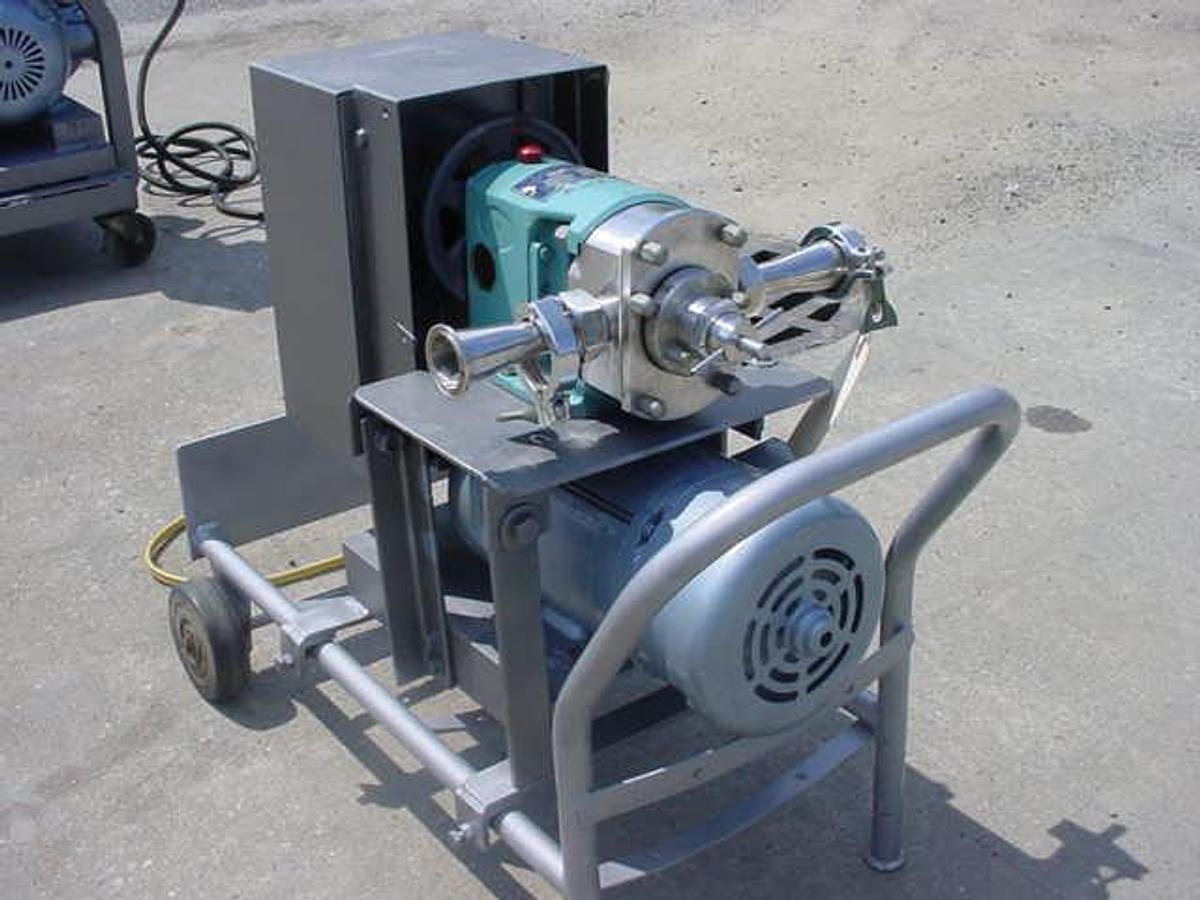
The Werner 1-1/4 inch stainless steel positive displacement pump is a portable unit, which adds flexibility for facilities that need to move the pump between different points in a production line or use it across multiple product runs. Portable pumps of this type are frequently used for batch transfers, cleaning-in-place (CIP) support, or as backup units in production environments. The stainless steel construction ensures the pump can be sanitized to food-grade standards between uses, which is a basic operational requirement in any licensed food facility.
What should buyers look for when purchasing used Werner food processing equipment?
Condition assessment is the most important step when buying used food processing equipment. For pumps and similar fluid-handling equipment, buyers should examine the internal components for wear, scoring, or corrosion on product-contact surfaces, as these issues can affect both sanitary performance and the accuracy of flow rates. Seals, gaskets, and rotors are wear items that may need replacement after extended use, and the availability of those parts for the specific Werner model in question should be confirmed before purchase. Asking the dealer for detailed photos or video of the unit's interior is a reasonable and standard request.
Beyond mechanical condition, buyers should verify that the equipment's specifications match their production needs, including inlet and outlet connection sizes, flow rate capacity, and power requirements. Used equipment is sold as-is, so the responsibility for thorough evaluation falls on the buyer. Choosing a dealer who specializes in food processing equipment is important because they are more likely to accurately represent the machine's history and condition, and to facilitate the kind of inspection that gives buyers confidence. In-person or video inspections arranged through the dealer are strongly recommended before committing to a purchase.
Are replacement parts available for used Werner food processing equipment?
Parts availability for used Werner equipment depends on the age and model of the specific machine. Werner produces custom-engineered equipment, which means some components may be proprietary or require direct sourcing from the manufacturer or authorized service providers. Before purchasing any used Werner unit, buyers are advised to contact Werner directly to ask about parts support for that particular model, including whether seals, rotors, impellers, or other wear components are still being produced and what lead times look like. The manufacturer is the most reliable source for this information, and their response will give buyers a realistic picture of long-term serviceability.
For older or discontinued models, third-party machining or aftermarket parts may be an option for some components, though this requires working with a qualified equipment service technician who can assess compatibility. Buyers should factor parts availability into their total cost of ownership calculation, since a machine that is difficult to service can result in costly downtime. Purchasing from a dealer who specializes in food processing equipment can also be helpful here, as experienced dealers often have insight into which models have strong parts ecosystems and which do not.
What certifications should buyers look for on commercial food processing equipment?
NSF International certification is the most widely recognized standard for food processing equipment in the United States. NSF-certified equipment has been evaluated for material safety, design features that prevent bacterial harborage, and cleanability, all of which are directly relevant to food safety compliance. Many state and local health departments, as well as third-party food safety auditors, require or strongly prefer NSF-certified equipment in licensed food production facilities. CE marking is the equivalent standard for equipment sold and operated within European markets, covering both safety and electromagnetic compatibility requirements.
For used equipment, buyers should ask whether the unit was originally built to NSF or other applicable standards, and whether the certification documentation is available. Age and modifications can affect whether a used machine still meets current certification requirements, so buyers operating in regulated environments should consult with their facility's food safety team or a qualified sanitation engineer before putting used equipment into production. Some facilities also require 3-A Dairy Standards compliance for equipment used in dairy processing, which has its own set of material and design specifications that go beyond general NSF requirements.
How is used food processing equipment typically inspected before purchase?
Used equipment dealers generally offer three forms of inspection: in-person visits to the dealer's facility or the location where the equipment is stored, live video calls where a dealer representative walks through the machine in real time, and pre-recorded video documentation of the equipment's condition. Each approach has its merits depending on the buyer's location and the complexity of the machine. For high-value or technically specific equipment like food processing pumps, a live video inspection is often more informative than static photos because it allows buyers to ask questions and direct attention to specific areas of concern.
In some cases, equipment being sold through a dealer is still located at the facility where it was last used, either still in production or recently decommissioned. When that is the situation, an in-person inspection can sometimes be arranged at the production site, which gives buyers the most complete picture of how the machine was operated and maintained. One important limitation to understand is that most used equipment dealers are not set up to run actual food production, so live product testing is generally not possible. The inspection is focused on mechanical condition, visual assessment of wear and sanitary surfaces, and verification of specifications, rather than a full production trial.
What are the typical shipping and logistics considerations for used food processing equipment?
Shipping used food processing equipment involves more planning than standard freight because of the weight, dimensions, and fragility of industrial machinery. Proper packaging is essential to prevent damage in transit, and costs will vary depending on whether the equipment is palletized, crated, or requires custom packaging. Heavier or larger machines may need professional rigging for both loading at the origin and unloading at the destination, and rigging services are typically an additional cost that buyers should budget for separately. Buyers should ask dealers to provide a breakdown of all shipping-related costs, including packaging, rigging, freight, and any required permits for oversized loads, to understand the full landed cost before agreeing to a purchase.
For smaller portable units like a bench-top or portable pump, shipping logistics are more straightforward, but careful packaging is still important to protect precision components and stainless steel surfaces from impact damage during transit. Buyers should confirm with the dealer exactly how the unit will be packaged and what carrier will be used. International shipments involve additional considerations including customs documentation, import duties, and compliance with destination country equipment standards. Clarifying all of these details before finalizing a purchase avoids unexpected costs and delays once the transaction is complete.
What are the standard payment terms for purchasing used food processing equipment?
Most used equipment dealers require payment in full before a machine is released for shipping. This is standard practice in the industry and reflects the fact that used equipment transactions do not involve the same credit infrastructure as new capital equipment purchases from manufacturers. Payment is typically accepted via wire transfer, though specific accepted methods vary by dealer. Buyers should confirm payment terms, accepted methods, and any deposit requirements at the start of the purchasing conversation to avoid delays once a price is agreed upon.
Some dealers extend payment terms to repeat customers with an established purchasing history, but this is the exception rather than the rule for first-time buyers. For buyers making a significant capital investment in used processing equipment, it is worth asking whether any flexibility exists, particularly for higher-value transactions. Regardless of payment terms, buyers should ensure that a clear written agreement is in place before any funds are transferred, covering the equipment description, condition as represented, agreed price, shipping terms, and any other conditions relevant to the sale.