Category
Manufacturer
Model
Vulcan-Hart/Cleveland
Vulcan-Hart/Cleveland is recognized for its innovative cooking equipment, especially in the restaurant and food service sectors. Their offerings include a variety of ovens, grills, and fryers that are designed to enhance food preparation efficiency.
FAQ:
Are Vulcan-Hart and Cleveland the same company or brand?
Vulcan-Hart and Cleveland are separate brands that operate under the same parent company, ITW Food Equipment Group, which is a division of Illinois Tool Works (ITW). This corporate relationship means both brands benefit from shared engineering resources and manufacturing standards, though each brand has developed its own distinct identity and product focus over the decades. Buyers shopping for used equipment from either brand are drawing from the same broad family of commercial foodservice manufacturers.
In practice, the two brands serve complementary roles in a commercial kitchen. Cleveland built its reputation around steam cooking technology, including steam kettles, combi steamers, and braising pans. Vulcan-Hart, by contrast, is best known for ranges, fryers, griddles, ovens, and broilers. Many large-scale foodservice operations run equipment from both brands side by side, which is one reason used Vulcan-Hart and Cleveland machines are often listed together by dealers who specialize in commercial cooking equipment.
What types of commercial cooking equipment does Vulcan-Hart Cleveland offer?
The combined Vulcan-Hart and Cleveland portfolio covers a wide range of commercial cooking categories. Vulcan-Hart products include heavy-duty ranges, convection ovens, fryers, griddles, charbroilers, and broilers built for continuous high-volume production. These machines are a common sight in restaurant kitchens, hotel banquet operations, school cafeterias, and correctional facilities. Cleveland rounds out the portfolio with steam-focused equipment such as steam kettles (available in floor-mounted and tabletop configurations, in capacities ranging from a few gallons up to 100 gallons or more), tilting braising pans, and combi steamers.
Within the kettle category alone, Cleveland offers self-contained electric models, direct steam models, and gas-fired options, giving operators flexibility based on their available utilities and production volume. Vulcan-Hart fryers range from countertop units suited for smaller operations to high-capacity floor models designed for continuous frying in fast-paced environments. Because both brands produce equipment across so many subcategories, used dealers frequently carry a broad selection of machines from this family, making it practical for buyers to source multiple pieces of equipment from a single seller.
What is the average lifespan of Vulcan-Hart Cleveland commercial cooking equipment?
Well-maintained Vulcan-Hart and Cleveland equipment is known for lasting well beyond what many operators expect from commercial cooking machinery. Vulcan ranges, fryers, and ovens are built with heavy-gauge stainless steel bodies, cast iron grates, and industrial burner systems specifically engineered for continuous use in demanding kitchen environments. Under regular maintenance and proper cleaning, these machines routinely serve 15 to 20 or more years in active production before requiring major overhauls. Cleveland steam kettles and braising pans are similarly constructed for durability, with stainless steel cooking surfaces and robust steam jacket systems that hold up over long service cycles.
The longevity of any specific used machine depends on how it was maintained, the intensity of its prior use, and whether it received timely service when components wore out. A unit that was properly descaled, cleaned, and serviced on schedule will be in substantially better condition than one that was neglected, even if both are the same age and model. Buyers evaluating used Vulcan-Hart or Cleveland equipment should ask dealers about the machine's service history and request an inspection, whether in person or via video, to assess the current condition of key components like burners, heating elements, seals, and control systems.
How energy efficient is Cleveland steam cooking equipment compared to conventional cooking methods?
Cleveland steam kettles and combi steamers are generally recognized in the foodservice industry for delivering meaningful energy and water savings compared to conventional open-flame or dry-heat cooking methods. Steam cooking transfers heat more efficiently to food than hot air does, which translates to faster cook times and lower energy consumption per batch in many applications. Some Cleveland combi steamer models have carried ENERGY STAR certification, reflecting measured performance against established efficiency benchmarks for commercial foodservice equipment. For high-volume operations cooking large batches of vegetables, proteins, or grains, the efficiency advantages of steam cooking can add up to noticeable reductions in utility costs over time.
It is worth noting that efficiency gains depend heavily on the specific model, the age of the equipment, and how well it has been maintained. Older steam kettles may have worn door gaskets, degraded insulation, or scale buildup inside steam jackets, all of which reduce efficiency compared to a properly serviced unit. Buyers considering used Cleveland steam equipment should factor in the cost of any necessary servicing or descaling when calculating the true operating cost of the machine. Consulting with a qualified service technician before putting a used unit into production is a practical step to confirm the equipment is operating at or near its designed efficiency level.
Does Vulcan-Hart Cleveland equipment meet NSF and UL certifications?
Vulcan-Hart and Cleveland have historically produced equipment certified to NSF International standards, which address sanitation and food safety in commercial foodservice equipment design. NSF certification confirms that a machine's surfaces, construction materials, and overall design meet hygiene standards that health departments in most jurisdictions recognize and require. UL (Underwriters Laboratories) listings cover electrical safety for equipment with electrical components, and many Vulcan-Hart and Cleveland models carry both NSF and UL marks as they left the manufacturing facility.
For used equipment, buyers should verify that the specific unit they are purchasing retains its certification markings and that no modifications have been made that would void those certifications. Health inspectors typically look for visible certification labels on commercial cooking equipment during facility inspections, so a missing or damaged label can create compliance complications even if the underlying machine meets the standard. If a unit has been modified or if labels are no longer legible, buyers may want to contact the manufacturer directly to confirm what certifications applied to that model and serial number, and to understand whether replacement documentation or labels can be obtained.
Are replacement parts and service technicians readily available for Vulcan-Hart Cleveland equipment?
One of the practical advantages of buying used Vulcan-Hart or Cleveland equipment is that both brands have been fixtures in commercial kitchens for decades, which means a large installed base of machines in the field. That installed base supports a broad parts ecosystem. Many common components, including burner orifices, thermostats, heating elements, door gaskets, and control valves, are stocked by foodservice equipment parts distributors across the country. For popular models, parts availability is generally good, though older or discontinued models may require more searching, and some components may need to be sourced from specialty suppliers.
Service technician familiarity is another benefit of the brands' longevity. Most commercial kitchen equipment service companies have technicians who have worked on Vulcan ranges, fryers, and Cleveland kettles or steamers. Before purchasing a specific used model, it is worth contacting the manufacturer or a local authorized service agent to confirm parts availability for that particular model and production year. Age and model can significantly affect the level of support available, and getting clarity on this before purchase helps buyers avoid situations where a machine is difficult or expensive to maintain after acquisition.
What should buyers look for when inspecting used Vulcan-Hart or Cleveland cooking equipment?
A thorough inspection of used commercial cooking equipment covers both the visible physical condition and the functional state of key operating components. For Vulcan-Hart ranges, fryers, and ovens, buyers should examine burners for corrosion or blockage, check cast iron grates for cracks, inspect the stainless steel body for dents or damage that could affect structural integrity, and assess the condition of thermostats and ignition systems. For Cleveland steam kettles and braising pans, the steam jacket interior and the condition of the draw-off valve, pressure relief valve, and lid seals are particularly important, since scale buildup or worn seals directly affect both safety and performance.
Most reputable used equipment dealers can accommodate in-person inspections, video walkthroughs, or recorded video captures of the machine so buyers can evaluate condition before committing to a purchase. Some equipment may still be installed at a production facility, where an inspection can be arranged through the dealer. Keep in mind that dealers typically do not have permits to run full production tests, so functional testing is generally limited to confirming that heating elements energize, burners ignite, and motors run, rather than cooking actual product. Buyers who want a deeper technical assessment may consider hiring an independent service technician to review the machine during the inspection.
What is a self-contained electric steam kettle, and what are typical commercial uses?
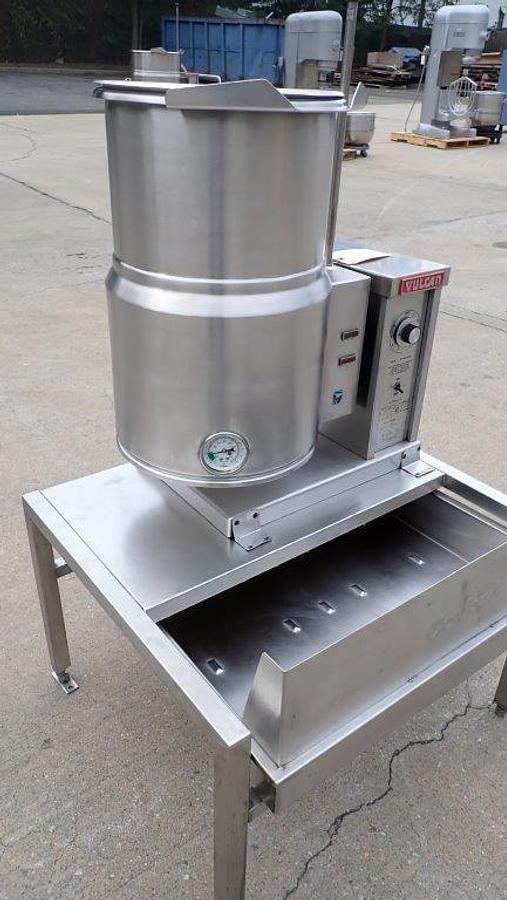
A self-contained electric steam kettle generates its own steam internally using electric heating elements and a water reservoir built into the jacket surrounding the cooking vessel. This design eliminates the need for a facility to have a dedicated steam supply line, making self-contained kettles more flexible in terms of placement and installation compared to direct-steam models that require a connection to a central boiler system. Cleveland is one of the most recognized manufacturers of this equipment type, producing self-contained electric kettles in a range of capacities, with smaller tabletop units suited for limited-menu operations and larger floor-mounted models designed for high-volume batch cooking.
Commercial steam kettles are used across a wide range of foodservice settings for soups, stocks, sauces, chili, oatmeal, pasta, vegetables, and other batch-cooked items. The indirect heating method of a steam jacket distributes heat evenly across the entire cooking surface, which reduces scorching and allows operators to cook large batches with consistent results. Hospitals, schools, correctional facilities, hotel banquet kitchens, and catering operations are among the most common users of floor-model steam kettles. A 6-gallon self-contained electric kettle, for example, is well suited for smaller batch production in a restaurant or catering environment where a full floor model would be oversized for the volume of food being prepared.
How does buying used Vulcan-Hart Cleveland equipment compare to buying from a manufacturer?
Purchasing used Vulcan-Hart or Cleveland equipment from a specialized dealer typically offers a significantly lower acquisition cost compared to buying comparable equipment directly from a manufacturer or authorized distributor. Commercial cooking equipment from these brands represents a substantial investment when purchased at full list price, and the used market allows operators to access the same heavy-duty construction and performance characteristics at a fraction of that cost. This price difference is especially relevant for operators opening a second location, replacing a single piece of equipment, or equipping a kitchen on a tighter capital budget.
The trade-off is that used equipment is sold as-is, without the manufacturer-backed coverage that typically accompanies a purchase from an authorized channel. This places greater responsibility on the buyer to conduct a careful inspection before purchasing and to select a dealer with a solid track record in commercial foodservice equipment. Unlike buying from a manufacturer, used equipment may have wear on components that affects performance or longevity, so due diligence during the inspection process is essential. Consulting with the manufacturer about parts availability and service support for a specific model and serial number is a practical step that helps buyers understand what level of ongoing support they can expect after the purchase.
What should buyers understand about shipping and payment for used commercial cooking equipment?
Used commercial cooking equipment varies considerably in size, weight, and fragility, all of which affect shipping logistics and cost. Smaller countertop units like tabletop steam kettles may ship on a standard pallet with appropriate blocking and bracing, while large floor-standing ranges, fryers, or high-capacity steam kettles often require custom crating or heavy-duty rigging for safe loading and unloading. Rigging services, which involve the use of forklifts or cranes to move heavy equipment, are typically quoted as a separate cost from freight. Buyers should ask dealers to provide a full breakdown of packaging, rigging, and freight charges before confirming a purchase so they can accurately calculate the total landed cost of the equipment at their facility.
On the payment side, most used equipment dealers require full payment before a machine ships. Some dealers extend payment terms to established repeat customers, but this is not standard practice for first-time buyers. Payment is typically processed by wire transfer or other methods the dealer specifies. Because used equipment is sold as-is, payment terms and shipping arrangements should be clearly confirmed in writing before any transaction is finalized. Buyers who are unfamiliar with a dealer should take time to research the seller's history and reputation in the commercial foodservice equipment market before committing funds.