Category
Manufacturer
Model
Variable Speed&Quot;
Variable Speed&Quot; offers a range of variable speed drives and controls for various manufacturing applications. Their solutions are designed to optimize machine performance and energy efficiency in production lines. Variable Speed&Quot; focuses on innovation to enhance operational capabilities.
FAQ:
What is a variable speed industrial pump and how does it differ from a fixed-speed pump?
A variable speed industrial pump uses a Variable Frequency Drive (VFD) to adjust the motor's rotational speed in real time, allowing the pump to match its output precisely to whatever the system demands at any given moment. A fixed-speed pump, by contrast, runs at a single constant speed regardless of actual demand, which means it either over-delivers and wastes energy or requires throttling valves and bypass lines to manage excess flow. The VFD essentially acts as the brain of the system, continuously modulating speed based on pressure sensors, flow meters, or process control signals.
The practical difference between the two pump types shows up most clearly in energy consumption and mechanical wear. Because power consumption scales with the cube of pump speed (a principle known as the Affinity Laws), even modest reductions in speed produce dramatic drops in energy use. Running a pump at 80% of full speed, for example, consumes only about 51% of the energy it would use at full speed. Beyond energy savings, the soft-start and soft-stop capabilities of variable speed drives reduce the mechanical shock that hammers seals, bearings, and impellers every time a fixed-speed pump cycles on or off, which translates directly into longer component life and lower maintenance costs over time.
How much energy can switching to a variable speed pump save compared to a fixed-speed pump?
Energy savings of 30% to 60% are commonly reported when facilities replace fixed-speed pumps with variable speed alternatives, though the actual figure depends heavily on how variable the system's demand is throughout a typical operating cycle. Applications with wide swings in required flow rate, such as HVAC circulation loops, municipal water distribution, or batch chemical processing, tend to see savings at the higher end of that range. Systems that run at near-constant demand see more modest gains.
The physics behind these savings is straightforward. The Affinity Laws state that pump power consumption is proportional to the cube of its operating speed. That means a 20% reduction in speed cuts power consumption by roughly 49%, not just 20%. Over the course of a year, those savings add up quickly in high-run-time industrial environments. When evaluating a used variable speed pump for purchase, it is worth calculating the expected annual energy savings against the acquisition cost, since the payback period is often surprisingly short, particularly for pumps that run continuously or near-continuously in production.
What industries and applications are variable speed industrial pumps best suited for?
Variable speed pumps are used across a wide range of industries precisely because so many processes involve fluctuating flow demands rather than steady-state conditions. HVAC and building systems rely on them for chilled water and hot water circulation, where building load varies throughout the day. Water and wastewater treatment plants use them to match pump output to incoming flow rates. Oil and gas operations depend on them for pipeline transfer, injection, and wellhead applications. Chemical processing, food and beverage production, mining, and pharmaceutical manufacturing are all major users as well.
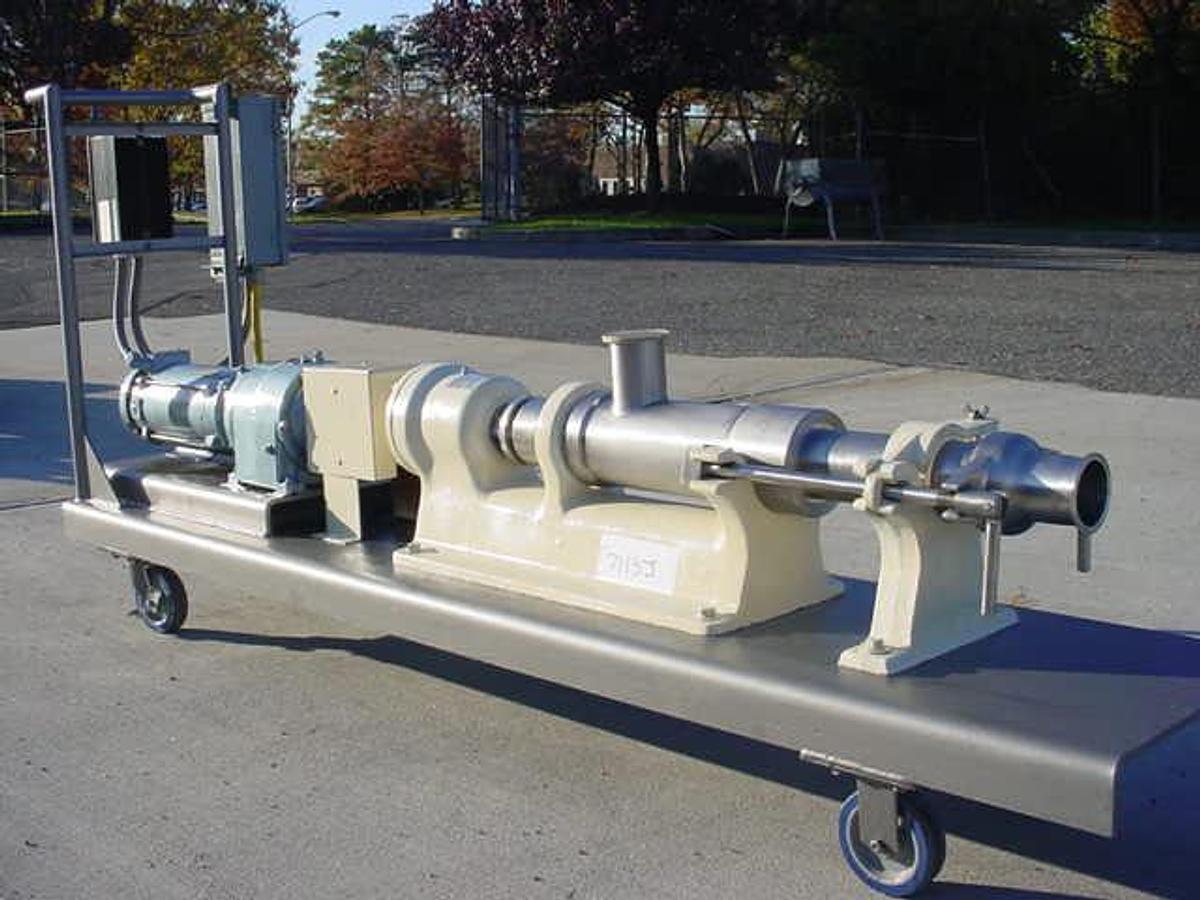
In food and beverage processing specifically, sanitary variable speed pumps (such as the Moyno 3-inch by 3-inch sanitary pump configuration) are designed to handle viscous or shear-sensitive products like sauces, dairy, and beverages without damaging the product or creating contamination risks. The ability to dial in precise flow rates is critical in these environments, where over-pumping can damage product quality and under-pumping can disrupt downstream filling or packaging equipment. The versatility of variable speed technology across pump types, including centrifugal, positive displacement, peristaltic, submersible, and multistage configurations, means there is almost always a variable speed solution appropriate for a given industrial application.
What types of variable speed industrial pumps are commonly available on the used equipment market?
The used equipment market carries variable speed configurations across most major pump categories. Centrifugal pumps are the most common, used for general water transfer, HVAC, and process fluid applications. Positive displacement pumps, including progressive cavity (such as Moyno-style designs), gear pumps, and peristaltic pumps, are frequently available used and are well suited for viscous fluids, slurries, and applications requiring precise metering. Submersible variable speed pumps show up regularly from dewatering, mining, and municipal water system decommissions. Multistage pumps designed for high-pressure applications in boiler feed, reverse osmosis, and pressure boosting are also found on the secondary market.
When shopping for used variable speed pumps, buyers should pay attention to whether the Variable Frequency Drive is included with the pump or has been removed and sold separately. In many cases, when a facility decommissions equipment, the VFD cabinet and the pump end are sold as a package, but this is not always guaranteed. Confirming what is included in the sale, the motor rating, the VFD brand and amperage capacity, and any associated control panels or sensors, is an important step before finalizing a purchase. A reputable used equipment dealer specializing in industrial pumps will be able to provide clear documentation of what is included in each listing.
What should I inspect when buying a used variable speed industrial pump?
Buying used industrial equipment puts the inspection responsibility squarely on the buyer, so a thorough evaluation before purchase is essential. On the mechanical side, the key components to assess are the pump casing for cracks or corrosion, the impeller or rotor for wear and erosion, the mechanical seals for signs of leakage or scoring, and the bearings for roughness or play. On pumps with progressive cavity or positive displacement designs, the stator and rotor wear are particularly important since these are consumable components that affect both performance and the cost of getting the pump back into service.
For the electrical and controls side, the condition of the Variable Frequency Drive (if included) deserves careful attention. VFDs contain capacitors and power electronics that degrade over time, so the age of the drive, its operating hours if logged, and the condition of the cooling fans and heat sinks all matter. Reputable used equipment dealers will typically accommodate in-person inspections, virtual walkthroughs, or detailed video captures of the equipment so buyers can assess condition before committing. Some equipment may still be installed and running at a facility, which offers the best possible view of operating condition, though dealers generally cannot replicate full production testing at their own locations due to permitting and infrastructure limitations. Buyers should also consult with the pump manufacturer to understand parts availability and support for the specific model and vintage before purchasing.
Do variable speed industrial pumps come with the Variable Frequency Drive included, or is the VFD sold separately?
This varies depending on how the equipment was originally configured and how the seller has listed it. In many industrial installations, the pump motor and the VFD are housed separately, with the drive mounted in a control panel some distance from the pump itself. When facilities decommission this equipment, the pump end, motor, and VFD may be sold as a complete package, or they may be separated and listed individually. Buyers should confirm explicitly with the seller what is included in the sale price before assuming a complete drive system is part of the deal.
If a used variable speed pump is sold without its VFD, sourcing a compatible drive is generally straightforward since major VFD manufacturers like ABB, Siemens, Danfoss, and Rockwell Automation produce drives that can be matched to most standard motor voltages and horsepower ratings. However, adding a VFD purchase to the project budget and accounting for any programming or integration work required is important for accurately estimating the total cost of putting the pump into service. When the VFD is included with the pump, buyers should verify that the drive's rated amperage and voltage match the motor specifications, and check whether the drive's programming parameters are still configured for the previous application or will need to be reset for the new one.
What flow rate and pressure ranges are typical for variable speed industrial pumps?
Variable speed industrial pumps span an enormous range of capacities, from small sanitary pumps handling a few gallons per minute in food processing lines to large centrifugal pumps moving tens of thousands of gallons per minute in water treatment or mining applications. Pressure capabilities are equally broad. Standard centrifugal pumps typically operate in the range of 20 to 200 PSI, while high-pressure multistage pumps used in boiler feed or reverse osmosis systems can exceed 1,000 PSI. Positive displacement pumps, including progressive cavity and gear pump designs, are often chosen specifically for their ability to maintain consistent flow at higher pressures regardless of downstream backpressure.
For buyers evaluating used variable speed pumps, the original nameplate data (flow rate in GPM or m3/hr, total dynamic head in feet or meters, motor horsepower, and operating speed in RPM) is the starting point for matching a pump to a new application. Keep in mind that a pump's actual performance in a used condition may differ from its nameplate ratings if wear has occurred on the impeller, rotor, or seals. Requesting any available performance test data or inspection records from the seller, and cross-referencing with the manufacturer's published pump curves for that model, helps establish realistic performance expectations before the equipment is put back into service.
Are used variable speed industrial pumps compatible with existing piping and control systems?
Mechanical compatibility depends on the pump's flange size, connection type (flanged, threaded, or tri-clamp for sanitary applications), and physical footprint relative to the installation space available. Most industrial pumps use standardized ANSI or DIN flange dimensions, which makes cross-brand substitution relatively straightforward for common sizes. Sanitary pumps use tri-clamp or similar hygienic fittings that are also fairly standardized across manufacturers. Buyers should confirm the inlet and outlet connection sizes and types against their existing piping before purchasing, particularly for larger or specialty pumps where adapters may add cost and complexity.
On the controls side, variable speed pumps driven by VFDs are generally quite adaptable. Most modern drives accept standard 4-20mA or 0-10V analog signals, digital on/off commands, and fieldbus protocols like Modbus, Profibus, or EtherNet/IP, which means integration into existing PLC or SCADA systems is usually achievable with minimal rewiring. If the used pump comes with its original VFD, the drive may need to be reprogrammed to match the new system's control signals and setpoint ranges. Buyers with complex automation environments may want to involve a controls engineer in the evaluation process to confirm compatibility before finalizing the purchase.
What is the typical lifespan of a variable speed industrial pump, and what maintenance does it require?
Industrial pumps are built to last, and many centrifugal and positive displacement pumps remain in service for 20 to 30 years or longer with proper maintenance. Variable speed operation actually tends to extend pump life compared to fixed-speed operation because the soft-start and soft-stop capabilities of VFDs eliminate the mechanical shock loads that occur every time a fixed-speed motor kicks on at full voltage. Reduced average operating speeds also mean less wear on seals, bearings, and impellers during periods of lower demand. The practical result is that a well-maintained variable speed pump often outlasts its fixed-speed counterpart in comparable service.
Routine maintenance requirements include periodic inspection and replacement of mechanical seals (typically every one to three years depending on the fluid handled and operating conditions), bearing lubrication or replacement, impeller inspection for erosion or cavitation damage, and checking VFD cooling fans and filters. For progressive cavity pumps like the Moyno design, the stator (the rubber element that mates with the rotor) is a wear item that requires replacement based on hours of service and the abrasiveness of the fluid pumped. When purchasing used equipment, asking the seller about the pump's service history, including the last time seals and bearings were replaced, gives a clearer picture of what maintenance will be needed to bring the machine up to reliable operating condition.
What certifications and standards should buyers look for when purchasing a variable speed industrial pump?
The relevant certifications depend heavily on the intended application. For food, beverage, and pharmaceutical processing, buyers should look for pumps that meet 3-A Sanitary Standards, which govern the design and surface finish requirements for equipment that contacts consumable products. FDA-compliant materials of construction (typically 316L stainless steel with food-grade elastomers) are also important in these industries. The Moyno sanitary pump design, for example, is built to these standards, making it appropriate for hygienic processing environments.
For general industrial applications, relevant standards include ANSI/HI (Hydraulic Institute) pump standards, which cover dimensions, performance testing, and installation guidelines for a broad range of pump types. For hazardous area installations involving flammable gases or dusts, buyers should verify that both the pump motor and the VFD carry appropriate ATEX (European) or NEC/UL ratings for the specific hazardous location classification. CE marking is relevant for equipment destined for European markets. When buying used equipment, verifying that the original certification plates are still attached and legible is important, as missing or damaged nameplates can complicate regulatory compliance inspections. Consulting with the pump manufacturer about the certification status of a specific model and serial number can help clarify compliance questions for older equipment.