Category
Manufacturer
Model
FAQ:
What sizes of Utensco mix tanks are typically available on the used equipment market?
Utensco mix tanks appear on the used equipment market in a range of capacities, with smaller units starting around 55 gallons and larger production-scale tanks reaching several hundred gallons or more. The 55-gallon vertical jacketed configuration is one of the more commonly encountered sizes in the surplus market, making it a practical option for small-batch production, pilot runs, or secondary mixing operations. Capacity is generally the first specification buyers lock in, since undersizing a tank creates production bottlenecks while oversizing can make temperature control and mixing efficiency harder to manage.
When sourcing a used Utensco tank, it helps to know your batch volume requirements before you start comparing listings. A tank is typically sized so the working volume sits at roughly 70 to 80 percent of the total rated capacity, which leaves headspace for agitation and prevents overflow. Buyers who need flexibility across multiple batch sizes sometimes purchase a smaller tank for development work and a larger unit for full production, since the used market often makes that kind of staged investment more affordable than buying everything at scale from the start.
What materials are Utensco mix tanks constructed from?
Utensco mix tanks are most commonly constructed from stainless steel, with 304 and 316L grades being the most prevalent in sanitary and food-contact applications. Stainless steel 316L is particularly valued in pharmaceutical, dairy, and chemical processing environments because its lower carbon content and higher molybdenum levels give it better resistance to pitting and corrosion from chlorides and aggressive cleaning agents. The interior finish matters as much as the alloy itself. Sanitary-grade tanks feature polished internal surfaces, often to a Ra 32 microinch finish or finer, which reduces microbial harborage points and makes clean-in-place (CIP) procedures more effective.
On the used market, buyers should inspect both the interior and exterior surfaces carefully. Scratches, pitting, weld discoloration, or compromised gaskets can affect sanitary compliance and may require remediation before the tank is put back into food, beverage, or pharmaceutical service. An in-person or video inspection is the most reliable way to assess surface condition before purchase. If the tank was previously used in a chemical application, it is worth confirming what products it held, since some chemicals can cause micro-pitting that is not immediately visible but can affect product quality or contaminate future batches.
What industries commonly use Utensco mix tanks?
Utensco mix tanks are used across a broad range of process industries, with food and beverage, pharmaceutical, cosmetics, and chemical processing being the most active buyers in both the new and used equipment markets. In food and beverage production, these tanks are used for blending sauces, dressings, dairy products, and beverage concentrates. The jacketed design found on many Utensco models makes them particularly useful for processes that require precise temperature control, such as pasteurization, emulsification, or the incorporation of heat-sensitive ingredients.
Pharmaceutical and nutraceutical manufacturers rely on sanitary stainless steel mix tanks for compounding, dissolving active ingredients, and preparing liquid formulations. Cosmetics producers use similar equipment for lotions, creams, and shampoos, where consistent viscosity and temperature management are critical to product quality. Chemical processors sometimes use Utensco tanks for non-sanitary blending applications, though those buyers tend to prioritize corrosion resistance and compatibility with specific chemicals over sanitary finish standards. The versatility of the jacketed, agitated tank design is what makes these units attractive across such different industries.
What is a jacketed mix tank, and why does the jacket matter?
A jacketed mix tank has a second outer wall surrounding part or all of the tank vessel, creating a cavity through which a heating or cooling medium, typically steam, hot water, glycol, or chilled water, can be circulated. This jacket allows the tank contents to be heated or cooled indirectly and uniformly without direct contact between the heat transfer fluid and the product. For temperature-sensitive applications like chocolate tempering, sauce cooking, cream cheese blending, or pharmaceutical compounding, the jacket is essential because it gives operators precise control over batch temperature without scorching or destabilizing the product.
On a used jacketed tank, the condition of the jacket itself deserves close attention during inspection. Leaks at jacket welds, damaged inlet or outlet ports, or corrosion inside the jacket cavity can compromise temperature control and may be expensive to repair. Buyers should ask whether the jacket has been pressure-tested and what the rated working pressure is, since steam-heated jackets typically operate at higher pressures than hot-water systems. Knowing the jacket's pressure rating also helps confirm compatibility with the buyer's existing utility infrastructure before the tank is shipped and installed.
Do used Utensco mix tanks typically include an agitator or mixer?
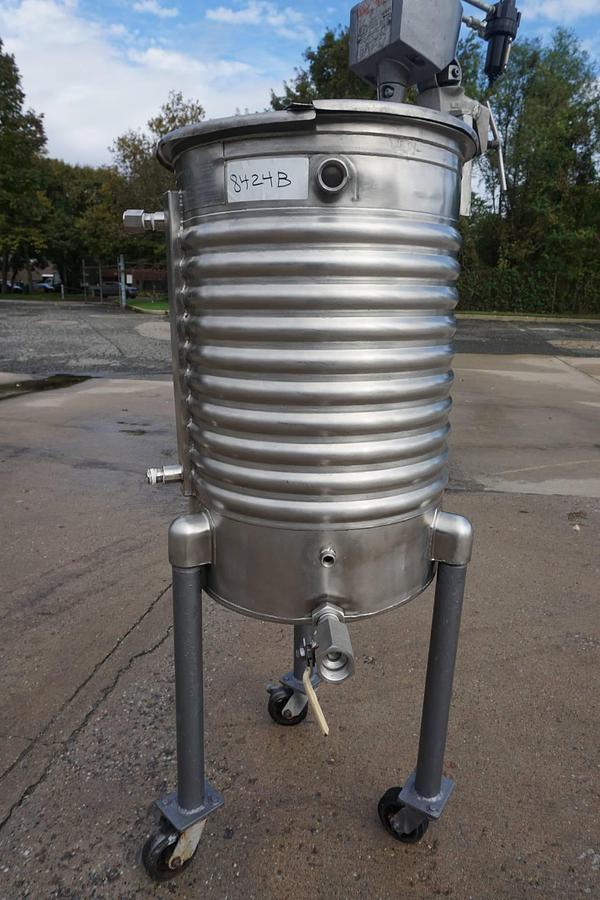
Many used Utensco mix tanks are listed with the agitator or mixer included, but this is not universal, and buyers should confirm what is included in any specific listing before purchasing. The 55-gallon Utensco vertical jacketed tanks that appear on the surplus market are sometimes configured with air-operated mixers, which use compressed air rather than an electric motor to drive the agitator. Air-operated drives are common in environments where explosion-proof requirements apply or where compressed air is more readily available than dedicated electrical circuits.
When a mixer is included, buyers should verify the condition of the agitator shaft, impeller blades, and seals, since these components experience wear and can affect mixing performance. The impeller style matters too. Propeller-style impellers work well for low-viscosity liquids, while anchor or paddle styles are better suited for thicker products like gels, creams, or pastes. If the tank is listed without a mixer, sourcing a compatible agitator separately is straightforward, but buyers should confirm the tank's top entry configuration, shaft diameter, and drive mounting dimensions to ensure a proper fit.
What should buyers look for when inspecting a used Utensco mix tank?
A thorough inspection of a used Utensco mix tank should cover several key areas: the interior surface condition, the integrity of the jacket, the condition of all valves and fittings, the agitator shaft and seal, and any sanitary clamp connections or gaskets. Interior pitting, deep scratches, or weld repairs can indicate prior damage or aggressive chemical exposure. For food, beverage, or pharmaceutical applications, the interior finish should meet the sanitary standards required by the buyer's regulatory environment, so it is worth confirming the original finish specification and comparing it to what is visible during inspection.
Reputable used equipment dealers will typically accommodate in-person inspections at their facility or provide detailed video walkthroughs of the tank. Some equipment may still be installed at the facility where it was last used, in which case the dealer can often arrange a plant visit or coordinate a video inspection directly with the site. Buyers should keep in mind that most used equipment dealers are not set up to run product trials or full production tests, since that type of operation requires different permitting and infrastructure. The goal of an inspection is to get an accurate picture of the tank's physical condition and mechanical integrity, which is the most reliable basis for a purchase decision.
What certifications or standards should buyers verify on a used Utensco mix tank?
For buyers in regulated industries, the most relevant certifications to verify on a used mix tank include ASME pressure vessel certification, 3-A Sanitary Standards compliance, and FDA-compliant materials of construction. ASME certification is particularly important for jacketed tanks because the jacket operates under pressure, and an ASME-stamped vessel has been designed and fabricated to meet specific safety standards for pressure containment. The ASME stamp and associated data plate should be physically present on the tank. If the data plate is missing or illegible, that is a meaningful red flag.
3-A Sanitary Standards apply to equipment used in dairy and food processing and address surface finish, drainage, cleanability, and materials that contact food products. Pharmaceutical buyers may also look for documentation indicating that the tank's materials of construction meet USP Class VI or similar biocompatibility standards. On the used market, original documentation is not always available, especially for older equipment. In those cases, buyers can sometimes work with a qualified inspector or the tank manufacturer's service network to evaluate whether the tank meets current standards. Consulting directly with the manufacturer about a specific model's original specifications is a practical step when documentation is incomplete.
What is the typical price range for used Utensco mix tanks?
Pricing for used Utensco mix tanks varies considerably based on tank size, configuration, surface finish, included accessories, and overall condition. Smaller tanks in the 50 to 100 gallon range with basic configurations tend to be more accessible price-wise than larger jacketed and agitated units with sanitary finishes and full instrumentation. Sanitary-grade tanks with polished interiors, ASME-stamped jackets, and included agitators command higher prices than comparable tanks with industrial finishes, reflecting both the higher cost of sanitary fabrication and the stronger demand from food, beverage, and pharmaceutical buyers.
Because pricing on used equipment is influenced by market supply at any given time, the best approach is to compare current listings across reputable used equipment dealers who specialize in process and food-grade equipment. Factors like the age of the tank, the condition of the jacket, whether the agitator is included, and the cost of any required refurbishment should all factor into the final landed cost calculation. Buyers should also account for shipping, rigging, and any site preparation costs when evaluating total investment, since those costs can be significant for heavier stainless steel vessels.
How are used mix tanks typically shipped, and what should buyers expect for freight costs?
Shipping costs for used mix tanks depend on the tank's size, weight, and the level of packaging or crating required to protect it in transit. Smaller tanks like 55-gallon units can often be palletized and shipped via LTL (less-than-truckload) freight, while larger or heavier vessels may require flatbed transport or specialized rigging for loading and unloading. The dealer's packaging approach matters significantly. Tanks that are properly crated or secured to heavy-duty pallets are far less likely to arrive with damage than those that are loosely loaded, so buyers should ask specifically about how the tank will be prepared for shipment.
For larger tanks, rigging costs at both the origin and destination can add meaningfully to the total landed cost. Buyers who do not have a forklift or loading dock at their facility will need to arrange for a liftgate delivery or coordinate with a rigger, which adds time and expense. It is worth getting a full freight quote, including any rigging fees, before finalizing a purchase so there are no surprises. Most used equipment dealers require full payment prior to shipment, and freight is typically arranged either by the dealer or directly by the buyer depending on the dealer's standard process.
Are used Utensco mix tanks suitable for both liquid and dry mixing applications?
Utensco mix tanks, particularly the vertical jacketed configurations commonly found on the used market, are primarily designed for liquid and semi-liquid mixing applications. They are well suited for blending aqueous solutions, emulsions, slurries, and viscous liquids like sauces, lotions, and pharmaceutical suspensions. The agitator style paired with the tank determines how effectively it handles different viscosities. Air-operated mixers with propeller impellers work well for lower-viscosity liquids, while thicker products may require a more robust drive and a different impeller geometry.
Dry powder mixing is a different process category that typically calls for dedicated ribbon blenders, paddle mixers, or tumble blenders rather than a vertical liquid mix tank. That said, some liquid mix tanks are used for dissolving dry ingredients into liquid bases, which is a common step in food, beverage, and pharmaceutical processing. In that application, the agitator keeps the liquid in motion while dry ingredients are added, facilitating dissolution. Buyers with dry blending requirements should evaluate whether a liquid mix tank fits their actual process or whether a different equipment category is more appropriate for their application.