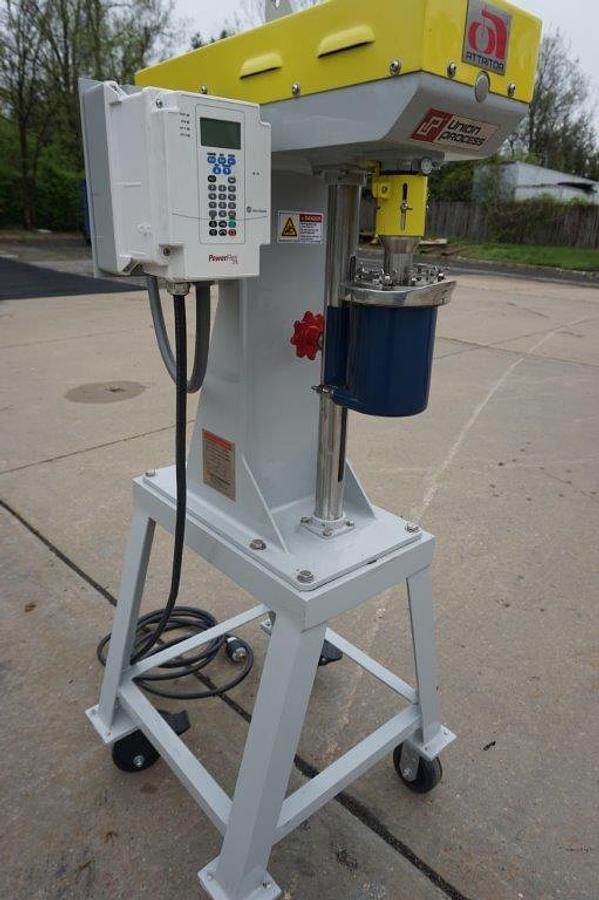
Category
Manufacturer
Model
Union Process Inc.
Union Process Inc. is a leader in the development of grinding and dispersing equipment, primarily for the chemical, paint, and ink industries. They are well-known for their continuous and batch attritors, which are used to achieve fine particle sizes in various materials. Union Process focuses on innovation to improve manufacturing processes and product quality.
FAQ:
What types of Union Process grinding mills are available on the used equipment market?
Union Process produces several distinct mill types, and all of them surface on the used equipment market with some regularity. The most commonly traded models are batch Attritors and continuous Attritors, but circulation mills and vibratory grinding mills also appear for sale. Batch Attritors are the workhorse for smaller production runs and laboratory work, while continuous Attritors are built for high-volume, uninterrupted processing. Circulation mills recirculate the slurry through a grinding tank repeatedly until the target particle size is reached, which makes them well-suited for applications requiring very tight particle size distributions.
The specific model that shows up most frequently in used equipment listings is the HDDM series, which is a high-density dispersion mill designed for fine and ultra-fine grinding. Buyers looking for a particular model should check with dealers who specialize in size reduction and milling equipment, as inventory turns over quickly. Because these machines are sold used rather than direct from the manufacturer, availability at any given moment depends entirely on what has recently come off production floors. Patience and a relationship with a knowledgeable dealer are usually the most reliable ways to find a specific Union Process configuration.
What is the difference between a batch Attritor and a continuous Attritor mill?
A batch Attritor loads a fixed quantity of material into the grinding tank, processes it until the desired particle size is achieved, and then the batch is discharged before the next cycle begins. This approach gives operators precise control over each individual run, making batch Attritors the preferred choice for R&D, small production volumes, specialty formulations, and situations where the product changes frequently. They are also easier to clean between batches, which matters in pharmaceutical, food-grade, and multi-product manufacturing environments.
A continuous Attritor, by contrast, feeds material in at one end and discharges finished product from the other in an uninterrupted stream. This design is built for high-volume manufacturing where the same material runs for extended periods. Throughput rates are significantly higher than batch processing, and labor costs per unit of output tend to be lower. The trade-off is that continuous mills are less flexible when frequent product changeovers are required. When evaluating used Attritors, buyers should confirm which configuration a machine is, since the mechanical differences between batch and continuous models affect installation requirements, maintenance schedules, and the types of applications each can handle.
What industries use Union Process Attritor mills?
Union Process Attritors have found a home in a wide range of industries, largely because of their ability to achieve fine and ultra-fine particle sizes that conventional ball mills and hammer mills cannot reliably reach. The chemical, paint, and ink industries have historically been the core markets, and these sectors generate a steady supply of used machines as production lines are updated or consolidated. Ceramics manufacturers use Attritors to grind raw materials to the particle sizes needed for consistent sintering and firing results. Electronics manufacturers rely on them for processing conductive pastes, battery materials, and other components where particle size directly affects product performance.
Pharmaceuticals and advanced materials manufacturing have become increasingly significant application areas as well. In pharma, Attritors are used for micronizing active ingredients to improve bioavailability. In advanced materials, they process tungsten carbide, metal powders, and other hard or abrasive substances. Coatings manufacturers use them for pigment dispersion and surface treatment applications. This breadth of use is one reason why used Union Process mills hold their value reasonably well and why buyers from very different industries are often competing for the same machines on the secondary market.
What materials can Union Process grinding mills process?
Union Process Attritors and related mills are capable of processing a broad spectrum of materials, from soft pigments and chemical compounds to extremely hard ceramics and metal powders. Common materials include titanium dioxide, calcium carbonate, silicon carbide, aluminum oxide, tungsten carbide, graphite, and various pharmaceutical compounds. The mills work in both wet and dry grinding modes depending on the model, which expands the range of materials they can handle. Wet grinding is more common in paint, ink, and chemical applications, while dry grinding is used for materials that cannot tolerate moisture or where a dry end product is required.
The construction materials of the mill itself matter when processing abrasive or chemically reactive substances. Union Process builds mills with different tank and agitator materials, including stainless steel, chrome steel, and various specialty linings, to resist wear and contamination. When buying a used mill, it is worth confirming what materials the machine was previously used to process, since residual contamination or accelerated wear in certain components can affect suitability for a new application. A dealer familiar with Union Process equipment should be able to provide that history, or at minimum facilitate a thorough inspection so buyers can assess the condition of wear surfaces before committing to a purchase.
What sizes and production capacities do Union Process mills come in?
Union Process designs mills across a wide capacity range, from small laboratory units intended for R&D and sample preparation all the way up to large production machines capable of handling hundreds of gallons of material per hour. Laboratory-scale Attritors typically have tank capacities measured in liters and are used to develop and refine processes before scaling up. Pilot-scale units bridge the gap between lab work and full production, and production-scale machines are available in increasingly large configurations for high-volume manufacturing environments.
The specific capacity of a used mill is one of the most important specifications to verify before purchasing, since it directly determines whether the machine fits a given production requirement. Motor horsepower, tank volume, and agitator shaft speed are the key figures to compare. Buyers should also consider the footprint and weight of the machine, since larger production-scale mills require substantial floor space, reinforced flooring, and in some cases overhead clearance for loading. A reputable dealer should be able to provide the full specification sheet for any used Union Process mill in their inventory, and buyers are encouraged to cross-reference those specs with Union Process's published documentation to confirm they match the intended application.
How does an Attritor mill differ from a conventional ball mill?
Both Attritor mills and conventional ball mills use grinding media, typically steel or ceramic balls, to reduce particle size through impact and attrition. The fundamental difference is in how that media is set in motion. A conventional ball mill rotates the entire grinding cylinder, relying on gravity and centrifugal force to tumble the media. This is an energy-intensive process with relatively limited control over the intensity of grinding action. Attritor mills, by contrast, use a stationary tank and a rotating agitator shaft fitted with arms or pins that actively stir the media. This direct agitation creates far more frequent and energetic media-to-media and media-to-particle contacts per unit of time.
The practical result is that Attritors can achieve finer particle sizes in shorter processing times and with lower energy consumption per unit of output compared to conventional ball mills of similar capacity. They also offer more precise control over process variables like temperature, media loading, and agitator speed. For applications targeting sub-micron or nanoscale particle sizes, conventional ball mills are often simply not capable of reaching the required fineness, whereas Attritors can. This performance advantage is a primary reason why used Union Process Attritors remain in demand even as machines age, and why buyers from industries like electronics and advanced materials actively seek them out on the secondary market.
What should buyers inspect when evaluating a used Union Process Attritor mill?
The most critical components to assess on a used Attritor are the agitator shaft and arms, the grinding tank interior, and the mechanical seal assembly. The agitator arms take the most abuse during operation because they are in constant contact with the grinding media, and wear on these surfaces directly affects grinding efficiency. Scoring, pitting, or significant dimensional loss on the arms is a sign that replacement parts will be needed before the machine returns to full performance. The tank interior should be inspected for liner wear, corrosion, or contamination from previous materials, particularly if the intended new application involves sensitive or reactive substances.
The drive system, including the motor, gearbox, and any variable speed controls, should also be evaluated carefully. Buyers should ask the dealer to facilitate either an in-person inspection or a detailed video walkthrough that covers all major components. Some machines may still be installed and running at a facility, which offers the opportunity to observe operation directly, though most dealers do not have the permitting or production infrastructure to run actual material through the mill as a demonstration. Consulting with Union Process directly about the age and model of a specific machine is also advisable, since parts availability and manufacturer support can vary depending on when the unit was built. A dealer with a track record in size reduction equipment is better positioned to provide accurate condition assessments than a general industrial auction house.
Do used Union Process mills come with a warranty?
Used industrial equipment, including Union Process mills, is almost universally sold on an as-is basis by dealers in the secondary market. Warranties are a feature of purchases made directly from the equipment manufacturer and are not typically extended by used equipment dealers. This places the responsibility for evaluating machine condition squarely on the buyer, which is why thorough pre-purchase inspection is so important. Buyers should not assume that a machine is in working order simply because it looks clean or complete in photographs.
To reduce risk, buyers should prioritize dealers who specialize in size reduction and milling equipment rather than general surplus dealers, since specialists are better equipped to accurately describe condition and identify potential issues. Asking for detailed inspection access, whether in person or via video, is a reasonable expectation and reputable dealers routinely accommodate this. It is also worth contacting Union Process directly to ask about parts availability and technical support for the specific model and approximate age of the machine under consideration, since older or discontinued models may have limited support infrastructure. Understanding the full picture before purchase, rather than relying on any post-sale recourse, is the most reliable approach when buying used milling equipment.
What are typical shipping and logistics considerations for purchasing a used Union Process mill?
Shipping a used grinding mill involves more complexity than standard freight because these machines are heavy, often contain precision components, and can be damaged by improper handling during transit. The seller or dealer is typically responsible for preparing the machine for shipment, which may involve draining fluids, securing moving parts, and crating or palletizing the unit to protect it during loading and transport. The level of packaging required varies by machine size and configuration, and buyers should ask for specifics on how the machine will be prepared before agreeing to a purchase price, since packaging and crating costs are often separate line items.
Larger production-scale Attritors may require rigging equipment for loading at the origin and unloading at the destination, which adds to the total landed cost of the machine. Buyers should request a full breakdown of freight, rigging, and crating charges so they can accurately compare the total cost of acquisition across different machines and dealers. Freight carriers experienced with industrial machinery are preferable to standard LTL carriers for anything beyond small laboratory units. International buyers face additional considerations including customs documentation, import duties, and the need for carriers familiar with cross-border industrial shipments. Getting all of these cost components in writing before finalizing a purchase prevents surprises once the machine is in transit.
What payment terms should buyers expect when purchasing used Union Process equipment?
The standard practice in the used industrial equipment market is full payment prior to shipment. This applies to the vast majority of transactions between buyers and dealers, regardless of machine type or price point. The rationale is straightforward: once a machine leaves a dealer's facility, the dealer has limited recourse if payment issues arise, so prepayment protects both parties by establishing clear terms before the equipment changes hands. Buyers who are unfamiliar with a particular dealer should treat this as a normal part of the process rather than a red flag.
Some dealers extend payment terms or financing arrangements to repeat customers or buyers with established relationships, but this is the exception rather than the rule for first-time transactions. Buyers looking to finance a used mill purchase should explore equipment financing through third-party lenders, which is a common approach for capital equipment acquisitions in manufacturing. Before sending any payment, buyers should confirm the dealer's credentials, verify that the machine exists and matches the described condition through inspection, and ensure that all costs including shipping, rigging, and any applicable taxes are clearly documented. A detailed invoice that itemizes every component of the transaction is a reasonable expectation and a mark of a professional dealer.