Category
Manufacturer
Model
Travaini
Travaini specializes in manufacturing vacuum pumps and systems for various industrial applications. They are particularly known for their robust rotary vane pumps that are widely used in the chemical and pharmaceutical sectors.
FAQ:
What types of Travaini vacuum pumps are available on the used equipment market?
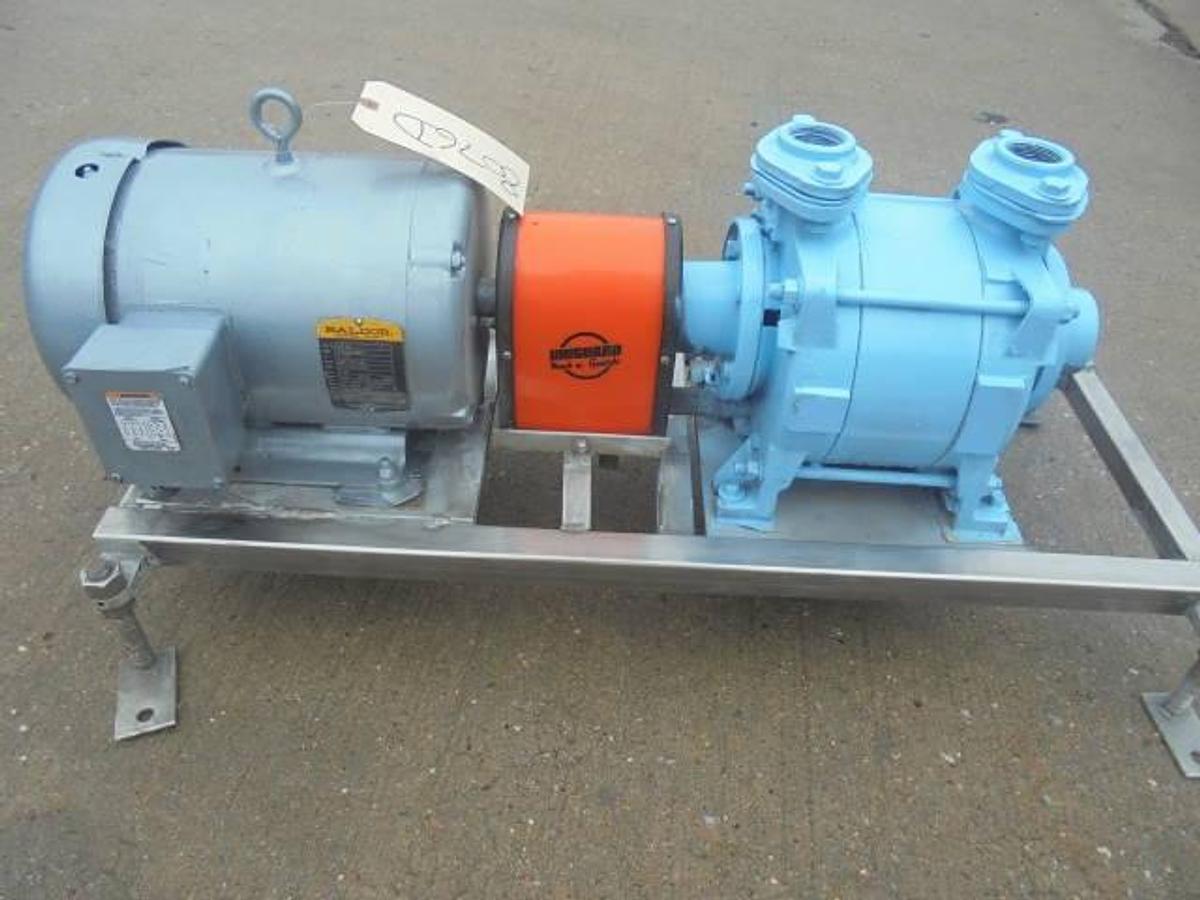
Travaini produces several distinct vacuum pump lines, and used examples from most of these series appear regularly in the secondary market. The most commonly traded models include liquid ring vacuum pumps from the TRVX and TRLX series, which cover a broad range of flow rates and vacuum levels suited to heavy industrial use. Rotary vane pumps are another category frequently found used, and Travaini is particularly well regarded for these in chemical and pharmaceutical applications. Specific models like the Travaini 40-150/C/GH, which pairs with a 7.5 HP motor, represent the kind of mid-range industrial unit that comes up for sale as facilities upgrade or decommission equipment.
Beyond individual pump units, used Travaini vacuum systems (pump plus ancillary components like separators, heat exchangers, and control panels) occasionally become available when entire process lines are sold off. Buyers looking for a specific series or capacity should work with dealers who specialize in process and vacuum equipment, since general industrial machinery dealers may not stock Travaini units consistently. Checking with a specialist dealer gives buyers a better chance of finding the right model and getting accurate technical information about the unit's configuration and condition.
What industries commonly use Travaini vacuum pumps?
Travaini vacuum pumps have a strong presence across industries where reliable, continuous vacuum duty is critical. Chemical processing and pharmaceutical manufacturing are two of the most prominent sectors, largely because liquid ring vacuum pumps handle vapor-laden, wet, or condensable gases without the risk of damage that would affect dry-running pump designs. This makes them a practical choice for distillation, drying, filtration, and solvent recovery processes where the gas stream contains moisture or reactive vapors. Food and beverage processing, paper and pulp production, and power generation facilities also rely on Travaini equipment for similar reasons.
Oil and gas operations use these pumps for vapor recovery and degassing applications, and the pumps also appear in environmental and wastewater treatment systems. The breadth of industries that have adopted Travaini equipment over the decades means used units turn up from a wide variety of plant closures and equipment upgrades. For buyers sourcing a used Travaini pump, understanding the previous application can be useful context for evaluating the pump's wear history and whether it suits the intended duty cycle.
How does liquid ring vacuum pump technology work, and why does Travaini favor it?
A liquid ring vacuum pump operates by rotating an impeller eccentrically inside a cylindrical casing that is partially filled with a sealant liquid, typically water. As the impeller turns, centrifugal force throws the liquid outward, forming a rotating ring against the casing wall. The space between the impeller hub and the liquid ring acts as the compression chamber, expanding and contracting with each rotation to draw in and compress gas. Because the liquid ring continuously absorbs heat and carries away condensable vapors, the process is essentially isothermal, which is gentler on the gas being handled than adiabatic compression in a dry pump.
Travaini has built much of its industrial reputation on this technology because it suits the demanding, often corrosive or vapor-heavy process streams found in chemical and pharmaceutical plants. The design has relatively few moving parts compared to reciprocating or dry screw pumps, which translates to lower maintenance frequency and longer service intervals. For buyers evaluating a used Travaini liquid ring pump, the low mechanical complexity is a practical advantage: there are fewer wear components to assess during inspection, and the pumps tend to age predictably when operated within their design parameters.
What vacuum levels can Travaini vacuum pumps achieve?
Travaini liquid ring vacuum pumps are generally capable of achieving vacuum levels in the range of 25 to 29 inches of mercury (roughly 25 to 75 torr absolute) in single-stage configurations. Two-stage liquid ring designs push further, reaching vacuum levels down to approximately 25 torr or below under favorable conditions. The exact achievable vacuum depends on the sealant liquid temperature, the specific pump model, and the composition of the gas being handled. Cooler sealant water allows deeper vacuum because the vapor pressure of the liquid is lower, leaving more of the pump's capacity available for actual gas compression.
Rotary vane pumps in the Travaini lineup can achieve deeper vacuum levels than liquid ring designs, often reaching into the range of 0.1 torr or lower in two-stage configurations, making them better suited for applications requiring high vacuum rather than rough or medium vacuum. When evaluating a used Travaini pump for a specific application, buyers should confirm the model's rated vacuum performance against the sealant temperature conditions available at their facility, since a pump rated at a particular vacuum depth under ideal test conditions may perform differently in real plant conditions with warmer cooling water.
What should buyers inspect when purchasing a used Travaini vacuum pump?
A thorough inspection of a used Travaini vacuum pump should cover both mechanical condition and process history. On the mechanical side, key areas include the condition of the impeller and casing for corrosion or erosion, the state of the shaft seals (mechanical seals or packing), bearing condition, and whether the pump rotates freely without unusual noise or resistance. For liquid ring pumps, the internal surfaces are particularly worth examining since aggressive process fluids can cause pitting or wear that affects both performance and longevity. Reputable used equipment dealers will typically accommodate in-person inspections, video walkthroughs, or photo documentation to give buyers an accurate picture of the machine's current state.
Process history matters too. A pump previously used in a clean water-sealed application will generally be in better condition than one that handled solvent vapors or corrosive gases without proper materials upgrades. Buyers should ask dealers about the pump's last known application, any maintenance records available, and whether the unit was decommissioned from an active production line or has been in storage. Keep in mind that most equipment dealers are not set up to perform live operational testing under actual process conditions, since that requires production-level permitting and infrastructure. The inspection goal is to get the clearest possible picture of mechanical condition and service history so buyers can make an informed decision.
Are used Travaini vacuum pumps a cost-effective alternative to buying new equipment?
Used Travaini vacuum pumps can offer significant cost savings compared to purchasing equivalent capacity equipment through standard distribution channels, often at a fraction of the price of a comparable unit. For facilities with budget constraints, maintenance departments replacing a failed pump, or operations that need a backup unit, the used market provides access to industrial-grade Travaini equipment that would otherwise be out of reach. The durability and relatively simple mechanical design of liquid ring and rotary vane pumps means that well-maintained used units can provide years of reliable service when properly evaluated before purchase.
The trade-off with used equipment is that buyers take on more responsibility for assessing condition, since used machinery is typically sold as-is without manufacturer backing. This makes the choice of dealer important. Working with a dealer who specializes in vacuum and process equipment, has a verifiable track record, and offers transparent inspection options reduces the risk considerably. Buyers should also factor in any reconditioning costs, replacement of wear parts like seals or bearings, and the cost of shipping and installation when calculating the true landed cost of a used unit versus other sourcing options.
Do warranties apply to used Travaini vacuum pumps?
Manufacturer warranties are tied to the sale of equipment through authorized channels and do not transfer to subsequent owners in most cases. Used Travaini vacuum pumps sold through the secondary market are typically offered on an as-is basis, which is standard practice for used industrial machinery dealers. This means the responsibility for evaluating the equipment's condition falls on the buyer, making pre-purchase inspection a critical step rather than an optional one.
Buyers should contact Travaini or their authorized service network directly to understand what level of technical support, parts availability, and service documentation exists for a specific model and serial number. Older or discontinued models may have limited parts availability, while more recent production units are more likely to have service support from the manufacturer. Selecting a dealer with deep experience in vacuum equipment and a history of accurately representing machine condition is the most practical way to manage the risk that comes with buying used industrial equipment without a warranty.
What are typical shipping and logistics considerations for used Travaini vacuum pumps?
Travaini vacuum pumps range from compact single-stage units to large industrial systems, and the logistics involved in shipping them vary accordingly. Smaller pumps can typically be palletized and shipped via standard freight carriers, but the packaging needs to be substantial enough to prevent damage during transit. Larger liquid ring pumps or complete vacuum systems may require custom crating, and the loading and unloading process at both ends can involve forklift or crane rigging, which adds to the overall cost. Buyers should ask dealers specifically about how the unit will be packaged, what rigging is required, and what the estimated freight cost is to their location before committing to a purchase.
Understanding the full landed cost is important when budgeting for a used pump purchase. The purchase price is only one part of the equation. Freight, rigging, and any required crating can add meaningfully to the total, particularly for heavy or oversized equipment being shipped across long distances. Some dealers will arrange shipping on the buyer's behalf, while others expect the buyer to coordinate their own carrier. Clarifying these logistics details upfront avoids surprises and helps buyers make accurate cost comparisons between available units.
What payment terms do used equipment dealers typically offer for vacuum pump purchases?
The standard practice among used industrial equipment dealers is to require full payment before a machine ships. This applies to vacuum pumps and most other categories of used machinery. The reasoning is straightforward: once equipment leaves the dealer's facility, verifying its condition becomes difficult, and the dealer's leverage in resolving any disputes diminishes. Buyers who are new to a particular dealer should expect to pay in full upfront as the default arrangement.
Some dealers extend credit terms or installment arrangements to established customers with a history of repeat purchases, but this is at the dealer's discretion and not a standard offering. Buyers making a first purchase with a dealer should plan for full prepayment and factor that into their cash flow planning. Wire transfer is the most common payment method for used industrial equipment transactions of this size, though some dealers accept other forms of payment. Clarifying payment expectations early in the buying process prevents delays once a unit is identified and a price is agreed upon.
Can replacement parts and rebuild components be sourced for used Travaini vacuum pumps?
Parts availability for Travaini vacuum pumps depends primarily on the model's age and whether the specific series is still in active production. For relatively recent models, Travaini's manufacturer network and authorized service centers are generally the most reliable source for replacement mechanical seals, bearings, impellers, and other wear components. Buyers considering a used Travaini pump should verify parts availability for that specific model before purchasing, since a pump that is mechanically sound but lacks a parts supply chain can become a maintenance liability over time.
For older or discontinued models, third-party seal manufacturers and aftermarket parts suppliers sometimes carry compatible components, particularly for common wear items like shaft seals and bearings. Rebuild kits, which bundle the most commonly replaced items for a specific pump model, are available through some specialty vacuum equipment suppliers. Consulting with Travaini's technical support or an authorized service center and providing the pump's model number and serial number is the most direct way to get an accurate picture of what support is available for a particular unit before committing to a purchase.