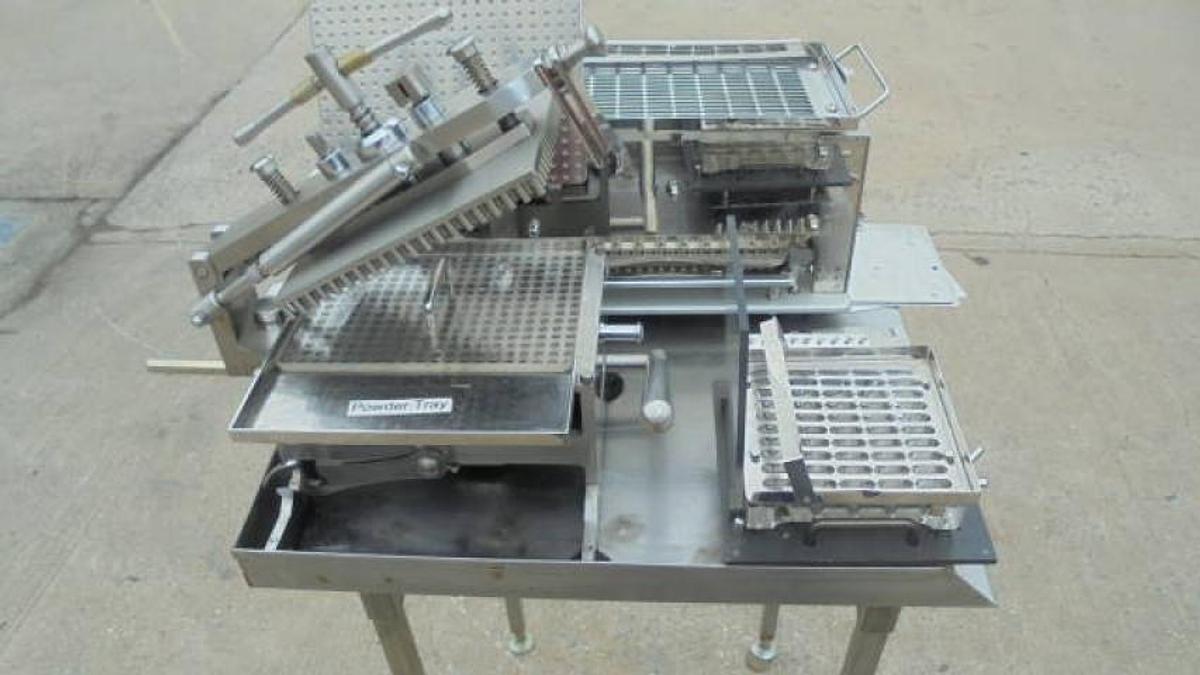
Category
Manufacturer
Model
FAQ:
What is a Torpac capsule filling system and what is it used for?
Torpac capsule filling systems are specialized pharmaceutical and nutraceutical equipment designed to fill empty hard-shell capsules with precise doses of powders, pellets, liquids, or tablets. The brand has built a strong reputation in lab-scale to mid-scale production environments, and their equipment is widely used by compounding pharmacies, nutraceutical startups, R&D departments, and contract manufacturers who need reliable, repeatable dosing without the overhead of full-scale industrial machinery.
Torpac's product line spans manual bench-top filling trays, semi-automatic systems, and more capable filling machines like the Profill 100 and Profill 300 models. The Profill series is particularly well-regarded for its balance of throughput and operational simplicity, making it a practical choice for operations that have outgrown hand-filling methods but don't yet require a fully automated production line. Because the systems are built around modular tooling, operators can swap capsule-size tooling sets to accommodate different product runs without replacing the entire machine.
What capsule sizes are compatible with Torpac filling machines?
Torpac capsule filling systems are engineered to work across the full standard capsule size range, from size 5 (the smallest, holding approximately 0.13 mL) up through size 000 (the largest commonly used, holding roughly 1.37 mL). This broad compatibility makes them practical for manufacturers who produce multiple SKUs with different fill weights or formulations, since the same machine platform can be retooled to handle different capsule sizes by swapping the appropriate tooling sets.
Beyond size compatibility, Torpac equipment is designed to work with both hard gelatin capsules and vegetarian HPMC (hydroxypropyl methylcellulose) capsules. This matters considerably for companies serving vegan, kosher, or allergen-sensitive consumer markets, where gelatin-based capsules are not acceptable. The ability to run HPMC capsules without machine modification gives operators more flexibility when sourcing capsule shells or responding to customer requirements.
What types of fill materials can Torpac capsule filling systems handle?
Torpac systems are built to handle a variety of fill materials, with free-flowing and tamped powders being the most common application. The tamping mechanism on semi-automatic models like the Profill series allows operators to achieve consistent fill weights even with powders that have variable bulk density or poor flow characteristics. Pellets and micro-beads used in modified-release formulations are also compatible, provided the tooling and fill chamber are configured appropriately for the particle size.
Beyond dry materials, some Torpac configurations can accommodate tablets or mini-tabs placed inside capsules, a technique used in combination products or when a precise number of small tablets needs to be delivered in a single dose. Liquid fills are possible on certain setups as well, though this typically requires additional accessories and careful attention to capsule sealing. Operators working with specialized or unusual fill materials should verify tooling compatibility before purchasing a machine, which is especially relevant when evaluating used equipment where the tooling configuration may differ from a standard setup.
What is the difference between the Torpac Profill 100 and Profill 300?
The Torpac Profill 100 and Profill 300 are both semi-automatic capsule filling systems, but they differ primarily in batch capacity and throughput. The Profill 100 is designed for smaller production runs, processing 100 capsules per cycle, which suits compounding pharmacies, R&D labs, or early-stage nutraceutical companies that need to produce moderate quantities with tight quality control. The Profill 300 handles 300 capsules per cycle, making it more appropriate for operations with higher volume demands or those looking to reduce the number of cycles required to fulfill a production batch.
Both models follow a similar operational workflow: capsules are loaded into the filling tray, the bodies and caps are separated, the fill material is dispensed and tamped into the bodies, and the caps are rejoined. The core difference is simply scale. When evaluating used examples of either model, buyers should confirm that the machine comes with the tooling set for the capsule size they intend to run, since tooling is often sold separately and purchasing a machine without the correct size plates and tamping tools adds to the total cost of getting operational.
What is the typical output rate of a Torpac semi-automatic capsule filling system?
Output rates for Torpac semi-automatic systems depend on the model, the operator's experience, and the characteristics of the fill material. A Profill 100 can yield roughly 1,000 to 2,000 capsules per hour under normal operating conditions, while a Profill 300 can push output closer to 3,000 to 6,000 capsules per hour with an experienced operator. These figures assume a reasonably free-flowing powder and a well-maintained machine; sticky or hygroscopic materials will slow cycle times.
These production rates position Torpac semi-automatic equipment firmly in the small-to-mid-scale segment. For context, fully automated capsule filling lines used in large pharmaceutical manufacturing can produce tens of thousands to hundreds of thousands of capsules per hour. Torpac systems are not intended to compete at that level. They serve a different market: operations where flexibility, low changeover time, and modest capital investment matter more than raw throughput. For compounding pharmacies or nutraceutical brands producing dozens of SKUs in relatively small batches, a Torpac semi-automatic system often hits the right balance.
Are Torpac capsule filling machines suitable for GMP pharmaceutical environments?
Torpac equipment has been widely adopted in pharmaceutical compounding pharmacies and R&D settings that operate under Good Manufacturing Practice (GMP) frameworks, which speaks to the brand's reputation for precision and cleanability. The machines are generally constructed with stainless steel contact parts and are designed to be disassembled for cleaning between product runs, which is a basic requirement in any regulated production environment. That said, GMP compliance is ultimately a function of the entire operating system, including SOPs, environmental controls, personnel training, and documentation, not just the machine itself.
When purchasing a used Torpac system for a GMP or cGMP environment, buyers should factor in the machine's history and condition. A used machine that has been properly maintained and cleaned will typically integrate into a compliant workflow without issue, but one that shows signs of wear, corrosion, or product residue may require reconditioning before it can be validated for regulated use. Consulting with the manufacturer about the specific model's documentation support, including IQ/OQ protocols, is a reasonable step before committing to a purchase.
What should buyers look for when inspecting a used Torpac capsule filling machine?
A thorough inspection of a used Torpac capsule filling system should cover both mechanical condition and completeness of tooling. On the mechanical side, buyers should check the filling tray, tamping pins, and powder funnel for signs of wear, warping, or corrosion. The alignment of the capsule plates is critical: if the holes are misaligned even slightly, capsule bodies won't seat properly, which leads to fill weight variation and capsule damage during closing. Any play or slop in the tamping mechanism is also worth noting, as this directly affects dosing consistency.
Completeness matters just as much as condition. Torpac systems rely on size-specific tooling sets, and a machine sold without the correct capsule size plates, tamping tools, or powder spreader is not immediately production-ready. Buyers should confirm exactly which tooling is included and whether it matches their intended capsule size. Reputable used equipment dealers will typically accommodate in-person or video inspections so buyers can assess these details before committing. Most dealers do not have the permits required to run actual product through the machines during a demonstration, but a visual and mechanical inspection can still reveal a great deal about the equipment's condition and completeness.
Are replacement parts and accessories readily available for used Torpac equipment?
Torpac, as a manufacturer, produces a wide range of accessories and replacement components for their capsule filling systems, including tamping tools, powder funnels, capsule openers, and size-specific filling plates. For buyers of used equipment, parts availability is a practical concern, and it's worth contacting Torpac directly before purchasing to confirm whether the specific model and configuration they're considering is still supported with replacement parts. Older or discontinued models may have limited parts availability, which can affect long-term operating costs.
Beyond the manufacturer, the secondary market for Torpac accessories is reasonably active given the brand's popularity in compounding and nutraceutical circles. Tooling sets for common capsule sizes (size 0, 00, and 1 are among the most frequently used) tend to be easier to source than tooling for less common sizes. Buyers should also ask the seller whether any spare parts or additional tooling sets are included with the machine, as this can add meaningful value to a used purchase and reduce the time to getting the equipment into production.
What is the typical price range for used Torpac capsule filling systems?
Pricing for used Torpac capsule filling equipment varies based on model, condition, included tooling, and the seller. Bench-top manual filling trays and simpler accessories are the most affordable entry point and can often be found for a few hundred dollars. Semi-automatic systems like the Profill 100 and Profill 300 occupy a higher price tier, generally ranging from a few thousand dollars up to the low five figures depending on age, condition, and what tooling is included. Machines that are in clean, well-maintained condition with a complete set of tooling for a common capsule size will typically command a premium over units sold without accessories or showing significant wear.
Buyers should also account for total landed cost when comparing prices. Shipping, rigging, and any reconditioning work needed before the machine is production-ready can add meaningfully to the purchase price. Larger machines may require specialized freight handling and unloading equipment, which adds to logistics costs. Getting a clear picture of all these costs upfront, before committing to a purchase, is the best way to avoid surprises and accurately compare options across different sellers.
What should buyers understand about payment and shipping when purchasing used capsule filling equipment?
Most used equipment dealers require payment in full before a machine is released for shipment. Some dealers extend payment terms to established repeat customers, but first-time buyers should generally plan for full payment upfront. Wire transfer is the most common payment method for machinery transactions of this size. Buyers should verify the seller's identity and legitimacy before sending funds, and working with dealers who have a documented track record in pharmaceutical or nutraceutical equipment is a reasonable precaution.
Shipping costs for capsule filling equipment depend on the size and weight of the machine, the distance involved, and the level of packaging required to prevent transit damage. Smaller bench-top Torpac systems may ship on a standard pallet, while larger semi-automatic models may require custom crating. Heavier machines may also need rigging services for loading at the origin and unloading at the destination, which are typically separate line items from freight. Buyers should request a detailed quote that breaks out packaging, rigging, and freight costs so they understand the full cost before agreeing to a purchase.