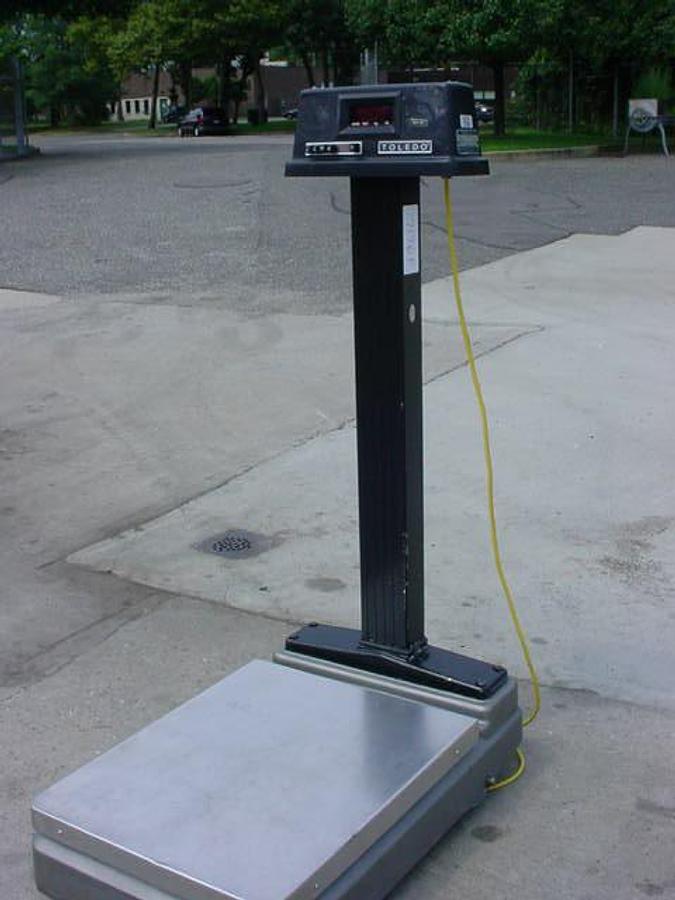
Category
Manufacturer
Model
Toledo
Toledo is recognized for its high-precision weighing and packaging solutions, primarily serving the food and pharmaceutical industries. Their equipment is designed to ensure accuracy and compliance in production processes. Toledo’s focus on innovation and reliability positions them as a leader in their field.
FAQ:
What types of used Toledo digital scales are available on the market?
Used Toledo digital scales span a wide range of form factors and use cases, so buyers generally have solid options regardless of their application. Common types found on the secondary market include portable digital scales (such as the Toledo Digitol), bench scales, platform scales, floor scales, and precision balances. The Toledo Model 0280 is one example of a portable digital scale that surfaces regularly in the used equipment market. Each type is built for a different weight range and environment, so it helps to know your required capacity and whether the scale needs to be stationary or moved between locations.
Beyond portability and size, Toledo scales differ in their connectivity and display options. Some models are standalone units with simple LED or LCD readouts, while others are designed to integrate with printers, checkweighers, or production line systems. Used equipment listings will typically specify the model number, which makes it straightforward to look up the original manufacturer specifications and confirm whether a particular unit fits your operation. Buyers shopping for used Toledo scales should pay close attention to the model details provided by the seller, as the Toledo line covers everything from sub-kilogram precision balances to heavy-duty floor scales rated for several thousand pounds.
What industries are Toledo digital scales best suited for?
Toledo digital scales have earned a strong reputation across industries where weighing accuracy directly affects product quality, regulatory compliance, or transaction fairness. Food processing and packaging is probably the most prominent application, where Toledo equipment is used to portion ingredients, verify fill weights, and meet food safety standards. Pharmaceutical manufacturing is another core market, given the tight tolerances required when measuring active ingredients or finished dosage forms. Retail grocery, logistics and warehousing, agriculture, and general manufacturing are also well-represented industries in the Toledo customer base.
The reason Toledo scales appear across such a broad range of sectors comes down to the combination of durability and precision the brand has built over more than a century of production. In food and pharma especially, equipment needs to hold calibration under demanding conditions, including temperature swings, moisture exposure, and high-throughput use. Toledo's stainless steel construction options and sealed load cells make their scales well-suited to washdown environments. For buyers sourcing used Toledo equipment, this industrial-grade build quality means the scales tend to hold up well even after years of service, provided they have been maintained and calibrated properly.
How accurate are Toledo digital scales, and what resolution can buyers expect?
Toledo digital scales are widely regarded as among the more accurate options in commercial and industrial weighing. Depending on the model, readability can be as fine as 0.001 lb or 1 gram on precision bench scales, while heavier-duty floor and platform models typically read in increments of 0.1 lb, 0.2 lb, or 0.5 lb depending on their capacity range. The accuracy of any given unit is tied to its division count, which is the ratio of the scale's total capacity to its smallest readable increment. Toledo designs across the product line generally offer strong division counts relative to their capacity class.
For buyers purchasing used Toledo scales, accuracy is one of the most important things to verify before putting a unit into service. Even a well-built scale can drift out of calibration over time, particularly if it was stored improperly or subjected to overloading. Prospective buyers should ask sellers about the last known calibration date and whether the scale was in active production use prior to being decommissioned. After purchase, having the unit recalibrated by a certified scale technician is standard practice and ensures the scale is reading accurately before it enters your workflow. This is especially critical for applications involving commercial trade transactions or regulated industries.
Are Toledo digital scales NTEP certified and legal for commercial trade use?
Many Toledo digital scale models carry NTEP (National Type Evaluation Program) certification, which is the standard that determines whether a scale is legally approved for commercial trade transactions in the United States. NTEP certification means the scale design has been evaluated and approved by the National Conference on Weights and Measures, confirming it meets accuracy and repeatability standards required for buying and selling goods by weight. Common applications requiring NTEP-approved scales include retail food sales, meat counters, produce markets, and any transaction where a customer is charged based on the weight of a product.
When shopping for used Toledo digital scales, buyers who need legal-for-trade compliance should confirm that the specific model they are considering carries an NTEP Certificate of Conformance. The NTEP CC number is typically found on a label affixed to the scale, and the certificate can be verified through the NCWM database. It is also worth noting that NTEP certification applies to the scale's design, but individual units still need to be registered with the local weights and measures authority in most jurisdictions and may require periodic inspection. A used scale that was previously certified and in trade use can often be recertified, but buyers should check with their local jurisdiction to understand the requirements before assuming a used unit will qualify.
What weight capacities do Toledo digital scales cover?
Toledo's product line covers an exceptionally wide capacity range, which is one reason the brand appears in so many different industries. On the light end, precision balance models handle weights under 1 kilogram with very fine readability, making them appropriate for laboratory or pharmaceutical use. Mid-range bench and platform scales commonly cover capacities from 30 lbs up to 500 lbs, which fits retail, food portioning, and general industrial applications. At the heavy end of the spectrum, Toledo floor scales can handle 2,000 lbs, 5,000 lbs, or even 10,000 lbs or more, making them suitable for pallet weighing, freight, and bulk material handling.
For buyers sourcing used Toledo scales, matching capacity to application is critical. A scale that is consistently used near or at its maximum capacity will wear out faster and may develop accuracy issues over time. As a general rule, selecting a scale with a maximum capacity roughly 20 to 30 percent above your typical load gives the unit some headroom and extends its service life. When reviewing used equipment listings, the model number will usually point you to the manufacturer's published specifications, where you can confirm both the maximum capacity and the minimum recommended load. Some Toledo models also offer dual-range or multi-interval modes, which allow finer readability at lower weights while still accommodating heavier loads.
What is the difference between Toledo bench scales, platform scales, and floor scales?
The main differences between these scale types come down to size, capacity, and how they are positioned in a workspace. Bench scales are compact units designed to sit on a countertop or workbench, and they typically handle lighter loads in the range of a few pounds up to a few hundred pounds. They are common in food retail, deli counters, laboratory settings, and anywhere that portioning or checkweighing happens at a work surface. Toledo bench scales often feature stainless steel platforms and bright digital displays, making them practical for environments where hygiene and quick readouts matter.
Platform scales and floor scales are larger and built for heavier loads. Platform scales usually sit on a low-profile base and are used to weigh items that are placed on the platform by hand or with a hand truck, with capacities typically ranging from a few hundred to a couple thousand pounds. Floor scales are the heaviest-duty category, often recessed into a floor or positioned at loading dock level to accommodate pallets and heavy containers. Some Toledo floor scale models are designed for forklift loading. When evaluating used Toledo equipment in any of these categories, buyers should check that the platform surface is free of significant damage, that the load cells are intact, and that the display unit powers on and communicates correctly with the base.
Can Toledo digital scales be integrated with printers, computers, or POS systems?
Many Toledo digital scale models are built with connectivity in mind, and integration with external devices is a common feature across the commercial product line. Serial (RS-232) output is the most traditional connectivity option, allowing a scale to send weight data to a printer, PC, or POS terminal. Some Toledo models also support USB or Ethernet connections depending on the generation and configuration. In retail and food service environments, Toledo scales are frequently paired with label printers to produce price-by-weight labels at the point of sale, and certain models include built-in label printing functionality.
For buyers purchasing used Toledo scales with integration in mind, it is important to verify which communication ports are present on the specific unit and whether the necessary cables or interface modules are included. Older Toledo models may rely on communication protocols or connector types that require adapters to work with current systems. Sellers of used equipment can often provide photos of the rear panel or interface options, and the model number can be cross-referenced with manufacturer documentation to confirm compatibility details. If the scale will be used with a specific POS or inventory system, checking that system's list of compatible scale models before purchasing is a practical step that avoids integration headaches after the fact.
What should buyers look for when inspecting a used Toledo digital scale before purchasing?
A thorough inspection of a used Toledo digital scale covers both the physical condition of the unit and its functional performance. On the physical side, buyers should look at the condition of the weighing platform or platter, checking for cracks, heavy corrosion, or deformation that could affect how loads sit on the scale. The display should be checked for dead pixels, fading, or flickering, since a compromised readout makes the scale difficult to use accurately. The cable connecting the display to the base should be intact and free of cuts or heavy wear, and all buttons or keypad functions should respond properly.
Functionally, the most important check is whether the scale zeros correctly and holds a stable reading under load. Sellers who offer video inspections or in-person viewings can demonstrate the scale powering on, zeroing, and responding to a test weight. Keep in mind that most used equipment dealers do not have the permitting or production infrastructure to run full product testing, so the inspection will typically confirm that the unit operates as expected rather than simulating a complete production environment. After purchase, having the scale professionally calibrated before putting it into service is a sound practice, particularly for applications in regulated industries or commercial trade. Buyers should also ask the seller about the scale's history, including how long it was in service and under what conditions, as this context helps assess how much remaining service life to expect.
How does buying a used Toledo digital scale compare to buying new equipment?
Purchasing used Toledo digital scales offers meaningful cost advantages compared to buying current production equipment, often at a fraction of the price for a unit that is mechanically sound and ready to calibrate and put into service. Toledo scales are built to industrial standards with durable components, which means well-maintained units can deliver reliable performance long after leaving their first owner. For businesses that need weighing capacity quickly, used equipment is also typically available for faster acquisition than ordering through standard distribution channels, where lead times can stretch depending on model availability.
The tradeoffs are worth understanding clearly. Used equipment is sold as-is, meaning the buyer takes on the responsibility of verifying condition through inspection before committing to a purchase. There is no manufacturer coverage on a used unit, and the availability of service parts for older Toledo models can vary depending on how long ago a particular model was in production. Buyers should consult with the manufacturer or a certified scale service technician to understand what parts and support are realistically available for the specific model they are considering. Selecting a reputable used equipment dealer with a track record in industrial machinery and a willingness to facilitate thorough inspections goes a long way toward reducing the risk that comes with buying pre-owned equipment.
What should buyers know about shipping and payment when purchasing used Toledo digital scales?
Shipping used scales requires more planning than shipping standard parcels, and costs can vary considerably based on the size and weight of the unit. Smaller portable Toledo scales like the Digitol can often be palletized and shipped via standard freight carriers, but larger platform or floor scales may require custom crating to prevent damage in transit. Buyers should ask the seller specifically how the unit will be packaged, what the freight cost includes, and whether rigging or specialized loading equipment is needed at either end of the shipment. For heavy floor scales, a forklift or pallet jack may be required for unloading, and that cost falls on the buyer if not arranged in advance. Getting a clear picture of the total landed cost, including packaging, freight, and any rigging fees, before agreeing to a purchase prevents surprises.
On the payment side, most used equipment dealers require payment in full before a machine ships. This is standard practice in the industry and reflects the fact that used equipment transactions do not carry the same financing infrastructure as retail purchases. Some dealers extend payment terms to repeat customers with an established relationship, but first-time buyers should expect to pay upfront. Wire transfer is the most common payment method for used industrial equipment transactions. Buyers should confirm payment terms, accepted methods, and the timeline from payment to shipment with the seller before finalizing a deal.