Category
Manufacturer
Model
FAQ:
What is a ribbon blender and how does it work?
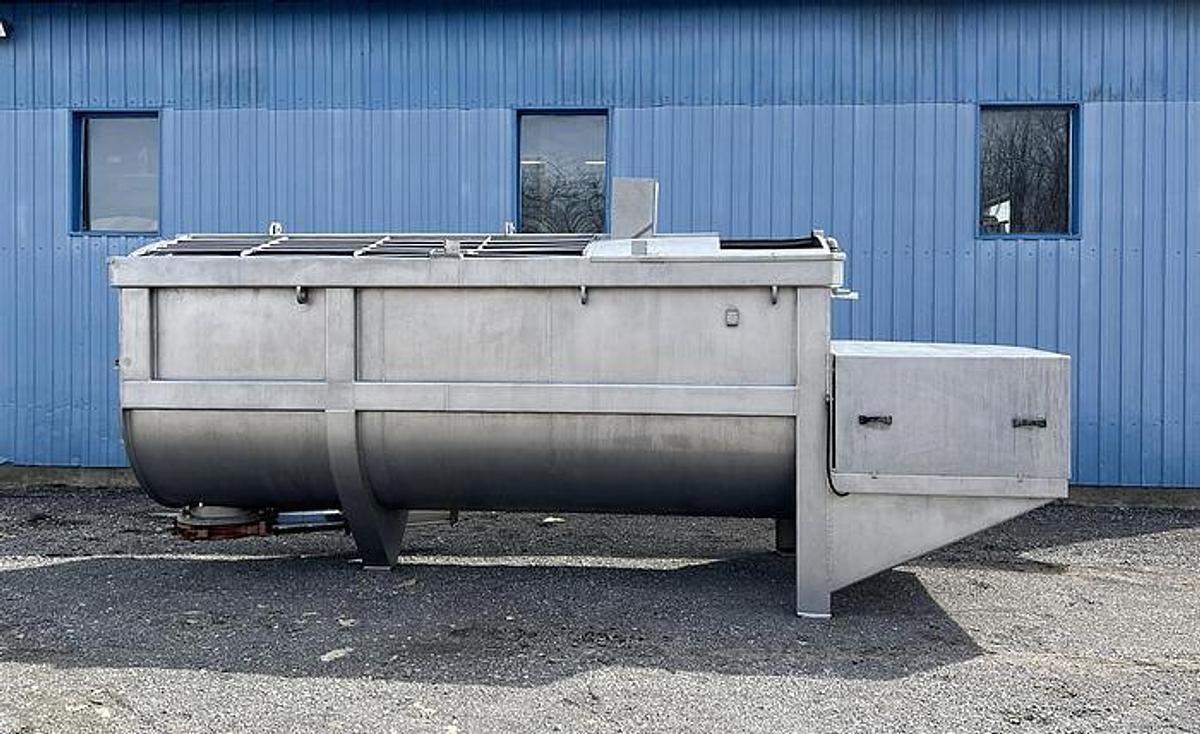
A ribbon blender is a horizontal mixing machine that uses a central shaft fitted with inner and outer helical ribbon agitators to blend dry, semi-dry, or paste-like materials. The two ribbons rotate in opposing directions simultaneously, with the outer ribbon moving material toward the center of the trough and the inner ribbon pushing it back toward the ends. This counter-directional flow creates a continuous, controlled circulation pattern that produces a thorough, homogeneous mix across the entire batch.
The design is particularly effective because no single portion of the material sits idle during the cycle. Batch cycle times for ribbon blenders typically fall between 10 and 20 minutes depending on the material characteristics, fill level, and the degree of homogeneity required. Because the blending action is gentle relative to high-shear mixers, ribbon blenders are well suited for fragile or friable materials that need to be mixed without being broken down. The horizontal trough design also makes loading and discharging straightforward, which keeps cycle times efficient in production environments.
What industries commonly use Titan ribbon blenders?
Titan ribbon blenders see use across a broad range of industries where consistent dry or semi-dry blending is a production requirement. Food processing operations use them for blending spice mixes, flour-based products, powdered beverages, and nutritional supplements. Chemical manufacturers rely on ribbon blenders for mixing pigments, detergent powders, fertilizers, and plastic compounding materials. Pharmaceutical producers use them for pre-blending active ingredients and excipients prior to tableting or encapsulation. Agricultural feed mills also use ribbon blenders heavily for combining grain-based feed ingredients.
The versatility of the ribbon blender design is a large part of why it appears in so many different sectors. A single machine can often handle products with varying bulk densities and particle sizes without significant reconfiguration. For buyers sourcing used Titan ribbon blenders, it is worth identifying whether a specific machine was previously used in a food, chemical, or pharmaceutical environment, since that history can affect cleaning requirements and the suitability of the machine for a new application. Construction materials, such as carbon steel versus stainless steel, and surface finish details are key factors when evaluating a used unit for a new industry context.
What sizes and capacities are available for used Titan ribbon blenders?
Industrial ribbon blenders span a wide capacity range, from small laboratory units of around 1 cubic foot up to large-scale production models exceeding 1,000 cubic feet. Titan ribbon blenders available on the used equipment market include larger production-scale units, such as 250 cubic foot models, which are well suited for high-volume blending operations in food processing, chemical manufacturing, or agricultural feed production. Finding a specific capacity on the used market depends on what has come out of decommissioned or upgraded production lines at any given time.
When evaluating capacity, buyers should keep in mind that ribbon blenders are typically filled to between 40 and 70 percent of their total volumetric capacity for optimal blending performance. Overfilling reduces the effectiveness of the ribbon action, while underfilling can create inefficient mixing patterns. A 250 cubic foot blender, for example, would realistically handle working batch sizes in the range of 100 to 175 cubic feet depending on the material's bulk density and flow characteristics. Buyers should confirm the working capacity alongside the nominal capacity when reviewing specifications for any used unit.
What materials of construction should I look for when buying a used ribbon blender?
The construction material of a ribbon blender trough, ribbon agitator, and shaft has a direct impact on what products can be processed and what cleaning protocols are required. Carbon steel is the most common construction material for general industrial applications such as mixing fertilizers, animal feed, or non-reactive chemical powders. It is durable and cost-effective but is not suitable for food contact applications or corrosive materials without a protective coating. 304 stainless steel is the standard choice for food-grade and pharmaceutical applications, offering good corrosion resistance and easier sanitation. 316 stainless steel provides additional resistance to chlorides and is preferred for more aggressive chemical environments or applications requiring frequent washdown with harsh cleaning agents.
For buyers sourcing used ribbon blenders, the construction material of the specific machine available is an important filter. A carbon steel unit previously used in a chemical plant may not be appropriate for a food processing application without significant refurbishment. Conversely, a stainless steel unit from a food facility may be an excellent fit for a pharmaceutical or nutraceutical operation. Beyond the trough and ribbon material, buyers should also pay attention to the discharge valve design, since flush-mounted butterfly valves are preferred for sanitary applications while simpler slide gates are more common in industrial settings. Inspecting weld quality, interior surface finish, and any signs of corrosion or pitting is an important part of evaluating any used unit.
What is the difference between a single ribbon and a double ribbon blender?
A single ribbon blender uses one continuous helical ribbon mounted on a central shaft, which moves material in a single direction along the length of the trough. This configuration can be effective for certain light-duty or less demanding blending applications, but it tends to produce longer blend times and can leave dead zones near the ends of the trough where material circulation is less active. Single ribbon designs are less common in high-volume industrial settings for this reason.
A double ribbon blender uses two concentric ribbons, an outer ribbon and an inner ribbon, that are pitched in opposite directions. As the shaft rotates, the outer ribbon moves material toward the center while the inner ribbon simultaneously moves material toward the ends. This opposing flow creates a more active, three-dimensional circulation pattern that results in faster blend times, more uniform mixing, and fewer dead zones. The double ribbon configuration is the standard for most industrial applications and is the design found in the majority of production-scale Titan ribbon blenders. When evaluating a used ribbon blender, confirming whether it is a single or double ribbon design is a basic but important specification check.
What motors and horsepower are typically found on industrial ribbon blenders?
Motor sizing on a ribbon blender is determined primarily by the working capacity of the machine and the bulk density of the materials being processed. Smaller ribbon blenders in the 10 to 50 cubic foot range often use motors in the 5 to 20 horsepower range, while larger production units in the 200 to 500 cubic foot range commonly require motors from 30 to 75 horsepower or more. For very large blenders or applications involving dense or sticky materials, motors exceeding 100 horsepower are not uncommon. The drive system typically includes a gear reducer between the motor and the shaft to bring the ribbon speed down to an appropriate RPM for blending, usually somewhere between 20 and 50 RPM for most applications.
For buyers evaluating used ribbon blenders, the motor condition and horsepower rating are important inspection points. A motor that has been properly maintained and is appropriately sized for the intended application is a significant part of the machine's value. Buyers should ask for details on the motor brand, horsepower, voltage, and phase configuration to confirm compatibility with their facility's electrical supply. Three-phase power is standard for industrial blender motors, and confirming the voltage rating (typically 208, 230, or 460 volts in North American facilities) before purchase avoids costly electrical modifications after delivery.
Are used ribbon blenders suitable for food-grade or pharmaceutical applications?
Used ribbon blenders can be suitable for food-grade or pharmaceutical applications, but suitability depends heavily on the specific machine's construction, previous use history, and current condition. The key requirements for food and pharmaceutical use include stainless steel construction (typically 304 or 316 grade), a polished interior surface finish to minimize product retention and facilitate cleaning, flush-mounted discharge valves that leave no dead pockets, and sealed bearings or stuffing boxes to prevent contamination at the shaft ends. Machines that meet these criteria and were previously used in similar regulated environments are generally strong candidates for continued food or pharmaceutical service.
Buyers should approach used equipment in this category with careful due diligence. Requesting detailed photos or a video inspection of the trough interior, welds, discharge valve, and shaft seals is a reasonable starting point. Some used equipment dealers can arrange in-person inspections at the facility where the machine is currently located, which gives buyers the clearest picture of actual condition. It is also worth consulting with the Titan manufacturer or an authorized service provider to understand what refurbishment, re-polishing, or component replacement might be needed to bring a specific used unit into compliance with current food safety or pharmaceutical manufacturing standards. Age and prior use environment are both factors that affect how much preparation work a machine may require before it is ready for a regulated production setting.
What should buyers inspect before purchasing a used Titan ribbon blender?
A thorough inspection of a used ribbon blender covers several key areas that affect both performance and longevity. The trough interior should be examined for corrosion, pitting, worn or damaged ribbon edges, and the condition of any welds. Ribbon clearance from the trough wall is a critical specification, since excessive gap between the ribbon and the trough bottom allows material to accumulate without being swept, reducing blend quality. The shaft and end seals should be checked for wear, since leaking seals can allow product to contaminate the bearings or allow lubricant to enter the product zone. The discharge valve should open and close cleanly with no binding, and the valve seat should be free of damage or heavy buildup.
On the mechanical side, the motor, gearbox, and drive components deserve close attention. Checking for unusual noise, vibration, or heat during operation is valuable when a live run is possible. Most used equipment dealers can accommodate in-person inspections or provide detailed video walkthroughs of the machine. Some machines may still be in active production at a facility, in which case the dealer can often coordinate an inspection at the plant. Buyers should keep in mind that most dealers are not set up to run actual product through a machine during inspection, since that level of production testing requires permitting and facility capabilities beyond what a typical equipment dealer maintains. The goal of the inspection is to get an accurate picture of the machine's mechanical condition and overall state of maintenance.
What are typical shipping and delivery considerations for a large ribbon blender?
Shipping a large industrial ribbon blender involves logistics planning that goes beyond standard freight. Machines in the 250 cubic foot range are heavy, often several thousand pounds, and require proper rigging for safe loading and unloading. Depending on the machine's dimensions, flatbed trucking or a specialized heavy equipment carrier may be needed. The trough, drive assembly, and any removable components should be carefully secured and protected to prevent damage in transit. Crating requirements will vary based on the machine's size, fragility, and the distance being shipped, and packaging costs are typically quoted separately based on what level of protection is required.
Buyers should request a detailed breakdown of all costs associated with getting the machine to their facility, including rigging at the point of origin, freight charges, and any unloading or rigging costs at the destination. Having the right equipment on the receiving end, such as a forklift with adequate capacity or a crane for larger units, is the buyer's responsibility to arrange. Buyers should confirm all of these logistics details with the dealer before finalizing a purchase so that the full landed cost is understood upfront. Surprises in freight or rigging costs are a common issue with large equipment purchases that can be avoided with clear communication before the sale is completed.
What payment terms should buyers expect when purchasing used industrial blending equipment?
Used industrial equipment transactions, including ribbon blenders, are generally handled on a payment-before-shipment basis. Most used equipment dealers require full payment prior to releasing a machine for shipping, which is standard practice in the industry and reflects the nature of the used equipment market where machines are sold as-is without the financial backstop of a manufacturer's return policy. Buyers who have an established purchasing history with a particular dealer may occasionally be offered payment terms, but this is the exception rather than the rule for first-time transactions.
Buyers should factor payment timing into their procurement planning, particularly for larger capital equipment purchases that may require internal approval processes or financing arrangements. It is also worth clarifying with the dealer exactly when payment is due relative to inspection, since most buyers prefer to complete their inspection before releasing funds. Understanding the full sequence of inspection, payment, rigging, and shipment before the transaction begins helps avoid misunderstandings and keeps the process moving efficiently. For buyers financing the purchase through a third party, coordinating the financing timeline with the dealer's payment requirements is an important early step in the process.