Category
Manufacturer
Model
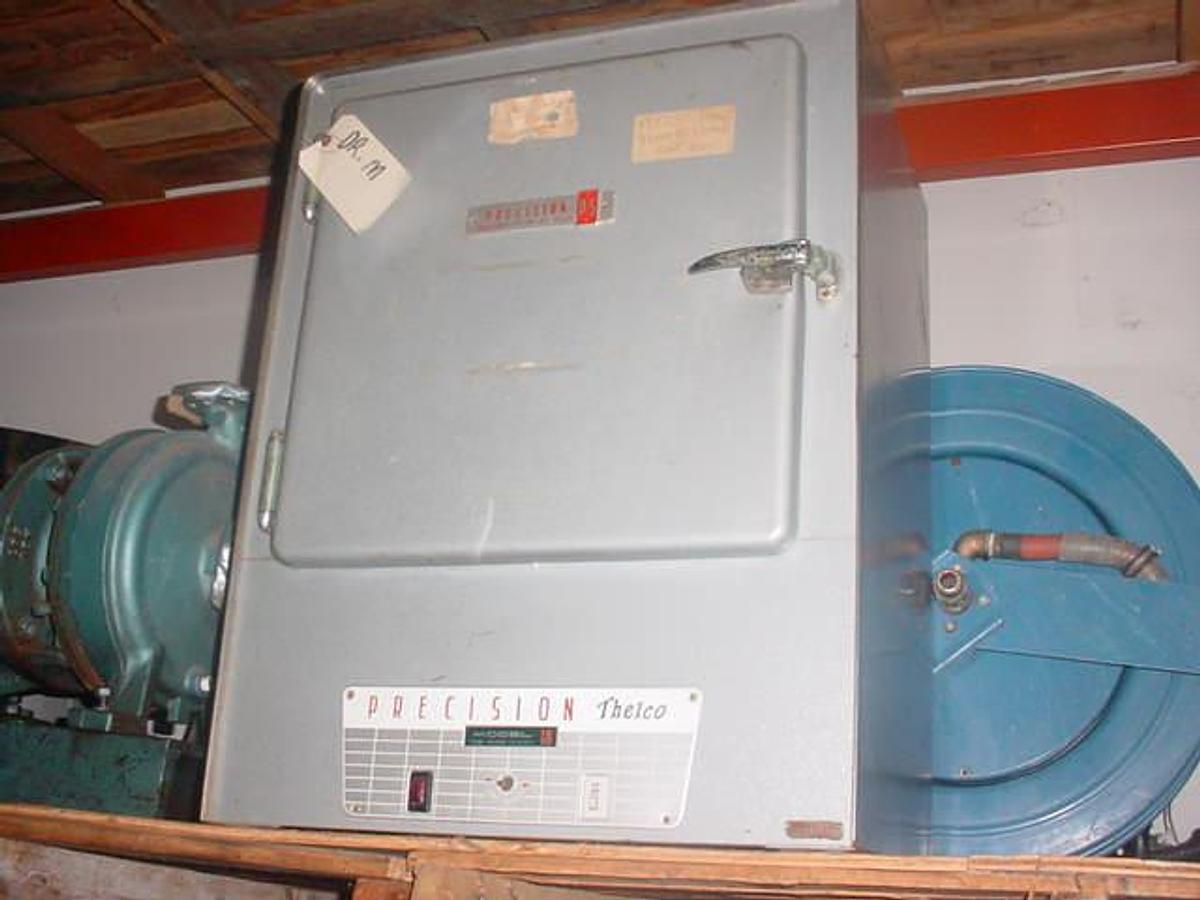
Thelco
Thelco is recognized for its high-quality laboratory and industrial ovens, serving a variety of sectors including pharmaceuticals and food processing. Their products are designed for precise temperature control and reliability, making them essential for applications such as sterilization and drying. Thelco’s commitment to quality ensures that their equipment meets stringent industry standards.
FAQ:
What is Thelco and what are their laboratory ovens known for?
Thelco is a legacy laboratory equipment brand historically associated with Precision Scientific. The brand built a strong reputation over several decades by producing gravity and mechanical convection ovens that were widely adopted in academic research, pharmaceutical labs, food processing facilities, and industrial settings. Thelco ovens became known specifically for their durability, straightforward design, and reliable temperature control, qualities that made them a staple in laboratories that needed consistent performance without a lot of complexity.
The brand is no longer actively manufactured under the Thelco name, which means the ovens available today are used machines sourced from the secondary market. Despite being legacy equipment, Thelco ovens remain highly sought after because of their proven longevity. Models like the Thelco Model 6 and Model 18 still appear regularly in lab equipment listings precisely because they continue to function well long after their original installation. For labs that need a dependable oven for drying, sterilization, or baking applications and do not require the latest digital controls, a used Thelco oven can be a practical and cost-effective choice.
What temperature range do Thelco laboratory ovens typically support?
Most Thelco laboratory ovens operate across a temperature range starting at approximately ambient plus 10 degrees Celsius on the low end, reaching up to around 260 degrees Celsius at the high end. This range covers the majority of common laboratory tasks, including moisture removal, sample drying, glassware drying, low-temperature sterilization, and baking or curing processes. The specific range can vary slightly depending on the model, so it is worth confirming the rated specifications for any particular unit before purchasing.
For applications that require temperatures above 260 degrees Celsius, such as high-temperature ashing or advanced materials testing, a Thelco oven would generally not be the right fit, and a muffle furnace or high-temperature laboratory furnace would be more appropriate. Within their rated range, however, Thelco ovens are well regarded for maintaining stable temperatures consistently over time. When buying a used unit, it is a good practice to ask the seller about the oven's last known calibration and whether temperature uniformity testing has been performed, since older equipment can develop hot spots or thermostat drift that affects performance.
What is the difference between a Thelco gravity convection oven and a mechanical convection oven?
Gravity convection ovens, sometimes called natural convection ovens, rely on the natural movement of heated air rising and cooler air sinking to circulate heat throughout the chamber. Thelco gravity convection models are preferred for applications where airflow needs to be gentle and undisturbed, such as drying delicate samples, working with powders that could be displaced by forced air, or processing materials that are sensitive to turbulence. The tradeoff is that heat distribution can be less uniform than in a forced-air design, and recovery times after opening the door tend to be slower.
Mechanical convection ovens, also called forced-air or forced-draft ovens, use a blower or fan to actively circulate heated air throughout the chamber. This produces faster heat-up times, more uniform temperature distribution across the chamber, and quicker temperature recovery after the door is opened. These characteristics make mechanical convection models better suited for higher-throughput drying, sterilization cycles where consistency matters, and applications where multiple samples are placed throughout the chamber simultaneously. When selecting a used Thelco oven, matching the convection type to the intended application is one of the most important factors to consider alongside chamber size and temperature range.
What sizes and chamber capacities are available for used Thelco laboratory ovens?
Thelco produced laboratory ovens in a range of chamber sizes to serve different laboratory needs, from compact benchtop units suited for small sample volumes to larger floor-standing models capable of handling bigger batches or bulkier items. Benchtop models typically offer chamber capacities in the range of a few liters up to roughly 30 to 50 liters, making them well suited for academic labs, quality control stations, or any environment where bench space is limited. Larger cabinet-style models can offer significantly more interior volume, which is useful for industrial or production-scale drying and sterilization tasks.
Because all Thelco ovens currently available are used machines, the selection at any given time depends on what has come off of laboratory and industrial floors and entered the secondary market. Buyers should pay attention to the interior chamber dimensions listed in the specifications rather than relying on model names alone, since the same model number was sometimes produced in multiple sizes across different production runs. Confirming the number of included shelves and the maximum load per shelf is also worthwhile, particularly for applications where samples need to be arranged across multiple levels within the chamber.
Can Thelco ovens be used for drying, sterilization, and curing applications?
Thelco laboratory ovens are well suited for a range of thermal processing tasks. Drying is the most common application, covering everything from removing residual moisture from glassware and labware to drying chemical samples, biological specimens, and food products. For straightforward drying work, both gravity and mechanical convection Thelco models perform reliably within their rated temperature range. Curing applications, such as setting adhesives, coatings, or polymer samples, are also a common use case as long as the required cure temperature falls within the oven's operating range.
For sterilization, Thelco ovens can be used for dry heat sterilization of glassware and heat-stable instruments, which is a standard practice in many laboratory settings. Dry heat sterilization typically requires sustained temperatures in the range of 160 to 180 degrees Celsius for a defined period of time, which falls within the operating range of most Thelco models. It is worth noting that dry heat sterilization is distinct from steam sterilization performed by an autoclave, and the two methods are not interchangeable for all materials. Buyers using a Thelco oven for sterilization should verify that the unit maintains temperature uniformity across the chamber, which is especially important in a used machine that may not have been recently calibrated.
Are replacement parts and heating elements still available for older Thelco ovens?
Parts availability for Thelco ovens is one of the more practical considerations for anyone buying a used unit. Since Thelco is a legacy brand no longer actively manufactured under that name, sourcing factory parts through a manufacturer's service channel is generally not an option. However, many of the components used in Thelco ovens, including heating elements, thermostats, temperature controllers, and door gaskets, are generic or semi-generic parts that can be sourced through laboratory equipment repair specialists, electrical supply companies, or aftermarket parts suppliers. The simplicity of older Thelco designs actually works in the buyer's favor here, since straightforward resistive heating elements and bimetallic or analog thermostat assemblies are far easier to replace than proprietary digital control systems.
Before purchasing a used Thelco oven, it is a good idea to consult with the manufacturer's successor organization or a qualified laboratory equipment service technician to understand what level of support is realistically available for the specific model and age of the unit. Dealers who specialize in used laboratory equipment can often provide guidance on parts availability based on their experience servicing similar machines. Buyers should factor potential service and parts costs into their total cost of ownership calculation, particularly if the unit will be relied upon heavily in a production or regulated laboratory environment.
What industries and applications commonly use Thelco laboratory ovens?
Thelco laboratory ovens have historically served a broad cross-section of industries. Pharmaceutical and biotech laboratories use them for drying glassware, preparing samples, and performing stability testing at controlled temperatures. Food science and food processing operations use them for moisture analysis, product testing, and small-scale drying applications. Academic and research institutions have long relied on Thelco ovens for general-purpose laboratory work, from undergraduate teaching labs to graduate research settings, largely because of the brand's reputation for durability and ease of use.
Beyond those core sectors, Thelco ovens also appear in materials testing labs, environmental testing facilities, chemical manufacturing quality control departments, and electronics manufacturing environments where components need to be dried or cured at controlled temperatures. The relatively wide temperature range and the availability of both gravity and mechanical convection models made Thelco equipment adaptable across many different workflows. For buyers in any of these industries looking at the used market, a Thelco oven in good working condition can still serve these same functions effectively, provided the unit is inspected and verified before purchase.
What should buyers look for when inspecting a used Thelco laboratory oven before purchasing?
A thorough inspection of a used Thelco oven should cover both the mechanical and electrical condition of the unit. On the mechanical side, buyers should examine the chamber interior for signs of corrosion, contamination residue, or damage to the interior walls and shelf supports. Door seals and gaskets should be inspected for cracks, hardening, or compression failure, since a compromised seal will cause heat loss and make it difficult to maintain stable temperatures. The condition of the heating elements, if visible, and any external wiring or control components should also be reviewed.
On the functional side, the most important test is whether the oven heats up to its rated temperature and holds that temperature consistently over time. Reputable used equipment dealers will typically accommodate in-person inspections, video walkthroughs, or video captures of the machine in operation so buyers can assess its current working condition. If the oven is still installed at an active facility, an in-person inspection can sometimes be arranged at the production site. Buyers should also ask about the oven's service history, when it was last used, and whether any repairs or component replacements have been made. Since used equipment is generally sold as-is, a careful pre-purchase inspection is the buyer's primary tool for assessing risk.
What is the typical price range for a used Thelco laboratory oven?
Pricing for used Thelco laboratory ovens on the secondary market varies depending on the model, chamber size, age, and overall condition of the unit. Smaller benchtop models in working condition have historically sold in the range of a few hundred dollars, while larger cabinet models or units that have been cleaned and functionally tested can command prices in the range of several hundred to over a thousand dollars. The specific configuration, including whether the unit is a gravity or mechanical convection model, the temperature range, and the number of shelves included, all factor into the price.
Buyers should keep in mind that the purchase price is only part of the total cost. Shipping and freight costs for laboratory ovens can add meaningfully to the overall expense, particularly for heavier cabinet-style units that require palletization, crating, or specialized rigging for loading and unloading. Asking the seller for a detailed breakdown of packaging, rigging, and freight costs before committing to a purchase is the best way to understand the full landed cost of the equipment. Payment terms for used equipment purchases typically require full payment prior to shipment, though some dealers may offer alternative arrangements for established customers.
How does buying a used Thelco oven differ from buying a used oven from a currently active manufacturer?
The most significant practical difference is the question of manufacturer support. For used equipment from a brand that is still actively producing and servicing its product line, buyers can often contact the manufacturer directly for technical documentation, calibration procedures, replacement parts, and service support, even for older units. With a legacy brand like Thelco, which is no longer manufactured under that name, that direct manufacturer relationship is not available in the same way. Buyers should reach out to the successor organization or brand to understand what documentation and support resources, if any, remain accessible for the specific model they are considering.
That said, the fundamental considerations for evaluating any used laboratory oven are the same regardless of brand. The machine's current working condition, the availability of key wear parts, the quality of the pre-purchase inspection, and the reputation of the dealer are the factors that matter most. Thelco ovens have a strong track record for longevity and mechanical simplicity, which actually reduces some of the risk associated with buying a legacy brand. A well-maintained Thelco oven that has been inspected and verified to operate correctly can deliver reliable service for years. Selecting a used equipment dealer with a long history in laboratory equipment and a willingness to facilitate thorough inspections is the most effective way to manage the risks inherent in any used equipment purchase.