Category
Manufacturer
Model
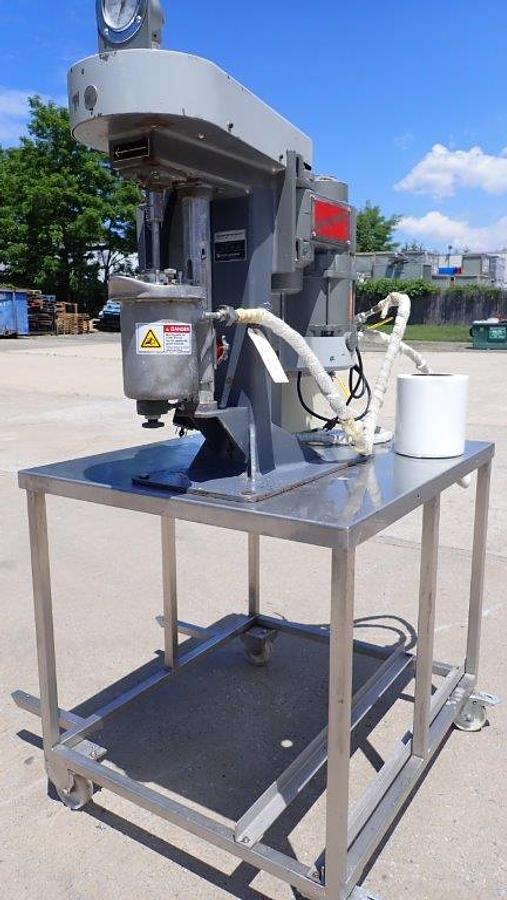
Szegvari Attritor
Szegvari Attritor is known for its high-energy ball mills used in the manufacturing of inks, coatings, and other materials. Their equipment is recognized for its ability to achieve fine particle sizes and uniform dispersion. Szegvari’s technology is essential for industries that require precision in material processing.
FAQ:
What is a Szegvari Attritor grinding mill and how does it work?
The Szegvari Attritor is a high-energy stirred ball mill invented by Andrew Szegvari and commercialized by Union Process, Inc. Unlike a conventional ball mill that relies on the rotation of the entire drum to tumble grinding media, the Attritor uses a stationary tank combined with a rotating central shaft fitted with impeller arms. As the shaft spins, those arms agitate a charge of grinding media, typically small steel or ceramic balls, at high velocity. The result is a dense field of particle-on-particle and media-on-particle impacts that breaks down material far more efficiently than tumbling-style mills can achieve.
This design gives the Attritor a significant energy advantage over conventional ball mills. Because the agitation is internal and continuous rather than relying on gravity, the grinding action is more intense per unit of energy consumed. The stationary tank also makes it easier to control temperature, add cooling jackets, and maintain a sealed environment, which matters a great deal for heat-sensitive materials or applications requiring an inert atmosphere. The technology is widely regarded as a benchmark for fine and ultra-fine wet grinding in industries ranging from inks and coatings to advanced ceramics and pharmaceuticals.
What particle sizes can a Szegvari Attritor grinding mill achieve?
One of the defining characteristics of the Szegvari Attritor is its ability to grind materials to very fine particle sizes, well below what conventional ball mills can reliably produce. Depending on the material, the grinding media selected, and the processing parameters, Attritor mills can reduce particles to the sub-micron range, and under the right conditions, into the nanometer range. This capability makes them especially valuable in applications where tight particle size distribution and uniform dispersion are critical to product performance, such as electronic pastes, pigment dispersions, and specialty coatings.
Achieving the finest particle sizes typically requires careful selection of grinding media size and material, appropriate agitator tip speed, sufficient residence time, and in many cases a wet grinding configuration. Smaller grinding media generally produces finer results but requires longer processing times. Users should also account for the physical and chemical properties of the feed material, since hardness, density, and tendency to agglomerate all influence the final grind. When evaluating a used Attritor mill for a specific application, it is worth consulting with the manufacturer, Union Process, to understand how the particular model and size will perform with the target material.
What are the different configurations available for the Szegvari Attritor?
Szegvari Attritor mills are produced in several distinct configurations designed to suit different production scales and processing requirements. The Type S is a batch wet-grinding unit, which is the most common configuration and well suited for laboratories and smaller production runs. The Type SD is designed for continuous wet grinding, where slurry is fed in at one end and discharged at the other, making it appropriate for higher-throughput operations. The Type SL is a circulation-mode mill where slurry is pumped through the grinding chamber repeatedly until the target particle size is reached. For applications that require dry processing, the Type HD handles dry grinding. Laboratory-scale units are also available for process development and small-batch work.
Each configuration has a different footprint, motor size, tank volume, and discharge arrangement, so buyers looking at used Attritor mills should confirm which type they are purchasing and verify that it matches their intended application. A batch unit cannot simply be converted to continuous operation without significant modification. When reviewing used equipment listings, it is useful to note details like tank capacity, agitator shaft diameter, motor horsepower, and whether the unit is explosion-proof, as the featured Size 1 explosion-proof unit illustrates. These specifications directly determine what production volumes and material types the mill can handle.
What materials can be processed with a Szegvari Attritor grinding mill?
The Szegvari Attritor is used across a wide range of materials, and that versatility is a large part of why it became so widely adopted in industry. Common applications include grinding and dispersing pigments for inks and coatings, processing ceramic powders such as alumina and zirconia, milling metal powders for powder metallurgy, producing electronic pastes and thick-film materials, and grinding pharmaceutical actives and excipients. The mill is also used in food processing, cosmetics, and the production of advanced composites and battery materials, where tight control over particle size and homogeneity is essential.
The choice of grinding media plays a major role in determining which materials are suitable. Carbon steel media is economical and works well for many industrial applications but introduces iron contamination, which rules it out for color-sensitive or chemically reactive materials. Ceramic media such as alumina or yttria-stabilized zirconia is preferred for white pigments, electronic materials, and pharmaceutical applications where contamination must be minimized. Tungsten carbide media is used for very hard materials. When evaluating a used Attritor for a specific material, buyers should confirm that the tank lining and media type are compatible with their feed material and that any previous use has not left residual contamination that could affect product quality.
Is the Szegvari Attritor available in both wet and dry grinding configurations?
Yes, the Szegvari Attritor product line covers both wet and dry grinding, though the two configurations are mechanically quite different and are not interchangeable. Wet grinding is by far the more common application for Attritor mills. In wet mode, the feed material is suspended in a liquid carrier, which helps dissipate heat, prevents dust, and generally allows for finer particle size reduction and better dispersion. The liquid also lubricates the grinding media, reducing wear rates. Wet Attritors are used extensively in the production of inks, paints, coatings, ceramic slurries, and pharmaceutical suspensions.
Dry grinding Attritors, designated as the Type HD, are designed with features to handle the challenges of processing dry powders, including provisions for dust containment and different media retention systems. Dry grinding is used for materials that cannot tolerate liquid or where downstream processing requires a dry product. However, dry grinding typically generates more heat and produces somewhat coarser results compared to wet grinding at equivalent energy input. Buyers evaluating used Attritor mills should clearly identify whether the unit was configured for wet or dry service, as the internal components, seals, and discharge systems differ significantly between the two. Attempting to run a wet-configured mill in dry service, or vice versa, without proper modification is not advisable.
What industries commonly use the Szegvari Attritor grinding mill?
The Szegvari Attritor has found a home in a broad range of industries, largely because of its ability to achieve fine and ultra-fine particle sizes with good control over distribution and dispersion. The inks and coatings industry is one of the heaviest users, relying on Attritor mills to grind and disperse pigments to the tight specifications that printing and surface coating applications demand. The electronics industry uses them to produce thick-film pastes, conductive inks, and battery electrode materials where particle size directly affects electrical performance. Advanced ceramics manufacturers depend on Attritor mills for grinding and blending ceramic powders before forming and sintering.
Pharmaceutical and nutraceutical producers use Attritors for milling active ingredients to improve bioavailability, and cosmetics manufacturers use them for pigment dispersion in creams and color cosmetics. Powder metallurgy operations use the mills to blend and activate metal powders for sintering or thermal spray applications. The food industry uses them for grinding cocoa, spices, and other materials where particle fineness affects texture and flavor release. This breadth of application means that a used Szegvari Attritor mill can often be repurposed across industries, though buyers should always verify that the unit's materials of construction and prior use history are compatible with their intended application before purchasing.
What grinding media options are used with Szegvari Attritor mills, and how does the choice affect performance?
Grinding media selection is one of the most consequential decisions in operating an Attritor mill, as it directly affects grinding efficiency, contamination levels, and media wear rates. The most common options are carbon steel, stainless steel, chrome steel, tungsten carbide, and various ceramics including alumina, zirconia, and glass beads. Carbon steel is the least expensive and works well for applications where iron contamination is acceptable, such as certain mineral processing or pigment applications. Stainless steel offers better corrosion resistance and lower contamination risk. Chrome steel provides high hardness and is often used for abrasive materials.
Ceramic media is preferred for applications requiring minimal contamination, such as white or light-colored pigments, electronic materials, and pharmaceutical products. Yttria-stabilized zirconia is particularly popular because it combines high density, which improves grinding efficiency, with very low wear rates and minimal contamination. Tungsten carbide media is reserved for extremely hard materials where other media would wear too quickly. The size of the media also matters: smaller beads produce finer grinds but require more processing time and can be harder to retain in the mill. When purchasing a used Attritor, buyers should ask about the media that was previously used, as residual media in the tank can affect the first production runs and cross-contamination must be considered if the mill is being repurposed for a different material.
What should buyers know about inspecting a used Szegvari Attritor mill before purchasing?
Inspecting a used Attritor mill carefully before committing to a purchase is essential, since these are precision pieces of equipment whose internal components, including the agitator shaft, impeller arms, tank lining, and seals, experience significant wear over time. Buyers should request a thorough visual inspection of the tank interior for signs of wear, pitting, or corrosion. The agitator shaft and impeller arms should be checked for straightness and wear at the contact points. Seals and bearings are wear items that may need replacement, so understanding their condition at the time of purchase helps estimate refurbishment costs. Reputable used equipment dealers will accommodate in-person inspections or provide detailed video walkthroughs of the machine.
It is worth noting that most used equipment dealers do not have the permitting or facilities to run actual production tests with a buyer's specific material. The inspection is therefore focused on mechanical condition rather than process performance. Buyers should also ask about the machine's history, including what materials were processed, what grinding media was used, and whether the unit was maintained on a regular schedule. For explosion-proof models, such as the Size 1 unit noted in current listings, buyers should verify that the explosion-proof components and certifications are intact and have not been modified. Consulting with Union Process directly about the specific model being considered is also advisable, as they can provide guidance on parts availability, expected service life, and what to look for in the inspection.
What does it mean that a Szegvari Attritor is listed as explosion-proof, and why does it matter?
An explosion-proof designation on an Attritor mill means the electrical components, motor, switches, and enclosures have been designed and certified to prevent ignition of flammable vapors, gases, or dust in the surrounding environment. This is achieved through sealed enclosures that contain any internal sparks or arcs, along with components rated to operate safely within defined hazardous location classifications, typically following standards set by organizations such as NFPA or the relevant national electrical code. The explosion-proof rating is critical for facilities that process flammable solvents, solvent-borne inks or coatings, or combustible powders where an ignition source could trigger a fire or explosion.
For buyers evaluating a used explosion-proof Attritor, the condition and integrity of the explosion-proof components deserve special attention during inspection. Unlike standard electrical components, explosion-proof enclosures and fittings must remain unmodified and undamaged to maintain their rating. Any repairs, modifications, or damage to the motor housing, conduit fittings, or control enclosures could compromise the explosion-proof classification. Buyers should ask the seller for documentation on the original hazardous location rating and verify that no alterations have been made. If the mill is intended for use in a classified hazardous area, it may also be worth having an electrical inspector or the facility's safety team review the unit before it goes into service, particularly given that it is used equipment with an unknown full maintenance history.
What are the typical shipping and payment considerations when buying a used Szegvari Attritor mill?
Used Attritor mills are substantial pieces of industrial equipment, and shipping logistics require careful planning. The mill must be properly prepared for transport, which typically involves draining and cleaning the tank, securing or removing the agitator shaft if necessary, and crating or palletizing the unit to prevent damage in transit. Larger or heavier units may require professional rigging for loading at the seller's facility and unloading at the buyer's location, and that rigging cost is typically separate from freight charges. Buyers should ask the seller for a detailed breakdown of packaging, rigging, and freight costs before finalizing a purchase, since the total landed cost can differ significantly from the listed equipment price alone.
On the payment side, most used equipment dealers require full payment before the machine ships. Some dealers may extend terms to established repeat customers, but buyers new to a dealer should expect to pay in full upfront. It is worth taking time to verify the reputation and track record of the dealer before sending payment, particularly for a higher-value piece of equipment like an Attritor mill. Dealers who specialize in the process equipment or chemical industry and have a long history in the market are generally a safer choice than general-purpose resellers. Asking for references or checking industry forums for feedback on a dealer's reliability and transparency is a reasonable step in the due diligence process.