Category
Manufacturer
Model
Sun Lab
Sun Lab focuses on providing advanced laboratory equipment and manufacturing solutions, primarily for the pharmaceutical and biotech sectors. They are recognized for their high-precision instruments, including mixers and homogenizers, which are essential for product development and quality control in labs. Their commitment to innovation ensures they meet the evolving needs of their clientele.
FAQ:
What types of laboratory equipment does Sun Lab manufacture?
Sun Lab specializes in high-precision laboratory equipment designed primarily for pharmaceutical and biotech applications. Their product line includes mixers, homogenizers, and three roll mills, which are used extensively in product development, formulation work, and quality control processes. These instruments are built to handle the demanding requirements of lab environments where consistency and accuracy are critical to research outcomes.
Three roll mills, for example, are used to disperse, mix, and refine viscous materials such as inks, adhesives, cosmetics, and pharmaceutical compounds. Homogenizers are essential for creating uniform particle sizes in emulsions and suspensions, a common requirement in drug formulation. Sun Lab's focus on precision manufacturing has made their equipment a recognized choice in industries where measurement accuracy and repeatable results directly affect product quality.
What should I know about buying used Sun Lab equipment?
Purchasing used Sun Lab laboratory equipment can be a practical way to access high-quality instruments at a lower cost than buying directly from a manufacturer. Used equipment dealers typically sell machines on an as-is basis, which places the responsibility of evaluation squarely on the buyer. This makes it especially important to work with dealers who have a long track record in the laboratory and scientific equipment space and who specialize in the specific type of machinery you need.
Before committing to a purchase, buyers should request as much documentation as possible about the machine's history, including any service records or prior usage details. It is also worth contacting the manufacturer directly to understand what level of technical support, spare parts, and service documentation is still available for the specific model and age of the unit. Sun Lab equipment used in pharmaceutical or biotech settings may have been subject to rigorous maintenance protocols, which can be a positive indicator of condition, but independent verification through inspection remains the most reliable approach.
How do I inspect used laboratory equipment before purchasing?
Reputable used equipment dealers typically offer buyers several inspection options, including in-person visits, live video walkthroughs, or pre-recorded video documentation of the machine. The goal is to give the buyer an accurate picture of the equipment's current physical and functional condition. For precision instruments like mixers or three roll mills, a visual inspection should cover the condition of rollers, seals, motors, control panels, and any wear points that affect performance.
Some equipment may still be installed and running at a production facility, in which case the dealer can often arrange access for an inspection at the site. Keep in mind that most used equipment dealers are not set up to run full production tests, as that requires separate permitting and operational infrastructure. What a buyer can reasonably expect is a demonstration of mechanical function, a review of visible wear, and an honest account of any known issues. If in-person travel is not feasible, a detailed video inspection conducted by the dealer or a third-party inspector is a widely accepted alternative.
What are the shipping considerations for large laboratory equipment like Sun Lab machines?
Shipping heavy or sensitive laboratory equipment requires more planning than standard freight. Machines like three roll mills and industrial homogenizers need to be properly secured, palletized, or crated to prevent damage during transit. The level of packaging required will vary depending on the size and fragility of the unit, and buyers should ask dealers specifically about how the equipment will be prepared for shipment. Inadequate packaging is one of the most common causes of damage to used machinery in transit, so this is not a detail to overlook.
For larger machines, specialized rigging may be required to safely load and unload the equipment, which adds to the total cost. Buyers should request a full breakdown of shipping, crating, and rigging charges before finalizing a purchase so they have a clear picture of the total landed cost. Lead times for freight shipments can also vary significantly depending on distance, carrier availability, and whether the equipment needs to be decommissioned and removed from an active facility before it can ship.
What are typical payment terms when buying used laboratory equipment?
Most used laboratory equipment dealers require payment in full before a machine is shipped. This is standard practice in the industry and reflects the logistical and financial risks involved in moving high-value equipment. Buyers who are working with a dealer for the first time should expect to pay upfront, and should factor this into their procurement planning, particularly for higher-cost instruments.
Some dealers may offer extended payment terms to established customers with a prior purchasing history, but this is handled on a case-by-case basis and is not a standard offering across the industry. Buyers should ask about accepted payment methods early in the process, as wire transfers are common for larger transactions. If financing is needed, buyers may want to explore third-party equipment financing companies that specialize in laboratory or industrial machinery, as these can sometimes be arranged independently of the dealer.
How does a three roll mill work and what is it used for in laboratory settings?
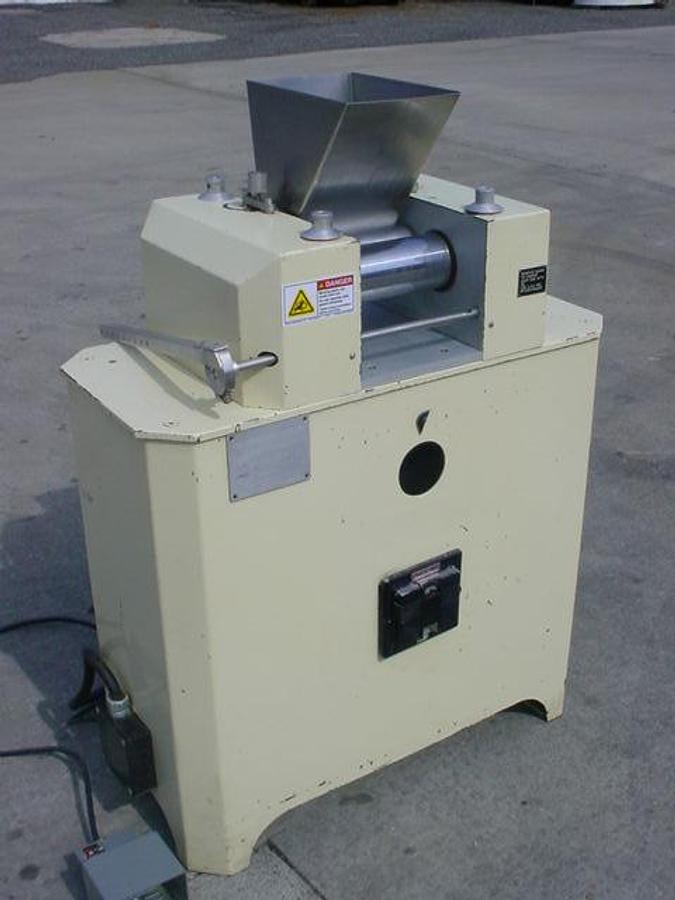
A three roll mill uses three horizontally positioned rollers that rotate in alternating directions and at different speeds to mix, disperse, or homogenize viscous materials. Material is fed between the first and second rollers, passes through the gap between them under high pressure, and then transfers to the third roller where it is scraped off by a blade. The shear forces generated in the narrow gaps between rollers are what break down particle agglomerates and create a uniform, finely dispersed product.
In laboratory and pharmaceutical settings, three roll mills are used to process materials like ointments, creams, pastes, pigment dispersions, adhesives, and electronic materials such as thick-film pastes. The ability to precisely control roller gap, speed, and temperature makes them particularly valuable for formulation development, where consistency across batches is critical. Sun Lab three roll mills are designed to meet the precision demands of pharmaceutical and biotech research, where even small variations in particle size or dispersion quality can affect product performance and regulatory compliance.
Does age or model affect the availability of parts and support for used Sun Lab equipment?
Yes, the age and specific model of a used Sun Lab machine can have a meaningful impact on the level of manufacturer support available. Older models may be discontinued, and manufacturers sometimes limit or discontinue parts production for equipment that is no longer in their active lineup. Before purchasing a used unit, it is worth reaching out to Sun Lab directly to ask about parts availability, service manuals, and whether technical support is still offered for that particular model.
This step is easy to overlook but can significantly affect the long-term usability of the equipment. A machine that runs well at the time of purchase but has no available replacement parts for wear components like rollers, seals, or motors may become difficult to maintain over time. Buyers who plan to use the equipment in a regulated environment, such as pharmaceutical manufacturing or quality control, should also confirm whether the manufacturer can provide any documentation or support needed for equipment qualification processes.
What industries commonly use Sun Lab laboratory equipment?
Sun Lab equipment is used across several industries that require precise mixing, dispersion, and homogenization of materials. Pharmaceutical and biotech companies are among the primary users, relying on instruments like homogenizers and three roll mills for drug formulation, emulsion preparation, and quality control testing. The ability to achieve consistent particle size distribution and uniform blending is a core requirement in these fields, where product performance and regulatory compliance depend on manufacturing precision.
Beyond pharma and biotech, Sun Lab equipment also finds application in cosmetics manufacturing, where creams, lotions, and other viscous formulations require thorough mixing. The electronics industry uses three roll mills to process conductive pastes and coatings used in printed circuit boards and other components. Research institutions and university laboratories also use this type of equipment for materials science and chemical engineering work. The versatility of Sun Lab's core product types makes used units attractive to a broad range of buyers across both industrial and academic settings.
What documentation should I request when buying used laboratory equipment?
When purchasing used laboratory equipment, especially for regulated industries like pharmaceuticals or biotech, documentation can be just as important as the physical condition of the machine. Buyers should ask for any available service and maintenance records, which can give insight into how well the machine was maintained and whether any major components were replaced. Operator manuals and technical documentation are also worth requesting, as these are sometimes difficult to obtain independently for older or discontinued models.
For equipment intended for use in a regulated environment, buyers may also want to ask whether any calibration records, qualification documents, or validation reports were maintained by the previous owner. While used equipment dealers are generally not in a position to provide fresh calibration certificates or compliance documentation, having historical records can simplify the re-qualification process. Buyers should also confirm with the manufacturer what documentation they can provide for the specific model, as some manufacturers maintain records that can support installation qualification and operational qualification activities even for equipment that has changed hands.
How should I evaluate a used equipment dealer before purchasing laboratory machinery?
Choosing the right dealer is one of the most important decisions in the used equipment buying process. Because used laboratory equipment is sold as-is, the buyer has limited recourse if problems arise after the sale. A dealer with a long history of selling laboratory and scientific equipment in your specific industry is generally a safer choice than a general industrial surplus reseller, because they are more likely to accurately represent the condition and capabilities of the machines they sell. Look for dealers who are transparent about what they know and don't know about a machine's history.
Practical indicators of a trustworthy dealer include their willingness to accommodate thorough inspections, their responsiveness to technical questions, and their ability to provide detailed photos, videos, or live demonstrations of the equipment. Dealers who specialize in pharmaceutical or biotech equipment will also tend to have a better understanding of the documentation and condition standards that buyers in those industries require. Asking for references from past buyers, or checking for a verifiable transaction history, can also help confirm that a dealer operates with integrity before you commit to a significant purchase.