Category
Manufacturer
Model
Speedaire
Speedaire provides a range of pneumatic equipment for various manufacturing applications, including packaging and assembly. Their products are widely used across multiple industries, including automotive and food processing. Speedaire’s commitment to quality and reliability has established them as a trusted brand in the market.
FAQ:
What types of Speedaire equipment are available on the used market?
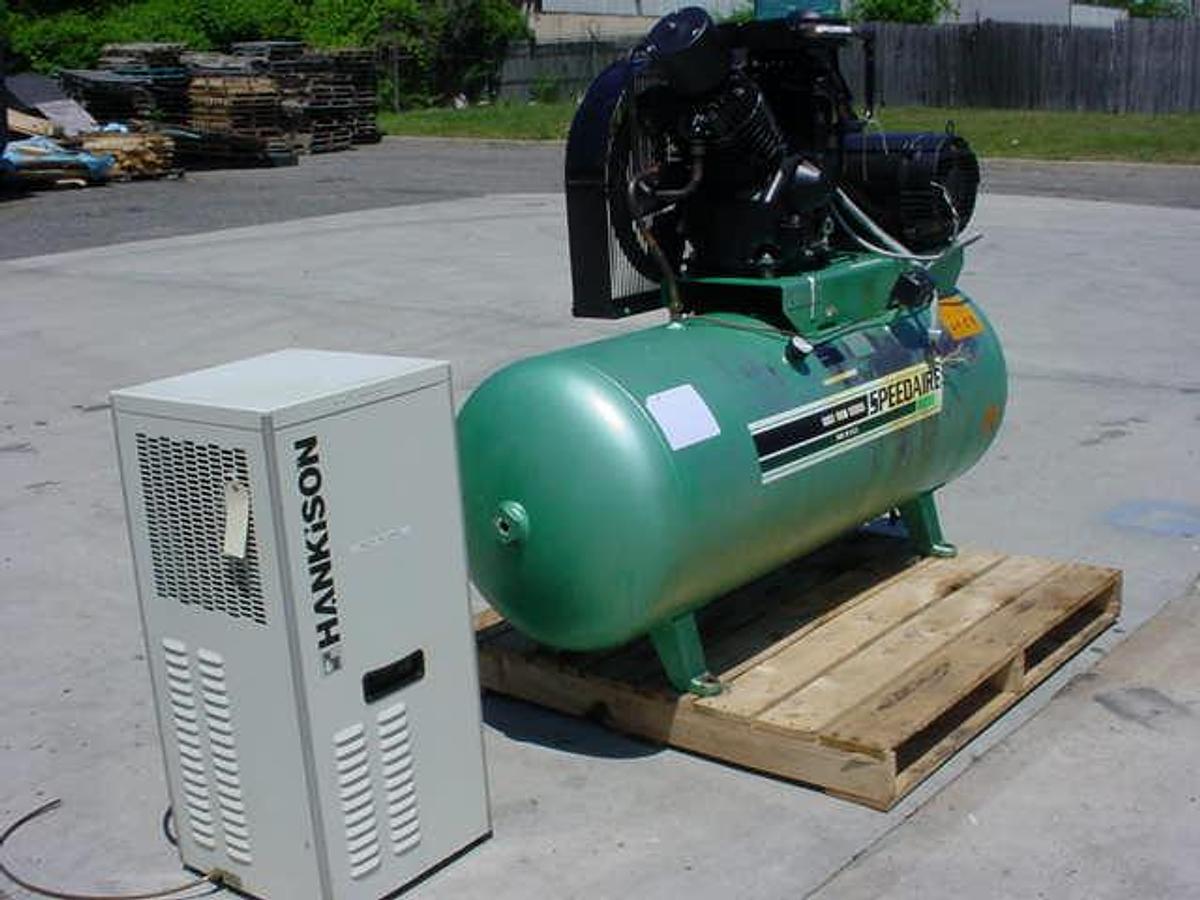
Speedaire built a broad line of pneumatic equipment aimed at industrial and manufacturing environments. The most commonly found units on the used market are tank-mounted air compressors, including models with integrated air dryers, which were designed for continuous-duty applications in facilities like automotive plants, food processing operations, and packaging lines. Horsepower ratings across available used units typically range from small fractional-HP portable units up to 15 HP and beyond for larger tank-mounted configurations. Speedaire also produced air dryers, filters, and related pneumatic accessories that supported compressed air systems in demanding production settings.
Because Speedaire was a house brand sold exclusively through Grainger industrial supply, the equipment was purpose-built for industrial buyers rather than the consumer market. That focus on durability and performance in heavy-use environments is a big part of why these machines still circulate actively in the used and surplus market years after the brand was phased out. Buyers searching for used Speedaire equipment will most often encounter tank-mounted reciprocating compressors, which remain among the most sought-after units due to their straightforward maintenance profile and long service life when properly maintained.
Is Speedaire still being manufactured, and what does that mean for buyers?
Speedaire is considered a legacy or discontinued brand. It was a private-label line sold exclusively through Grainger, and Grainger has since transitioned its compressor offerings away from the Speedaire name. That means used and surplus equipment channels are now the primary, and essentially only, source for Speedaire machines. No current production runs exist, so buyers cannot purchase these units directly from a distributor as they would a current-model compressor.
For practical purposes, this affects a few things worth understanding before buying. Parts availability depends heavily on the specific model and which OEM actually manufactured the unit, since Speedaire equipment was produced by several contract manufacturers over the years, including DeVilbiss, Campbell Hausfeld, and Ingersoll Rand. Many components cross-reference with those brands, which can make sourcing replacement parts more feasible than it might initially appear. Buyers should research the specific model number and identify the underlying OEM before purchasing, and consulting directly with those manufacturers is a reasonable step to gauge what level of parts support remains available for a given unit.
Who actually manufactured Speedaire air compressors?
Speedaire was a private-label brand, meaning Grainger sourced the equipment from outside manufacturers rather than building it in-house. Over the years, several well-known OEM partners produced Speedaire-branded compressors, including DeVilbiss, Campbell Hausfeld, and Ingersoll Rand. The specific manufacturer for any given unit depended on the model, horsepower class, and the time period in which it was made, so two Speedaire compressors from different eras may have entirely different internal components despite carrying the same brand name.
This manufacturing history has real implications for maintenance and parts sourcing. Because the underlying machines came from established compressor manufacturers, many Speedaire components cross-reference directly with parts still available for those OEM brands. A buyer who identifies which manufacturer built their specific Speedaire unit can often find pumps, valves, pressure switches, and other wear items by searching under the corresponding OEM part numbers. This cross-referencing capability is one reason Speedaire equipment has remained viable in industrial settings long after the brand itself was discontinued.
What should I inspect when buying used Speedaire equipment?
Buying used industrial equipment calls for a thorough inspection, and Speedaire compressors are no exception. Key areas to examine include the compressor pump itself, looking for signs of oil leaks, scoring on cylinder walls, or worn piston rings that would indicate the pump is near the end of its service life. The tank should be inspected carefully for rust, pitting, or any signs of corrosion, particularly around welds and the drain valve. A tank that shows significant internal rust is a safety concern and can be a deal-breaker regardless of how well the rest of the machine runs. Check the pressure switch, safety relief valve, belts, and motor mounts as well, since these are common wear items.
Reputable used equipment dealers will typically accommodate in-person inspections or provide video walkthroughs of machines so buyers can assess condition before committing. Some units may still be installed and operational at a facility, which allows for a running inspection, though keep in mind that most dealers cannot simulate full production conditions or test the machine under actual load in a shop environment, as that requires different permitting and infrastructure. Buyers should ask specifically what inspection options are available, request photos of the data plate and any visible wear points, and factor the machine's age and hours into their assessment of remaining service life.
What CFM and PSI ratings are common in used Speedaire compressors?
Speedaire compressors were built for industrial service, so the performance specifications tend to be more substantial than what you'd find in consumer-grade equipment. Tank-mounted reciprocating models in the used market commonly deliver airflow in the range of 40 to 60 CFM at 90 PSI for mid-range units, with larger models capable of higher output depending on horsepower and pump configuration. Maximum operating pressures on industrial Speedaire compressors typically fall in the 125 to 175 PSI range, which suits most manufacturing, assembly, and pneumatic tool applications. Specific ratings vary considerably by model, so reviewing the data plate or model documentation is essential before assuming a unit will meet a particular application's demands.
For buyers matching a compressor to a specific use case, the key figures to focus on are SCFM (standard cubic feet per minute) at the target operating pressure, not just the peak PSI rating. A compressor with a high maximum PSI but insufficient CFM output won't adequately supply high-demand tools or multiple simultaneous air users. When evaluating a used Speedaire unit, ask the seller for the original specification sheet or model number so you can cross-reference the factory-rated performance figures, which gives a much clearer picture of whether the machine fits the intended application.
Are replacement parts and filters still available for Speedaire equipment?
Parts availability for Speedaire equipment varies by model and depends largely on which OEM manufacturer built the unit. Because Speedaire compressors were produced by DeVilbiss, Campbell Hausfeld, Ingersoll Rand, and other manufacturers under a private-label arrangement, many internal components share part numbers with those brands' own product lines. This means buyers willing to do some cross-referencing research often find that pumps, valves, gaskets, pressure switches, and filters are still obtainable through industrial supply channels or directly from the OEM. Filters in particular tend to be more standardized and are frequently available through general pneumatic supply distributors.
That said, some older or less common Speedaire models may present genuine parts challenges, especially for pump-specific components that were unique to a particular OEM run. Before purchasing a used Speedaire unit, it's worth identifying the model number, the likely OEM manufacturer, and then contacting that manufacturer directly to ask what parts remain available and what the expected support horizon looks like. This due diligence step can save significant headaches down the road, particularly for buyers planning to rely on the equipment for production-critical applications where downtime is costly.
What is the typical price range for used Speedaire compressors?
Pricing for used Speedaire compressors varies widely depending on the size, horsepower, condition, and configuration of the unit. Smaller portable or fractional-HP models can be found at relatively modest prices in the surplus market, while larger tank-mounted industrial units, particularly those with integrated air dryers, command significantly higher prices due to their production-grade capabilities. A 15 HP tank-mounted compressor with a dryer, for example, represents a substantially larger investment than a basic single-stage unit, and pricing reflects both the original cost of the equipment and its remaining service life.
Buyers should also account for the full landed cost of the equipment, not just the purchase price. Shipping, rigging, and packaging costs for industrial compressors can be substantial, particularly for larger units that require heavy-duty crating or specialized loading equipment. Asking the seller for a detailed breakdown of all costs before committing to a purchase is the right approach. In general, used industrial compressors offer meaningful savings compared to purchasing current-model equipment, but the total cost of ownership should include any reconditioning, parts replacement, or installation work needed to bring the unit to operating condition.
What industries commonly use Speedaire air compressors?
Speedaire equipment was designed for demanding industrial environments and saw widespread adoption across several manufacturing sectors. Automotive manufacturing was a primary market, where compressed air powers assembly tools, painting equipment, and pneumatic actuators throughout the production process. Food and beverage processing facilities relied on Speedaire compressors for packaging line automation, conveying systems, and cleaning operations. Packaging operations more broadly, along with general assembly manufacturing, were also core application areas where the brand established a strong presence.
The industrial-grade construction of Speedaire equipment made it well-suited to environments where compressors run continuously over long shifts and where downtime has a direct cost impact. This reputation for durability in high-demand settings is a significant reason why used Speedaire units remain attractive to buyers in those same industries today. A facility looking to expand capacity or replace aging equipment can often find a used Speedaire compressor that fits established pneumatic infrastructure without the capital outlay of purchasing current-production industrial equipment.
How does shipping and delivery work for used Speedaire compressors?
Shipping industrial compressors requires more planning than typical freight because of the weight, size, and mechanical sensitivity of the equipment. Used equipment dealers will generally package machines according to the level of protection required, ranging from basic palletization for smaller units to full wooden crating for larger or more complex configurations. The cost of packaging, crating, and rigging varies based on the machine's size and weight, and buyers should request a detailed shipping quote before finalizing a purchase so there are no surprises in the total landed cost. Larger tank-mounted compressors may require forklift loading at the origin and unloading equipment on the receiving end, which is an additional cost factor to plan for.
For buyers without loading dock facilities or appropriate unloading equipment at their location, arranging freight delivery requires some advance coordination. Discussing delivery logistics with the seller early in the process helps avoid delays and unexpected expenses. Most reputable dealers will walk buyers through the shipping process and provide specifics on how the equipment will be prepared for transit, what carrier options are available, and what the buyer needs to have in place to receive the shipment safely.
What are the payment terms for purchasing used Speedaire equipment?
Payment practices in the used industrial equipment market follow fairly consistent conventions. Most dealers require full payment before a machine is released for shipping, which is standard practice given the nature of used equipment transactions. This protects both parties and ensures the sale is complete before the logistical process of packaging, rigging, and freight begins. Buyers who are new to a particular dealer should expect to pay in full upfront, as extended payment terms are generally reserved for established customers with a prior transaction history.
Accepted payment methods vary by dealer but commonly include wire transfer, ACH, and in some cases credit card for smaller purchases. Buyers should confirm accepted payment methods early in the process, along with any associated fees. Because used equipment is typically sold as-is, completing payment also signals the buyer's acceptance of the machine's condition as represented, which is why thorough inspection before purchase, whether in person or via video, is an important step to complete before funds are transferred.