Category
Manufacturer
Model
Shionogi
Shionogi is a pharmaceutical company that also produces specialized manufacturing equipment for the healthcare sector. They are known for their high-precision filling and packaging machines that meet stringent regulatory standards. Their solutions ensure the safe and efficient production of pharmaceutical products.
FAQ:
What types of pharmaceutical equipment is Shionogi known for producing?
Shionogi is a Japanese pharmaceutical company that also produces specialized manufacturing equipment for the healthcare and pharmaceutical sectors. Their equipment portfolio is centered on high-precision filling and packaging machines, with the Qualicaps 'Quali-Fill' line of capsule fillers being among the most recognized product categories. These machines are designed to meet stringent regulatory standards and support the safe, efficient production of pharmaceutical products at both semi-automatic and fully automated scales.
Buyers searching for Shionogi equipment on the secondary market should also be aware that pharmaceutical facilities operated by Shionogi have historically used equipment from other Japanese OEM manufacturers, including brands like Hata, Sejong, Kikusui, and Powrex. When equipment from a Shionogi facility is liquidated, it may carry those OEM brand names rather than the Shionogi name directly. Understanding this distinction helps buyers search more effectively and evaluate what they find on the used equipment market.
What is the Shionogi Qualicaps Quali-Fill 8S capsule filler, and what is it used for?
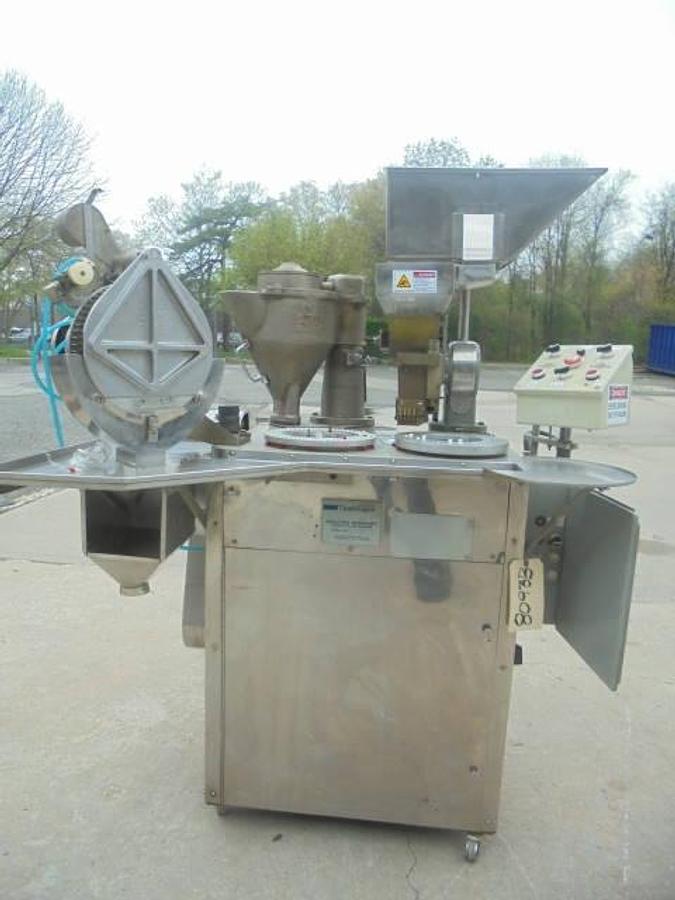
The Shionogi Qualicaps Quali-Fill 8S is a semi-automatic capsule filling machine designed for pharmaceutical manufacturing environments. The '8S' designation refers to its configuration, and the machine is built to handle the precise filling of hard gelatin or HPMC capsules with powders, pellets, or granules. Semi-automatic capsule fillers like this model are commonly used in small-to-mid-scale production runs, research and development settings, or clinical trial manufacturing, where flexibility and precision matter more than high-volume throughput.
On the used equipment market, the Quali-Fill 8S is a sought-after machine because of its reputation for accuracy and its suitability for GMP-regulated environments. Buyers considering this type of equipment should request documentation on the machine's service history, any calibration records, and its current mechanical condition. Since these are used machines, a thorough inspection, either in person or via video, is the most reliable way to assess whether the equipment meets production requirements before committing to a purchase.
Where can I find used Shionogi pharmaceutical equipment for sale?
Used Shionogi pharmaceutical equipment surfaces through several channels, including specialized used pharmaceutical equipment dealers, industrial auction houses, and direct liquidation sales from pharmaceutical facilities. Dealers who focus specifically on pharmaceutical and life sciences machinery tend to be the most reliable source, as they typically have industry-specific knowledge, can speak to the equipment's condition, and are more likely to have documentation such as maintenance logs or calibration records on hand. Choosing a dealer with a long track record in the pharmaceutical equipment space is particularly important when buying used machinery, since there is no manufacturer backing the transaction.
It is worth noting that some equipment listed as coming from Shionogi facilities may carry the brand name of the actual OEM manufacturer rather than the Shionogi name, since large pharmaceutical companies source equipment from multiple suppliers. Buyers should search by both the Shionogi name and by specific equipment categories, such as capsule fillers or packaging machines, to capture the full range of relevant listings. Asking dealers directly about the equipment's facility of origin can also help clarify provenance.
Is used pharmaceutical equipment like Shionogi machines GMP-compliant?
GMP compliance is tied to how equipment is validated and maintained within a specific manufacturing environment, not to the equipment itself in isolation. A used Shionogi capsule filler or packaging machine that was previously operated in a GMP-regulated facility can potentially be requalified and revalidated for use in another regulated environment, but that process is the responsibility of the buyer and their quality team, not the equipment dealer. The machine's prior GMP status does not automatically transfer to a new facility or a new production context.
For buyers in regulated industries, documentation is the critical factor. Batch records, calibration certificates, preventive maintenance logs, and any IQ/OQ/PQ validation protocols from the machine's prior use can significantly reduce the time and cost of requalification. When evaluating used pharmaceutical equipment, buyers should ask dealers specifically what documentation is available and whether the machine was decommissioned from an active GMP facility. Consulting with a validation specialist or your internal quality team before purchase is strongly advisable.
What should I inspect before buying used Shionogi pharmaceutical equipment?
Before purchasing any used pharmaceutical equipment, a thorough inspection is one of the most important steps a buyer can take. For machines like capsule fillers and packaging equipment, key inspection points include the condition of contact parts such as dosing discs, tamping pins, and sealing components, the integrity of any electronic controls or HMI panels, the state of mechanical drive systems, and evidence of prior wear, corrosion, or repairs. Reputable dealers will accommodate in-person inspections at their facility or, in cases where the equipment is still located at the facility where it was used, can often arrange access through the current owner.
Video inspections and detailed photo documentation are also commonly offered when travel is not practical. Keep in mind that most used equipment dealers do not have the permitting or infrastructure to run actual pharmaceutical production, so functional testing with real product is generally not possible. What dealers can typically demonstrate is that the machine powers on, mechanical components move as intended, and the equipment is free of obvious damage. Buyers should use the inspection to verify the machine's condition against the seller's description and to identify any components that may need replacement before the equipment returns to production.
Are spare parts available for used Shionogi Qualicaps equipment?
Parts availability for used Shionogi Qualicaps equipment depends on the specific model and its age. For machines that are relatively recent or that were produced in sufficient volume, the manufacturer or authorized service providers may still stock replacement components such as capsule tooling, dosing discs, tamping pins, and sealing parts. Before purchasing a used machine, prospective buyers are strongly encouraged to contact the manufacturer directly to determine what level of parts and technical support is available for that particular model. The manufacturer's response can vary significantly based on how long ago the model was produced and whether it has been discontinued.
For older or discontinued models, buyers may need to source parts through third-party suppliers, machine shops capable of fabricating components, or other used equipment dealers who may have compatible parts from similar machines. Some buyers also purchase a second machine of the same model specifically for parts. Understanding parts availability before committing to a purchase can prevent significant production delays down the line, so this is a due diligence step that should not be skipped.
What is the typical price range for used pharmaceutical capsule filling equipment?
Pricing for used pharmaceutical capsule filling equipment varies widely based on the machine's model, age, condition, production capacity, and the documentation available with it. Entry-level semi-automatic capsule fillers in working condition can range from a few thousand dollars into the low tens of thousands. Mid-range machines with higher throughput or more automation tend to fall in the $20,000 to $80,000 range on the secondary market, while large-scale fully automatic capsule filling lines from established manufacturers can exceed $100,000 or more depending on configuration and condition.
For specific models like the Shionogi Qualicaps Quali-Fill 8S, pricing will reflect the machine's semi-automatic nature and its suitability for smaller-scale or development-oriented production. Buyers should also factor in the total landed cost, which includes shipping, rigging, crating, and any reconditioning or validation work required before the machine goes back into production. A lower purchase price does not always mean lower total cost if significant refurbishment is needed, so getting a clear picture of the machine's current condition during inspection is essential to accurate cost planning.
What are the shipping and logistics considerations when buying used pharmaceutical equipment?
Shipping used pharmaceutical equipment requires more planning than standard freight. Machines like capsule fillers and packaging equipment contain precision components that can be damaged by vibration, improper securing, or inadequate packaging during transit. Sellers will typically palletize or crate equipment depending on its size and fragility, and the level of packaging required directly affects shipping costs. Buyers should ask the dealer specifically how the equipment will be packaged and what that packaging cost covers, since this is often quoted separately from the base freight charge.
Larger or heavier machines may require specialized rigging for loading at the seller's facility and unloading at the destination. Rigging services, which involve cranes, forklifts, or other heavy-lift equipment, are an additional cost that buyers need to account for. Before finalizing a purchase, requesting a full breakdown of packaging, rigging, freight, and any applicable fees gives buyers an accurate picture of the total landed cost. For international shipments, customs duties, import documentation, and compliance with destination-country regulations add another layer of complexity that should be addressed with a freight forwarder experienced in pharmaceutical equipment.
What payment terms should I expect when purchasing used pharmaceutical equipment?
Most used pharmaceutical equipment dealers require full payment before the equipment is released for shipping. This is standard practice in the industry and reflects the nature of used machinery transactions, where the dealer has already taken on the cost of acquiring and holding the equipment. Payment is typically accepted by wire transfer, and buyers should confirm accepted payment methods with the dealer early in the process to avoid delays once a purchase decision is made.
Some dealers may offer extended terms or financing arrangements to established customers with a prior purchase history, but this is not universal and should not be assumed. Buyers who are new to a particular dealer should expect to pay in full upfront. For larger purchases, some buyers work with third-party equipment financing companies that specialize in industrial machinery, which can provide more flexible payment structures while still allowing the seller to receive full payment at the time of sale. Asking about available options early in the negotiation gives buyers the most time to arrange financing if needed.
How does buying used pharmaceutical equipment differ from buying directly from a manufacturer?
Purchasing used pharmaceutical equipment through the secondary market is fundamentally different from buying directly from a manufacturer in several important ways. Used equipment is sold as-is, meaning the buyer takes on the responsibility of assessing the machine's condition, verifying its history, and determining whether it meets their production requirements. There is no manufacturer production queue, lead time, or build-to-spec customization involved. For buyers who need equipment quickly or who have a specific budget constraint, the secondary market can offer significant advantages in both speed and cost compared to sourcing a machine through a manufacturer's sales channel.
The trade-off is that used equipment does not come with manufacturer-backed support in the same way a purchase direct from the factory would. Buyers are responsible for their own due diligence, including inspection, documentation review, and post-purchase validation. Selecting a dealer who specializes in pharmaceutical equipment, has a verifiable track record, and can provide detailed information about the machine's history goes a long way toward reducing that risk. Consulting with the original manufacturer about support availability for the specific model being considered is also a practical step that can clarify what technical resources will be accessible after the purchase.