Category
Manufacturer
Model
FAQ:
What types of capping machines did Shanghai Kuixing manufacture?
Shanghai Kuixing produced a range of capping equipment designed for packaging lines across multiple industries. Their lineup included both semi-automatic and fully automatic machines, with rotary chuck cappers being among their most recognized models. The six-head rotary chuck capper, for example, was built for higher-volume production environments where consistent torque application and speed were priorities. Other configurations in their catalog addressed different cap styles and container formats depending on the application.
In terms of cap compatibility, Shanghai Kuixing machines were generally engineered to handle screw caps, press-on caps, crown caps, and pump caps, giving buyers flexibility across product lines. This versatility made their equipment a practical choice for facilities running multiple SKUs or switching between packaging formats. For buyers exploring used Shanghai Kuixing equipment today, understanding the specific model and its original intended application is an important first step before purchase.
What industries used Shanghai Kuixing capping machines?
Shanghai Kuixing capping machines found wide application across the food and beverage, pharmaceutical, cosmetic, and personal care industries. These sectors share a common need for reliable, repeatable cap sealing at production scale, and rotary chuck cappers in particular are well-suited to glass and plastic bottles used in those markets. Beverage producers capping water, juice, or sauces, as well as cosmetic manufacturers sealing lotions and shampoos, were typical end users of this type of equipment.
Pharmaceutical and nutraceutical operations also relied on chuck capping technology due to the precise torque control it offers, which matters when regulatory compliance and tamper-evident packaging are involved. When evaluating a used Shanghai Kuixing machine, it helps to know which industry the machine was previously running in, since production environments vary significantly in terms of sanitation requirements, chemical exposure, and run hours. That history can give a buyer a clearer picture of the machine's current condition.
What is a rotary chuck capper and how does it work?
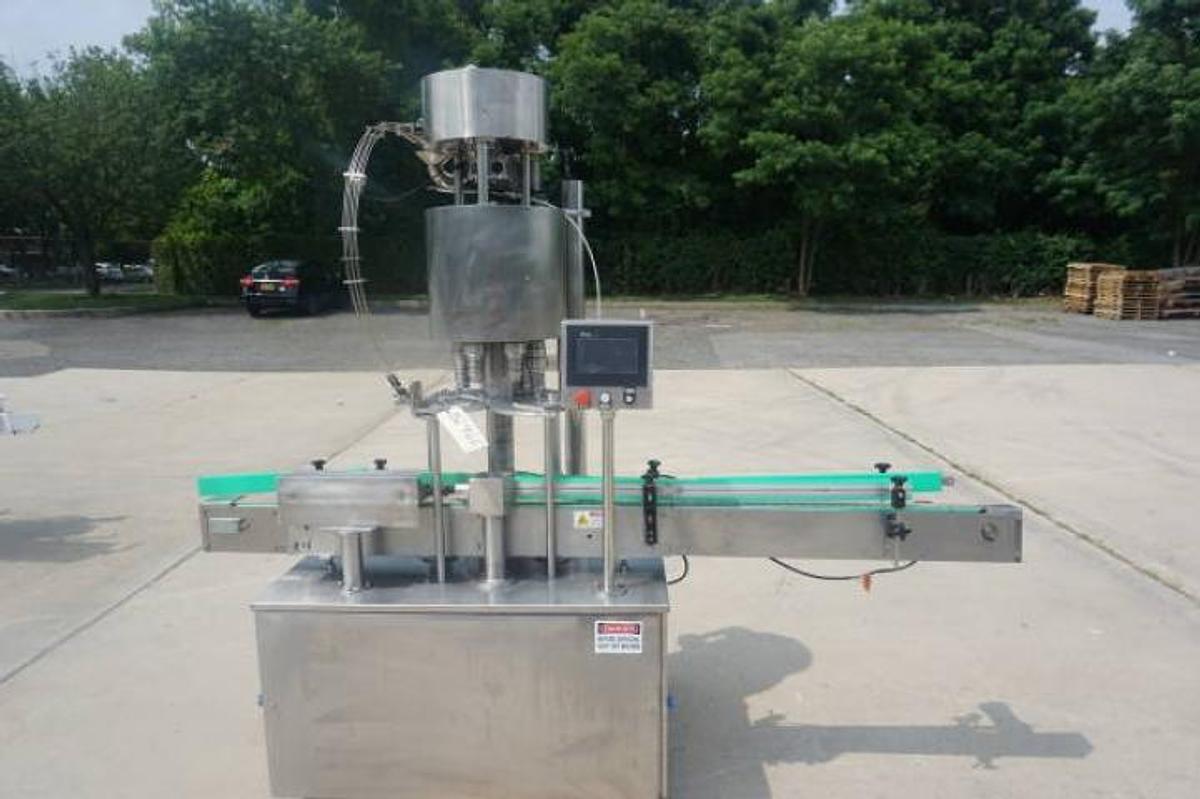
A rotary chuck capper is a type of automatic capping machine that uses a series of spinning chuck heads arranged around a rotating turret to apply screw-type caps to containers. As bottles move along a conveyor and enter the capping station, each bottle is gripped and held in position while a chuck descends, engages the cap, and applies a controlled amount of torque to thread it onto the bottle neck. The rotary design allows multiple caps to be applied simultaneously in a continuous motion, which is what enables high throughput without stopping the line.
The number of heads on the machine directly affects output capacity. A six-head rotary chuck capper, like the Shanghai Kuixing model commonly seen on the used market, can typically cap several hundred bottles per minute depending on bottle size, cap type, and line speed. Chuck cappers are favored for their torque consistency and their ability to handle a range of cap diameters with changeover tooling. For used equipment buyers, the condition of the chucks, clutch mechanisms, and turret components are key inspection points since these parts experience the most wear during production.
What should buyers inspect when purchasing a used Shanghai Kuixing capping machine?
Buying used packaging machinery requires a more hands-on evaluation than purchasing equipment straight from a manufacturer. For a used Shanghai Kuixing capper, the most important areas to inspect include the chuck heads and clutch assemblies, the cam tracks and timing components, the conveyor and infeed system, and the electrical panel and controls. Worn chucks can result in inconsistent torque and cross-threaded caps, while damaged cam tracks affect the up-and-down motion of the capping heads. Asking the seller for the machine's approximate run hours and production history gives useful context for how much wear to expect.
Reputable used equipment dealers will typically accommodate in-person inspections at their facility or, where the machine is still in production at a plant, can arrange access for a buyer or their representative to observe it running. Virtual inspections via live video call or recorded video walkthroughs are also a common option. Keep in mind that most equipment dealers are not set up to run actual product through a machine during inspection, since full production testing requires different permitting and facility capabilities. Buyers should also contact Shanghai Kuixing or an authorized service provider to ask about parts availability and technical support for the specific model and age of machine they are considering, since older models may have more limited support options.
Are replacement parts available for used Shanghai Kuixing capping machines?
Parts availability for used Shanghai Kuixing equipment depends on the age of the machine and the current support posture of the manufacturer. Shanghai Kuixing, like most Chinese packaging machinery manufacturers, produced machines with a mix of proprietary components and standard industrial parts. Wear items like chuck inserts, O-rings, belts, and bearings are often sourced from standard suppliers and may be readily available through industrial distributors regardless of the machine's age. Proprietary components tied to specific model designs, such as custom tooling or control boards, can be harder to source if the manufacturer has discontinued that model or updated their product line.
Before committing to a purchase, prospective buyers are advised to contact Shanghai Kuixing directly to ask about parts support for the specific model number and approximate production year. This conversation can reveal whether the manufacturer still stocks parts, whether a local or regional distributor carries inventory, and whether the company offers any technical documentation or service support for international buyers. A third-party packaging machinery service company familiar with Chinese-built cappers can also be a resource for sourcing compatible components or fabricating replacements when factory parts are no longer available.
How does the price of a used Shanghai Kuixing capping machine compare to buying new equipment?
Used Shanghai Kuixing capping machines are typically available at a significant discount compared to purchasing comparable equipment directly from a manufacturer. Chinese-manufactured capping machines in general are already priced competitively relative to Western-built equivalents, with semi-automatic models often falling in the range of $1,000 to $5,000 and fully automatic inline or rotary systems ranging from roughly $8,000 to $15,000 or more depending on configuration. On the used market, prices drop further based on age, condition, and the completeness of the machine, meaning buyers can sometimes acquire capable production equipment at a fraction of what a comparable machine would cost sourced directly.
The trade-off is that used machines come without the assurances that accompany a purchase from a manufacturer. There is no warranty, and the buyer takes on responsibility for verifying the machine's condition before purchase. This makes the inspection process critically important. A well-maintained used capper in good mechanical condition can represent excellent value, while a machine with significant wear or missing components may end up costing more in repairs and downtime than the purchase price savings justify. Factoring in shipping, rigging, any required refurbishment, and the cost of spare parts gives a more accurate picture of total acquisition cost.
What are typical shipping considerations when buying a used capping machine?
Shipping a used capping machine involves more planning than most buyers initially expect, particularly for larger rotary systems. The machine needs to be properly prepared for transit, which typically means draining any fluids, securing moving parts, and either palletizing or crating the equipment to prevent damage. The level of packaging required depends on the size and fragility of the machine, the shipping method, and the distance involved. Heavier or more complex machines may require professional rigging for loading and unloading, which adds to the overall cost and needs to be arranged in advance.
Buyers should ask the seller for a clear breakdown of packaging, rigging, and freight costs before finalizing a purchase, since these expenses can be substantial and vary widely based on the machine's weight, dimensions, and destination. For international shipments, import duties, customs clearance fees, and compliance with local electrical or safety standards are additional factors to account for. Getting a full landed cost estimate, meaning the total cost to have the machine delivered and ready for installation, helps avoid surprises and allows for a more accurate comparison against other equipment options.
What payment terms do used equipment dealers typically offer for machinery purchases?
Most used equipment dealers require full payment prior to releasing a machine for shipment. This is standard practice in the industry and reflects the nature of used equipment transactions, where machines are sold as-is and dealers need to confirm cleared funds before committing to packing and shipping. For buyers who are unfamiliar with a particular dealer, paying in full upfront underscores the importance of doing thorough due diligence on the seller's reputation and track record before entering into a transaction.
Some dealers may offer payment terms or financing arrangements to established customers with a history of prior purchases, though this is less common for first-time buyers. Wire transfer is the most widely accepted payment method for used machinery transactions, though other methods may be available depending on the dealer. Buyers should clarify payment expectations, including the timing of payment relative to inspection and shipment, before proceeding. Working with a dealer who has a verifiable history in the packaging machinery space and can provide references from past customers adds an important layer of confidence when making a significant capital equipment purchase.
How do semi-automatic and fully automatic capping machines differ in terms of production suitability?
Semi-automatic capping machines require an operator to manually place caps on bottles before the machine applies torque or pressure to seal them. This approach works well for smaller production runs, startups, or facilities where line speeds are modest and labor costs are manageable. Semi-automatic cappers are generally simpler mechanically, easier to maintain, and less expensive to acquire, making them a reasonable entry point for operations that do not yet justify the investment in full automation. Their flexibility also makes them useful for short runs with frequent changeovers.
Fully automatic cappers, including rotary chuck systems like the Shanghai Kuixing six-head model, integrate into a continuous packaging line where cap sorting, feeding, placement, and tightening all happen without operator intervention between each bottle. These machines are designed for sustained high-volume output and are most cost-effective when running large batches of a consistent product. The tradeoff is greater mechanical complexity, higher acquisition cost, and more involved changeover procedures when switching between bottle or cap sizes. For buyers evaluating used equipment, matching the machine's design capacity to their actual production requirements is one of the most important factors in making a sound purchasing decision.
How can buyers verify the condition of a used capping machine before purchasing?
Verifying the condition of used packaging machinery before purchase is the buyer's primary responsibility, since used equipment is sold as-is without manufacturer backing. The most reliable method is an in-person inspection at the dealer's facility or, in cases where the machine is still installed at a production plant, at the site where it is currently operating. During an in-person visit, a buyer or their qualified technician can examine mechanical components, check for wear on high-contact parts, review the electrical system, and assess the overall condition of the frame and guarding.
When travel is not practical, reputable dealers can accommodate virtual inspections via live video call, allowing a buyer to direct the camera to specific areas of concern and ask questions in real time. Pre-recorded video walkthroughs are another option, though live video gives more flexibility to examine details on the spot. It is worth noting that most equipment dealers cannot run actual product through a machine during inspection, as full production testing requires operational permits and facilities that dealers do not typically maintain. For buyers with limited packaging machinery experience, engaging an independent machinery appraiser or a packaging line consultant to assist with the inspection can be a worthwhile investment before committing to a purchase.