Category
Manufacturer
Model
Seitzschenk
Seitzschenk specializes in manufacturing equipment for the food and beverage industry, particularly in the area of bottling and filling. Their machines are designed for high-speed operations, ensuring efficiency and reliability in production lines. Seitzschenk’s commitment to quality has made them a trusted partner for manufacturers.
FAQ:
What is a Seitz-Schenk filter press and what is it used for?
A Seitz-Schenk filter press is a depth filtration system designed to remove suspended solids, microorganisms, and particulates from liquid products. Unlike surface filtration methods that trap particles only on a membrane's exterior, depth filtration works by passing liquid through a thick filter medium, typically a cellulose-based sheet or pad, that captures contaminants throughout its entire structure. This makes Seitz-Schenk filter presses particularly effective for achieving high levels of clarity and biological reduction in sensitive liquids where product quality is critical.
The machines are widely used in food and beverage production, pharmaceutical manufacturing, and specialty chemical processing. In winemaking and brewing, they are valued for their ability to produce brilliantly clear finished products while preserving flavor integrity. In pharmaceutical and edible oil applications, the hygienic construction and consistent filtration performance make them a practical choice for regulated production environments. The filter press format, which typically uses horizontal plates and filter sheets loaded between them, allows operators to adjust filtration intensity by selecting different sheet grades, ranging from coarse clarification pads to sterile-grade sheets capable of removing yeast and bacteria.
What industries commonly use Seitz-Schenk filter presses?
Seitz-Schenk filter presses have a long history of use across several process industries where liquid clarity and purity are non-negotiable. In the food and beverage sector, they are standard equipment in wineries, breweries, juice processing facilities, and edible oil refineries. Winemakers rely on them for pre-bottling polishing filtration, while brewers use them to remove yeast and haze-forming proteins from finished beer. Juice producers use them to achieve the brilliant clarity consumers expect in premium products.
Beyond beverages, Seitz-Schenk filter presses are also found in pharmaceutical manufacturing, where the hygienic stainless steel construction and validated filtration performance meet the strict requirements of drug production. Specialty chemical processors use them to clarify process liquids and remove fine solids that would otherwise interfere with downstream operations. The versatility of the depth filtration sheet system, which can be swapped out for different grades depending on the application, is a major reason these machines appear across such a broad range of industries. Their compact horizontal plate design also makes them practical for facilities where floor space is limited.
What are the typical sizes and capacity ranges available for Seitz-Schenk filter presses?
Seitz-Schenk filter presses are available in a range of plate sizes and frame configurations to suit production volumes from small craft operations to large industrial facilities. Plate dimensions are the primary way capacity is described, with common sizes including 12-inch by 12-inch units suited for smaller batch operations, and larger formats used in high-volume production environments. The total filtration area of a press is determined by both the plate size and the number of plates in the stack, so a single frame design can often be scaled up by adding more plates.
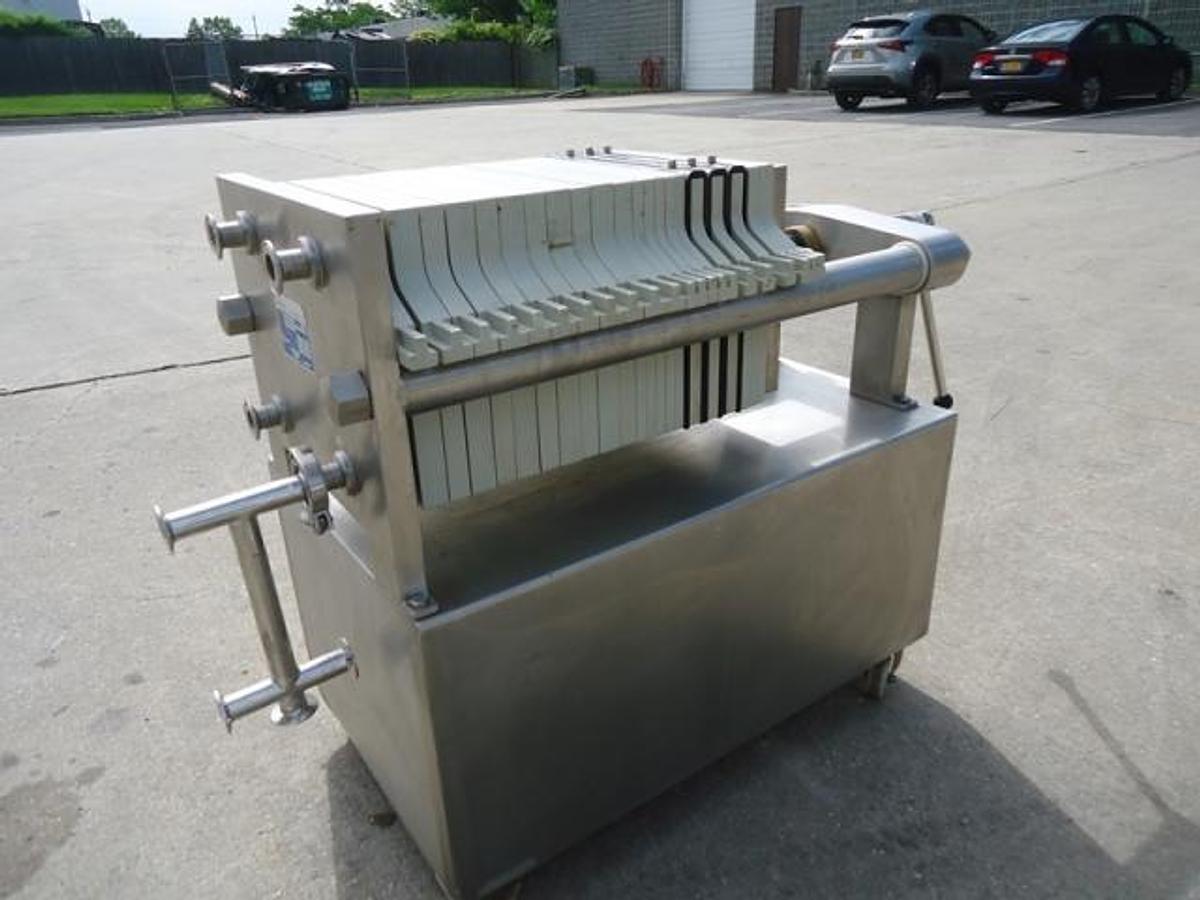
A 12-inch by 12-inch polypropylene filter press with a stainless steel frame, for example, is a practical size for wineries, craft breweries, or pilot-scale pharmaceutical operations that need reliable filtration without the footprint of a full industrial unit. Larger presses with more plates and bigger plate dimensions are used in high-throughput beverage bottling lines or continuous chemical processing. When evaluating a used Seitz-Schenk filter press, buyers should pay close attention to the plate count, plate condition, and frame dimensions to ensure the unit matches their production flow rate and batch size requirements.
Are used Seitz-Schenk filter presses reliable, and what should buyers look for?
Used Seitz-Schenk filter presses can be highly reliable pieces of equipment, largely because the brand has a strong reputation for quality construction and the machines are built to withstand demanding production environments. The stainless steel frames and polypropylene or stainless plate components used in many models are inherently durable and resistant to corrosion, which means a well-maintained press can deliver many years of service life beyond its first installation. That said, reliability of any used machine depends heavily on how it was maintained, how intensively it was used, and whether it has been properly cleaned and stored.
Buyers should focus their inspection on the condition of the frame, the filter plates, the inlet and outlet connections, and any pumps or auxiliary components included with the unit. Filter sheets are consumable items replaced during normal operation, so their condition at the time of sale is less critical than the condition of the permanent hardware. Reputable used equipment dealers will typically accommodate in-person or video inspections so buyers can assess the machine's current state before committing to a purchase. It is also worth contacting the manufacturer directly to understand parts availability and support options for the specific model and age of the press being considered, since older models may have different levels of manufacturer support than more recent production runs.
What filtration ratings do Seitz-Schenk filter presses support?
Seitz-Schenk filter presses use interchangeable depth filtration sheets or pads that are available in a range of grades, allowing the same press frame to handle everything from coarse clarification to near-sterile filtration. Sheet grades are typically classified by their filtration intensity, which is expressed in terms of the particle size and microbial load they are designed to remove. Coarse grades are used for initial clarification to remove large suspended solids and gross turbidity, while progressively finer grades are used for polishing and, at the finest end, for biological reduction that removes yeast cells and reduces bacterial counts to very low levels.
In wine and beer production, it is common to use a sequence of sheet grades in successive filtration passes, starting with a coarser pad for bulk clarification and finishing with a tight grade for pre-bottling polish. Sterile-grade sheets, sometimes called EK or equivalent grades, are capable of removing virtually all viable microorganisms and are used in pharmaceutical and sterile beverage applications. Because Seitz-Schenk filter presses use a standard sheet format that is compatible with filter media from multiple manufacturers, operators are not locked into a single supplier for consumables, which helps control long-term operating costs and ensures supply continuity.
What materials of construction are used in Seitz-Schenk filter presses, and are food-grade versions available?
Seitz-Schenk filter presses are commonly built with stainless steel frames and either polypropylene or stainless steel filter plates, depending on the model and intended application. Stainless steel is the standard construction material for food-grade and pharmaceutical-grade equipment because it resists corrosion, is easy to clean and sanitize, and does not impart flavors or contaminants to the product being filtered. Polypropylene plates are lightweight and chemically resistant, making them a practical choice for applications involving acidic or mildly corrosive liquids such as wine, juice, and certain chemical process streams.
For food and beverage production, the hygienic design of Seitz-Schenk presses, including smooth internal surfaces, minimal dead zones, and easy disassembly for cleaning, is a key advantage. The filter sheets themselves are manufactured from food-grade cellulose and other approved materials, and the overall system is designed to meet the hygiene standards expected in regulated food production and pharmaceutical environments. When purchasing a used unit, buyers should verify the materials of construction match their application requirements and inspect all product-contact surfaces for wear, pitting, or damage that could compromise hygienic performance or product quality.
How easy is it to source spare parts and filter consumables for a Seitz-Schenk filter press?
One of the practical advantages of Seitz-Schenk filter presses is that the filter sheets and pads used as consumables are widely available from multiple suppliers, not just the original equipment manufacturer. The depth filtration sheet format used in these presses has become an industry standard in beverage and pharmaceutical filtration, and compatible sheets in a full range of grades are produced by several reputable filter media manufacturers. This broad availability keeps consumable costs competitive and reduces the risk of supply disruptions that can occur when a facility depends on a single source for critical production materials.
For mechanical spare parts such as seals, gaskets, end plates, and hardware, availability depends on the specific model and age of the press. Buyers considering a used Seitz-Schenk filter press should contact the manufacturer before purchasing to understand what level of parts support is available for that particular model. Older machines may have some components that are no longer stocked by the manufacturer, in which case buyers should assess whether aftermarket alternatives or fabricated replacements are practical options. A thorough inspection of the press before purchase, with specific attention to the condition of seals and gaskets, can help buyers anticipate near-term maintenance needs and factor those costs into their purchasing decision.
What should buyers expect regarding payment terms when purchasing a used Seitz-Schenk filter press?
Payment practices in the used industrial equipment market follow fairly consistent conventions. Most used equipment dealers require full payment before a machine is released for shipping, which reflects the practical realities of selling high-value capital equipment on a secondary market. This is a standard expectation buyers should plan for when budgeting for a used filter press purchase. Some dealers may extend payment terms to customers with whom they have an established purchasing history, but first-time buyers should generally expect to pay in full prior to shipment.
Buyers should also factor in costs beyond the purchase price of the machine itself. Shipping costs, rigging fees for loading and unloading heavy equipment, and any crating or palletization required to protect the press in transit can add meaningfully to the total landed cost. Larger filter press units with heavy stainless steel frames may require specialized rigging equipment for loading and unloading, which is typically arranged and priced separately from freight. Asking the dealer for a detailed breakdown of all costs, including packaging, loading, freight, and any destination rigging, before finalizing a purchase will give buyers an accurate picture of what the equipment will actually cost to put into service.
How are inspections typically handled for used Seitz-Schenk filter presses?
Inspections are a standard and expected part of buying used industrial filtration equipment, and reputable dealers will accommodate them in several formats. In-person inspections allow a buyer or their technical representative to physically examine the press, check the condition of the frame, plates, seals, and connections, and assess overall cleanliness and maintenance history. For buyers who cannot travel to the equipment's location, video inspections and detailed photo documentation are common alternatives that can provide a thorough view of the machine's current condition.
Some used filter presses are sold directly from active production facilities where the equipment may still be in operation or has recently been decommissioned. In those cases, the dealer can often arrange an inspection at the plant site, and buyers may be able to observe the machine in or near its working environment. It is worth noting that used equipment dealers generally do not have the production permits or infrastructure to run actual filtration trials with product, so functional testing in the dealer's facility is typically not possible. The inspection process is therefore focused on visual and mechanical assessment rather than process performance testing, which makes working with a dealer who has deep knowledge of filtration equipment and can accurately describe the machine's condition especially important.
How does a Seitz-Schenk filter press compare to other filtration technologies used in beverage production?
Seitz-Schenk filter presses using depth filtration sheets occupy a well-established position in beverage production, sitting between coarser technologies like centrifugation or diatomaceous earth filtration and finer technologies like membrane crossflow filtration. Depth filtration with cellulose sheets offers a practical combination of throughput, clarity, and biological reduction that makes it suitable for the polishing and pre-bottling filtration stages where product appearance and microbial stability matter most. The technology has been trusted in wine and beer production for decades precisely because it delivers consistent results without requiring the significant capital investment or operational complexity of crossflow membrane systems.
Compared to diatomaceous earth (DE) filtration, which is another common beverage filtration method, depth filtration sheet presses have the advantage of simpler operation and easier disposal of spent filter media, since DE handling and disposal presents environmental and health considerations that sheet filtration does not. Crossflow membrane filtration offers the advantage of continuous operation without filter media changeouts, but at a substantially higher equipment cost and with more complex maintenance requirements. For many small to mid-sized beverage producers, a used Seitz-Schenk filter press represents a cost-effective way to access proven depth filtration technology without the capital outlay of purchasing new equipment or investing in more complex filtration systems.