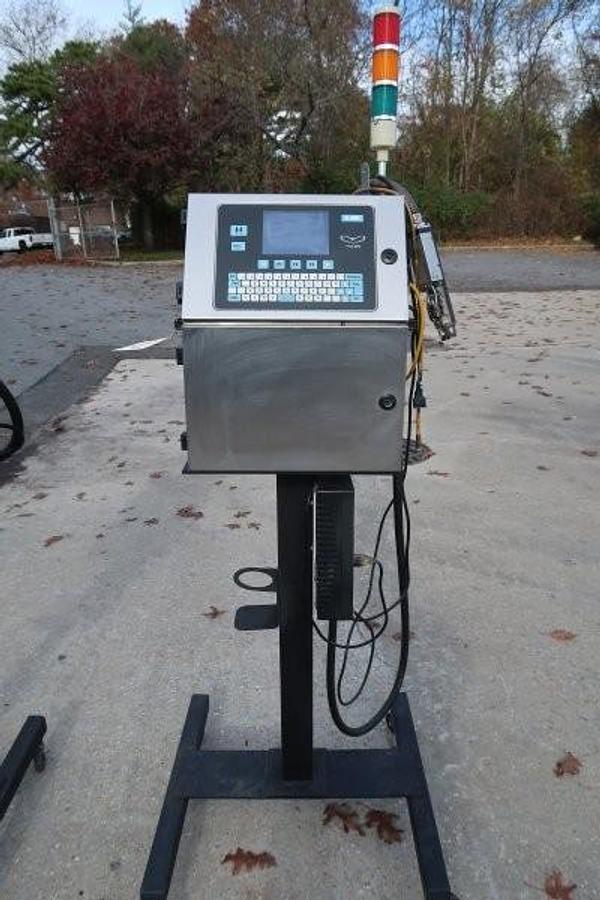
Category
Manufacturer
Model
Saturn
FAQ:
What is a Saturn inkjet coder and what is it used for?
Saturn inkjet coders are industrial coding machines designed to print product identification information directly onto packaging, containers, and other surfaces during the manufacturing process. They are used to apply date codes, expiration dates, lot numbers, batch codes, barcodes, and even logos at high speeds without ever making contact with the product surface. This makes them a practical choice for production lines where consistent, legible marking is required across thousands of units per shift.
These machines are widely used across food and beverage, pharmaceutical, cosmetics, and general industrial manufacturing. The appeal is straightforward: they integrate directly into existing production lines and print on the fly without slowing output. The Saturn S480 is one of the more commonly available models on the used market, and it represents a capable option for facilities that need reliable continuous inkjet coding without the price tag of purchasing unused equipment.
What is the difference between continuous inkjet (CIJ) and thermal inkjet (TIJ) coding?
Continuous inkjet (CIJ) and thermal inkjet (TIJ) are two distinct technologies used in industrial coding, and understanding the difference matters when selecting a used Saturn coder. CIJ machines generate a continuous stream of ink droplets, using electrostatic deflection to direct droplets onto the substrate or recirculate unused ink back into the system. This makes CIJ well suited for high-speed production lines and for printing on curved, uneven, or porous surfaces. CIJ machines can also print at greater throw distances, meaning the printhead does not need to be directly against the surface.
TIJ, by contrast, uses heat to vaporize ink and propel droplets onto the substrate. TIJ systems tend to be simpler mechanically, with fewer moving parts and lower maintenance requirements, but they typically require the printhead to be very close to the surface and are better suited for flat, smooth substrates. TIJ cartridges are self-contained, which simplifies changeovers but can increase per-unit ink costs. When shopping for a used Saturn inkjet coder, confirming which technology the specific model uses will directly affect how it fits into your production environment and what consumables you will need to source.
What print resolution can you expect from a Saturn inkjet coder?
Print resolution on Saturn inkjet coders typically falls in the range of 300 to 600 DPI depending on the specific model and configuration. At these resolutions, the machines are capable of producing clear, legible date codes, alphanumeric strings, 1D barcodes, 2D matrix codes, and simple graphics or logos. For most industrial coding applications, this level of resolution is more than adequate, particularly for regulatory compliance marking on food, pharmaceutical, and consumer goods packaging.
It is worth keeping resolution in mind relative to the specific use case. If the primary need is a simple date code or lot number on a carton, even the lower end of that range performs reliably. If the application involves printing scannable barcodes or detailed graphics, confirming the model's rated resolution before purchase is a smart step. When buying a used Saturn coder, asking the seller for a sample print output or a video demonstration of the machine printing is one of the best ways to verify that print quality meets production standards before committing to the purchase.
What types of substrates can Saturn inkjet coders print on?
Saturn inkjet coders are built for versatility across a wide range of substrate types. Depending on the ink formulation installed, these machines can print on corrugated cardboard, glass, metal cans, plastic bottles and films, foil packaging, coated and uncoated paper, rubber, and even some porous or textured surfaces. CIJ models in particular are known for their ability to handle non-flat and non-porous surfaces because of the non-contact printing method and adjustable throw distance.
The key variable is the ink type. Different inks are formulated for different surface chemistries, and using the wrong ink on a given substrate will result in poor adhesion, smearing, or codes that fade quickly. When evaluating a used Saturn coder, it is important to understand what ink was previously used in the machine and whether that ink is compatible with your target substrate. Some inks also require specific solvent flushes during changeovers, so confirming the machine's ink history with the seller helps avoid compatibility issues and unnecessary downtime after installation.
What ink types are compatible with Saturn inkjet coding machines?
Saturn inkjet coders are generally designed around proprietary or semi-proprietary ink systems, which means the inks are formulated specifically for the machine's printhead and ink circuit. Common ink categories used in these machines include MEK-based (methyl ethyl ketone) inks for non-porous surfaces like plastics and metals, acetone-based inks for certain plastics, alcohol-based inks for food-contact or sensitive applications, and water-based inks for porous substrates like cardboard. The specific ink type a given machine uses depends on the model and how it was configured for its previous production environment.
Before purchasing a used Saturn coder, buyers should confirm what ink type the machine requires and then verify that they can source that ink reliably going forward. This is a practical supply chain question that is easy to overlook during the excitement of finding a good deal on equipment. Contacting the Saturn manufacturer directly to ask about ink availability for a specific model and serial number is a reasonable step, since older or discontinued models may have more limited ink supply options than current production machines. Securing a reliable ink source before the machine arrives on your floor avoids costly delays.
How fast do Saturn inkjet coders print, and can they keep up with high-speed production lines?
Saturn inkjet coders are designed for industrial production environments, and their printing speeds are built to match. CIJ models in particular are capable of printing at line speeds measured in meters per second, with many configurations handling several hundred to over a thousand products per minute depending on the code size and complexity. Simpler codes with fewer characters print faster than complex multi-line codes or barcodes, so the effective throughput depends on what is being printed as much as the machine's rated speed.
For facilities running high-speed packaging lines in food, beverage, or pharmaceutical production, Saturn coders have a track record of keeping pace without becoming a bottleneck. When evaluating a used machine, it is a good idea to ask the seller about the production environment the coder came from, including what line speeds it was running at and how long it had been in service. A machine that was operating at or near its rated speed in a demanding environment up until decommissioning is generally a better indicator of mechanical health than one that sat idle for an extended period. Sellers who specialize in coding and marking equipment should be able to provide this kind of background.
What should buyers know about purchasing a used Saturn inkjet coder versus buying unused equipment?
Buying a used Saturn inkjet coder can offer meaningful cost savings compared to sourcing unused equipment, but it comes with a different set of considerations. Used machines are typically sold as-is, which means the condition, maintenance history, and remaining service life vary from unit to unit. Reputable used equipment dealers who specialize in coding and marking machinery are generally a better source than general-purpose auction platforms, because they are more likely to have relevant technical knowledge and to accurately represent the machine's condition.
The inspection process is especially important with used inkjet coders. Ink systems can develop blockages, printhead wear, or seal degradation if a machine has been sitting idle or was not properly flushed before storage. Buyers should request a video or in-person inspection that includes the machine powering on, the ink system priming, and ideally a live print demonstration. It is also worth contacting the Saturn manufacturer before purchasing to ask about parts availability and technical support for the specific model, since older models may have limited service support. Understanding the full landed cost including shipping, any needed reconditioning, and consumables is essential to making an accurate comparison against the cost of unused equipment.
How should a used Saturn inkjet coder be inspected before purchase?
A thorough inspection of a used Saturn inkjet coder should cover several key areas: the physical condition of the cabinet and printhead, the state of the ink system, the condition of electrical components, and a functional demonstration if at all possible. Start by asking the seller for detailed photographs of the machine from multiple angles, including close-ups of the printhead, ink lines, filters, and control panel. Look for signs of corrosion, cracked ink lines, or damaged seals, which can indicate poor storage conditions or deferred maintenance.
Beyond photos, request a video of the machine powering on and cycling through its startup sequence, including ink system priming. If the seller can demonstrate the machine actually printing, that is the most valuable confirmation of working order available short of an in-person visit. Some machines may still be installed in an active facility, in which case the dealer may be able to arrange an in-person inspection at the plant. Keep in mind that most equipment dealers do not have production facilities themselves, so live product testing is rarely an option at the dealer's location. Asking specific questions about the machine's service history, when it was last used, and how it was prepared for storage gives additional context for assessing risk before making a purchase decision.
What are the typical shipping considerations for a used Saturn inkjet coder?
Saturn inkjet coders are precision machines with sensitive components, including ink systems, printheads, and electronics, that require careful preparation before shipping. Ink systems should be thoroughly flushed with the appropriate solvent before transport to prevent dried ink from damaging internal components during transit. The machine should be properly palletized or crated to protect it from vibration and impact, and the level of packaging required will affect the overall shipping cost. Buyers should ask the seller specifically how the machine will be prepared and packaged before it ships.
Shipping costs for industrial coding equipment vary based on the machine's size and weight, the distance being shipped, and whether any special handling or liftgate service is needed at the delivery location. Larger or heavier configurations may require freight service with forklift unloading rather than standard pallet delivery. Getting a clear breakdown of all shipping-related costs, including packaging, freight, and any destination handling, before finalizing a purchase helps avoid surprises. The total landed cost, meaning the purchase price plus all shipping and handling, is the number that should be compared when evaluating multiple machines or sourcing options.
Are replacement parts and consumables readily available for used Saturn inkjet coders?
Parts and consumables availability is one of the most practical questions to resolve before purchasing any used inkjet coder, and Saturn machines are no exception. Consumables like inks, solvents, and filters are the ongoing operational costs that continue well after the initial purchase. For many Saturn models, these items can be sourced either directly through the manufacturer or through third-party suppliers who produce compatible alternatives. The availability picture can change significantly depending on the age and model of the machine, so verifying this before purchase is time well spent.
For replacement parts, the situation is similar. Printheads, ink pumps, seals, and circuit boards may be available through the manufacturer for current or recently discontinued models, but older machines may require sourcing parts from the used equipment market or from third-party repair specialists. Contacting Saturn's manufacturer or an authorized service provider with the machine's model number and serial number before buying gives a realistic picture of what support to expect. Dealers who specialize in coding and marking equipment often have knowledge of parts availability for specific models and can be a useful resource during the evaluation process.