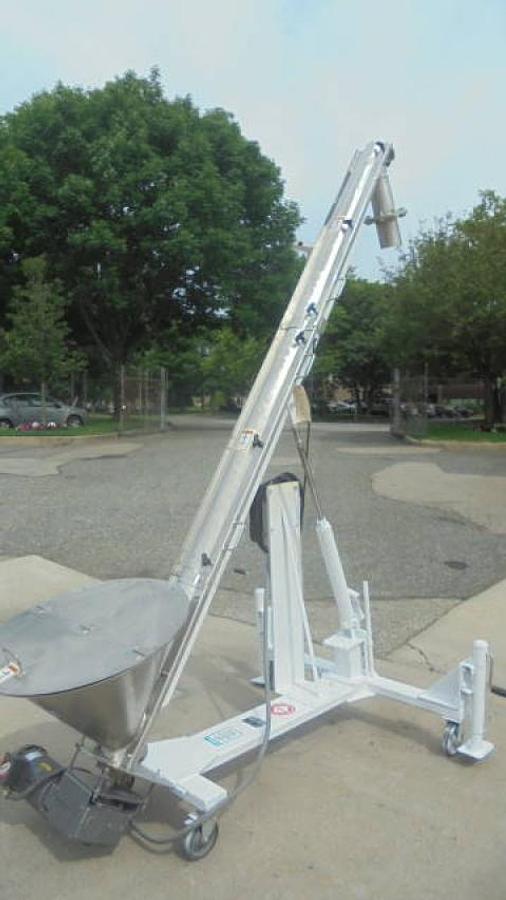
Category
Manufacturer
Model
S. Howes Company
S. Howes Company specializes in manufacturing equipment for various industries, including food, chemical, and pharmaceutical sectors. They are particularly known for their mixing, drying, and separation machinery, which are essential for optimizing production processes. Their innovative designs focus on efficiency and reliability, making them a trusted choice among manufacturers.
FAQ:
What types of equipment does S. Howes Company manufacture?
S. Howes Company has built its reputation around bulk material handling and processing equipment, with a product line that spans screw conveyors, ribbon blenders, mixers, dryers, and separation machinery. Their screw conveyors and feeders are available in a range of configurations, including inclined designs with adjustable height discharge, and are frequently constructed in stainless steel to meet sanitary requirements in food, pharmaceutical, and chemical processing environments. The company's ribbon blenders are particularly well regarded for their ability to handle dry and semi-dry materials uniformly, making them a go-to choice for producers who need consistent batch results.
Beyond mixing and conveying, S. Howes has produced drying and separation equipment suited to industries where moisture control and particle classification are critical steps in the production process. Their machines are known for heavy-duty construction and straightforward mechanical designs, which contributes to long service lives and relatively low maintenance demands. This combination of durability and versatility is a large part of why S. Howes equipment continues to circulate actively in the used machinery market long after its initial installation.
What industries commonly use S. Howes Company equipment?
S. Howes equipment serves a broad cross-section of process industries, but it shows up most frequently in food processing, chemical manufacturing, pharmaceutical production, plastics compounding, and agricultural processing. In food applications, the stainless steel construction options are especially important because they allow equipment to meet sanitary standards for direct or indirect contact with consumable products. Ribbon blenders and screw conveyors from S. Howes are regularly found in flour milling, spice blending, pet food production, and similar operations where dry or semi-dry bulk materials need to be moved or mixed reliably.
On the chemical and pharmaceutical side, the same durability that appeals to food processors makes S. Howes equipment attractive for handling powders, granules, and other bulk solids that may be abrasive or require careful containment. Agricultural operations use their conveying equipment for grain handling and seed processing, while plastics manufacturers rely on their mixers and feeders for compounding and blending resin materials. The wide applicability across these sectors means that used S. Howes machines can often be repurposed from one industry to another, which adds to their appeal in the secondary market.
Why does used S. Howes Company equipment retain strong resale value?
Several factors contribute to the durability of S. Howes equipment's resale value. First, the company has a long history of building machines with heavy-gauge materials and conservative engineering tolerances, which means units that have been in service for many years often still have substantial usable life remaining. Stainless steel construction, common across much of their product line, resists corrosion and wear in ways that carbon steel alternatives cannot match, so machines come out of service in better physical condition than comparable equipment from manufacturers who cut corners on materials.
Second, S. Howes has maintained a consistent product philosophy over decades, which means parts and mechanical knowledge transfer across generations of equipment. Buyers in the used market are often experienced operators who already know how to run and maintain these machines, which reduces the learning curve and lowers the perceived risk of buying secondhand. Ribbon blenders and screw conveyors in particular tend to attract competitive bidding at auction and through private sales because demand from food, pharmaceutical, and chemical processors consistently outpaces the available supply of quality used units.
How do I verify the condition of used S. Howes Company equipment before buying?
Verifying condition before committing to a purchase is one of the most important steps in any used equipment transaction. Reputable dealers will typically offer in-person inspections, virtual walkthroughs via video call, or recorded video captures of the machine so buyers can assess its physical state, check for wear on contact surfaces, and review the condition of drive components, seals, and structural welds. For S. Howes screw conveyors and mixers, key areas to examine include the flighting or ribbon for wear or deformation, the condition of the trough or vessel interior, shaft seals, bearings, and the gearbox or drive assembly.
Some equipment may still be installed and running at a production facility, in which case the dealer can arrange an inspection at the plant where the machine is operating. This gives buyers the opportunity to observe the equipment under actual working conditions, which is far more informative than a static inspection of a decommissioned unit. Keep in mind that dealers generally do not have production permits that would allow them to run actual product through a machine at their own facility, so functional testing in a dealer's warehouse is usually limited to dry cycling the drive and mechanical components. Buyers should also contact S. Howes directly to understand what level of technical support and parts availability they can expect for a specific model and age of equipment, since this can vary.
Are replacement parts still available for older S. Howes Company machines?
Parts availability for S. Howes equipment depends on the specific model and its age, but the company's reputation for consistent mechanical design over many years works in buyers' favor. Because S. Howes has historically used standardized components across product generations, many wear parts such as flighting sections, seals, bearings, and drive components can be sourced either directly from the manufacturer or through industrial parts suppliers who stock compatible components. Buyers considering a used S. Howes machine should reach out to the manufacturer before finalizing a purchase to confirm what level of support they can expect for that particular model.
For older or discontinued models, the picture can be more mixed. Some components may no longer be stocked by the manufacturer, but the straightforward mechanical construction of most S. Howes equipment means that skilled fabricators can often reproduce wear parts to specification. Bearings, gearboxes, and drive motors on these machines are typically standard industrial components available from multiple sources regardless of the machine's age. Consulting with a dealer who specializes in this type of processing equipment is a practical way to get a realistic assessment of parts availability before committing to a purchase.
What should buyers know about shipping and rigging costs for S. Howes Company equipment?
Shipping costs for used industrial equipment like S. Howes conveyors and mixers can vary significantly based on the size and weight of the machine, the distance involved, and the level of packaging or crating required to protect it in transit. Smaller units such as a 4-inch diameter inclined screw conveyor feeder may ship on a standard pallet with appropriate blocking and bracing, while larger ribbon blenders or heavy-duty conveyors may require custom crating or skidding to prevent damage. Buyers should ask dealers for a detailed breakdown of packaging, rigging, and freight costs before agreeing to a purchase so the full landed cost is understood upfront.
For heavier equipment, loading at the dealer's facility and unloading at the destination may require a forklift or crane, and those rigging services carry their own costs that are typically separate from the freight charge. If the equipment is being picked up from a third-party facility such as a plant where it was in production, coordination between the dealer, the plant, and the buyer's freight carrier adds another layer of logistics to manage. Getting firm quotes from freight carriers who specialize in industrial machinery is advisable, as standard LTL carriers are not always equipped to handle heavy or oversized process equipment safely.
What are typical payment terms for purchasing used S. Howes Company equipment through a dealer?
Most used equipment dealers require payment in full before a machine is released for shipping. This is standard practice across the industry and reflects the fact that used machinery transactions do not carry the same financing infrastructure that new equipment purchases often do. Wire transfer is the most common payment method for transactions of any significant size, though dealers may also accept certified funds or other forms of verified payment. Buyers who have an established relationship with a particular dealer may occasionally be offered payment terms, but this is the exception rather than the rule for first-time transactions.
Buyers should factor the full payment requirement into their planning timeline, particularly if internal purchase approval processes or capital budget cycles are involved. It is also worth confirming with the dealer exactly when title transfers and when the machine will be released for pickup or shipment after payment clears, as processing times can vary. For high-value equipment, some buyers choose to use an escrow service to provide a measure of protection for both parties, though this adds a step to the transaction and should be agreed upon before any funds are transferred.
What is the difference between a screw conveyor and a screw feeder, and which S. Howes configuration is right for my application?
Screw conveyors and screw feeders are closely related pieces of equipment that share the same basic operating principle, but they serve different functions in a process line. A screw conveyor is designed primarily to move bulk material from one point to another, typically at a controlled rate, and can be configured horizontally, on an incline, or vertically depending on the layout of the facility. A screw feeder, by contrast, is specifically designed to meter material out of a hopper or bin at a precise, controlled rate, feeding downstream equipment consistently. S. Howes produces both types, and their inclined screw conveyor and feeder designs combine both functions, allowing material to be elevated while also controlling the feed rate.
Choosing the right configuration depends on factors including the bulk density and flowability of the material being handled, the required throughput rate, the elevation change involved, and whether the application demands sanitary construction. Stainless steel construction is essential for food, pharmaceutical, and certain chemical applications, while carbon steel may be adequate for agricultural or non-contact industrial uses. Adjustable height discharge, a feature found on some S. Howes units, adds flexibility for installations where the discharge point needs to accommodate different downstream vessels or conveyors. Consulting with a dealer who has handled S. Howes equipment across multiple industries can help match a specific used unit to the requirements of a given application.
Does used S. Howes Company equipment come with a warranty when purchased from a dealer?
Used industrial equipment is almost universally sold on an as-is basis by dealers, meaning there is no warranty coverage comparable to what a manufacturer might offer on a brand-new machine. The responsibility for assessing condition and fitness for purpose falls on the buyer, which is why thorough inspection before purchase is so important. Reputable dealers will facilitate inspections, provide accurate descriptions of what they know about a machine's history and condition, and be transparent about any visible wear or issues, but this is a matter of professional integrity rather than a formal warranty obligation.
Buyers can reduce their risk by working with dealers who have a long track record in the industry and who specialize in the type of equipment they are selling. A dealer with deep experience in food and chemical processing equipment will have a more accurate sense of what a used S. Howes mixer or conveyor should look like and how it should perform than a general surplus dealer. It is also worth contacting S. Howes directly before finalizing a purchase to understand what manufacturer support, if any, is available for the specific model being considered, as the level of technical assistance and parts support can vary by age and model.
How old is S. Howes Company and what is their reputation in the processing equipment industry?
S. Howes Company has been a fixture in the bulk material handling and processing equipment industry for well over a century, with roots tracing back to the 1800s in Silver Creek, New York. That kind of longevity in a capital equipment business is rare and reflects the degree to which their products have earned trust across multiple generations of plant engineers and production managers. The company built its name on mixing, conveying, drying, and separation equipment for the food, chemical, and pharmaceutical industries, and their machines have been installed in facilities across North America and internationally.
The practical consequence of this long history for buyers of used equipment is significant. A company that has been producing the same basic product categories for decades tends to develop deep institutional knowledge about what works, and their machines reflect that. The continued demand for used S. Howes equipment in the secondary market is itself a measure of the brand's standing. Operators who have run S. Howes machines in production tend to seek them out again when expanding capacity or replacing worn equipment, which keeps resale demand healthy and makes it easier for buyers to find experienced technicians and operators who are already familiar with the equipment.