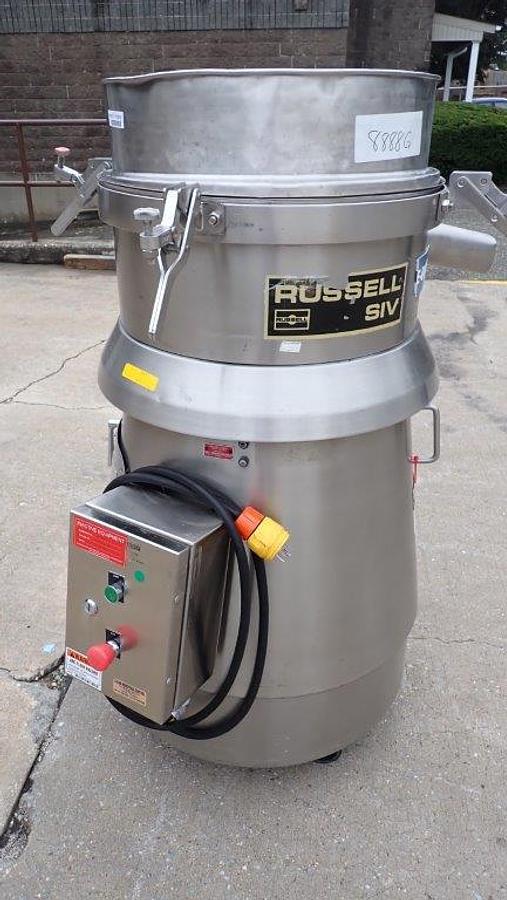
Category
Manufacturer
Model
Russell Finex
Russell Finex is a leader in separation and filtration technology, serving industries such as food, pharmaceuticals, and chemicals. Their equipment is designed to ensure product quality and compliance with industry standards.
FAQ:
What types of Russell Finex equipment are commonly available on the used market?
Russell Finex produces a fairly broad range of separation and filtration machinery, and several of their most popular models surface regularly on the used equipment market. Common finds include the Russell Compact Sieve, the Vibro Energy Round Separator, the Finex Separator, the Russell Liquid Solid Separator, and self-cleaning inline sieves. Each of these machines targets a slightly different application, from high-throughput dry powder screening to liquid filtration in hygienic processing environments. The Vortisiv is another model that appears in used inventories, particularly in stainless steel configurations suited for food and pharmaceutical work.
Buyers shopping for used Russell Finex equipment should pay close attention to the specific model and any listed specifications, since throughput capacity, screen mesh size compatibility, and material construction can vary significantly between units. Stainless steel construction is common across many Russell Finex models and is a key selling point for regulated industries. Checking with a dealer who specializes in separation and filtration equipment is the most reliable way to find a machine that matches your production requirements.
What industries use Russell Finex sieving and filtration equipment?
Russell Finex equipment has a wide footprint across process industries. Food processing is one of the largest application areas, where the machines are used to remove foreign material, grade particle sizes, and ensure product consistency in powders, granules, and slurries. Pharmaceutical manufacturers rely on Russell Finex sieves for GMP-compliant screening of active ingredients and excipients, where hygienic design and the ability to validate cleaning procedures are critical requirements. Chemical, coatings, ceramics, and plastics producers also use this equipment extensively for quality control and particle classification.
Metal powder processing is a growing application, particularly with the rise of additive manufacturing, where tight particle size distribution directly affects print quality. Buyers sourcing used Russell Finex machinery for any of these industries should confirm that the specific model they are considering is appropriate for their material type, whether wet or dry, abrasive or sensitive, and that the construction materials are compatible with their process chemistry. Consulting the manufacturer's documentation for a given model can help clarify suitability before purchase.
Is used Russell Finex equipment reliable, and what should buyers look for when purchasing?
Russell Finex has built a reputation over more than 85 years for manufacturing durable, well-engineered separation equipment, and many of their machines have long service lives when maintained properly. Used units can represent solid value, particularly for buyers who need proven separation technology without the lead time or cost associated with sourcing a machine through other channels. That said, reliability in a used machine depends heavily on how it was operated and maintained by the previous owner, so due diligence is essential.
Buyers should request an inspection before committing to a purchase. Reputable used equipment dealers will typically accommodate in-person visits, video walkthroughs, or recorded video inspections of the machine. Key things to examine include the condition of the screen deck and frame, the drive motor, any seals or gaskets, and the overall structural integrity of the unit. Because used equipment is sold as-is, selecting a dealer with a long track record in the separation and filtration category matters. It is also worth contacting Russell Finex directly to understand parts availability and technical support for the specific model and age of machine you are considering, since older models may have limited support infrastructure.
What is the difference between the Russell Compact Sieve and the Vibro Energy Round Separator?
Both machines are vibratory sieves designed for particle separation, but they serve somewhat different production scales and application profiles. The Russell Compact Sieve is designed with a smaller footprint and is often favored in pharmaceutical and specialty food applications where space is limited and hygienic access for cleaning is a priority. Its tool-free disassembly is a standout feature, allowing operators to break the machine down quickly for inspection or cleaning without specialized tools, which is a significant advantage in GMP environments.
The Vibro Energy Round Separator is a more traditional round vibratory screener suited for higher-volume applications across a wider range of industries, including chemicals, plastics, and coatings. It can typically accommodate multiple deck configurations for simultaneous multi-fraction separation, making it more versatile for operations that need to classify material into several size ranges in a single pass. On the used market, both models appear with some regularity, and the right choice depends on throughput requirements, the nature of the material being processed, and the space available in the production facility.
Can Russell Finex equipment handle both wet and dry materials?
Yes, Russell Finex designs equipment for both wet and dry processing applications, though the specific model matters considerably. Dry screening applications include powders, granules, and pellets across food, pharmaceutical, and chemical industries. Wet applications include liquid filtration, slurry screening, and the separation of solids from liquids, which is where models like the Russell Liquid Solid Separator and self-cleaning inline sieves are particularly relevant. The Vortisiv, for example, is commonly used in liquid processing lines to filter fine particles from viscous or free-flowing liquids.
When evaluating a used Russell Finex machine for wet applications, buyers should pay close attention to the condition of seals, gaskets, and any internal surfaces that contact liquid. Corrosion, wear on sealing surfaces, and screen frame integrity are all worth examining carefully. Stainless steel construction, which is standard on many Russell Finex models, provides good resistance to moisture and cleaning agents, but the history of the machine and the types of materials it previously processed can affect its suitability for a new application. An inspection, whether in person or via video, is particularly important for wet-duty machines.
How do I determine the right Russell Finex model for my application?
Selecting the right model starts with clearly defining the process requirements: what material is being screened or filtered, what particle size separation is needed, what throughput volume is required, and whether the application is wet or dry. Russell Finex offers models ranging from compact pharmaceutical-grade sieves to larger industrial separators, and each is engineered around different capacity and precision parameters. Reviewing the manufacturer's published specifications for each model line is a useful starting point, as these documents outline the intended applications, available screen mesh sizes, and construction options.
For used equipment specifically, the search is often constrained by what is available in the market at a given time, so buyers sometimes need to evaluate whether a specific used unit meets their needs rather than selecting from a full product catalog. Working with a dealer who understands the separation equipment category can help match available inventory to process requirements. If there is uncertainty about whether a particular model will perform adequately, reaching out to Russell Finex technical support with the machine's model number and age can provide useful guidance on its intended application range and any known limitations.
Are spare parts and replacement screens available for used Russell Finex machines?
Parts availability for Russell Finex equipment varies depending on the model and its age. Russell Finex, as a manufacturer with a long operating history, maintains support for many of their product lines, but older or discontinued models may have limited availability for certain components. Replacement screens, gaskets, and drive components are among the most commonly needed parts for vibratory sieving equipment, and buyers should investigate availability for their specific model before finalizing a purchase.
The best approach is to contact Russell Finex directly with the model number and serial number of the machine to get a clear picture of what parts are stocked or can be sourced. Some third-party suppliers also produce compatible screens and wear parts for widely used separation equipment models, which can be an alternative source. Buyers should factor parts availability into their total cost of ownership calculation, since a machine that is difficult to source screens or seals for may result in higher downtime costs over time, even if the initial purchase price is attractive.
What should buyers expect when inspecting used Russell Finex equipment before purchase?
Inspections of used separation equipment typically fall into three categories: in-person visits, live video walkthroughs conducted remotely, or recorded video reviews of the machine. Each approach has its place depending on the buyer's location and the dealer's setup. In-person inspections allow for the most thorough evaluation, including checking motor condition, screen frame alignment, seal integrity, and the overall cleanliness and corrosion status of the unit. Some machines may still be installed and operating at a production facility, which can allow a buyer to observe the equipment running, though dealers generally cannot run actual product through a machine since production operations require separate permitting.
For Russell Finex sieving equipment specifically, key inspection points include the condition of the screen mesh and frame, the vibration motor and its mounts, any rubber or silicone seals, and the structural integrity of the body and discharge points. On stainless steel units, look for signs of pitting, discoloration from harsh chemicals, or weld repairs that might indicate prior damage. Buyers should ask the dealer for any available maintenance records or history on the machine. Selecting a dealer with specific experience in filtration and separation equipment means they are more likely to have assessed the machine accurately and can answer technical questions about its condition.
What is the typical price range for used Russell Finex sieving and filtration equipment?
Pricing for used Russell Finex equipment varies considerably based on the model, size, age, and condition of the machine. Smaller units like compact pharmaceutical sieves or inline filters generally trade at lower price points than larger industrial round separators or multi-deck configurations. The construction material also plays a role, with stainless steel units typically commanding higher prices than carbon steel equivalents due to their broader application compatibility and longer service life in corrosive or hygienic environments.
Because used equipment pricing reflects market supply and demand at any given time, it is difficult to cite a fixed range that stays current. Buyers are best served by comparing available inventory across reputable dealers who specialize in separation and filtration equipment, rather than relying on list prices from other sources. Beyond the machine price itself, buyers should account for the full landed cost, which includes any required inspection, packaging, rigging for loading and unloading, freight charges, and any reconditioning work needed before the machine goes into service. Getting a clear picture of all these costs upfront avoids surprises after the purchase.
What are the typical payment and shipping terms for purchasing used Russell Finex equipment?
Most used equipment dealers require payment in full before a machine is released for shipping. Some dealers extend payment terms to established repeat customers, but this is not the norm for first-time buyers. Buyers should clarify payment expectations with the dealer early in the process to avoid delays once a purchase decision is made.
Shipping costs for Russell Finex equipment depend on the size and weight of the machine, the origin and destination, and the level of packaging or crating required to protect the unit in transit. Smaller sieve units may ship on a standard pallet, while larger separators or multi-component machines may require custom crating or specialized rigging for safe loading and unloading. Heavy or oversized machines may also require freight services with liftgate or dock capabilities at the delivery location. Buyers should ask the dealer for a detailed breakdown of packaging, rigging, and freight costs so that the full landed cost of the equipment is understood before the purchase is finalized.