Category
Manufacturer
Model
Rotap
Rotap provides innovative solutions for the packaging and processing industries, focusing on automated systems that improve efficiency. Their equipment is widely used in food packaging for its reliability and speed.
FAQ:
What is a Ro-Tap sieve shaker and how does it work?
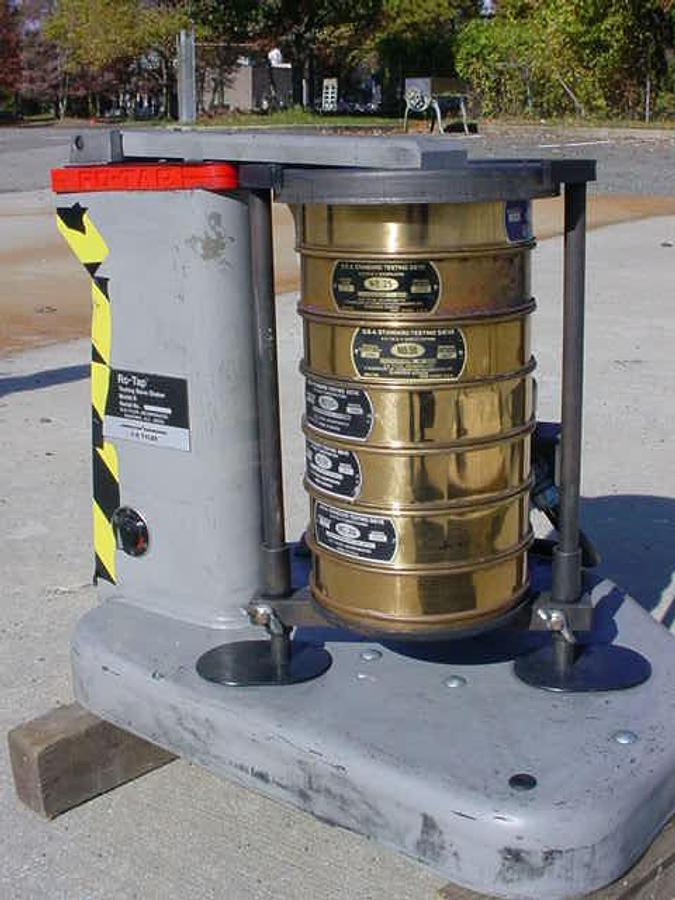
A Ro-Tap sieve shaker is a mechanical particle size analysis instrument that has been a laboratory standard for over 100 years. It works by combining two distinct motions simultaneously: a circular rotation and a vertical tapping action. Together, these two movements closely replicate the motion of hand-sieving, which makes the Ro-Tap highly effective at separating dry materials into distinct particle size fractions. The circular motion moves particles across the sieve surface, while the tapping action helps dislodge particles that might otherwise bridge or clog the sieve openings.
The machine holds a stack of wire mesh test sieves arranged from coarsest to finest, with a collection pan at the bottom. A timed sample run, typically 10 minutes, allows material to work its way down through each sieve layer. At the end of the run, the retained material on each sieve is weighed to produce a particle size distribution. This method is recognized across industries as one of the most repeatable and reliable approaches to particle sizing, and it forms the basis of standardized test procedures used in laboratories worldwide.
What is the difference between the Ro-Tap RX-29 and RX-30 models?
The RX-29 and RX-30 are the two most commonly referenced Ro-Tap sieve shaker models, and the core difference between them comes down to whether a tapping mechanism is included. The RX-29 uses both the circular rotation and the vertical tapping action, which is the classic dual-motion design that has defined Ro-Tap shakers for decades. This model is well suited for most standard dry materials including soils, aggregates, grains, powders, and mineral samples where the tapping action improves sieving efficiency without causing any harm to the material or the sieves.
The RX-30, by contrast, is a tap-free model that relies solely on the circular rotational motion. This design was developed for applications involving fragile or delicate materials where the tapping action could cause particle breakage or deformation, which would compromise the accuracy of the particle size analysis. The RX-30 is also preferred in situations where noise is a concern, since the tapping mechanism is the primary source of the sound associated with traditional Ro-Tap operation. Buyers evaluating used Ro-Tap equipment should confirm which model they are purchasing, as the intended application will determine which design is the right fit.
What sizes of sieves are compatible with a Ro-Tap sieve shaker?
Ro-Tap sieve shakers are designed to accommodate standard test sieve diameters, with the two most common sizes being 8-inch (203mm) and 12-inch (305mm). The 8-inch configuration is the most widely used in laboratory settings and is the size featured on many used Ro-Tap units available on the market, including the 8-inch model with a 7-tray capacity. The 12-inch configuration is used when larger sample sizes are needed or when working with coarser materials that benefit from a greater sieve surface area.
Compatibility between the shaker frame and the sieves is important to verify before purchasing, particularly when buying used equipment. Test sieves must match the diameter that the specific machine is built to accept, and they must also meet the applicable ASTM E11 or ISO 3310-1 specifications to produce results that are defensible under industry standards. Sieve frames are typically made from stainless steel or brass, and the wire mesh is available in a wide range of opening sizes to cover everything from coarse aggregate gradation testing down to fine powder analysis. When sourcing a used Ro-Tap, buyers should clarify whether sieves are included with the machine or sold separately.
How many sieves can a Ro-Tap sieve shaker stack at one time?
The stacking capacity of a Ro-Tap sieve shaker varies by model and configuration, but most standard units accommodate between 6 and 18 sieves in a single stack. The 8-inch Ro-Tap models commonly found in laboratory settings typically hold around 7 sieves plus a collection pan, which is sufficient for most particle size distribution tests. Larger or more specialized configurations can hold more sieves, which is useful when a finer resolution of size fractions is required across a wide particle size range.
The number of sieves that can be stacked has a practical impact on test resolution. More sieves in the stack means more size intervals captured in a single run, giving a more detailed picture of the particle distribution. However, stacking too many sieves can reduce sieving efficiency if the stack height interferes with the machine's clamping mechanism or if the weight of the stack affects the tapping motion. When evaluating a used Ro-Tap, it is worth confirming the maximum sieve capacity for that specific model and checking whether the clamping ring and cover are included, as these components are necessary for proper operation.
What industries use a Ro-Tap sieve shaker?
Ro-Tap sieve shakers are used across a broad range of industries where particle size analysis is a routine part of quality control or research. Mining and aggregate operations rely on them to grade crushed stone, sand, and gravel according to specification. Agricultural laboratories use them to analyze grain size and seed quality. The pharmaceutical industry uses sieve shakers to verify that powdered active ingredients and excipients fall within specified particle size ranges, which directly affects dosage consistency and dissolution rates. Construction materials testing, including soil classification and asphalt mix design, also depends heavily on sieve analysis.
Beyond these core sectors, Ro-Tap shakers appear in food processing facilities for analyzing flour, sugar, and other dry ingredients, as well as in chemical manufacturing for quality control of powders and granules. Environmental laboratories use them for soil and sediment analysis. The machine's longevity as an industry standard is largely due to its ability to produce repeatable results that comply with ASTM E11 and ISO 3310-1 testing standards, which are recognized by regulatory bodies and industry organizations across all of these sectors. Buying a used Ro-Tap is a practical option for many of these applications, since the machines are built to last and used units can deliver the same analytical performance as newer ones when properly maintained.
What certifications or standards does a Ro-Tap sieve shaker meet?
Ro-Tap sieve shakers are designed to comply with ASTM E11 and ISO 3310-1, which are the primary international standards governing test sieve specifications and sieve analysis procedures. ASTM E11 is the standard used predominantly in the United States and covers wire cloth test sieves used for testing and measurement purposes. ISO 3310-1 is the international equivalent and is widely referenced in European and global laboratory contexts. Compliance with these standards is essential for laboratories that need their test results to be accepted by clients, regulators, or certification bodies.
For buyers in regulated industries such as pharmaceuticals, food processing, or construction materials testing, verifying that a used Ro-Tap was manufactured to meet these standards is an important step in the purchasing process. The machine itself sets the motion parameters, but the sieves used in conjunction with it must also carry certification to the relevant standard. When purchasing a used unit, buyers should ask the seller about the model's original design specifications and consult the manufacturer to confirm whether that specific model and age of machine aligns with current testing standard requirements. Older machines may still perform within specification, but it is worth confirming before committing the equipment to a certified testing program.
How loud is a Ro-Tap sieve shaker during operation?
Ro-Tap sieve shakers with a tapping mechanism, such as the RX-29, are known for producing a distinctive and fairly loud noise during operation. The tapping action, which involves a hammer striking the sieve stack at a set rate, generates a repetitive impact sound that can be disruptive in open laboratory environments. Sound levels during operation can reach levels that prompt labs to position the machine in a separate room or enclosure, particularly in facilities where multiple people are working in close proximity.
For labs where noise is a concern, the tap-free RX-30 model is a quieter alternative, since it eliminates the tapping mechanism entirely and relies only on the circular rotation. Some labs also use sound-dampening enclosures designed to fit around the shaker during operation. When evaluating a used Ro-Tap, it is worth considering the layout of the facility where the machine will be used and whether noise mitigation measures will be needed. This is a practical operational factor that does not affect the machine's analytical performance but can have a real impact on day-to-day lab workflow.
What should buyers look for when inspecting a used Ro-Tap sieve shaker?
Inspecting a used Ro-Tap sieve shaker requires attention to both mechanical condition and completeness of components. The motor should run smoothly without unusual vibration or noise beyond what is normal for the model. The tapping mechanism, if present, should engage consistently and at the correct rate. The drive components, including the eccentric cam and connecting rod that generate the circular motion, should show no signs of excessive wear or play. The clamping ring and cover, which secure the sieve stack during operation, should be present and functional, as these are necessary for the machine to operate correctly and are sometimes missing on used units.
Buyers should also check the condition of the sieve trays if they are included with the machine. Wire mesh should be intact with no broken wires or distorted openings, as damaged sieves will produce inaccurate results. Reputable used equipment dealers will typically accommodate in-person or video inspections so buyers can assess the machine's condition before committing to a purchase. Keep in mind that most dealers do not have the permitting or production setup to run actual material through the machine during an inspection, so the assessment will focus on mechanical operation and visual condition. Consulting the manufacturer about parts availability for the specific model and age of the unit is also a smart step, as it affects long-term serviceability.
What are the typical shipping and logistics considerations when buying a used Ro-Tap sieve shaker?
Ro-Tap sieve shakers are relatively compact laboratory instruments compared to large industrial machinery, but they still require careful packaging to prevent damage during transit. The machine should be secured to a pallet and crated or boxed appropriately to protect the motor, drive mechanism, and any included components such as sieve trays or the clamping ring. Shipping costs will vary depending on the level of packaging required, the origin and destination, and the carrier used. Buyers should ask the seller for a detailed breakdown of packaging and freight costs to understand the full landed cost before finalizing a purchase.
For larger or heavier configurations, or in cases where the machine is being moved from an active production facility, additional rigging may be required for loading, which adds to the total cost. Most used equipment dealers require full payment prior to shipping. Buyers who have an established relationship with a dealer may be able to negotiate payment terms, but this is not standard practice for first-time transactions. Before the machine ships, buyers should confirm whether the dealer has tested the unit for basic mechanical function and what documentation, such as photos or video of the machine running, will be provided as part of the sale process.
Is buying a used Ro-Tap sieve shaker a practical choice compared to buying a new unit?
For many laboratories and testing facilities, a used Ro-Tap sieve shaker is a highly practical option. These machines are built with straightforward mechanical designs that have remained largely unchanged for decades, which means a well-maintained used unit can deliver the same analytical performance as a recently manufactured one. The core components, including the motor, eccentric drive, and tapping mechanism, are not complex electronics-dependent systems, so they tend to hold up well over time with basic maintenance. Purchasing a used unit can represent significant cost savings compared to buying from a manufacturer, which makes it an attractive option for labs operating on tighter budgets or for facilities that need a secondary unit.
The key considerations when buying used are the condition of the machine, the availability of replacement parts for that specific model, and the reputation of the seller. Buyers should select dealers who specialize in laboratory or industrial equipment and have a documented history of selling this type of machinery. It is also worth contacting the manufacturer directly to ask about parts and service support for the model in question, since older or discontinued models may have limited parts availability. A thorough inspection, either in person or via video, should always be part of the process before committing to a purchase. Used equipment is typically sold as-is, so the burden of verifying condition falls on the buyer, making the inspection step especially important.