Category
Manufacturer
Model
FAQ:
What is a Romaco Unipac machine and what is it used for?
Romaco Unipac machines are tube filling and sealing systems designed for high-precision packaging across pharmaceutical, cosmetic, and personal care industries. The brand has built a strong reputation over decades for producing reliable, well-engineered equipment that handles everything from medicated creams and ointments to toothpaste, lotions, and food-grade products. The machines automate the process of filling a measured dose of product into a tube and then sealing the open end, either through heat sealing for plastic and laminate tubes or through mechanical folding for aluminum tubes.
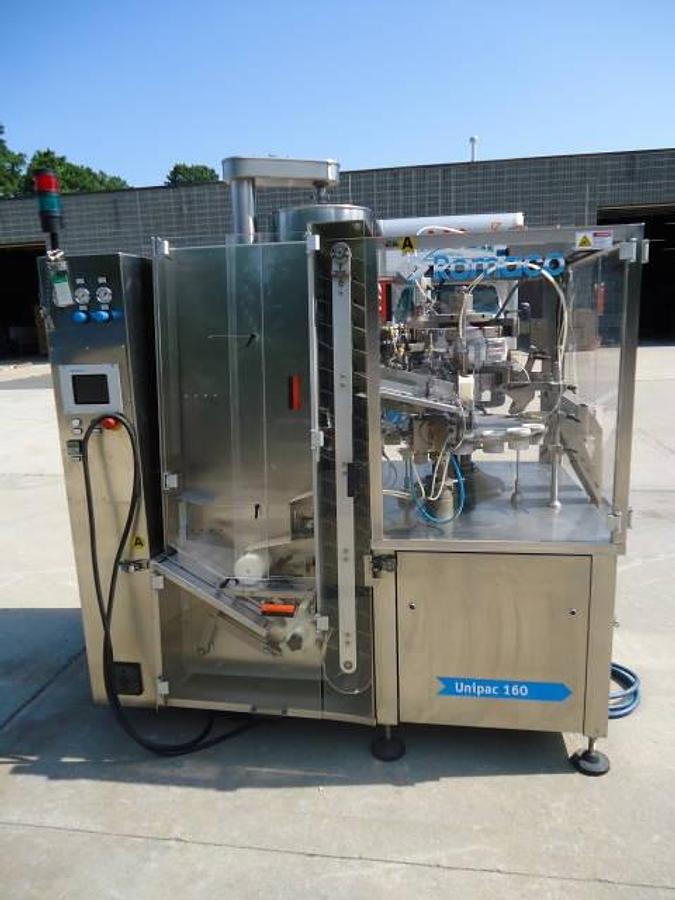
The Unipac line covers a broad range of production scales. Entry-level semi-automatic models are well suited to smaller manufacturers or contract packagers running lower volumes, while fully automatic systems handle high-speed production environments. Specific models like the Unipac 160 are capable of processing up to 100 tubes per minute using hot air sealing technology, making them a practical choice for mid-to-large scale operations. Because of their build quality and longevity, used Romaco Unipac machines retain strong resale value and remain in active production at facilities around the world long after their initial installation.
What production speeds do Romaco Unipac machines typically achieve?
Production output varies significantly across the Unipac model range, which is one reason buyers need to match the specific machine to their throughput requirements. Semi-automatic models typically process somewhere in the range of 25 to 40 tubes per minute, which is appropriate for smaller batches or facilities that require frequent product changeovers. Fully automatic models step that up considerably, with mid-range machines running at 60 to 100 tubes per minute and higher-end configurations exceeding 150 tubes per minute under optimal conditions.
The Unipac 160, for example, is a hot air plastic tube filling and sealing machine rated at 100 tubes per minute. The numbering convention in many Unipac models loosely corresponds to output capacity, so the 100, 300, 500, and 700 series each represent different tiers of speed and automation. When evaluating a used Unipac machine, buyers should keep in mind that actual throughput on a pre-owned unit may depend on its mechanical condition, the tube format being run, and whether any components have been serviced or replaced. A thorough inspection before purchase is the best way to assess real-world performance.
What tube materials and formats are compatible with Romaco Unipac equipment?
Romaco Unipac machines are designed to handle multiple tube substrate types, which is part of what makes them versatile across different industries. Plastic tubes, including polyethylene and polypropylene variants, are among the most common formats processed on Unipac hot air sealing machines, where heat is applied to fuse the open end of the tube after filling. Laminate tubes, which combine layers of plastic and aluminum foil for barrier protection, are also widely run on Unipac equipment and are common in pharmaceutical and premium cosmetic applications. Aluminum tube models use a different sealing mechanism, typically a mechanical fold or crimp rather than heat.
Tube diameter and length compatibility depends on the specific machine model and the tooling installed. Most Unipac systems accommodate a range of tube diameters, commonly from around 13mm up to 50mm or more, and can handle tube lengths from roughly 50mm to 200mm depending on the configuration. Changeover between tube formats generally requires a tooling change and machine adjustment, which is a standard part of operating this type of equipment. Buyers sourcing a used Unipac machine should confirm which tooling is included with the sale, since format-specific parts can represent a meaningful portion of the overall investment.
Do Romaco Unipac machines meet GMP, FDA, or CE regulatory standards?
GMP compliance and CE certification are standard features on most modern Romaco Unipac models, which makes them a practical choice for pharmaceutical manufacturers who operate under strict regulatory oversight. GMP-compliant design typically means the machine uses product-contact materials that meet food and pharmaceutical grade standards, has surfaces that are easy to clean and sanitize, and is built to minimize contamination risk during filling and sealing operations. CE marking indicates compliance with European health, safety, and environmental directives, which is a baseline requirement for equipment sold into European markets.
For buyers in the United States, FDA compliance expectations are generally met through adherence to current Good Manufacturing Practices (cGMP) rather than a specific machine certification. The Unipac platform's design characteristics, including enclosed filling zones, stainless steel contact parts, and precise dosing mechanisms, align well with cGMP requirements for pharmaceutical and OTC product manufacturing. When purchasing a used Romaco Unipac machine, buyers should verify the model year and specific configuration, since regulatory standards have evolved over time and older machines may require modifications or documentation reviews before being validated for use in a regulated production environment. Consulting with the manufacturer directly is advisable to understand what level of technical support and documentation is available for a given model.
What should buyers look for when inspecting a used Romaco Unipac machine?
Inspecting a used tube filling and sealing machine requires attention to both mechanical condition and the completeness of the machine as configured. Key areas to examine include the filling system (whether it uses piston, peristaltic, or auger filling), the sealing station, the tube feeding and orientation components, and the overall condition of product-contact surfaces. Wear on the sealing jaws or hot air nozzles, for instance, can directly affect seal quality and may require replacement before the machine is put back into production. Drive components, timing belts, and pneumatic systems should also be checked for signs of wear or leakage.
Reputable used equipment dealers will typically accommodate in-person inspections, video walkthroughs, or recorded video captures of the machine so buyers can assess condition before committing to a purchase. Some machines may still be installed at an active production facility, which can allow for observation of the equipment running, though most dealers do not have the permits or infrastructure to run actual product through a machine at their own location. Buyers should also verify what tooling, spare parts, and documentation come with the machine, since manuals, validation records, and format-specific change parts add real value. Consulting with Romaco directly about parts availability and support for the specific model and serial number is a worthwhile step before finalizing any purchase.
Are spare parts and technical support available for used Romaco Unipac machines?
Parts availability for Romaco Unipac equipment varies depending on the age and model of the machine. Romaco, as an active manufacturer, maintains support for many of its product lines, but the level of support available for older or discontinued models can be more limited. Buyers considering a used Unipac machine are strongly encouraged to contact Romaco directly before purchasing to ask specifically about parts availability, service documentation, and whether factory technical support is offered for the model in question. This conversation can reveal whether critical wear components like sealing jaws, filling pistons, or electronic control parts are still stocked or need to be sourced through third-party suppliers.
Beyond the manufacturer, a healthy aftermarket exists for many Unipac components, and experienced packaging equipment technicians familiar with the Unipac platform can often service and repair machines using a combination of Romaco parts and compatible alternatives. The machine's build quality and mechanical simplicity in many of its models contributes to their longevity and makes them relatively serviceable compared to some competing platforms. When purchasing from a used equipment dealer, it is worth asking whether any parts are included with the sale and whether the dealer has a history of selling Unipac equipment specifically, since familiarity with the product line can be a meaningful advantage when questions arise post-purchase.
What industries commonly use Romaco Unipac tube filling and sealing machines?
The pharmaceutical industry is the most prominent user of Romaco Unipac equipment, particularly for filling topical products like creams, ointments, gels, and pastes into tubes for retail and clinical distribution. The machines' GMP-compatible design and precision dosing make them well suited to regulated manufacturing environments where fill accuracy and contamination control are non-negotiable. Ophthalmic ointments, dermatological treatments, and over-the-counter topical medications are all common products filled on Unipac systems.
Beyond pharmaceuticals, the cosmetic and personal care sector is a major market for Unipac equipment. Products like face creams, hand lotions, sunscreen, hair treatments, and lip balms are routinely filled on these machines. The food industry also uses tube filling equipment for products like condiments, tomato paste, and specialty spreads, and Unipac systems configured with food-grade materials can serve this segment as well. Contract manufacturers and private label packagers often find the Unipac platform attractive because the same machine can be adapted across product types with tooling changes, making it a flexible asset across multiple customer accounts.
How does buying a used Romaco Unipac machine compare to purchasing new equipment?
Purchasing a used Romaco Unipac machine can represent a significant cost advantage over buying new packaging equipment, often at a fraction of the price of a comparable new system. For manufacturers operating under tight capital budgets, or for businesses scaling up production capacity without committing to full new-equipment pricing, the used market offers access to a proven, well-regarded platform that has demonstrated reliability in real production environments. The Unipac line's reputation for durability means that well-maintained machines can continue performing at a high level for many years after their initial installation.
The trade-off is that used equipment is sold as-is, without the assurances that come with purchasing directly from a manufacturer. Buyers take on the responsibility of thoroughly inspecting the machine before purchase, understanding its service history where possible, and budgeting for any reconditioning or parts replacement needed to bring it to their production standards. Unlike buying from a manufacturer, used equipment transactions typically do not include warranty coverage, which is why selecting a reputable dealer with deep experience in pharmaceutical and packaging machinery is so important. A dealer who specializes in this equipment category, has a verifiable track record, and supports pre-purchase inspections provides meaningful risk mitigation in a market where the buyer bears the burden of due diligence.
What are the typical shipping and logistics considerations for a Romaco Unipac machine?
Romaco Unipac machines, depending on the model and configuration, can range from moderately sized semi-automatic units to larger fully automatic systems that require substantial rigging and freight handling. Proper packaging for transit is critical. Machines should be securely palletized or crated to protect mechanical components, sensitive electronics, and precision tooling from damage during loading, transport, and unloading. The level of crating required, and therefore the packaging cost, will vary based on the machine's size, weight, and the distance it needs to travel.
Buyers should ask the selling dealer for a detailed breakdown of packaging, rigging, and freight costs before finalizing a purchase, since these can add meaningfully to the total landed cost of the equipment. Larger machines may require a forklift or crane for loading and unloading, and if the buyer's facility is not equipped for that, arranging third-party rigging services will be an additional expense. International shipments involve customs documentation, import duties, and potentially longer transit times, all of which should be factored into the acquisition timeline. Getting a clear picture of the full delivered cost, not just the machine price, is an important part of evaluating whether a specific used Unipac machine makes financial sense for a given application.
What payment terms are typical when purchasing a used Romaco Unipac machine from a dealer?
Used equipment dealers in the packaging machinery space generally require full payment before a machine is released for shipment. This is standard practice in the industry and reflects the nature of used equipment transactions, where the dealer needs to confirm funds before arranging logistics and transferring ownership. Buyers who are working with a dealer for the first time should expect to pay in full upfront, and should factor this into their procurement planning and cash flow timelines.
Some dealers extend payment terms to repeat customers or buyers with an established relationship, but this is at the dealer's discretion and not something a first-time buyer should count on. Wire transfer is the most common payment method for transactions of this size, though some dealers accept other forms of business payment depending on the transaction amount. Buyers using financing should arrange that independently before committing to a purchase, since most used equipment dealers do not act as lenders. Clarifying payment expectations early in the conversation with a dealer avoids surprises and helps move the transaction forward efficiently once an inspection is complete and a purchase decision is made.