Category
Manufacturer
Model
Rjm
Rjm provides specialized machinery for the packaging and processing of food products, focusing on solutions that enhance productivity and reduce waste. Their equipment is widely used in the snack food industry for its reliability and performance.
FAQ:
What types of liquids can RJM liquid filling machines handle?
RJM liquid filling machines are designed to handle a range of liquid products, with pressure gravity nozzle systems being particularly well-suited for free-flowing liquids. These include water-thin beverages, oils, sauces, dressings, and similar products that move readily through nozzle-based filling systems without requiring additional pumping pressure. The straight-line configuration common in RJM equipment makes it a practical choice for production lines processing consistent liquid viscosities at repeatable volumes.
For thicker products like gels, creams, or heavy syrups, buyers should carefully review the specific machine's nozzle type and filling mechanism before purchasing. Pressure gravity systems work best when the liquid flows predictably under its own weight assisted by mild pressure, so very viscous materials may require a different filling technology. When buying a used RJM machine, it is worth asking the dealer for details on what products the machine was previously running, since that production history gives a realistic picture of what the equipment can handle day to day.
What is the filling speed or output capacity of RJM liquid filling machines?
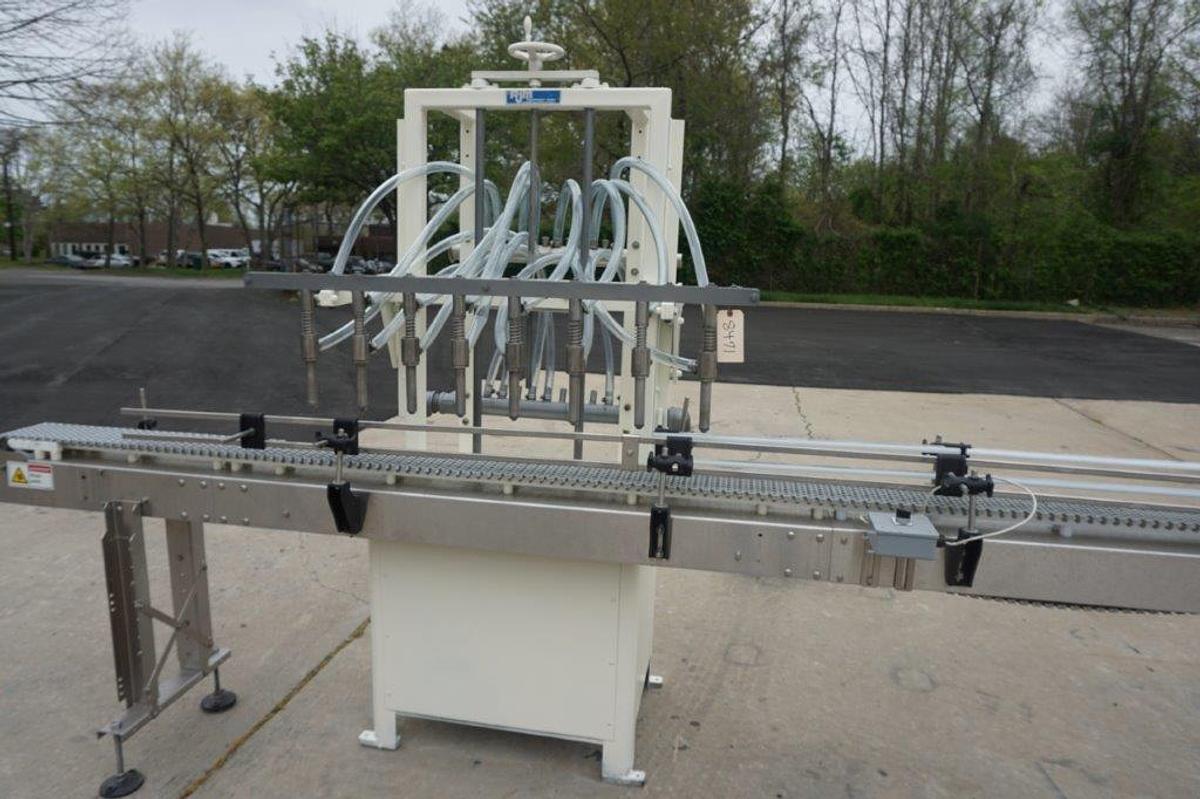
Output capacity on an RJM liquid filling machine depends heavily on the number of fill heads, the volume per fill cycle, and the viscosity of the product being run. An 8-spout straight-line machine like the RJM unit commonly found on the used equipment market can fill multiple containers simultaneously per cycle, which meaningfully increases throughput compared to single-head alternatives. Typical straight-line fillers in this class can process anywhere from several hundred to over a thousand containers per hour depending on fill volume and line speed.
Buyers evaluating a specific used RJM machine should ask the dealer about the machine's rated speed and, where possible, request video footage of the equipment running. Keep in mind that actual production speed can vary based on the age of the machine, the condition of its components, and how well it has been maintained. Reviewing the machine's fill head count alongside its rated cycle time gives the clearest picture of realistic output capacity for a given application.
What bottle or container sizes are compatible with RJM filling machines?
RJM straight-line liquid filling machines are generally built to accommodate a range of container sizes, with adjustability in nozzle spacing and fill volume being key factors that determine compatibility. Straight-line fillers are popular in food and beverage production partly because they can often be adjusted to handle different bottle heights, diameters, and fill volumes without requiring a complete changeover of parts. The specific range of compatible containers depends on the model and how it was originally configured for production.
When purchasing a used RJM filling machine, buyers should confirm with the dealer what container sizes the machine was set up to run and whether change parts for other sizes are included in the sale. Some used machines come configured for a single container type, while others may include tooling for multiple formats. Clarifying this before purchase helps avoid unexpected costs for additional change parts or modifications after the machine arrives.
Are RJM liquid filling machines suitable for small businesses or startups?
Used RJM liquid filling machines can be a cost-effective entry point for small food or beverage producers who need more throughput than hand-filling allows but are not yet ready to invest in a fully automated high-speed line. Multi-spout straight-line fillers, even at lower speeds, dramatically reduce the labor required to fill and cap containers compared to manual methods. Buying used rather than purchasing new equipment lowers the capital outlay significantly, which makes the math work better for operations with tighter budgets.
That said, small businesses should go in with realistic expectations about used equipment. Machines sold through reputable used equipment dealers are typically sold as-is, so a thorough inspection before purchase is essential. Arranging an in-person or video inspection to assess the machine's condition, confirm it powers on, and verify that all fill heads are functioning is strongly recommended. Startups should also factor in any refurbishment or parts costs that may be needed to bring the machine up to their production standards before committing to a purchase price.
How accurate are liquid filling machines with pressure gravity nozzle systems?
Pressure gravity filling is one of the more reliable methods for achieving consistent fill volumes with free-flowing liquids. In well-maintained machines, fill accuracy tolerances typically fall in the range of plus or minus 0.5 to 1 percent, which is acceptable for most food and beverage applications. This level of consistency is achieved through the combination of controlled pressure, gravity-assisted flow, and timed or volume-controlled nozzle cycles that repeat at the same parameters for each container.
On used equipment, fill accuracy can be affected by wear on nozzle seals, valve components, or timing mechanisms. Before purchasing a used pressure gravity filler, buyers should ask whether the machine has been tested and what fill tolerances were observed during testing. Keep in mind that most used equipment dealers do not have the permitting or facilities to run actual product through a machine, so accuracy verification may need to happen after delivery during the buyer's own commissioning process. Factoring in time for calibration and adjustment after installation is a practical step for any used filling machine purchase.
What materials are RJM liquid filling machines typically constructed from?
Liquid filling machines intended for food, beverage, or pharmaceutical applications are typically built with product-contact surfaces made from stainless steel, most commonly 304 or 316 grade. Stainless steel construction is important because it resists corrosion, does not react with most liquid products, and can withstand the cleaning and sanitation processes required in regulated production environments. The frame and structural components of straight-line fillers are also commonly stainless or coated carbon steel to handle the rigors of continuous production.
When evaluating a used RJM filling machine, inspecting the condition of the stainless steel surfaces, nozzles, and fill heads is an important part of the assessment. Surface pitting, corrosion, or damage to product-contact parts can affect both sanitation and fill performance. Buyers should request photos or video of these areas as part of the inspection process, and factor in any reconditioning costs if components show significant wear. Confirming the material grade of product-contact parts is especially important for buyers in food or pharma environments where regulatory compliance depends on it.
What should buyers look for when inspecting a used RJM liquid filling machine before purchase?
A thorough pre-purchase inspection of a used RJM filling machine should cover both the mechanical and electrical systems. On the mechanical side, key areas include the condition of fill nozzles and valve seals, the integrity of product-contact stainless steel surfaces, the smoothness of conveyor movement, and whether all fill heads cycle consistently. On the electrical side, buyers should confirm the machine powers on, that controls respond correctly, and that any sensors or timers are functioning as expected. Asking the dealer to demonstrate the machine running through a fill cycle, even with water, can reveal a great deal about its current working order.
Reputable used equipment dealers will typically accommodate in-person inspections at their facility, or provide detailed video walkthroughs if travel is not practical. In some cases, the machine may still be installed at a production facility, where an inspection can be arranged with the facility owner. Buyers should also contact the manufacturer directly to understand what parts and technical support are available for the specific model and age of machine they are considering, since older models may have limited parts availability. Going into a purchase with a clear picture of the machine's condition and the support ecosystem around it makes for a much smoother transaction.
What industries commonly use RJM straight-line liquid filling machines?
Straight-line liquid filling machines from manufacturers like RJM are used across a broad range of industries where consistent, repeatable liquid fills are needed at production scale. Food and beverage is the largest segment, covering products like sauces, dressings, oils, juices, and condiments. Personal care and cosmetics manufacturers use similar equipment for lotions, shampoos, and liquid soaps, while chemical producers rely on straight-line fillers for cleaning products, lubricants, and similar liquids. The snack food and specialty food sector also makes use of this type of equipment for liquid seasoning or sauce applications.
The common thread across these industries is the need for fill accuracy, sanitary construction, and the ability to run continuously at production speeds that manual filling cannot match. RJM equipment, based on available used inventory, appears to have a particular history in food production environments, which makes used units attractive to buyers in that sector. Buyers from regulated industries like pharmaceuticals should verify that any used machine meets the sanitary design standards required for their specific application before purchasing.
What is the typical price range for used liquid filling machines?
Used liquid filling machines span a wide price range depending on the number of fill heads, level of automation, age, condition, and the complexity of the filling system. Entry-level used semi-automatic fillers can be found for a few thousand dollars, while multi-head straight-line machines in good working condition typically sell in the range of $10,000 to $30,000 or more. Fully automated systems with integrated conveyors, capping, and controls can exceed that range considerably. The specific price of any given machine reflects its production capacity, the demand for that model in the used market, and its overall condition.
Buyers should think beyond the purchase price and account for the full landed cost of the equipment. Shipping, rigging, and crating charges can add meaningfully to the total, particularly for heavier machines that require specialized loading and unloading equipment. Any refurbishment, parts replacement, or installation costs should also be estimated before finalizing a budget. Getting a clear breakdown of all these costs from the dealer upfront helps avoid surprises and makes it easier to compare the true cost of different machines side by side.
How does shipping work for used liquid filling machines, and what costs should buyers expect?
Shipping a used liquid filling machine involves more complexity than standard freight because of the size, weight, and sensitivity of the equipment. Machines need to be properly palletized or crated before transport to prevent damage in transit, and the level of packaging required directly affects the shipping cost. Heavier or larger machines may require specialized rigging equipment for loading at the dealer's facility and unloading at the buyer's location, which adds to the overall cost. Buyers should ask dealers for a detailed breakdown of packaging, rigging, and freight charges before committing to a purchase so the full landed cost is clear.
For international shipments or long-distance domestic moves, freight costs can be substantial relative to the machine's purchase price, particularly for multi-head straight-line fillers that have significant footprints and weights. Some dealers work with preferred freight carriers who have experience moving industrial equipment, which can simplify the logistics. Buyers should also confirm whether the machine will be shipped via common carrier, flatbed truck, or another method, and make sure they have appropriate unloading equipment available at their facility when the machine arrives.