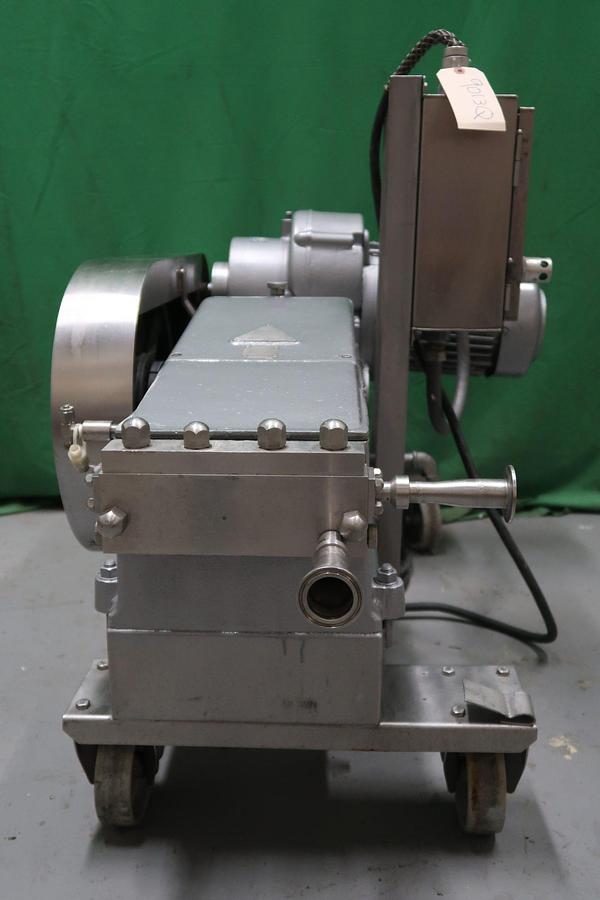
Category
Manufacturer
Model
Rannie
FAQ:
What is a Rannie high-pressure homogenizer and what does it do?
A Rannie high-pressure homogenizer is a precision processing machine designed to reduce particle size and create uniform emulsions or dispersions by forcing product through a small gap at very high pressure. The process breaks down fat globules, cells, or other particles to achieve consistent texture, stability, and bioavailability in the final product. Rannie machines are built to handle demanding continuous production environments, and their reputation for durability has made them a long-standing choice across multiple process industries.
The homogenization process works by pressurizing the product with a high-pressure pump and then passing it through a homogenizing valve where intense shear, turbulence, and cavitation do the actual size-reduction work. Rannie equipment is capable of operating at pressures commonly ranging from 500 bar up to 1,500 bar or higher depending on the model, which gives processors the flexibility to handle everything from gentle emulsification to aggressive cell disruption. Pilot plant models are also available for smaller-scale testing and R&D applications, making Rannie equipment useful at both laboratory and full production scale.
What industries commonly use Rannie equipment?
Rannie high-pressure pumps and homogenizers are used across a wide range of process industries, with the heaviest concentration in food and beverage, dairy, pharmaceutical, biotechnology, and chemical manufacturing. In dairy processing, Rannie homogenizers are used to stabilize milk and cream products by breaking down fat globules so they do not separate. In beverage production, they improve texture and shelf stability in products like juice, plant-based drinks, and nutritional beverages.
In pharmaceutical and biotechnology applications, Rannie equipment is used for cell disruption, liposome production, and the formulation of emulsions and suspensions where tight particle size control is critical. Sanitary and hygienic models that comply with food-grade and pharmaceutical processing standards are available, which makes Rannie machines suitable for regulated production environments subject to FDA, EHEDG, or 3-A standards. Chemical processors also use Rannie equipment for pigment dispersion, coating formulations, and other applications that require consistent, fine emulsification at scale.
What should buyers verify before purchasing used Rannie equipment?
Before committing to a purchase, buyers should confirm several key technical specifications to make sure the machine fits their application. Operating pressure is the most critical spec, since Rannie models vary significantly in their rated pressure range, and selecting a machine with insufficient pressure capacity will limit processing performance. Flow rate, motor size, and the materials of construction for wetted parts are also important, particularly for buyers working with corrosive, abrasive, or food-grade fluids that require specific alloys or surface finishes.
Beyond the specs sheet, buyers should request an inspection, either in person or via video, to assess the physical condition of the pump heads, homogenizing valves, seals, and drive components. Wear on these parts directly affects performance and rebuild costs. Parts availability is another factor worth investigating before purchase. Rannie service and spare parts have historically been handled through SPX Flow and authorized service centers, so it is worth contacting them to confirm what support and components are available for the specific model and serial number being considered. Understanding the full picture of the machine's condition and parts support helps buyers make a realistic assessment of total cost of ownership.
What pressure ratings are typical for Rannie high-pressure pumps?
Rannie high-pressure pumps are manufactured across a broad pressure range to accommodate different processing requirements. Entry-level models commonly operate in the range of 500 to 700 bar, which is sufficient for many standard food and beverage homogenization tasks. Mid-range models typically handle pressures between 800 and 1,200 bar, covering a wider variety of emulsification and dispersion applications. High-end Rannie units are capable of exceeding 1,500 bar, which is generally reserved for demanding applications like cell disruption in biotech or ultra-fine particle reduction in pharmaceutical manufacturing.
When evaluating a used Rannie pump, it is important to verify that the machine's rated pressure aligns with the intended application and that the unit has not been run consistently at or near its maximum rated pressure for extended periods, as this accelerates wear on pump components and valves. The model designation on a Rannie machine typically encodes flow rate and pressure capacity, so cross-referencing the model number with published specifications or contacting the manufacturer's service division can help buyers confirm the machine's original design parameters before purchase.
How long do Rannie high-pressure pumps typically last?
Rannie high-pressure pumps are built for industrial continuous-duty service, and well-maintained units have a reputation for exceptionally long operational life. In dairy and food processing plants where Rannie machines run multiple shifts per day, service lives of 20 to 30 years or more are not uncommon before major structural components require replacement. This longevity is a significant reason why used Rannie equipment remains in demand on the secondary market, as buyers recognize that a properly maintained machine still has substantial useful life remaining even after years of production service.
That said, the actual condition of any used Rannie pump depends heavily on how it was maintained and what it was processing. High-pressure components like pump plungers, seals, valve seats, and homogenizing valves are wear items that require periodic replacement regardless of overall machine age. A machine that was well-serviced with regular seal changes and valve maintenance will be in substantially better shape than one that was run hard without upkeep. Buyers should factor in the likely cost of reconditioning wear components when evaluating the purchase price of a used unit, and a pre-purchase inspection is the most reliable way to assess what service the machine will need.
Are used Rannie homogenizers suitable for pharmaceutical or food-grade applications?
Rannie manufactured sanitary and hygienic models specifically designed to meet the standards required in pharmaceutical and food-grade processing environments. These machines feature sanitary surface finishes on wetted parts, hygienic connections, and designs that support clean-in-place (CIP) and sterilize-in-place (SIP) procedures. When sourcing a used Rannie homogenizer for a regulated application, buyers need to confirm that the specific model being purchased is a sanitary-grade unit rather than a standard industrial model, as not all Rannie configurations meet food or pharma hygiene requirements.
For pharmaceutical applications in particular, buyers should also consider the validation history of the machine and whether documentation is available. Regulatory environments like FDA-regulated facilities often require equipment qualification documentation, and a used machine may or may not come with that paperwork depending on how the previous owner managed records. A thorough inspection of wetted surface condition, seal materials, and connection types is essential to determine whether the machine can be brought into compliance for a new regulated application. Consulting with a qualified process engineer or the manufacturer's service division before purchase is a practical step for buyers in these industries.
What is a Rannie pilot plant homogenizer and who uses it?
A Rannie pilot plant homogenizer is a smaller-scale version of a full production Rannie machine, designed for product development, process optimization, and small-batch manufacturing. These units operate on the same high-pressure homogenization principle as their full-scale counterparts but at significantly lower flow rates, making them practical for R&D labs, universities, and production facilities that need to validate formulations before scaling up to larger equipment. The ability to run trials on a pilot plant unit that replicates the mechanical action of a production homogenizer is valuable because it allows formulators to predict how a product will behave at scale.
Used Rannie pilot plant units appear on the secondary market periodically, often when companies upgrade to larger production equipment or consolidate research operations. For buyers, a used pilot plant homogenizer can be a cost-effective way to access genuine high-pressure homogenization capability without the capital expense of a full production machine. Key specs to evaluate on pilot plant models include maximum operating pressure, flow rate range, and the types of homogenizing valves included, since different valve configurations produce different shear profiles and are better suited to specific applications like emulsification versus cell disruption.
How does the inspection process work when buying used Rannie equipment?
Reputable used equipment dealers typically offer buyers the option to inspect machinery in person, through a live video call, or by reviewing video documentation of the machine captured by the dealer. For a high-value, mechanically complex machine like a Rannie homogenizer, getting a thorough look at the equipment before purchase is strongly advisable. An in-person inspection allows a buyer or their technician to examine wear components, check for visible damage or corrosion, review the condition of seals and valve seats, and assess the overall state of the machine in a way that photos alone cannot fully convey.
In some cases, used Rannie equipment is still installed and operating at the selling facility, which can allow a buyer to observe the machine running under production conditions. However, most used equipment dealers do not have the permitting or infrastructure to run actual product through processing equipment at their own facilities, so functional testing in a dealer's warehouse is generally not available. Buyers should ask the dealer specifically what inspection options are available for the machine they are considering, and for critical purchases, bringing a qualified Rannie service technician to the inspection can provide a professional assessment of the machine's condition and an estimate of any reconditioning work required before it returns to service.
What should buyers know about shipping and rigging used Rannie equipment?
Rannie high-pressure homogenizers are heavy, precision-built industrial machines, and shipping them requires careful planning to prevent damage in transit. Depending on the model, a Rannie homogenizer can weigh anywhere from several hundred kilograms for a pilot plant unit to several thousand kilograms for a full production machine. Proper packaging, which may include custom crating or heavy-duty palletization, is essential to protect the machine during transport, and the cost of that packaging will vary based on the size and fragility of the unit.
Loading and unloading large Rannie equipment typically requires specialized rigging equipment such as forklifts or cranes, and rigging services are generally an added cost beyond the base shipping rate. Buyers should ask the dealer for a detailed breakdown of packaging, rigging, and freight costs before finalizing a purchase so they have a clear picture of the total landed cost of the machine. For international shipments, import duties, customs clearance fees, and compliance with destination country equipment standards add further complexity and cost that buyers need to account for in their budgeting.
What are typical payment terms for purchasing used Rannie equipment?
The standard practice among used industrial equipment dealers is to require full payment before a machine is released for shipment. This applies to used Rannie equipment as it does to most other categories of used machinery. The rationale is straightforward: once a machine leaves the dealer's facility, the transaction is essentially complete, and collecting payment after the fact introduces risk that dealers are generally unwilling to accept on a one-time or infrequent transaction.
Some dealers may extend payment terms or financing arrangements to established repeat customers with a track record of purchases, but buyers should not assume this option will be available and should confirm payment expectations with the dealer early in the purchasing process. For large purchases, buyers often use wire transfer, though the accepted payment methods will vary by dealer. International buyers may also encounter additional considerations around currency exchange, banking fees, and the timing of fund transfers that can affect the overall transaction timeline. Clarifying all payment logistics before agreeing to a purchase avoids delays and misunderstandings at the point of finalizing the deal.