Category
Manufacturer
Model
Quantitative
Quantitative is known for its advanced weighing and measurement systems, serving industries such as food processing and pharmaceuticals. Their equipment is designed to ensure accuracy and compliance in production processes.
FAQ:
What types of products can quantitative filling equipment handle?
Quantitative filling equipment is designed to handle a wide range of product types, including free-flowing liquids, viscous pastes, creams, gels, granules, and powders. The specific mechanism used largely determines what a machine can fill effectively. Piston fillers, for example, are well-suited for thick, viscous products like sauces, lotions, and pastes because the piston action generates enough force to move dense materials through the filling nozzle. Gravity-fed and overflow fillers work better with thin, free-flowing liquids, while auger fillers are typically matched to dry powders and granular products.
Buyers looking at used quantitative filling equipment should pay close attention to the original product specifications for a given machine, since the pump or piston type, wetted parts, and nozzle configuration all influence product compatibility. A stainless steel piston filler that was previously used in a food processing facility, for instance, may be well-suited for a cosmetic or pharmaceutical application handling similar viscosities, but a thorough inspection of seals, valves, and contact surfaces is always recommended before repurposing the equipment for a different product type.
What is the typical filling accuracy of quantitative filling machines?
Filling accuracy is one of the most important performance metrics for quantitative filling equipment, and it varies based on the machine's mechanism, condition, and the product being filled. Gravimetric (weight-based) fillers tend to offer the highest precision, with tolerances commonly in the range of ±0.1% to ±0.5% by weight. Volumetric piston fillers typically achieve tolerances of ±0.5% to ±1%, which is acceptable for most food, cosmetic, and general industrial applications. Auger fillers used for powders can vary more widely depending on product density consistency.
For pharmaceutical and nutraceutical applications, filling accuracy is often a regulatory requirement, not just a production preference. Buyers in those sectors should verify the machine's documented fill accuracy at the time of inspection and consider whether the machine's metering components, such as pistons, cylinders, or load cells, show signs of wear that could affect precision. Used equipment that has been well-maintained can still perform within spec, but a pre-purchase inspection is the only reliable way to confirm current accuracy on a specific unit.
What fill volume ranges are supported, and can the machine be adjusted for different quantities?
Most quantitative filling machines are built to cover a defined volume range rather than a single fixed quantity, and adjustability is one of the key features buyers evaluate. Piston fillers, for example, are typically adjustable by changing the stroke length of the piston, which directly controls the volume dispensed per cycle. Depending on the model, a single machine might cover a range from a few milliliters up to several liters per fill, making it practical for producers who run multiple SKU sizes on the same line.
When buying used quantitative filling equipment, it is worth confirming what the actual adjustable range is for that specific model, since some machines are configured at the factory for a narrower range than their theoretical maximum. Changeover between fill sizes on piston-style machines is usually straightforward, often involving a simple adjustment to the stroke limiter or a swap of cylinders. Buyers should ask the dealer whether all adjustment hardware and any size-specific parts are included with the machine, as missing components can limit flexibility after purchase.
How fast is the filling speed, and what is the output capacity per hour?
Filling speed on quantitative equipment depends on the machine's level of automation, the number of fill heads, the product viscosity, and the container size being filled. A single-head semi-automatic piston filler operated by foot pedal might produce anywhere from 10 to 30 fills per minute under normal conditions, while a dual-head machine can roughly double that output. Fully automatic inline fillers with multiple heads can achieve hundreds of containers per minute in high-volume production environments.
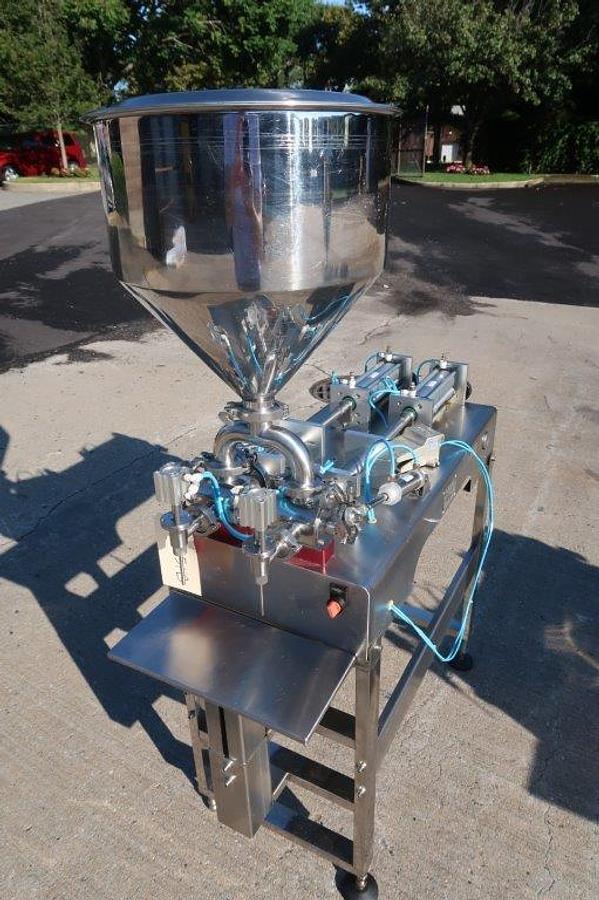
For buyers considering used semi-automatic equipment, like a dual-head air-operated piston filler with a foot switch, realistic throughput expectations should account for operator pace, container handling time, and any downtime for adjustments. These machines are generally a strong fit for small to mid-sized production runs where flexibility and lower capital cost matter more than maximum throughput. Buyers evaluating a specific used unit should ask whether the machine's speed-related components, including air pressure regulators, cylinders, and valves, are in good working order, since worn pneumatic components can reduce cycle speed and fill consistency.
What industries most commonly use quantitative filling equipment?
Quantitative filling equipment is used across a broad range of industries where precise, repeatable dispensing of product is essential to quality control and regulatory compliance. Food and beverage processing is one of the largest application areas, covering products like sauces, dressings, oils, dairy, and condiments. Pharmaceutical and nutraceutical manufacturers rely on quantitative fillers for liquid medications, supplements, and topical preparations where dosing accuracy is critical. The cosmetics and personal care industry uses this type of equipment for lotions, shampoos, serums, and creams, while chemical and industrial manufacturers fill lubricants, cleaning agents, and specialty fluids.
Quantitative, as a brand, has historically served food processing and pharmaceutical sectors with equipment designed around accuracy and compliance in production environments. Buyers sourcing used Quantitative equipment can generally expect machines built to food-grade or pharmaceutical-grade construction standards, which often means stainless steel contact surfaces and designs that facilitate cleaning and sanitation. That said, any used machine should be inspected to confirm its current condition meets the hygiene and compliance requirements of the buyer's specific application.
What does 'air-operated' mean on a piston filler, and what are the practical implications for buyers?
An air-operated piston filler uses compressed air to drive the piston's fill and retract strokes, rather than relying solely on manual force from the operator. This pneumatic actuation makes the filling cycle faster, more consistent, and less physically demanding than a purely manual piston filler. The operator typically initiates each fill cycle using a foot switch, which frees both hands for container handling and helps maintain a steady production pace. Air-operated machines generally deliver more repeatable fill volumes than manual designs because the piston stroke is controlled mechanically rather than by hand pressure.
From a practical standpoint, buyers of used air-operated filling equipment need to confirm that a suitable compressed air supply is available at their facility. Most pneumatic fillers require a clean, dry air source at a specific pressure range, commonly between 60 and 100 PSI, and an air compressor of adequate capacity. Buyers should also inspect the pneumatic components of any used machine, including cylinders, seals, and air lines, since these parts are subject to wear and can affect both fill speed and accuracy if they are degraded. Replacement pneumatic components are generally available and affordable, but it is useful to know the condition going in.
Why is stainless steel construction important in quantitative filling equipment?
Stainless steel construction is considered a baseline requirement for filling equipment used in food, pharmaceutical, and cosmetic production because of its corrosion resistance, durability, and ease of sanitation. The two grades most commonly specified are 304 and 316 stainless steel. Grade 304 is suitable for most food and cosmetic applications, while 316 stainless offers greater resistance to chlorides and harsh cleaning chemicals, making it the preferred choice for pharmaceutical applications or environments where aggressive sanitizing agents are used regularly. Stainless steel surfaces do not harbor bacteria the way porous materials can, and they withstand repeated washdowns without degrading.
For buyers evaluating used stainless steel filling equipment, the condition of the stainless surfaces is an important inspection point. Surface pitting, deep scratches, or signs of corrosion can compromise both hygiene and structural integrity. Wetted parts, meaning any component that comes into direct contact with the product, deserve the closest scrutiny. Seals, gaskets, and O-rings made from food-grade or pharmaceutical-grade elastomers should also be inspected, as these are wear items that may need replacement regardless of the machine's overall condition. A machine with solid stainless construction but worn seals is generally a straightforward refurbishment compared to one with structural corrosion.
What is the difference between semi-automatic and fully automatic quantitative filling equipment?
Semi-automatic filling machines require an operator to be present for each fill cycle, typically to position the container and trigger the fill using a foot switch or hand control. The machine handles the metering and dispensing of the product, but the operator manages container placement and cycle initiation. This makes semi-automatic equipment more flexible and easier to set up for short runs or frequent product changeovers, and it generally carries a lower purchase price than fully automated systems. Foot-switch-operated piston fillers are a classic example of this category.
Fully automatic filling systems integrate container feeding, filling, and often capping or labeling into a continuous, operator-minimal process. These machines are designed for high-volume, consistent production runs where labor costs and throughput are the primary economic drivers. For small to mid-sized businesses, semi-automatic equipment often delivers a better return on investment because the lower upfront cost and operational flexibility outweigh the throughput advantage of full automation. Buyers sourcing used equipment in either category should evaluate the machine's current mechanical condition carefully, since the value of any used filler depends heavily on its actual operating state rather than its specifications on paper.
What should buyers inspect when purchasing used quantitative filling equipment?
A thorough inspection is the most important step a buyer can take when purchasing used filling equipment, since these machines are sold as-is and the buyer bears responsibility for assessing condition. Key areas to examine include the condition of all wetted parts (cylinders, pistons, nozzles, valves, and seals), the structural integrity of the frame and stainless steel surfaces, the functionality of pneumatic or mechanical drive components, and the accuracy of the metering mechanism. Buyers should ask the dealer whether an in-person or video inspection can be arranged, and many reputable dealers will accommodate either option. In some cases, a machine may still be installed at a production facility, making it possible to observe it running under actual conditions.
It is also worth consulting with the equipment manufacturer to understand what level of technical support, spare parts, and service documentation is available for the specific model and age of machine being considered. Older models may have limited parts availability, which is a practical factor in long-term ownership cost. Buyers should request any available maintenance records, and pay attention to how the machine was stored if it has been decommissioned, since extended idle periods can affect seals, lubricants, and pneumatic components. Selecting a dealer who specializes in filling and packaging equipment, rather than a generalist reseller, tends to result in more accurate condition assessments and more useful pre-sale information.
What are typical shipping and logistics considerations for used filling equipment?
Shipping used filling equipment involves more complexity than standard freight because these machines are heavy, often have precision components that can be damaged by vibration or impact, and may require specialized handling at both the origin and destination. Proper packaging is critical: smaller machines are typically palletized and shrink-wrapped, while larger or more fragile units may require custom wooden crating to prevent movement and absorb shock in transit. Buyers should ask the dealer specifically about the packaging method being used and whether crating costs are included in the quoted price or billed separately.
Larger filling machines may also require rigging services for loading at the dealer's facility and unloading at the buyer's location. Rigging involves the use of forklifts, cranes, or other heavy-lift equipment, and it adds to the total landed cost of the machine. Buyers should factor in all of these costs, including freight, packaging, rigging, and any local delivery fees, when comparing the price of a used machine to alternatives. Most used equipment dealers require full payment before a machine ships, so buyers should be prepared to complete payment and confirm all logistics details before the equipment leaves the seller's facility.