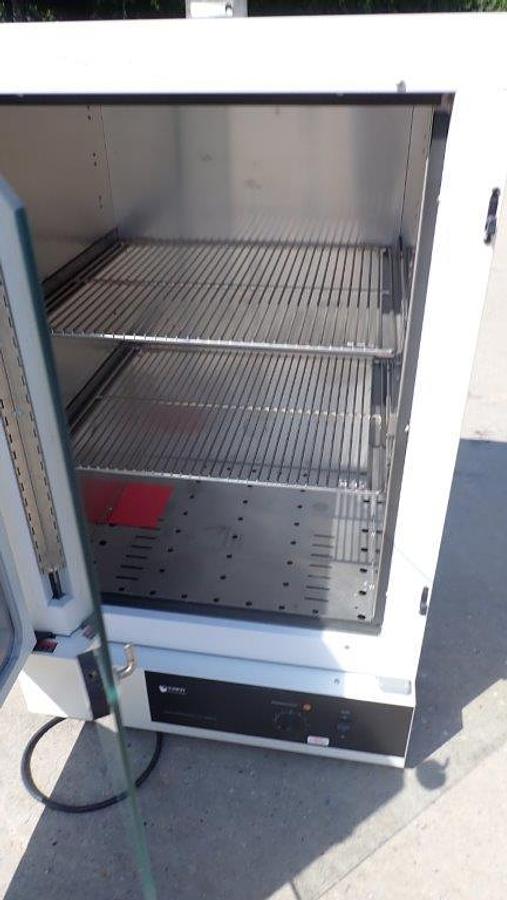
Category
Manufacturer
Model
Precision
Precision specializes in high-precision machining equipment, catering to industries such as aerospace and automotive. Their machines are known for their accuracy and reliability in producing complex components.
FAQ:
What is the difference between a precision lab oven and a standard incubator?
A precision lab oven and a standard incubator both maintain controlled temperature environments, but they serve different primary purposes and operate across different temperature ranges. A standard incubator is designed for biological applications like cell culture, microbiology, and sample growth, typically operating between ambient temperature and around 60°C to 70°C. It prioritizes gentle, stable warmth and often includes humidity control. A drying oven, by contrast, operates at much higher temperatures, sometimes reaching 300°C or beyond, and is used for sterilization, drying, curing, and annealing.
A precision lab oven incubator occupies a unique middle ground. These dual-purpose instruments are engineered to perform reliably across both lower biological temperature ranges and higher drying or sterilization ranges within a single unit. The key differentiator is the quality of temperature control. Precision-grade models use microprocessor-based PID controllers that maintain temperature uniformity within ±0.1°C to ±1°C depending on the model and set point, which is far tighter than what most basic incubators or general-purpose ovens can achieve. For labs that handle both microbiological work and materials processing, a precision lab oven incubator reduces the need for two separate pieces of equipment, which is one reason used units in good working condition are in consistent demand on the secondary market.
What temperature range does a precision lab oven incubator typically support?
Most precision lab oven incubators support a temperature range from just above ambient (typically around 5°C above room temperature) up to approximately 200°C to 250°C, though the exact range varies by manufacturer and model. Entry-level or incubator-focused units may top out around 70°C to 100°C, while full-featured oven incubators extend well beyond that to accommodate drying, baking, and sterilization protocols. Some high-performance models offer a lower threshold near 25°C, which is useful for applications like BOD (biochemical oxygen demand) testing that require precise control at near-ambient temperatures.
When evaluating a used precision lab oven incubator, the temperature range is one of the first specifications to verify against your application requirements. A unit that has been used primarily as a drying oven at high temperatures may have different wear characteristics than one that spent its service life running at 37°C for cell culture. Buyers should request documentation or ask the dealer about the machine's prior use history where available, and confirm that the temperature controller and heating elements are functioning correctly across the intended range before purchase. Inspections, whether in person or via video, are the most reliable way to assess this before committing to a used unit.
How accurate is the temperature control in a precision lab oven incubator?
Temperature accuracy is one of the defining characteristics of a precision lab oven incubator, and it is what separates these instruments from general-purpose ovens or basic incubators. High-quality units use microprocessor-based PID (proportional-integral-derivative) controllers, which continuously adjust the heating output to minimize deviation from the set point. In well-maintained units, temperature uniformity across the chamber can be as tight as ±0.1°C, though a range of ±0.5°C to ±1°C is more typical across the full chamber volume, particularly in larger units where airflow patterns create minor gradients.
For used equipment, temperature accuracy depends heavily on the condition of the controller, the heating elements, and the door seals. A unit with a degraded door gasket or a thermocouple that has drifted out of calibration may show wider temperature variation than its rated specification. This is why calibration history and functional testing are important considerations when buying used. Reputable used equipment dealers will typically accommodate in-person or video inspections so buyers can observe the unit cycling and holding temperature. For critical applications in pharmaceutical, clinical, or research settings, buyers may also want to perform independent calibration verification after delivery using NIST-traceable reference thermometers before putting the unit into service.
What chamber sizes and capacities are available for precision lab oven incubators?
Precision lab oven incubators are manufactured in a wide range of chamber sizes to accommodate different workload volumes. Compact benchtop units typically start around 0.5 to 1.5 cubic feet and are suited for small sample batches, teaching labs, or limited bench space. Mid-range units commonly fall between 2 and 5 cubic feet, which covers the majority of general laboratory applications. Larger floor-standing models can exceed 10 cubic feet and are used in production-scale testing, pharmaceutical stability studies, or high-throughput research environments.
Choosing the right chamber size involves more than just matching current sample volume. Overloading a chamber compromises airflow and temperature uniformity, so it is generally recommended to select a unit with at least 20 to 30 percent more capacity than your typical load. On the used market, buyers have access to a broader range of sizes than what may be available through standard supply channels at a given time, which can be an advantage for labs with specific footprint or capacity requirements. When reviewing a used unit, confirm the number of shelves included, the maximum load per shelf, and whether the interior dimensions are compatible with the racks, trays, or vessels you plan to use.
Is a used precision lab oven incubator suitable for cell culture and microbiological work?
A precision lab oven incubator can be suitable for cell culture and microbiological applications, provided it meets a few specific requirements. The most critical is the ability to maintain a stable temperature at 37°C (standard mammalian cell culture temperature) with minimal fluctuation, ideally within ±0.5°C or better. Units with PID controllers and forced-air convection or gravity convection systems can achieve this, though gravity convection models tend to produce gentler airflow that is less disruptive to sensitive cultures. For CO2-dependent cell culture, a standard oven incubator is not sufficient on its own since it does not regulate gas concentration or humidity. However, for general microbiological incubation of bacterial cultures, yeast, or environmental samples, a well-functioning precision oven incubator is entirely appropriate.
When purchasing a used unit for biological work, the interior condition of the chamber matters significantly. Stainless steel interiors are preferred because they are easier to decontaminate. Buyers should inspect or request photos of the chamber interior for signs of corrosion, residue buildup, or damage that could complicate sterilization. It is also worth confirming that the unit can be operated with the door sealed tightly and that any fan or vent systems are in working order. Used precision lab oven incubators in good condition can serve biological labs reliably, but a thorough pre-purchase inspection is the most important step in making that determination.
What certifications or compliance standards should a precision lab oven incubator meet?
For labs operating in regulated environments, compliance standards are a meaningful purchase consideration. Common certifications associated with precision lab oven incubators include UL listing (Underwriters Laboratories) for electrical safety in North American markets, CE marking for equipment used in European Union countries, and ISO 9001 certification for manufacturing quality management. In pharmaceutical and clinical settings, equipment may also need to meet FDA 21 CFR Part 11 requirements for electronic records if the unit includes data logging capabilities, or be compatible with GMP (Good Manufacturing Practice) validation protocols.
On the used equipment market, buyers should ask the dealer for any available documentation related to the unit's certification status at the time of manufacture. While a used machine may no longer carry an active service contract or manufacturer support, the underlying design certification (such as a UL mark on the nameplate) remains valid as a reference to the unit's safety design standards. Buyers in highly regulated industries should also factor in the cost and feasibility of requalification or revalidation after installation. Consulting with the original manufacturer about parts availability and technical support for the specific model and age of the unit is a practical step that can help labs plan for ongoing compliance requirements before finalizing a purchase.
What electrical requirements should buyers expect for a precision lab oven incubator?
Precision lab oven incubators are commonly available in single-phase configurations, which is the standard for most benchtop and mid-size laboratory units. Single-phase units typically operate on 120V or 208/240V depending on the model and power draw. Larger floor-standing ovens with higher wattage heating elements may require 240V single-phase or, in some industrial-scale configurations, three-phase power. The electrical requirements are usually listed on the unit's nameplate and in the manufacturer's specification sheet, so this information is generally available even for older used equipment.
Before purchasing a used precision lab oven incubator, buyers should confirm that the unit's voltage and amperage requirements match the available circuits in their facility. Running a unit on an undersized circuit is a safety hazard and can also affect temperature performance. If a lab is moving from one voltage standard to another (for example, importing a 240V unit into a facility with 120V outlets), a step-up transformer may be required, which adds to the total landed cost. Single-phase units, like those commonly found in the used lab equipment market, are generally straightforward to integrate into standard laboratory electrical infrastructure, but it is always worth having an electrician confirm compatibility before the unit arrives.
What should buyers know about inspecting a used precision lab oven incubator before purchase?
Inspecting a used precision lab oven incubator thoroughly before purchase is the most effective way to avoid unexpected costs after delivery. Reputable used equipment dealers will typically offer in-person inspections, virtual walkthroughs, or video recordings of the machine so buyers can assess its current condition. Key things to evaluate include the state of the door seals and gaskets (which directly affect temperature stability), the condition of the interior chamber surfaces, the responsiveness and accuracy of the temperature controller, and whether the heating elements cycle on and off correctly. Any visible corrosion, damaged insulation, or malfunctioning controls should be factored into the purchase decision.
It is also worth asking the dealer about the unit's prior operating environment. A machine that was used in a clean laboratory setting will typically be in better condition than one pulled from an industrial production floor. Some units may still be in active use at a facility where an in-person inspection can be arranged at the actual site. Keep in mind that most equipment dealers do not have the permitting required to run full production tests with actual samples, so functional testing is generally limited to confirming that the unit powers on, heats up, and holds temperature. For critical applications, buyers may want to budget for post-delivery calibration verification to confirm the unit performs within specification before putting it into regular use.
How does shipping work for a used precision lab oven incubator, and what costs should buyers anticipate?
Shipping a used precision lab oven incubator involves more logistical planning than shipping standard lab consumables or small instruments. The level of packaging required depends on the size and fragility of the unit. Benchtop models may ship on a standard pallet with protective foam and shrink wrap, while larger floor-standing units typically require custom crating to prevent damage in transit. The cost of palletization or crating is usually the buyer's responsibility and will vary based on the unit's dimensions and weight. Buyers should ask the dealer for a detailed breakdown of packaging costs before finalizing the purchase so there are no surprises in the total landed cost.
For larger or heavier units, professional rigging may be required for both loading at the dealer's facility and unloading at the destination. Rigging fees are an added cost that buyers should factor into their budget, particularly for floor-standing ovens that cannot be moved with a standard pallet jack. Shipping timelines vary depending on carrier availability, distance, and the freight method selected (LTL freight versus dedicated transport, for example). Buyers should request estimated transit times and confirm whether the shipment will be delivered to the dock or requires inside delivery, as inside delivery to a specific lab room often involves additional charges. Getting all of these details in writing before payment ensures a clear understanding of the full cost of acquisition.
What payment terms are typical when purchasing a used precision lab oven incubator from a dealer?
Used equipment dealers generally require full payment before a unit is shipped. This is standard practice in the industry and reflects the fact that used machinery is sold without the financing infrastructure that sometimes accompanies purchases from large equipment manufacturers. For first-time buyers working with a dealer, wire transfer and credit card are the most common payment methods. Some dealers may accept purchase orders from established institutions like universities or hospitals, though this varies by dealer. Repeat customers with an established relationship may occasionally be offered payment terms, but buyers should not assume this is available without asking directly.
Because payment is typically required upfront, the inspection process takes on added importance. Buyers are essentially accepting the machine in its current condition at the time of sale, which is why thorough pre-purchase due diligence, including requesting photos, videos, or an in-person visit, is so critical. Selecting a dealer with a long track record in laboratory equipment specifically (rather than a general industrial machinery reseller) provides an added layer of confidence that the unit has been accurately represented. Checking a dealer's history, customer reviews, and industry tenure before sending payment is a practical safeguard that experienced lab equipment buyers consistently recommend.